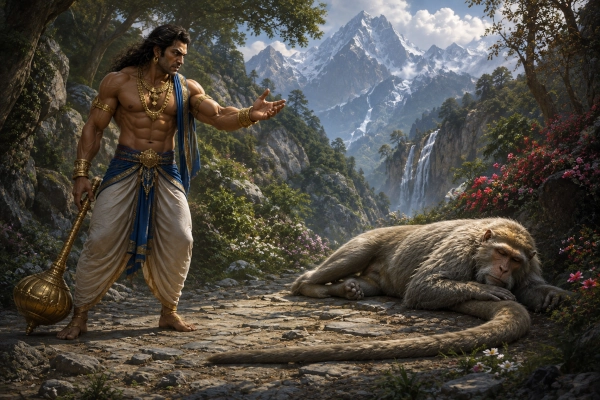
During the long exile of the Pandavas, Bhima often found himself moving through forests, mountains and remote regions far from the royal courts he had once known. Exile had taken away the comforts of palace life, but it had also brought the brothers into contact with sages, celestial beings and extraordinary events that would shape them before the great war of Kurukshetra. Among the most memorable of these encounters was Bhima’s meeting with an elderly monkey whose frail appearance concealed one of the greatest heroes of an earlier age.
The meeting would become a lesson in humility for the mightiest of the Pandavas. Bhima possessed enormous physical strength and had defeated warriors, rakshasas and wild beasts that few men could face. Yet on a lonely mountain path, all that strength would prove useless against the tail of an old monkey. Only when Bhima abandoned pride and approached the stranger with respect would he discover that the monkey before him was Hanuman, the immortal servant of Sri Rama and, through the wind-god Vayu, his own elder brother.
Draupadi and the Fragrant Saugandhika Flower
The episode takes place during the Pandavas’ years in exile, when the brothers and Draupadi spent time in the regions near the Himalayas. One day, a wonderfully fragrant flower was carried by the wind to the place where Draupadi was sitting. Its beauty and perfume immediately attracted her attention. The blossom was a Saugandhika flower, famed for its extraordinary fragrance and associated with the gardens of the northern mountains.
Draupadi was delighted by the flower and asked Bhima if he could obtain more of them. She wished to take some back for Yudhishthira and to enjoy their fragrance during the difficult years of exile. Bhima needed little encouragement. He loved Draupadi deeply, and the opportunity to fulfil her wish while displaying his courage and strength appealed strongly to his nature.
Bhima therefore set out toward the direction from which the fragrant breeze had carried the flower. He moved rapidly through the forest, confident that no animal, rakshasa or mountain obstacle could stop him. His powerful body cut through the wilderness with the energy of a storm, and the sound of his movement disturbed the animals and birds around him.
Bhima, Son of Vayu
Bhima had always known that his strength was extraordinary. He was the son of Kunti and the wind-god Vayu, and from childhood his physical power had surpassed that of ordinary men. Even among the Pandavas, each of whom possessed remarkable abilities, Bhima’s strength stood apart.
He had survived attempts on his life that would have killed almost anyone else. He had fought and slain powerful rakshasas, including Hidimba and Bakasura. His arms had the force to crush enemies in battle, and his appetite, endurance and energy seemed almost limitless. When Bhima walked through a forest, he did not usually behave like a traveller who feared what might be hidden among the trees. More often, it was the creatures of the forest that feared him.
This confidence was justified by his achievements, but confidence can gradually harden into pride. Bhima had rarely encountered a physical obstacle that he could not overcome. The world had repeatedly confirmed his belief in his own strength, and therefore he had little reason to imagine that a simple object lying across a mountain path might defeat him.
That was about to change.
The Strange Monkey on the Path
As Bhima travelled deeper into the mountainous forest, he came upon a narrow path. Lying across that path was an old monkey. The animal appeared weak and aged, and its body showed none of the power that Bhima associated with dangerous creatures.
The monkey’s tail stretched across the path and blocked Bhima’s way.
Bhima stopped and looked at the animal with irritation. He was in a hurry to find the Saugandhika flowers, and he saw no reason why an elderly monkey should delay him. Confident in his authority and strength, he called out and ordered the monkey to move aside so that he could continue.
The monkey slowly opened his eyes and looked at Bhima without fear. Instead of immediately obeying, he spoke calmly and asked why Bhima was disturbing an old and exhausted creature. He explained that he was too weak to move easily and suggested that Bhima should simply step over him if he wished to continue.
Bhima refused. To step over another living being was improper, and he was unwilling to do so. He again told the monkey to move its tail out of the way.
The monkey replied with the same calmness. If Bhima was unwilling to step across him, then Bhima himself could simply move the tail aside.
Bhima Reaches for the Tail
The request seemed almost absurd to Bhima. He had uprooted trees, wrestled powerful enemies and performed feats that terrified ordinary men. Moving the tail of an elderly monkey appeared so trivial that he did not even consider it an effort.
Bhima reached down with one hand and took hold of the tail.
He expected it to move instantly.
It did not move at all.
Bhima was surprised but not concerned. He assumed that his first attempt had been careless, so he gripped the tail more firmly and tried again. The tail remained exactly where it was.
His expression changed.
Bhima now applied greater force. The muscles of his arms tightened as he pulled, yet the monkey’s tail did not shift even the smallest distance. It seemed rooted to the earth more firmly than a mountain.
The old monkey watched quietly.
Bhima could hardly believe what was happening.
The Strength of Bhima Fails
Bhima now used both hands. He bent forward, planted his feet securely and pulled with far greater force. The effort that could have dragged a heavy tree across the ground accomplished nothing.
The tail remained motionless.
Bhima increased his strength again. His arms, shoulders and back strained with effort, and the ground beneath his feet seemed to bear the force of his struggle. Yet the old monkey’s tail still did not move.
For perhaps the first time in his life, Bhima encountered a physical challenge that completely defeated him.
There was no battle in which he could strike harder. There was no enemy he could seize and throw. The object before him was merely a tail lying peacefully across a path, and yet all the strength of the mighty son of Vayu could not lift it.
Bhima’s confidence began to turn into astonishment.
He looked again at the old monkey and understood that appearances had deceived him.
Pride Gives Way to Humility
Bhima stopped trying to move the tail. His breathing was heavy from the effort, but his mind had changed more profoundly than his body. He no longer saw a weak animal obstructing his path. He understood that some extraordinary being stood before him.
The lesson came with remarkable simplicity. Bhima had approached the monkey with the certainty that strength alone would solve the problem. Each failed attempt stripped away part of that certainty until humility replaced pride.
Bhima joined his hands respectfully and addressed the monkey in a very different manner. He apologised for his earlier arrogance and asked the mysterious being to reveal his true identity. No ordinary monkey, he said, could possess such power.
The old monkey had been waiting for precisely this change.
It was not Bhima’s strength that needed to be tested. Everyone already knew that Bhima was strong. What needed to be tested was whether he could recognise a power greater than his own and respond with humility rather than anger.
Once Bhima had understood that lesson, the stranger was ready to reveal himself.
The Monkey Reveals His Identity
The elderly monkey told Bhima that he was Hanuman, the great hero whose deeds were celebrated in the story of Sri Rama. Bhima immediately understood the full significance of the revelation.
Hanuman, like Bhima, was a son of Vayu.
The mighty vanara who had crossed the ocean in search of Sita, entered Lanka, confronted Ravana’s forces and carried the mountain bearing life-saving herbs was therefore Bhima’s elder brother.
Bhima was overwhelmed.
The figure lying casually across the path was the same Hanuman whose strength, devotion and courage belonged to an earlier age. Bhima’s own physical power, immense as it was, existed within a tradition already embodied by this greater son of Vayu.
The revelation transformed the encounter completely. Bhima had begun by ordering an old monkey to move. He now stood before his elder brother with reverence.
The Two Sons of the Wind-God
The relationship between Bhima and Hanuman carries a special meaning because both derive their extraordinary strength from Vayu. Yet their personalities reveal different expressions of that divine power.
Bhima’s strength is direct, physical and often forceful. He confronts enemies openly, breaks obstacles and destroys those who threaten his family. His anger can be terrible, but his loyalty to the Pandavas and Draupadi is equally powerful.
Hanuman’s strength is even greater, but it is governed by perfect discipline and devotion. In the Ramayana, he repeatedly demonstrates immense power while remaining entirely devoted to Sri Rama. His greatness lies not only in what he can do but in the fact that he never allows his abilities to become greater than his Dharma.
This distinction explains why the meeting is so important for Bhima. Hanuman does not need to defeat him in combat. He teaches him simply by lying across a road.
The elder brother shows the younger that true strength does not constantly need to announce itself.
Bhima Asks to See Hanuman’s Great Form
Once he learned Hanuman’s identity, Bhima wanted to understand the power of the hero whose deeds he had heard since childhood. He asked Hanuman to show him the enormous form he had assumed when he crossed the ocean during the search for Sita.
Hanuman initially explained that the conditions of different Yugas were not the same. Time itself changes the nature of beings and the expression of power in the world. The extraordinary events of the age of Rama belonged to another period.
Yet Bhima continued to request the vision.
Hanuman finally agreed.
The elderly and apparently frail monkey began to reveal a form of immense magnitude. His body expanded until Bhima saw before him a being whose size and splendour were beyond ordinary comprehension. The mountain landscape itself seemed small beside him.
Bhima, who rarely feared anything, looked upon his elder brother in awe. The experience showed him that the strength he had considered extraordinary was only a fraction of what divine power could become.
Hanuman then returned to the harmless form of the old monkey.
The lesson had been completed.
Hanuman Speaks About the Ages of the World
During their conversation, Hanuman also spoke to Bhima about the nature of the Yugas and the gradual changes that occur in Dharma, human strength and the conditions of the world.
The world of the Pandavas was not the same as the world through which Hanuman had travelled with Rama. The passage of time brings changes in human character, spiritual capacity and physical strength. Even great heroes exist within the limits of the age into which they are born.
For Bhima, this teaching added a larger perspective to his own abilities. His strength could not be understood only by comparing himself with the warriors around him. He belonged to a much greater cosmic order in which even the strongest individual remained small beside the movement of time and Dharma.
Hanuman was therefore teaching him something more profound than humility before an elder brother. He was teaching Bhima humility before the universe itself.
The Search for the Saugandhika Flowers
Bhima eventually explained the purpose of his journey. He had come into the region in search of the fragrant Saugandhika flowers desired by Draupadi.
Hanuman knew the terrain and warned him about the dangers ahead. The mountains and forests were not ordinary places, and celestial regions were not to be entered carelessly simply because one possessed great physical strength.
He directed Bhima toward the path he should follow and advised him to proceed with greater awareness.
The encounter had therefore changed the way Bhima continued his journey. He still possessed the same enormous power, but he had been reminded that power did not make every place his to command and did not make every being weaker than himself.
The mountain path had become a place of instruction.
Hanuman’s Blessing to Bhima
Before allowing Bhima to continue, Hanuman embraced his younger brother and blessed him.
The meeting between the two sons of Vayu was no longer a contest of strength. It had become an exchange of affection between brothers separated by different ages of the world.
Hanuman assured Bhima that his strength and courage would serve him in the struggles that lay ahead. The Pandavas were still in exile, but both brothers understood that the conflict with the Kauravas had not disappeared. A time would come when Bhima would need every measure of his strength upon the battlefield.
Hanuman’s blessing therefore connected the ancient world of the Ramayana with the approaching war of the Mahabharata.
The hero who had served Rama would not fight as a warrior in the Pandavas’ army, but his presence would still accompany them.
Hanuman on Arjuna’s Banner
Hanuman promised that when the great war came, he would be present upon the banner of Arjuna’s chariot.
This promise would later become one of the most recognisable images of the Kurukshetra war. Arjuna’s banner would bear the emblem of Hanuman, and the chariot driven by Krishna would carry the presence of the great vanara above it.
Hanuman also promised that his mighty roar would strengthen the Pandavas and terrify their enemies.
The significance of this blessing went beyond battlefield morale. The banner symbolically joined the two great Itihasas. The world of Rama and the world of Krishna were not disconnected stories. Hanuman’s presence upon Arjuna’s chariot linked the Dharma struggles of the two ages.
The same being who had served Rama in the battle against Ravana would witness the struggle of the Pandavas against the Kauravas.
Bhima Continues With a Different Understanding
When Bhima finally left Hanuman and continued toward the Saugandhika flowers, he remained physically the same man who had entered the forest. His arms had not grown stronger, and he had acquired no new weapon.
Yet he had changed.
The Bhima who had approached the elderly monkey believed that physical power gave him the right to command whatever blocked his path. The Bhima who departed had experienced the limits of that assumption.
He had learned that the strongest being in a place may not appear strong.
He had learned that age and outward weakness can conceal immense power.
Most importantly, he had learned that recognising one’s limits does not reduce greatness. It gives greatness discipline.
This lesson would matter increasingly as the Pandavas moved toward the war that would determine the future of the Kuru dynasty.
Why Hanuman Did Not Simply Reveal Himself
Hanuman could have introduced himself the moment Bhima arrived. He could have appeared in his magnificent form and immediately received Bhima’s reverence.
Instead, he chose to appear old and weak.
The disguise was the lesson.
Had Hanuman displayed his greatness openly, Bhima would naturally have respected him. The real question was whether Bhima could respect a being who appeared insignificant.
Bhima initially failed that test. He spoke with pride and assumed the stranger should move simply because Bhima wished to pass.
Only after his strength failed did his attitude change.
Hanuman therefore showed that humility learned through experience often penetrates more deeply than humility taught through words.
Bhima would never again forget the tail he could not lift.
Strength Without Humility
The Mahabharata repeatedly examines the relationship between strength and character. Great power can defend Dharma, but the same power can become destructive when joined with pride.
Bhima’s strength itself is never condemned. The Pandavas will depend upon it repeatedly. Without Bhima, many powerful enemies could never be defeated, and several vows of justice could never be fulfilled.
What must be controlled is the belief that strength places a person above everyone else.
Hanuman provides the perfect teacher because he possesses far greater power than Bhima yet behaves with extraordinary humility. He does not boast about crossing the ocean or burning Lanka. He does not demand that Bhima bow before him. He appears as an old monkey and waits until Bhima becomes capable of recognising the truth.
In that contrast lies the central teaching of the episode.
The Elder Brother and the Younger Brother
The meeting also has a deep emotional beauty because Bhima discovers that he is not merely speaking with a legendary hero. He is meeting a brother.
Both are sons of Vayu, but their lives belong to different ages. Hanuman’s great earthly mission had already been completed in the service of Rama. Bhima’s greatest trial still lay ahead.
Hanuman therefore stands in the story almost like an elder who has already travelled the path of heroic strength and can warn the younger man about its dangers.
He does not tell Bhima to become weak.
He teaches him how strength should be carried.
Power should remain available when Dharma demands it, but it should not dominate every encounter. A warrior must know when to strike, but he must also know when to bow.
Bhima learns both truths from the same brother.
The Tail That Became a Teacher
The most memorable object in the entire episode is not a weapon, mountain or celestial flower.
It is a tail lying across a road.
Bhima cannot lift it because the problem is never really about physical strength. The obstacle exists to reveal something within Bhima himself.
As long as he approaches the monkey with arrogance, the tail remains immovable. Once his pride breaks and he asks with humility, the deeper truth is revealed.
The tail therefore becomes a teacher.
It shows Bhima that not every obstacle is meant to be overcome by force. Some obstacles exist because a person must first change the way he sees the world.
This idea appears repeatedly throughout the Mahabharata. Warriors who can defeat armies may still fail before questions of Dharma. Kings who command kingdoms may still be powerless before destiny. Physical strength solves only certain kinds of problems.
Wisdom begins when a person recognises which kind stands before him.
The Meeting of the Ramayana and the Mahabharata
The encounter between Bhima and Hanuman is also remarkable because it brings two great epic traditions together within a single moment.
Hanuman belongs eternally to the story of Rama. His devotion to Rama and Sita defines his identity, and his deeds in the Ramayana made him one of the greatest symbols of courage, service and Bhakti in Indian civilisation.
Bhima belongs to the generation of the Mahabharata.
When the two meet, the heroic age of Rama seems to reach forward and bless the Pandavas before Kurukshetra.
This connection becomes visible once again when Hanuman takes his place upon Arjuna’s banner. The Pandavas therefore enter the great war carrying not only their own strength but also the symbolic blessing of an earlier victory of Dharma over Adharma.
Hanuman becomes a bridge between the two ages.
Bhima’s Greatest Victory in the Encounter
Bhima does not defeat Hanuman.
He does not lift the tail.
He does not prove that his strength is equal to that of his elder brother.
Yet the encounter still gives Bhima a victory.
He defeats his own pride.
When his strength fails, he could have become angry. He could have blamed the monkey, issued threats or refused to accept what his senses were telling him.
Instead, he recognises that the problem lies in his understanding.
He becomes respectful, asks who the stranger truly is and listens when the answer comes.
That ability to change is itself a form of strength.
A weaker man might have protected his pride even after being proven wrong.
Bhima chooses truth instead.
When Strength Bowed Before Strength
Bhima entered the forest in search of a flower for Draupadi. He expected perhaps to face dangerous animals, difficult terrain or powerful guardians. What he did not expect was that his greatest obstacle would be an elderly monkey resting beside the path.
Yet that encounter became far more valuable than the flowers he sought.
The monkey taught Bhima that power may hide behind weakness, that age deserves respect, and that physical might has limits. When the stranger revealed himself as Hanuman, Bhima discovered that the lesson had come from his own elder brother, another son of Vayu whose strength exceeded even his own.
Hanuman did not diminish Bhima by humbling him. He prepared him.
The years ahead would require Bhima to use terrible force. He would face warriors and fulfil vows born from some of the deepest injustices suffered by the Pandavas. Such a man needed strength, but he also needed to remember that strength itself was not the highest truth.
Dharma stood above it.
Wisdom stood above it.
And there would always be powers greater than one’s own.
The meeting of Bhima and Hanuman therefore remains one of the most beautiful lessons in the Mahabharata. The mighty Pandava who could defeat rakshasas and shatter warriors could not move the tail of an old monkey. Only when his pride gave way to humility did the road before him truly open.
Bhima had set out searching for the fragrance of the Saugandhika flower, but on that mountain path he found something far more enduring: the blessing of his elder brother and the knowledge that true strength becomes greatest when it knows how to bow.
You may also like
-
National Institute of Naturopathy Opens Admissions for BNYS Programme at Pune for 2026–27
-
Yudhishthira’s Counter-Diplomacy With Shalya: Working With an Ally Who Has Joined the Other Side
-
Gnani AI Launches Nationwide Challenge Offering Up to 100 Paid AI Internships
-
NMMSS Scholarship Application Deadline Extended to October 31, 2026
-
DGCA Introduces Training Framework for Gyroplane Pilots in India
