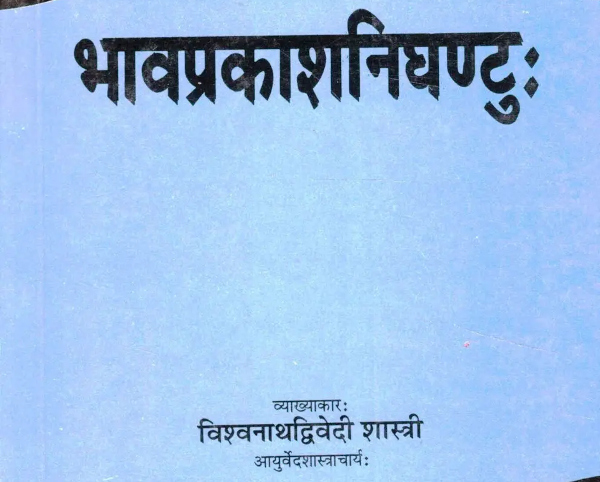
Bhavaprakasha Nighantu is one of the most respected Ayurvedic works on Dravyaguna, the science of medicinal substances. It belongs to the larger Ayurvedic classic Bhavaprakasha, composed by Acharya Bhavamishra in the 16th century. In the history of Ayurveda, this text stands at a very important moment. It comes after the foundational age of Charaka, Sushruta and Vagbhata, and it gathers the wisdom of earlier traditions into a systematic, practical and clinically useful form.
The word Nighantu means a lexicon, glossary or catalogue of names. In Ayurveda, a Nighantu is much more than a list of words. It is a disciplined record of herbs, minerals, animal-derived substances, foods, drinks, oils, ghee, honey, sugarcane products and medicinal preparations. It explains their names, qualities, actions and therapeutic uses. Bhavaprakasha Nighantu is therefore a great Ayurvedic materia medica: a treasury of substances that shows how India understood the healing power of nature through taste, potency, post-digestive effect, action, energetics and clinical application.
Acharya Bhavamishra wrote at a time when Ayurveda had already developed a vast intellectual foundation. Earlier classics had explained the principles of life, disease, diagnosis, surgery, pharmacology, rejuvenation, purification and dietetics. Bhavamishra’s achievement was to collect, arrange and refresh this knowledge for the needs of his own age. His work preserved the authority of the ancient tradition while also showing awareness of new diseases, new drugs, new trade routes and new medical interactions.
Bhavaprakasha is counted among the Laghu Trayi, the “lesser triad” of Ayurveda, along with Madhava Nidana and Sharangadhara Samhita. This title does not reduce its importance. It shows that these works became highly useful for physicians because they were practical, organised and suited to clinical study. Madhava Nidana became famous for disease diagnosis, Sharangadhara Samhita for formulations and pharmaceutical knowledge, and Bhavaprakasha for its broad medical, pharmacological and dietary coverage.
The structure of Bhavaprakasha is traditionally divided into three major sections: Purva Khanda, Madhyama Khanda and Uttara Khanda. Purva Khanda deals with foundational principles, daily and seasonal regimen, embryology, anatomy, pharmacological ideas and the Nighantu portion. Madhyama Khanda deals with diseases, diagnosis and treatment. Uttara Khanda focuses on Vajikarana and Rasayana, the branches linked with vitality, reproductive strength, rejuvenation and longevity.
The Nighantu portion is the heart of Bhavaprakasha’s contribution to Dravyaguna. It classifies substances into vargas, or groups. These vargas are arranged according to practical understanding: some groups contain medicinal herbs, some contain aromatic substances, some contain trees, some contain flowers and fruits, while others contain grains, vegetables, water, milk, curd, buttermilk, butter, ghee, oils, honey, sugarcane products and fermented preparations. This arrangement shows the Ayurvedic view that medicine is not separate from food, agriculture, ecology and daily living.
This is the true beauty of Bhavaprakasha Nighantu. It treats the kitchen, field, forest, cowshed, river, garden and pharmacy as connected spaces of healing. A grain is studied as food and medicine. Ghee is studied as nourishment and therapeutic carrier. Honey is studied for its action, age and type. Sugarcane is studied through its stages and products. Vegetables are studied for their effect on digestion and doshas. Water is examined through source and quality. This makes the text a complete guide to food as medicine.
The Ayurvedic method of describing a substance is highly sophisticated. Bhavaprakasha Nighantu usually looks at a dravya through several lenses: rasa, guna, virya, vipaka, karma and prabhava. Rasa means taste, such as sweet, sour, salty, pungent, bitter or astringent. Guna means qualities such as heavy, light, oily, dry, sharp, soft, mobile or stable. Virya means potency, usually heating or cooling. Vipaka means post-digestive effect. Karma means action in the body, such as digestive, nourishing, scraping, cleansing, strengthening, wound-healing, fever-reducing or rejuvenating. Prabhava means a special action that cannot be explained only through ordinary properties.
This framework allows Ayurveda to understand a substance in a living way. A herb is not judged only by appearance. It is studied through its effect on digestion, tissues, doshas, channels, strength, elimination, immunity, mind and vitality. This is why Bhavaprakasha Nighantu remained valuable for physicians. It gave them a method to choose herbs according to constitution, disease, season, strength, age and digestive capacity.
The text also gives great importance to synonyms. In older India, the same plant could have different names in Sanskrit, Prakrit, regional languages and local medical practice. A single herb might be known by its shape, taste, habitat, colour, action, mythological association or region. By recording synonyms, Bhavaprakasha Nighantu helped physicians identify substances across regions. This was crucial in a country with vast botanical diversity and many local healing traditions.
Bhavaprakasha Nighantu is also valuable because it records medieval India’s contact with wider medical and trade networks. Bhavamishra included substances that had become important through trade and cross-cultural medical exchange. Drugs such as Chopchini, also called Madhusnuhi, are often discussed as examples of newer entries into Ayurvedic materia medica. Other substances linked with fragrance, spice, trade and external influence show how Ayurveda remained open, observant and adaptive while staying rooted in its own principles.
The text reflects the living spirit of Indian medical science. Ayurveda was not a frozen system. It observed new substances, tested their properties, classified them through rasa-guna-virya-vipaka, and placed them within its own clinical logic. This made Bhavaprakasha Nighantu a bridge between ancient classical Ayurveda and the changing medical world of the medieval period.
One of the important concepts associated with the text is Pratinidhi Dravya, or substitute drugs. This idea has great practical value. A physician may face situations where a particular herb is unavailable, regionally rare, costly, seasonally absent or difficult to procure in pure form. The concept of substitutes helps maintain continuity of treatment by selecting another substance with comparable properties and action. This shows the practical wisdom of Ayurveda. It recognises geography, availability and clinical need.
Bhavaprakasha Nighantu also supports the idea of drug examination and proper identification. This became even more important because many herbs had similar names, regional variations or disputed identities. Later scholars and commentators gave special attention to botanical identification. Among modern scholars, the commentary of Prof. K. C. Chunekar, edited with Dr. G. S. Pandey, became especially important for students and researchers because it connected the classical Sanskrit names with botanical understanding, plant identity and modern study.
The varga system of Bhavaprakasha Nighantu deserves special attention. Haritakyadi Varga includes many famous medicinal substances, including the great fruits used in classical formulations. Karpuradi Varga highlights aromatic and fragrant substances. Guduchyadi Varga contains many important herbs and climbers, including Guduchi, one of Ayurveda’s most celebrated rasayana and jwara-related herbs. Pushpa Varga focuses on flowers. Phala Varga focuses on fruits. Vatadi Varga examines important trees. Dhatu and Upadhatu sections bring mineral and metallic substances into the Ayurvedic pharmacological world. Visha Varga shows the deep toxicological awareness of Ayurveda, where poisonous substances were studied carefully for controlled therapeutic use after purification and processing.
The food-related vargas are equally powerful. Dhanya Varga deals with grains. Shaka Varga deals with vegetables and greens. Vari Varga deals with water. Dugdha Varga deals with milk. Dadhi Varga deals with curd. Takra Varga deals with buttermilk. Navanita Varga deals with butter. Ghrita Varga deals with ghee. Taila Varga deals with oils. Madhu Varga deals with honey. Ikshu Varga deals with sugarcane and its products. Sandhana Varga deals with fermented preparations. These chapters show that dietetics is central to Ayurveda. A physician must know herbs, and he must also know food.
Bhavaprakasha Nighantu therefore supports the core Ayurvedic idea that daily diet can either preserve health or disturb balance. The text teaches that food has qualities, potency and action. Rice, barley, green gram, sesame oil, ghee, honey, sugarcane, curd, buttermilk and leafy vegetables are not treated as ordinary edible items. They are understood as substances that influence digestion, strength, tissues, channels, doshas and disease tendency.
This is why Bhavaprakasha Nighantu remains important for modern Ayurvedic food writing. It gives a classical foundation for explaining how food behaves in the body. It helps us understand why Ayurveda praises some foods for strength, some for lightness, some for cleansing, some for nourishment, some for digestion, and some for careful seasonal use. The text turns the Indian kitchen into a place of preventive medicine.
The clinical importance of Bhavaprakasha Nighantu is immense. A physician reading this text receives guidance on which substance supports digestion, which substance reduces fever, which substance helps respiratory disorders, which substance supports skin health, which substance nourishes reproductive tissue, which substance cleanses wounds, which substance acts as rasayana, and which substance should be handled with caution. The text connects pharmacology with disease management.
Bhavaprakasha as a whole also discusses many diseases in Madhyama Khanda. It includes classical disease categories and also gives attention to conditions that became prominent in later times. This is another reason the text is respected. It acts as a medical bridge between the ancient samhita period and later clinical practice. It gives the physician a practical collection of disease descriptions, formulations, herbs, diet and regimen.
The language of Bhavaprakasha Nighantu is another strength. It is concise, poetic and functional. Like many Ayurvedic classics, it uses verses that could be memorised by students and physicians. This helped oral transmission and clinical recall. A trained physician could remember the properties of a herb, its synonyms and its action through compact Sanskrit lines. This gave the text long life in gurukula learning, traditional practice and later Ayurveda colleges.
The work also has botanical importance. Many modern researchers use Bhavaprakasha Nighantu to study the history of medicinal plant use in India. It preserves names of plants, their classical identities, their therapeutic actions and their place in older medical practice. For ethnobotany, pharmacognosy, Ayurveda pharmacology and traditional knowledge research, the text remains a valuable source.
In the digital age, Bhavaprakasha Nighantu has gained new relevance. Its contents are being studied through e-texts, searchable Sanskrit platforms, academic reviews and knowledge-graph projects. This shows that the text can serve both traditional physicians and modern researchers. Its structured descriptions are suitable for digital mapping because each substance can be linked with rasa, guna, virya, vipaka, karma, synonyms, botanical identity and therapeutic use.
The greatness of Bhavaprakasha Nighantu lies in its balance. It respects ancient authority, but it also includes later knowledge. It studies powerful herbs, but it gives equal attention to food. It records names, but it also explains actions. It belongs to Sanskrit scholarship, but it remains useful in the clinic. It is rooted in Indian tradition, but it reflects awareness of trade, regional practice and wider medical exchange.
For Ayurveda students, Bhavaprakasha Nighantu is a gateway into Dravyaguna. For practitioners, it is a guide to medicinal selection. For researchers, it is a source of classical pharmacological data. For cultural writers, it is a record of India’s relationship with plants, food, minerals, animals, agriculture and healing. For the common reader, it reveals how deeply Indian civilisation studied the medicinal intelligence of everyday life.
Bhavaprakasha Nighantu teaches that healing begins with right understanding of substances. A herb has personality. A food has energy. A medicine has context. A physician must know the body, the disease, the season, the land, the patient and the dravya. This is the living science preserved by Bhavamishra.
In the larger history of Ayurveda, Bhavaprakasha Nighantu stands like a luminous bridge. On one side are the ancient foundations of Charaka, Sushruta and Vagbhata. On the other side are later physicians, regional traditions, new substances, practical formulations and modern research. Between them stands Bhavamishra’s great lexicon, carrying forward the civilisational memory of India’s healing world.
Bhavaprakasha Nighantu is therefore more than a book of herbs. It is India’s classical map of medicinal life. It shows that the forest, field, kitchen, cow, river, mineral world and human body are part of one healing universe. It remains one of Ayurveda’s finest expressions of the idea that nature, when properly understood, becomes medicine.
Reference
- Bhavamishra — Bhavaprakasha Nighantu, classical Ayurvedic materia medica.
- Prof. K. C. Chunekar and Dr. G. S. Pandey — Bhavaprakasha Nighantu, Sanskrit text with Hindi commentary, Chaukhambha Bharati Academy.
- National Institute of Indian Medical Heritage, CCRAS — e-Nighantu digital edition of Bhavaprakasha Nighantu.
- International Journal of Ayurveda and Pharma Research — “Bhavaprakasha Nighantu: A Comprehensive Review,” 2025.
- International Journal of Research in Ayurveda and Pharmacy — “A Review of Bhavaprakasha: An Important Ayurvedic Treatise,” 2023.
- Ayurvedic Dravyaguna literature on rasa, guna, virya, vipaka, prabhava and karma.
- Research on Bhavaprakasha Nighantu vargas, including Haritakyadi, Karpuradi, Guduchyadi, Vatadi, Dhanya, Shaka, Madhu, Ghrita and Ikshu vargas.
- Modern Ayurveda research on digital annotation and knowledge-graph study of Bhavaprakasha Nighantu.
You may also like
-
NMMSS Scholarship Application Deadline Extended to October 31, 2026
-
Ayurveda on Eating at the Right Time: How Food Timing Supports Balance and Health
-
Ayurveda and Late-Night Living: What Irregular Sleep Does to the Body
-
India’s Ayush Services Economy Reaches $36.92 Billion, RIS Study Projects Strong Growth to 2047
-
DGCA Introduces Training Framework for Gyroplane Pilots in India
