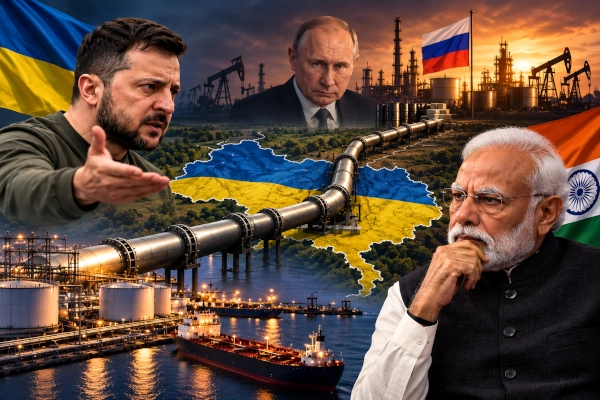
Ukrainian President Volodymyr Zelensky has once again called on India, China and Turkey to stop purchasing Russian energy, arguing that Moscow depends on revenues from these markets and that cutting this trade could increase pressure on Russia to end the war in Ukraine.
The argument is understandable from Kyiv’s perspective. Russia is a major energy exporter, and oil and gas revenues remain an important part of its economy. Ukraine therefore has a direct strategic interest in reducing Moscow’s ability to earn money from international energy sales.
There is, however, another part of the Russian oil trade that deserves attention whenever such demands are directed at India. Russian crude continues to travel through Ukrainian territory towards European consumers through the southern branch of the Druzhba pipeline.
That reality does not make India’s circumstances identical to Ukraine’s, nor does it invalidate Ukraine’s attempt to reduce Russian revenues. It does demonstrate something important: energy relationships become considerably more complicated when governments must balance geopolitical objectives against supply security, infrastructure, contractual arrangements and economic consequences.
Zelensky Calls on Major Buyers to Stop Russian Energy Trade
Speaking in an interview with The Wall Street Journal, Zelensky argued that Russia’s economy was relying on energy relationships with countries including India, Turkey and China. He maintained that if these countries stopped their energy trade with Moscow, the resulting pressure could force Russia towards ending the conflict.
India has become one of the world’s largest buyers of Russian crude since the escalation of the Ukraine conflict in 2022. Russian barrels became particularly attractive to Indian refiners when Western sanctions and changes in European purchasing patterns redirected substantial volumes of Russian crude towards Asian markets.
Russian crude nevertheless remains only one component of India’s much larger energy-supply system. India imports oil from several regions and adjusts purchases according to availability, refinery requirements, freight costs and market prices. Recent data also show that these volumes can change substantially: India’s Russian crude imports declined by 16.5 per cent month-on-month in August 2026 to approximately 2.1 million barrels per day, although Russia remained the country’s largest supplier.
India’s position has consistently been that energy procurement must be considered in the context of the requirements of more than 1.4 billion people. External Affairs Minister S. Jaishankar has also rejected the proposition that stopping purchases of individual Russian commodities would by itself end the conflict, maintaining that a settlement ultimately requires dialogue, diplomacy and negotiation.
Russian Crude Continues to Cross Ukraine
The difficulty with presenting Russian energy purchases as a simple choice between continuing or ending the war becomes apparent when the Druzhba pipeline is considered.
The southern branch of Druzhba carries crude from Russia through Belarus and Ukraine towards Central Europe. Hungary and Slovakia have remained important recipients of crude delivered through this system.
The pipeline is not merely a historical remnant that has ceased operating during the war. It remains part of Europe’s functioning energy infrastructure.
Its continuing importance became particularly visible in 2026 when Russian attacks on Ukrainian energy infrastructure interrupted crude supplies through Druzhba. The disruption affected deliveries to Hungary and Slovakia, prompting discussions involving Ukraine, the European Commission and European Union member states over restoring supplies and securing alternative routes.
The European Commission confirmed that Hungary and Slovakia responded by releasing emergency stocks and increasing alternative supplies, including non-Russian crude transported through Croatia’s Adria pipeline. European institutions simultaneously worked with Ukraine over the restoration of Druzhba transit.
The episode demonstrated that Russian oil crossing Ukraine remains sufficiently important to parts of Central Europe for interruptions to trigger emergency energy-security measures and diplomatic intervention.
Ukraine’s Position Reflects Its Own Practical Constraints
Ukraine’s continued operation of its section of Druzhba should not be portrayed as evidence that Kyiv supports Russian energy exports. Ukraine is fighting a war against Russia and has repeatedly sought stronger international sanctions on Moscow.
The more relevant point is that even Ukraine has had to operate within a complicated network of existing infrastructure, commercial arrangements and the energy requirements of neighbouring European states.
Ukraine also receives transit fees for moving oil through its pipeline network. Those revenues should not be exaggerated. They represent only a small fraction of Ukraine’s overall government finances and are nowhere near sufficient to describe the Ukrainian state as dependent on Russian oil transit.
Nevertheless, the existence of the arrangement matters. Russian crude enters the Ukrainian pipeline system, crosses Ukrainian territory and reaches European customers while payments are made for providing that transit service.
This is precisely why the Druzhba issue deserves to be part of the wider debate over demands that India disengage from Russian oil.
Hungary and Slovakia Also Invoke Energy Security
Hungary and Slovakia have repeatedly emphasised the difficulty of rapidly replacing Russian pipeline crude. Their geographical position, refinery configurations and established pipeline infrastructure have historically tied significant parts of their oil supply to Druzhba.
Alternative supplies are possible. The Adria pipeline through Croatia provides another route, and the European Union has been working towards further diversification away from Russian energy.
Yet the fact that emergency stocks and alternative shipments had to be mobilised when Druzhba supplies were interrupted demonstrates the practical consequences of abruptly removing an established source of crude.
This is an energy-security argument.
It is also fundamentally the type of argument India has made about its own purchases.
India’s Responsibility Is to Its Own Energy Consumers
India’s circumstances are substantially different from those of Hungary and Slovakia. India is not dependent upon a Russian pipeline and can source crude from numerous suppliers across the Middle East, Africa, the Americas and elsewhere.
The scale of India’s energy requirement, however, creates a different challenge. India is one of the world’s largest crude importers and must secure enormous quantities of oil continuously to operate its transport system, industries, agriculture and broader economy.
Price therefore matters alongside physical availability.
A government responsible for more than 1.4 billion people cannot treat the cost of energy as an abstract geopolitical consideration. Higher crude prices eventually work their way through transport costs, manufacturing, agricultural inputs and inflation. The burden is ultimately carried by households and businesses.
This does not mean India must purchase Russian oil regardless of circumstances. It means that decisions concerning millions of barrels of daily crude imports inevitably involve national energy security and economic consequences.
The same principle is visible in Europe’s treatment of Druzhba.
Removing Russian Oil Is Not Simply a Matter of Finding Another Seller
The global oil market further complicates the argument.
If a major importer stops buying Russian crude, it must purchase replacement barrels elsewhere. When one country makes that decision, markets can usually adjust. If several of the world’s largest consumers simultaneously attempt to replace large quantities of Russian crude, competition for alternative supplies increases.
The consequences depend on how much Russian production remains available to other buyers, how quickly producers elsewhere can increase supply, tanker availability, refinery compatibility, freight costs and conditions in major producing regions.
The problem is particularly significant when international oil markets are already facing supply uncertainty.
This is why energy sanctions have frequently been structured around restrictions, exemptions, transition periods and alternative supply arrangements rather than an assumption that enormous volumes of crude can disappear from established trade routes overnight.
Druzhba Reveals the Difficulty Behind the Political Message
There is therefore an important distinction between Zelensky’s strategic objective and the practical implementation of that objective.
Ukraine wants Russian energy revenues reduced because it believes those revenues strengthen Moscow’s capacity to continue the war. From Ukraine’s standpoint, that objective is entirely understandable.
Yet Ukraine’s own territory continues to form part of a supply chain carrying Russian oil to European Union members because the consequences of immediately terminating that supply are more complicated than the political slogan suggests.
Europe has accepted temporary arrangements for Hungary and Slovakia while simultaneously seeking to reduce its dependence on Russian energy. Ukraine has continued operating the transit infrastructure while fighting Russia. India continues purchasing crude while diversifying its suppliers and responding to changing international prices.
These are different circumstances, but they demonstrate the same underlying reality: governments make energy decisions within the constraints of infrastructure, markets, national requirements and the welfare of their populations.
One Standard Must Recognise Every Country’s Energy Reality
Ukraine can legitimately ask countries to help reduce Russia’s revenues. India can equally examine that request according to its own economic circumstances and energy-security requirements.
What becomes difficult to sustain is the suggestion that India’s Russian oil purchases can be judged without acknowledging similar considerations elsewhere.
If the continued movement of Russian crude through Ukraine can be explained by contractual obligations, European energy security, infrastructure limitations and the need for an orderly transition towards alternative supplies, then those same categories of practical considerations cannot simply be dismissed when India invokes its own energy requirements.
India’s circumstances are not Ukraine’s circumstances. Hungary’s circumstances are not India’s. Slovakia’s circumstances are not Hungary’s. Each country has different infrastructure, suppliers, populations and economic vulnerabilities.
That is precisely why the debate should move beyond accusations over who purchases Russian oil and examine the consequences of removing those supplies.
Ukraine’s own Druzhba pipeline provides a powerful illustration of that reality.
Russian crude continues to cross a country that is itself at war with Russia because energy systems cannot always be reorganised according to political demands overnight. Europe is working towards alternatives while protecting the immediate energy requirements of its member states.
India is entitled to approach its energy security with the same seriousness.
If Russian oil revenues are to be reduced substantially, the durable solution will require adequate alternative production, reliable transportation routes, affordable prices and a transition that does not transfer the economic burden onto ordinary consumers.
Until those conditions exist, the Russian oil debate will remain more complicated than simply asking countries to stop buying it.
References
The Wall Street Journal — Zelensky interview on Russia, energy trade and international pressure, September 2026.
European Commission, Directorate-General for Energy — Statement on the interruption of oil transit through the Druzhba pipeline and energy supplies to Hungary and Slovakia, 26 February 2026.
European Council — Joint statement concerning the Druzhba pipeline, Ukraine and restoration of oil supplies to Hungary and Slovakia, 17 March 2026.
Ministry of External Affairs, Government of India — Statements on India’s energy security, diversified sourcing and Russian energy purchases.
Reuters — India oil-import data showing Russian crude imports declining in August 2026 while Russia remained India’s largest supplier.
The Indian Express — Report on External Affairs Minister S. Jaishankar’s September 2026 remarks in Kyiv concerning Russian oil purchases, dialogue and diplomacy.
You may also like
-
India Leads BIMSTEC Security Cooperation as Seven Nations Adopt Delhi Declaration
-
India and Cyprus Strengthen Naval Cooperation with Focus on Maritime Security and Joint Training
-
India’s NSA Ajit Doval Holds High-Level Security Talks with Iran Amid Rising Tensions in West Asia
-
India Expands Diplomatic Presence in Central America with New Embassy in Costa Rica
-
India and Czech Republic Agree to Expand Defence Industrial Cooperation During Rajnath Singh–Karel Havlíček Talks
