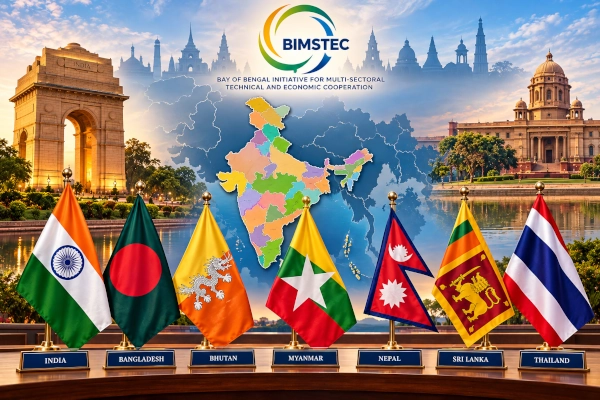
India has strengthened regional security cooperation by hosting the first BIMSTEC Home Ministers’ Meeting in New Delhi on October 13, 2026, bringing together seven member countries to address terrorism, organised crime, narcotics trafficking, cybercrime and illicit financial activities. The meeting, chaired by Union Home Minister Amit Shah, concluded with the adoption of the Delhi Declaration, establishing a framework for closer cooperation on regional security challenges.
The meeting brought together delegations from Bangladesh, Bhutan, India, Myanmar, Nepal, Sri Lanka and Thailand. It marked an important step in strengthening security cooperation under the Bay of Bengal Initiative for Multi-Sectoral Technical and Economic Cooperation (BIMSTEC).
Amit Shah Calls for Collective Action Against Terrorism
Addressing the meeting, Union Home Minister Amit Shah emphasised India’s policy of zero tolerance towards terrorism and called for stronger cooperation among BIMSTEC countries to prevent terrorist organisations from operating across national borders.
He urged member countries to strengthen intelligence sharing, financial investigations, mutual legal assistance and extradition arrangements. These measures would help prevent terrorist organisations from establishing safe havens, recruiting members, raising funds or conducting activities against neighbouring countries.
The Home Minister identified five priority areas for cooperation: drug control, counterterrorism and legal assistance, repatriation of fugitive criminals, cybersecurity and cybercrime investigations, and institutional cooperation and capacity building.
He also highlighted the importance of coordinated action among law enforcement agencies, intelligence organisations and border management authorities.
Seven Nations Adopt Delhi Declaration on Regional Security
The meeting concluded with the adoption of the Delhi Declaration, reaffirming the commitment of BIMSTEC countries to strengthening regional peace, security and cooperation.
The declaration condemned terrorism and violent extremism in all forms, including cross-border terrorism. It emphasised the importance of implementing the BIMSTEC Convention on Combating International Terrorism, Transnational Organised Crime and Illicit Drug Trafficking, which entered into force in March 2021.
Member countries agreed to strengthen cooperation in combating radicalisation, terrorist financing, organised crime, human trafficking, cybercrime and illegal financial transactions.
The declaration also recognised the growing use of technology by criminal networks, particularly in online fraud, human trafficking and financial crimes. It called for stronger investigative cooperation and assistance to victims of trafficking.
BIMSTEC Approves Major Agreements on Drug Trafficking and Financial Crimes
A major outcome of the meeting was the approval of several regional cooperation instruments addressing emerging security threats.
The Home Ministers approved the BIMSTEC Convention against Trafficking in Persons, aimed at improving cooperation in preventing human trafficking, prosecuting offenders and protecting victims.
They also approved the BIMSTEC Plan of Action on Drug Control, covering illegal trafficking in narcotic drugs, psychotropic substances and precursor chemicals.
To address financial crimes, the member countries approved a Memorandum of Understanding on Capacity Building to Combat Money Laundering and Terror Financing. The agreement promotes professional training, financial intelligence sharing, investigations, asset recovery and cooperation against terrorism financing.
Additionally, the meeting approved a Plan of Action on Illicit Financial Flows and Their Prevention, providing a framework for identifying and addressing illegal financial transactions across the region.
India Proposes BIMSTEC Disaster Management Centre in Gujarat
Disaster management emerged as another important area of cooperation during the meeting.
Amit Shah highlighted India’s proposal to establish a BIMSTEC Disaster Management Centre in Jamnagar, Gujarat, building on the initiative announced by Prime Minister Narendra Modi during the sixth BIMSTEC Summit in Bangkok in April 2025.
The proposed centre will support regional cooperation in disaster preparedness, emergency response and capacity building.
The Home Ministers also approved a Plan of Action for Enhancing Preparedness and Coordination to Address Natural Disasters in the Bay of Bengal Region.
The plan includes cooperation in early warning systems, disaster mapping, joint exercises, research, technological innovation, training and tsunami risk reduction.
These initiatives aim to improve the ability of BIMSTEC countries to respond collectively to cyclones, floods, earthquakes and other natural disasters affecting the region.
BIMSTEC Strengthens Regional Security Framework
Established in 1997, BIMSTEC connects seven countries across South Asia and Southeast Asia through a regional framework for economic, technical and security cooperation.
The Bay of Bengal region occupies an important position in international maritime trade and regional connectivity. Its security challenges extend beyond national boundaries, requiring closer cooperation between governments and law enforcement institutions.
The first Home Ministers’ Meeting provided a dedicated platform for reviewing existing security initiatives and developing coordinated responses to emerging threats.
Member countries also agreed to strengthen training programmes, institutional cooperation and engagement with international organisations involved in combating terrorism and transnational crime.
India Advances Collective Security Cooperation in Bay of Bengal Region
The successful conclusion of the first BIMSTEC Home Ministers’ Meeting represents an important milestone in regional security cooperation.
The adoption of the Delhi Declaration, approval of agreements addressing human trafficking and financial crimes, and strengthened cooperation in disaster management provide a foundation for coordinated regional action.
By bringing together seven countries under a common security framework, India has helped advance BIMSTEC’s efforts to build a safer, more resilient and economically connected Bay of Bengal region.
References
- Ministry of Home Affairs, Government of India — Under the Chairmanship of Union Home Minister Shri Amit Shah, India Hosts First Meeting of BIMSTEC Home Ministers in New Delhi. Press Information Bureau, October 13, 2026.
https://www.pib.gov.in/PressReleseDetailm.aspx?PRID=2322937 - Ministry of Home Affairs, Government of India — First BIMSTEC Home Ministers’ Meeting Concludes with Adoption of Delhi Declaration. Press Information Bureau, October 13, 2026.
https://www.pib.gov.in/PressReleseDetailm.aspx?PRID=2322964 - Ministry of Home Affairs, Government of India — India Is Honored to Host the First BIMSTEC Home Ministers’ Meeting in New Delhi, Says Union Home Minister Amit Shah. Press Information Bureau, October 12, 2026.
https://www.pib.gov.in/PressReleseDetailm.aspx?PRID=2322415 - BIMSTEC Secretariat — Official information on BIMSTEC cooperation mechanisms and regional initiatives.
https://bimstec.org/
You may also like
-
India and Cyprus Strengthen Naval Cooperation with Focus on Maritime Security and Joint Training
-
India’s NSA Ajit Doval Holds High-Level Security Talks with Iran Amid Rising Tensions in West Asia
-
India Expands Diplomatic Presence in Central America with New Embassy in Costa Rica
-
India and Czech Republic Agree to Expand Defence Industrial Cooperation During Rajnath Singh–Karel Havlíček Talks
-
UK Announces Over £1 Billion in New Commercial Deals with India
