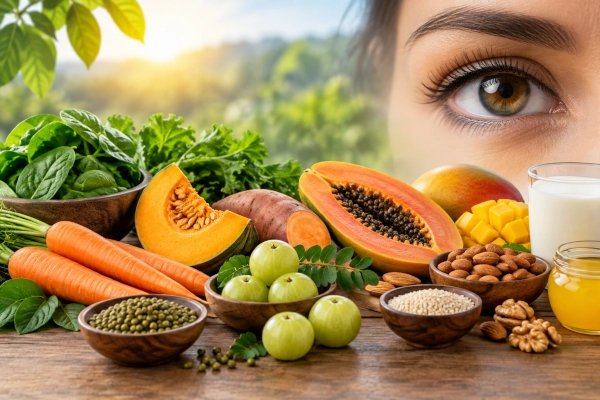
Good eyesight depends on much more than a single herb, vegetable or vitamin. The retina, lens, cornea, optic nerve and tiny blood vessels of the eye all require steady nourishment, while conditions such as diabetes, high blood pressure, smoking, prolonged ultraviolet exposure and ageing can gradually affect vision. Ayurveda has traditionally approached eye health through a combination of Ahara, or diet, Vihara, or daily habits, and specialised eye-care practices, rather than relying on one remedy alone.
Within Ayurveda, substances traditionally considered supportive to the eyes are often described as Chakshushya. Eye health is also discussed within Shalakya Tantra, the branch concerned with disorders affecting the eyes, ears, nose and throat. The Central Council for Research in Ayurvedic Sciences notes that classical Ayurvedic eye care places importance on appropriate diet and lifestyle as part of maintaining ocular health.
Modern nutrition arrives at a similar broad principle from a different direction. The eyes require adequate vitamin A, carotenoids such as lutein and zeaxanthin, antioxidants and an overall diet that helps maintain vascular and metabolic health. The National Eye Institute recommends a balanced diet rich in dark leafy vegetables and other nutrient-dense foods as one part of protecting long-term vision.
The important point is that food can support healthy eyes, but it cannot correct refractive errors such as myopia, replace spectacles, reverse cataracts or serve as a treatment for glaucoma, retinal disease or sudden loss of vision.
Amla: One of Ayurveda’s Traditional Eye-Supporting Foods
Amla, or Amalaki, occupies a prominent place in Ayurvedic nutrition and Rasayana traditions. Ayurvedic literature commonly describes Amalaki as Chakshushya, meaning traditionally beneficial or supportive to the eyes. It is also one of the three fruits used in Triphala, another preparation with a long history in Ayurvedic ophthalmic practice. CCRAS literature continues to discuss Triphala and Chakshushya Rasayana in the context of traditional eye health.
From a modern nutritional perspective, fresh amla is valuable primarily because it is a nutrient-dense fruit and an important dietary source of vitamin C and plant polyphenols. ICMR-National Institute of Nutrition dietary guidance lists fresh amla among foods rich in vitamin C.
Vitamin C contributes to normal antioxidant defence throughout the body. However, eating amla should not be presented as a proven treatment for cataract, macular degeneration or poor eyesight. Its strongest role is as part of a varied diet rich in fruits and vegetables.
Fresh amla can be eaten raw when tolerated, grated into foods, made into chutney or consumed as an unsweetened preparation. Preparations containing very large quantities of sugar may undermine some of the metabolic advantages of eating the fruit itself.
Spinach and Other Dark Green Leafy Vegetables
Among all foods associated with eye health, dark green leafy vegetables have some of the strongest modern nutritional evidence.
Spinach, amaranth leaves, drumstick leaves and other dark greens contain carotenoids, particularly lutein and zeaxanthin. Unlike beta-carotene, which the body can convert into vitamin A, lutein and zeaxanthin accumulate directly in tissues of the eye, especially the macula and lens.
The National Eye Institute notes that lutein and zeaxanthin are present in the retina and lens and may function as antioxidants while helping absorb high-energy light. Large clinical studies such as AREDS2 have also established an important role for lutein and zeaxanthin within specific supplement formulations used for people at particular stages of age-related macular degeneration.
This does not mean that everyone needs an eye supplement. For most healthy people, regularly eating vegetables rich in these carotenoids is a sensible nutritional strategy.
Spinach can be cooked lightly with dal, added to soups or prepared as part of a mixed vegetable dish. Amaranth and drumstick leaves are equally useful Indian options and provide variety across seasons.
Ayurvedic dietary traditions have long valued green vegetables as part of a balanced meal rather than as isolated medicinal substances. That principle remains practical today: eating several different vegetables regularly is more useful than depending on one supposed “superfood.”
Carrots, Pumpkin and Sweet Potato for Vitamin A Precursors
Carrots became famous as an eye food for good reason, although their benefits are sometimes exaggerated.
Carrots, pumpkin, sweet potato and other orange or deep-yellow vegetables contain beta-carotene, which the body can convert into vitamin A. Vitamin A is essential for normal vision because it contributes to rhodopsin, a light-sensitive protein in the retina that allows the eye to function under low-light conditions. It also helps maintain the normal tissues of the cornea and conjunctiva.
Vitamin A deficiency can cause difficulty seeing in dim light and, when severe, can damage the surface of the eye. ICMR-NIN specifically notes the importance of vitamin A for dim-light vision and identifies green leafy vegetables, carrots, sweet potatoes, papaya and mango among foods containing carotenoids.
For someone who already obtains adequate vitamin A, however, eating increasingly large quantities of carrots will not produce progressively sharper eyesight. Nutrition corrects deficiency and supports normal function; it does not transform normal vision beyond its physiological limits.
Pumpkin or carrot can be cooked into sabzi, soups or dals, while sweet potato makes a useful seasonal alternative to refined snacks.
Papaya and Mango Add Colour and Carotenoids
Ayurvedic eating traditionally gives importance to seasonal fruits, and papaya and mango provide useful carotenoids as part of that pattern.
Their yellow-orange colour reflects pigments that include provitamin A carotenoids. When eaten as part of a varied diet, these fruits contribute to the nutrient pool needed for normal retinal and epithelial function.
Papaya has the additional advantage of being relatively easy to combine with other fruits and meals. Mango can also contribute valuable carotenoids, although portion size may be relevant for people who need to manage blood glucose carefully.
There is no need to consume exotic or expensive foods for eye nutrition. A combination of ordinary Indian foods such as spinach, amaranth, carrot, pumpkin, papaya and amla can provide a diverse range of nutrients.
A Small Amount of Healthy Fat Can Improve Carotenoid Absorption
Ayurvedic cooking frequently combines vegetables with a small amount of ghee or oil, and modern nutritional science provides an interesting explanation for why some fat alongside vegetables can be useful.
Carotenoids are fat-soluble compounds. Studies show that eating carotenoid-rich vegetables together with dietary fat can improve their absorption. A systematic review of clinical and laboratory studies found that carotenoid bioavailability generally increased when dietary fat was consumed with the meal.
This does not mean vegetables should be drenched in fat. A modest amount is sufficient.
Traditional ghee can be used in small quantities where it suits the individual’s diet. Modern evidence suggests that fats rich in unsaturated fatty acids, such as certain vegetable oils, can also enhance carotenoid absorption and may sometimes do so more effectively than highly saturated fats.
The practical principle is simple: a lightly cooked spinach, carrot or pumpkin dish containing a modest amount of fat may allow the body to absorb carotenoids more efficiently than an extremely low-fat meal.
Green Gram and Simple Balanced Meals
Traditional Ayurvedic discussions of eye-supporting diets frequently include Mudga, or green gram, along with grains and vegetables. Green gram is not a specialised medicine for the retina, but it can form part of a balanced diet providing plant protein, minerals and complex carbohydrates.
This wider nutritional context matters because eye health is closely connected with metabolic health.
Diabetes can damage retinal blood vessels and lead to diabetic retinopathy, while high blood pressure and abnormal cholesterol can also increase the risk of several eye problems. The National Eye Institute therefore advises maintaining physical activity and controlling conditions such as diabetes and hypertension as part of protecting vision.
A meal consisting of green gram or another pulse, vegetables, whole grains and a modest amount of healthy fat may therefore support the eyes indirectly by supporting overall metabolic health.
This is closer to the traditional Ayurvedic idea of nourishment than searching for one ingredient capable of “improving eyesight.”
Nuts and Seeds Can Support the Overall Diet
Almonds, walnuts, sesame and other nuts and seeds are often included in traditional Indian dietary patterns. They provide fats, protein and several micronutrients and can help create a more nutritionally complete diet when eaten in moderate portions.
Their role in eye health should not be exaggerated. Eating almonds or sesame every day has not been shown to restore poor eyesight or eliminate the need for spectacles. Their benefit lies mainly in contributing to an overall diet rich in nutrient-dense whole foods.
For people who tolerate them well, a small serving of unsalted nuts or seeds can be included with breakfast, added to porridge or eaten as a snack instead of highly processed foods.
Milk, Ghee and Vitamin A
Milk and ghee occupy an important place in traditional Ayurvedic nutrition. Dairy foods can provide preformed vitamin A, although the amount varies according to the product and its fat content.
NIH guidance notes that dietary vitamin A comes from two broad sources: preformed vitamin A from animal-derived foods such as dairy, eggs and fish, and provitamin A carotenoids from plant foods.
For people who consume dairy, moderate amounts can therefore contribute to vitamin A intake. There is no need, however, to consume large quantities of ghee in the belief that it will sharpen vision. Excess calories and saturated fat can create other health problems when taken disproportionately.
Ayurveda itself places considerable importance on suitability, digestion and quantity, rather than assuming that more of a beneficial food is always better.
Eggs for Those Who Include Them in Their Diet
For people whose diet includes eggs, the yolk provides vitamin A and carotenoids including lutein and zeaxanthin. Although green leafy vegetables generally contain larger amounts of these pigments, carotenoids from different foods contribute collectively to dietary intake.
Eggs can therefore be one option within a balanced diet rather than an essential eye food.
Vegetarians can obtain the same broad nutrient classes through combinations of dark leafy vegetables, orange vegetables, fruits, pulses, nuts, seeds and dairy where consumed.
What About Eye Supplements?
The popularity of lutein, zeaxanthin, zinc and vitamin supplements has created the impression that everyone should take an “eye vitamin.” That is not what the evidence shows.
The AREDS and AREDS2 formulations were developed for specific groups of people with age-related macular degeneration. The National Eye Institute states that the formulations can reduce progression to advanced AMD in people at sufficiently high risk, but AREDS studies did not show a benefit for people without AMD or those with early AMD.
Supplements should therefore not automatically be added simply because someone spends long hours looking at a computer screen or wants better vision.
People diagnosed with macular degeneration should discuss AREDS2 or other supplements with their ophthalmologist rather than attempting to reproduce therapeutic doses through self-medication.
Ayurveda Should Complement Proper Eye Examination
Ayurvedic food traditions can offer a useful framework for eating more seasonal fruits, vegetables, pulses and minimally processed foods. But neither Ayurveda nor nutrition should delay diagnosis when vision changes.
The Ministry of AYUSH’s own cross-referral guidance identifies severe eye pain, sudden blurring or loss of vision and refractive errors requiring correction among situations that require conventional ophthalmic assessment.
New flashes of light, a sudden increase in floaters, a curtain-like shadow across vision, eye injury, severe redness or sudden visual loss should also be treated as reasons to seek urgent professional eye care rather than trying dietary or home remedies first.
Regular eye examinations become increasingly important with age and are particularly important for people with diabetes, high blood pressure, a family history of glaucoma or existing eye disease.
Building an Eye-Friendly Ayurvedic Plate
A practical eye-supporting meal does not have to look medicinal. A plate might contain green gram dal, spinach or amaranth, carrot or pumpkin, whole grains and a small amount of suitable cooking fat, followed by a seasonal fruit such as papaya or amla.
Across the week, the vegetables and fruits can change according to season and availability. What matters is repeatedly supplying the body with carotenoids, vitamins and other protective nutrients rather than occasionally consuming large quantities of one ingredient.
Ayurveda’s broader message is particularly useful here. Health is maintained through repeated daily habits rather than emergency remedies after disease appears.
Modern eye science reinforces that idea. Good nutrition, physical activity, protection from ultraviolet light, control of diabetes and blood pressure, avoidance of smoking and regular eye examinations all contribute to preserving vision over the long term.
Foods such as amla, spinach, amaranth leaves, drumstick leaves, carrots, pumpkin, sweet potato, papaya, green gram, nuts and seeds can therefore form a sensible Ayurvedic-inspired foundation for eye nutrition.
They cannot guarantee perfect eyesight, but combined with appropriate medical care and healthy daily habits, they can provide the nutrients the eyes need to continue performing one of the body’s most remarkable functions: turning light into vision.
You may also like
-
Robotics, AI and Nanoscience Set to Transform Precision Medicine in India
-
Why Ayurveda Recommends Eating Only When Hungry
-
Ayurveda on Eating at the Right Time: How Food Timing Supports Balance and Health
-
Ayurveda and Late-Night Living: What Irregular Sleep Does to the Body
-
India’s Ayush Services Economy Reaches $36.92 Billion, RIS Study Projects Strong Growth to 2047
