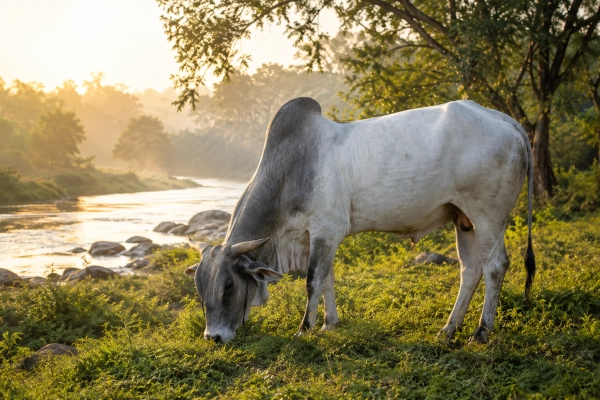
Amritmahal cattle are among India’s most distinguished indigenous draught breeds. Developed in the former Mysore State, these powerful animals became celebrated for their speed, stamina, agility and ability to transport military equipment across long distances. Their compact bodies, hard hooves, muscular limbs and energetic temperament made them exceptionally suitable for rapid movement, agricultural work and transport through the dry and uneven terrain of southern Karnataka.
Although mechanisation has greatly reduced the use of working bullocks, the Amritmahal remains an important part of Karnataka’s agricultural, military and ecological heritage. The breed is officially registered by the ICAR–National Bureau of Animal Genetic Resources, with Karnataka recognised as its home tract and the accession number INDIA_CATTLE_0800_AMRITMAHAL_03001.
Origin and development of the breed
The history of the Amritmahal is closely connected with the rulers of Mysore. The term “Amrit Mahal” has commonly been interpreted as referring to an establishment or department created for maintaining cattle associated with the royal household. The original herds reportedly included recognised Mysore cattle types such as Hallikar, Hagalvadi and Chitaldroog or Chitradurga cattle.
The royal cattle establishment initially served more than one purpose. Cows were kept for milk and dairy supplies, while selected male calves were trained as powerful draught animals. As their working qualities became increasingly valuable, systematic attention shifted towards producing bullocks capable of carrying loads, pulling guns and accompanying armies over long distances.
Over time, the animals were reportedly classified according to their duties. Some became gun bullocks used for moving artillery, others served as pack bullocks carrying supplies, and another category was trained for ploughing and general draught work. This organised selection for strength, speed and endurance helped shape the Amritmahal into a specialised working breed.
The military bullocks of Mysore
The most celebrated chapter in the history of Amritmahal cattle concerns their use in military logistics. Before motor vehicles and railways, armies depended heavily on cattle to move artillery, ammunition, tents, food and other supplies. A military bullock needed far more than physical strength: it required stamina, sure-footedness, heat tolerance and the ability to maintain a steady pace over difficult terrain.
Amritmahal bullocks became renowned for combining these qualities. Historical accounts described them as unusually courageous and enduring animals that could remain in the yoke for extended periods. One frequently repeated account states that bullocks associated with the Mysore forces completed a march of about 100 miles in approximately two and a half days. Such historical distance claims should be read as accounts of the breed’s reputation rather than as modern controlled performance records.
Their ability to move guns rapidly was especially important during military campaigns. Haidar Ali and Tipu Sultan are traditionally associated with the careful maintenance and deployment of these cattle. Fast-moving draught animals could help an army bring artillery into position, withdraw equipment during danger and maintain supply lines over routes where wheeled transport was difficult.
The importance of the breed continued beyond the Mysore wars. Historical administrative records praised Amritmahal bullocks for their endurance and compared their superiority over ordinary cattle to that of a thoroughbred horse over a common road animal.
Native tract in Karnataka
The traditional breeding region of the Amritmahal lies in the dry and semi-arid parts of Karnataka. The breed is principally associated with districts including Chikkamagaluru, Chitradurga and Hassan, while its wider breeding tract has also extended into Tumakuru, Davanagere and parts of Shivamogga.
These areas contain dry plains, rocky stretches, scrub vegetation and seasonal grasslands. Generations of selection under such conditions produced animals capable of walking long distances, grazing extensively and remaining active in a hot climate. Recent research involving indigenous-cattle owners across six Karnataka districts continues to identify Amritmahal cattle as a breed valued particularly for traction power and multiple farm uses.
Physical appearance
Amritmahal cattle possess an athletic and commanding appearance. Their conformation reflects the breed’s development for movement rather than heavy milk production.
The coat is generally grey, although its shade can vary from nearly white to dark steel grey or almost black. Bulls are often darker around the head, neck, shoulders and hump, while cows tend to be lighter. White-grey markings may occur on the face and dewlap. The muzzle, hooves and tail switch are generally dark.
The head is long, narrow and well shaped, tapering towards the muzzle. The forehead is moderately prominent and may show a central furrow. The ears are relatively small and fine, while the eyes are bright and alert.
One of the breed’s most recognisable features is its pair of long, pointed horns. They rise from the top of the head, extend backwards and upwards and may turn inward towards their sharply pointed ends. Their length and sword-like form contribute greatly to the majestic appearance of mature Amritmahal animals.
The neck is strong, the shoulders are firm and the hump is well developed, particularly in bulls and working bullocks. The body is compact rather than excessively heavy. The legs are muscular, clean and well placed, while the small, hard hooves provide durability during movement over dry and stony ground.
Temperament and behaviour
Amritmahal cattle are active, energetic and highly alert. Traditionally raised in large grazing herds with limited individual handling, they may display a spirited or fiery temperament. Young animals therefore require experienced handling and patient training.
Once properly trained, Amritmahal bullocks can become disciplined and responsive working animals. Their alertness, fast reactions and willingness to move contributed to their historical suitability for rapid transport. These qualities also distinguish them from slower, heavier draught breeds developed primarily for pulling massive loads at a measured pace.
Their energetic nature should be treated as part of their specialised working character. Calm management, regular handling from a young age and avoidance of rough treatment are important when preparing them for agricultural or transport work.
Draught power and working ability
Amritmahal bullocks are especially suited to work requiring a combination of speed and endurance. They can be used for ploughing, carting, hauling farm produce and travelling between fields or villages. Historically, their reputation rested on quick transport rather than on maximum pulling strength alone.
Several physical characteristics contribute to their working ability:
- A compact and balanced body supports efficient movement.
- Strong shoulders and a developed hump provide power for draught work.
- Muscular legs allow sustained trotting and long-distance travel.
- Hard hooves provide resistance against wear on dry and rocky surfaces.
- Their relatively light, athletic frame reduces the energy needed for movement.
- Adaptation to local heat and grazing conditions helps them work within Karnataka’s semi-arid environment.
Modern research on cattle keepers in Karnataka found that farmers continue to value Amritmahal animals for traction power, adaptability and their ability to provide several forms of utility within traditional mixed farming systems.
Role in traditional agriculture
For centuries, draught cattle supplied the main source of mobile power in Indian agriculture. Amritmahal bullocks ploughed land, transported grain, moved fodder, carried manure and pulled carts containing agricultural produce.
Their manure contributed organic matter and nutrients to cultivated fields. Crop residues, grasses and locally available fodder could in turn sustain the cattle, forming an integrated crop-livestock system. This relationship reduced dependence on purchased fuel and chemical inputs while supporting soil fertility.
The breed remains relevant in regions where small fields, irregular terrain, narrow village roads or limited access to machinery make animal power useful. Bullock-based operations can also cause less soil compaction than heavy agricultural machinery, although the suitability of either method depends on local farming conditions and the work being performed.
Milk production
Amritmahal is classified primarily as a draught breed. Its cows generally produce modest quantities of milk, much of which has traditionally been required for raising strong calves. Historical attempts to maintain the cattle partly for palace dairy requirements eventually gave way to greater emphasis on the performance of male animals.
The breed should therefore be evaluated according to its principal qualities—draught ability, adaptability, hardiness and genetic heritage—rather than compared directly with specialised dairy breeds selected for high milk yield. Published descriptions commonly place its lactation production well below that of modern dairy cattle, although actual yield varies with nutrition, management, age and individual genetics.
The Amrit Mahal Kavals
A distinctive institution connected with the breed is the Amrit Mahal Kaval. Kavals were reserved grazing lands used to maintain royal or government cattle herds. They provided space for seasonal movement, grazing, breeding and the raising of young stock under extensive conditions.
These lands were more than livestock farms. They developed into grassland ecosystems supporting native grasses, insects, birds, reptiles and other wildlife. They also provided grazing and livelihood resources for surrounding rural communities.
At the time of Independence, Amrit Mahal grasslands reportedly extended over more than 400,000 acres. An ICAR–Indian Grassland and Fodder Research Institute assessment published in 2025 estimated that the remaining area had fallen to approximately 58,000 acres across five Karnataka districts. The consultation also reported declining forage availability and losses of palatable grass species.
The contraction and fragmentation of these grazing lands affect both the cattle and the broader grassland environment. Conserving the breed therefore requires protection and restoration of the ecological system in which it developed.
Management and feeding
Amritmahal cattle have traditionally been maintained through extensive or semi-extensive grazing. Herds move across grasslands and scrub areas, consuming native grasses, crop residues and locally available vegetation.
Hardiness does not mean that the animals can remain productive without adequate nutrition. Working bullocks require sufficient energy, protein, minerals and clean drinking water. Green fodder, dry roughage, crop residues and balanced concentrates can be combined according to the animal’s workload and physiological condition.
Pregnant cows, growing calves, breeding bulls and animals performing heavy work require particular nutritional attention. Mineral supplementation is important where local soil and fodder are deficient. Regular vaccination, parasite control, hoof inspection and veterinary care are also necessary.
Rotational grazing can allow grasslands time to recover and reduce pressure on preferred plant species. ICAR–IGFRI has identified reseeding with native grasses and legumes, weed control, fodder banks and participatory grazing management as possible measures for restoring the Amrit Mahal grassland system.
Threats facing the breed
The greatest challenge facing specialised draught cattle is the decline in demand for animal power. Tractors, trucks and motorised agricultural equipment have replaced bullocks in many activities. Because Amritmahal cows produce limited milk, farmers operating in a dairy-oriented market may find it difficult to justify maintaining purebred animals.
Other pressures include:
- Reduction and fragmentation of traditional grazing lands.
- Shortage of quality fodder during dry periods.
- Indiscriminate crossbreeding and loss of breed purity.
- Limited availability of selected breeding bulls in some regions.
- Declining transmission of traditional breeding knowledge.
- Reduced interest among younger farmers in maintaining draught cattle.
- High maintenance costs when animals have no regular economic role.
Research on Karnataka’s indigenous breeds has similarly identified mechanisation, random crossbreeding, urbanisation, market changes and declining youth participation in crop-livestock agriculture as threats to native cattle resources.
Conservation programmes
Amritmahal is recognised as a distinct indigenous breed by ICAR–NBAGR. Its genetic material is represented in the National Gene Bank, which maintains frozen semen from numerous indigenous livestock breeds for long-term conservation and future breeding requirements.
The Government of India has also identified the Amrithmahal Subcentre at Lingadahalli in Chikkamagaluru district as a Gokul Gram location with a mandate connected to the Amrit Mahal breed. Such institutional herds can support pure breeding, production of breeding males, scientific documentation and distribution of superior germplasm.
Effective conservation, however, cannot depend entirely on government farms. Farmers maintaining purebred herds within the native tract are essential custodians of the breed. Incentives for breeders, accessible veterinary services, organised selection of bulls, breed societies, reliable registration systems and markets for purebred animals can strengthen community-based conservation.
Creating a modern role for Amritmahal cattle
The long-term survival of Amritmahal cattle depends on giving the breed meaningful economic and cultural value. Conservation programmes can explore carefully designed roles in low-input agriculture, organic farming, breeding services, heritage farms, livestock exhibitions and controlled draught competitions that protect animal welfare.
The breed’s history can also become part of Karnataka’s educational and rural-tourism programmes. Amritmahal cattle are connected with the Mysore kingdom, military logistics, indigenous breeding knowledge and the management of Karnataka’s historic grasslands. Presenting these connections accurately can generate wider public support for conservation.
Research should continue into the breed’s genetics, disease resistance, feed efficiency, heat tolerance, reproductive performance and sustainable use in mixed farming. Such work could reveal traits valuable for livestock production under increasingly variable climatic conditions.
Conclusion
Amritmahal cattle represent a remarkable achievement of indigenous animal breeding. Karnataka’s rulers and cattle keepers gradually developed an animal capable of travelling quickly, working for long periods and moving vital equipment across challenging terrain. Their strength served agriculture, while their speed and endurance earned them a distinguished place in the military history of Mysore.
Today, the breed faces a world very different from the one in which it was created. Its future rests on combining scientific breeding, farmer participation, grassland restoration, genetic conservation and new economic uses. Protecting the Amritmahal means preserving more than an uncommon draught animal. It means safeguarding Karnataka’s pastoral landscape, agricultural knowledge and the living heritage of one of India’s most celebrated working cattle breeds.
References
ICAR–National Bureau of Animal Genetic Resources. Cattle Breeds of India: Amritmahal.
ICAR–National Dairy Research Institute. Farmers’ Preferences and Breeding Practices for Indigenous Cattle Breeds in the Breeding Tract of Karnataka. Indian Journal of Animal Sciences, 2024.
ICAR–Indian Grassland and Fodder Research Institute. Sustainable Management of Amrit Mahal Grasslands in Karnataka, 2025.
ICAR–National Bureau of Animal Genetic Resources. National Gene Bank.
Press Information Bureau, Government of India. Details of Gokul Gram and Mandated Indigenous Breeds, 2025.
The Imperial Gazetteer of India: Mysore—Agriculture and Amrit Mahal Cattle Establishment.
You may also like
-
ZSI Scientists Identify New Fish Species Bathymyrus perplexus From the Bay of Bengal
-
Rare Afro-Asian Sand Snake Rediscovered in Kutch After More Than 150 Years
-
Indravati Tiger Reserve to Reopen for Wildlife Safaris After Four Decades
-
Tiny 3.3-mm Parasitic Wasp Discovered in Assam Marks First Record of Its Genus in India
-
How India Brought the Greater One-Horned Rhinoceros Back From the Brink
