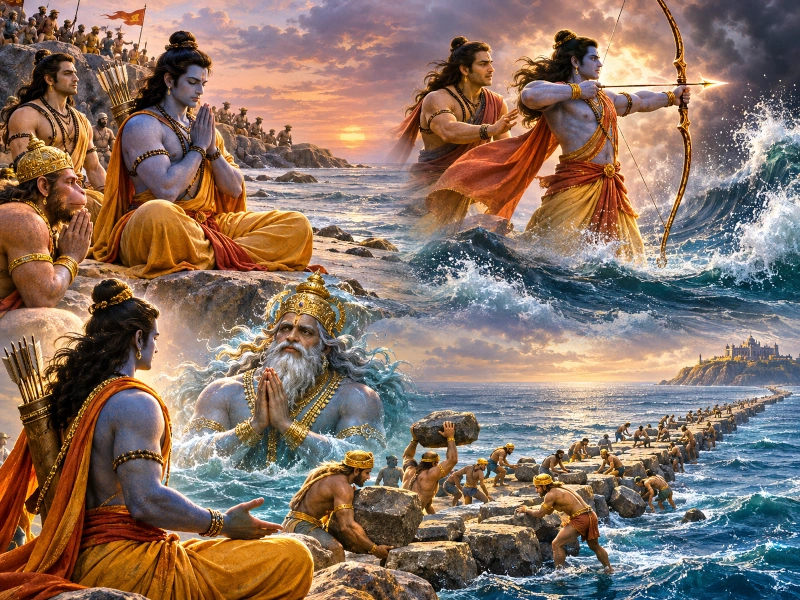
Ramayana Diplomacy | Yuddha Kāṇḍa, Sargas 21–22
The Vālmīki Rāmāyaṇa presents an important episode in strategic decision-making when Rāma reaches the shores of the ocean with his Vānara army during the campaign to rescue Sītā from Laṅkā. Although his forces are prepared for the expedition, the ocean constitutes a formidable geographical barrier that prevents their advance. Rather than immediately resorting to force, Rāma initially seeks the cooperation of the Ocean deity through peaceful supplication, demonstrating a preference for accommodation over confrontation.
The episode subsequently develops into a study of the relationship between diplomacy, strategic patience, credible pressure and negotiated solutions. When peaceful appeals fail to elicit a response, Rāma adopts a more forceful position, compelling the Ocean deity to appear and explain the limitations governing his ability to assist. The resulting agreement enables the construction of a bridge to Laṅkā, transforming an apparent strategic impasse into an opportunity for engineering, cooperation and military advancement.
The Strategic Challenge of Crossing the Ocean
The successful mobilisation of the Vānara army under Sugrīva brought Rāma to the southern coast, but military strength alone could not guarantee access to Laṅkā. The ocean provided Rāvaṇa’s kingdom with a natural defensive barrier, complicating the movement of personnel and resources. Rāma therefore needed a solution that would enable the collective movement of his forces rather than merely facilitate the passage of a few exceptional warriors.
The challenge confronting Rāma was consequently both military and diplomatic in character. The objective was not to conquer the ocean but to secure passage across it, preserving the strength of his army for the principal campaign. This distinction between the immediate obstacle and the ultimate strategic objective forms an important foundation for understanding Rāma’s subsequent conduct.
Vibhīṣaṇa’s Counsel: Diplomacy as the First Instrument
The decision to approach the Ocean peacefully followed the counsel of Vibhīṣaṇa, who understood the strategic circumstances confronting Rāma’s expedition. Vibhīṣaṇa recalled the traditional association between the ocean and the descendants of King Sagara, an ancestor of Rāma. His recommendation was founded upon an understanding of historical relationships, inherited obligations and the possibility of securing cooperation without confrontation.
Rāma’s acceptance of this counsel demonstrates the importance of consulting individuals who possess knowledge relevant to a particular strategic challenge. Rather than relying exclusively upon military capability, he recognised the potential of established relationships and diplomatic engagement. The episode illustrates how cultural memory, historical associations and informed advice can become valuable instruments of diplomacy.
Strategic Patience and the Pursuit of Peaceful Cooperation
Rāma spread kuśa grass upon the shore and undertook a period of disciplined supplication lasting three nights. He approached the Ocean with reverence, observing the prescribed restraints and allowing sufficient opportunity for a response. Vālmīki describes Rāma during this episode as both knowledgeable in statecraft and devoted to dharma, bringing political judgement and moral responsibility together within the same course of action.
This period of waiting represents strategic patience rather than indecision. Rāma possessed considerable military strength, yet he deliberately refrained from employing it while seeking a cooperative solution. His conduct demonstrates that restraint can be an expression of confidence and that the possession of overwhelming capabilities does not eliminate the obligation to explore peaceful alternatives.
The Limits of Persuasion
Despite Rāma’s respectful approach, the Ocean did not appear before him during the three nights of supplication. The absence of a response prompted Rāma to reconsider the effectiveness of his chosen method. Speaking to Lakṣmaṇa, he expressed concern that patience, forgiveness, sincerity and courteous conduct could be misunderstood as weakness by those incapable of appreciating their significance.
The passage presents a fundamental dilemma in diplomacy: peaceful intentions do not necessarily produce reciprocal cooperation. Negotiation requires some degree of responsiveness from the other party, and unilateral restraint cannot indefinitely guarantee progress. When a legitimate strategic objective remains obstructed, leadership must determine whether continued patience is productive or whether a change in approach has become necessary.
Rāma’s frustration also reveals the importance of distinguishing moral conduct from strategic passivity. The preference for peaceful engagement remains valuable, but it must be accompanied by an ability to respond when circumstances render persuasion ineffective. Diplomacy becomes considerably more effective when restraint is understood as a deliberate choice rather than an absence of alternatives.
From Persuasion to Credible Coercion
Having concluded that peaceful supplication had failed, Rāma instructed Lakṣmaṇa to bring his bow and arrows. He declared his intention to dry up the ocean so that the Vānara army could proceed towards Laṅkā. The subsequent discharge of arrows disturbed the waters, demonstrating that Rāma possessed both the capability and the determination to overcome the obstruction through force.
In contemporary strategic terminology, this transition can be examined through the concept of coercive diplomacy. Coercive diplomacy employs threatened or limited force to induce cooperation or a change in behaviour without necessarily pursuing complete military confrontation. Rāma’s immediate purpose remained the passage of his army, rather than the destruction of the Ocean itself as an independent objective.
The credibility of his pressure arose from the demonstrated relationship between his declared intention and his capabilities. His earlier restraint had established a preference for peaceful accommodation, while his subsequent actions demonstrated that continued non-cooperation would carry consequences. The combination of willingness to negotiate and capacity to act transformed the strategic circumstances.
Lakṣmaṇa and the Importance of Restraining Escalation
The narrative also records Lakṣmaṇa intervening as Rāma’s anger intensified. He sought to restrain Rāma and encouraged him to consider alternative means of accomplishing his objective. This intervention introduces an important dimension of strategic decision-making: the responsibility of trusted advisers to exercise independent judgement during moments of heightened confrontation.
Credible pressure can strengthen a negotiating position, but uncontrolled escalation can generate consequences extending far beyond the original dispute. Lakṣmaṇa’s intervention illustrates the importance of internal counsel, particularly when frustration threatens to influence decisions involving considerable destructive power. Effective leadership benefits from advisers who possess both loyalty and the confidence to recommend restraint.
The episode does not portray coercion as an unrestricted entitlement arising from superior strength. Instead, it presents a tension between the necessity of decisive action and the responsibility to maintain control over its consequences. This balance remains central to the ethical employment of power.
The Ocean’s Response: Recognising the Limits of Compulsion
As Rāma prepared to employ an exceptionally powerful celestial weapon, the Ocean deity appeared before him and explained the fundamental nature of his existence. He observed that earth, wind, space, water and light remain governed by their inherent characteristics. The ocean could not simply abandon its natural properties or transform itself into shallow waters in response to fear, affection or persuasion.
This explanation introduces a significant distinction between unwillingness and inability in diplomatic negotiations. Although pressure succeeded in bringing the Ocean into direct engagement with Rāma, it could not eliminate the natural limitations governing the proposed solution. A successful negotiation therefore required an accommodation that respected those limitations while advancing Rāma’s legitimate strategic objective.
The Ocean assured Rāma that he would facilitate the passage of the Vānara army and prevent aquatic creatures from obstructing its movement. The discussion consequently shifted from confrontation towards practical cooperation. Rather than demanding that the Ocean fundamentally alter its nature, Rāma accepted an alternative capable of achieving the intended outcome.
Nala and the Transformation of Diplomacy into Engineering
The Ocean identified Nala, the son of Viśvakarmā, as possessing the capabilities necessary to construct a bridge across the waters. He offered to support the structure, enabling the Vānara army to undertake the crossing. This proposal transformed the diplomatic settlement into a practical engineering undertaking that would directly support the forthcoming military campaign.
Nala subsequently directed the construction of the bridge with the collective assistance of the Vānara forces. The undertaking brought together technical knowledge, organisational capability, manpower and cooperation with the natural environment. The bridge became the means through which a geographical obstacle was converted into a strategic advantage.
From the perspective of statecraft, the episode demonstrates that diplomacy must ultimately translate political agreements into operational results. Negotiations may establish favourable conditions, but technical competence and institutional coordination determine whether those conditions produce meaningful outcomes. The construction of the Setu represents the successful integration of diplomatic engagement, engineering expertise and military logistics.
Sāma and Daṇḍa: Complementary Instruments of Statecraft
The encounter between Rāma and the Ocean can be examined through the traditional Indian concepts of Sāma and Daṇḍa. Sāma involves conciliation, persuasion and peaceful engagement, while Daṇḍa represents the employment or threatened employment of coercive authority. Although the episode does not formally enumerate the classical fourfold framework of statecraft, its progression illustrates the relationship between these two instruments.
Rāma initially pursued Sāma through respectful supplication and disciplined patience. When this approach failed to generate engagement, he resorted to measures associated with Daṇḍa, demonstrating that peaceful intentions were supported by considerable capability. Once the Ocean responded constructively, however, Rāma returned to a cooperative approach rather than continuing the confrontation.
The episode therefore illustrates the complementary character of persuasion and coercion. Neither instrument is universally sufficient in isolation, and their effectiveness depends upon circumstances, timing and the nature of the objective. Strategic judgement lies in determining when to employ each instrument and when to restore peaceful engagement.
The Importance of Providing a Diplomatic Exit
An important feature of the encounter is that Rāma did not insist upon the destruction of the Ocean after receiving a constructive response. The Ocean was permitted to explain his limitations and propose a solution consistent with his inherent nature. This created an opportunity to resolve the confrontation without requiring the complete submission or destruction of the other party.
In modern diplomatic terminology, such an opportunity can be understood as an avenue for de-escalation. Coercive diplomacy becomes more effective when pressure is accompanied by a credible means through which the opposing party can cooperate and bring the confrontation to an end. Demands that leave no practical alternative may prolong resistance even when a mutually acceptable arrangement is possible.
Rāma’s acceptance of the Ocean’s proposal demonstrates flexibility regarding the means of achieving his objective. His fundamental requirement was the successful passage of his army, not the unconditional acceptance of his original demand. By distinguishing the strategic objective from the method of achieving it, he preserved the possibility of a negotiated settlement.
Strategic Communication and the Credibility of Resolve
The Ocean episode also demonstrates the significance of strategic communication in establishing credibility. Rāma’s initial conduct communicated peaceful intentions, while his subsequent actions conveyed determination to overcome the obstacle. These contrasting approaches revealed both his preference for cooperation and the limits of his willingness to tolerate continued obstruction.
Effective strategic communication requires consistency between declared intentions, available capabilities and actual conduct. Threats unsupported by capability may fail to influence negotiations, while the indiscriminate demonstration of strength can undermine opportunities for peaceful cooperation. The challenge lies in communicating resolve without allowing confrontation to become an objective in itself.
Rāma’s eventual acceptance of an alternative solution further reinforced the distinction between determination and inflexibility. He remained committed to reaching Laṅkā while demonstrating a willingness to reconsider the means through which that objective could be accomplished. This combination of strategic firmness and operational flexibility is an important characteristic of effective leadership.
Dharma and the Responsible Exercise of Power
The narrative cannot be understood exclusively as an illustration of coercive diplomacy without considering its underlying ethical dimensions. Rāma’s initial supplication reflects reverence for the natural order, while Lakṣmaṇa’s intervention highlights the dangers associated with anger and excessive destruction. The Ocean’s explanation further establishes that even considerable power must operate with an understanding of fundamental limitations.
Dharma, in this context, provides an ethical framework within which strategic capabilities are exercised. The possession of superior strength does not automatically justify its unrestricted employment, particularly when alternative solutions remain available. Leadership requires an awareness of the consequences of action and a willingness to reconsider methods that may produce unnecessary destruction.
The eventual construction of the bridge reflects a constructive resolution in which strength, restraint, knowledge and cooperation contribute towards a common practical outcome. The episode demonstrates that the responsible exercise of power involves not merely the ability to overcome resistance but also the wisdom to recognise when destruction is unnecessary.
Contemporary Relevance to Diplomacy and Strategic Affairs
The encounter between Rāma and the Ocean offers several insights relevant to contemporary international relations, although the epic narrative belongs to a distinct theological and cultural context. States frequently encounter situations in which diplomatic engagement, strategic patience, economic pressure and military preparedness must operate within a coordinated framework. The effectiveness of these instruments depends upon their relationship to clearly defined political objectives.
The episode also highlights the importance of understanding the constraints confronting negotiating parties. Political, geographical, economic and institutional limitations can prevent an actor from fulfilling a particular demand, irrespective of the pressure applied. Successful diplomacy requires identifying feasible alternatives rather than assuming that every obstacle results from deliberate hostility.
The construction of the Setu additionally underscores the strategic importance of infrastructure and technological capability. Diplomatic agreements become considerably more valuable when supported by the engineering, logistical and organisational capacity necessary to implement them. National strength therefore emerges not from military preparedness alone but from the integration of diplomacy, knowledge, technology and institutional competence.
Conclusion: The Wisdom of Strength Governed by Restraint
Rāma’s encounter with the Ocean before the Laṅkā campaign presents a multidimensional understanding of diplomacy within the Vālmīki Rāmāyaṇa. It brings together informed counsel, peaceful persuasion, strategic patience, credible coercion, responsible restraint and practical problem-solving. The episode demonstrates that effective leadership requires the ability to move between different instruments of statecraft without losing sight of the principal objective.
The ultimate achievement was not the destruction of the Ocean but the establishment of a passage across it. Through the cooperation of the Ocean, the engineering capabilities of Nala and the collective efforts of the Vānara army, Rāma secured the conditions necessary to advance towards Laṅkā. The transition from confrontation to construction illustrates how strategic obstacles can be overcome through a combination of resolve and creative accommodation.
The enduring significance of this episode lies in its understanding that strength and diplomacy need not be opposing forces. When guided by dharma, informed judgement and clearly defined objectives, power can support negotiation, restraint can reinforce credibility, and cooperation can transform seemingly insurmountable barriers into opportunities for collective achievement.
References
Primary Text: Vālmīki Rāmāyaṇa, Yuddha Kāṇḍa.
- Sarga 19 — Vibhīṣaṇa’s recommendation to seek the cooperation of the Ocean.
- Sarga 21, Verses 1–12 — Rāma’s peaceful supplication and three nights of waiting.
- Sarga 21, Verses 13–25 — Rāma’s observations concerning forbearance, conciliation and the employment of force.
- Sarga 21, Verses 26–35 — The disturbance of the Ocean and Lakṣmaṇa’s intervention.
- Sarga 22, Verses 25–28 — The Ocean’s explanation of inherent natural limitations and assurance of cooperation.
- Sarga 22 — The Ocean’s recommendation concerning Nala, construction of the Setu and crossing of the Vānara army.
Textual Sources: Vālmīki Rāmāyaṇa, Sanskrit text and English translation, preserved through the Valmiki Ramayana digital archive hosted by Sanskrit Documents.
Interpretative Note: The concepts of coercive diplomacy, strategic communication, escalation management and diplomatic de-escalation are contemporary analytical frameworks applied to the original epic narrative. Verse and Sarga numbering may vary across editions.
You may also like
-
India Reaffirms Commitment to Indian Ocean Security at Eighth Colombo Security Conclave
-
India–Nepal Joint Military Exercise SURYAKIRAN XX Commences in Nepal
-
Satyabhāmā in the Narakāsura Campaign: Warrior Queens, Combat Readiness and Battlefield Resilience
-
Maldives Foreign Minister Arrives in India for 25th IORA Council of Ministers Meeting
-
Warcraft in the Purāṇas: Krishna’s Destruction of Mura and the Defences of Pragjyotiṣa
