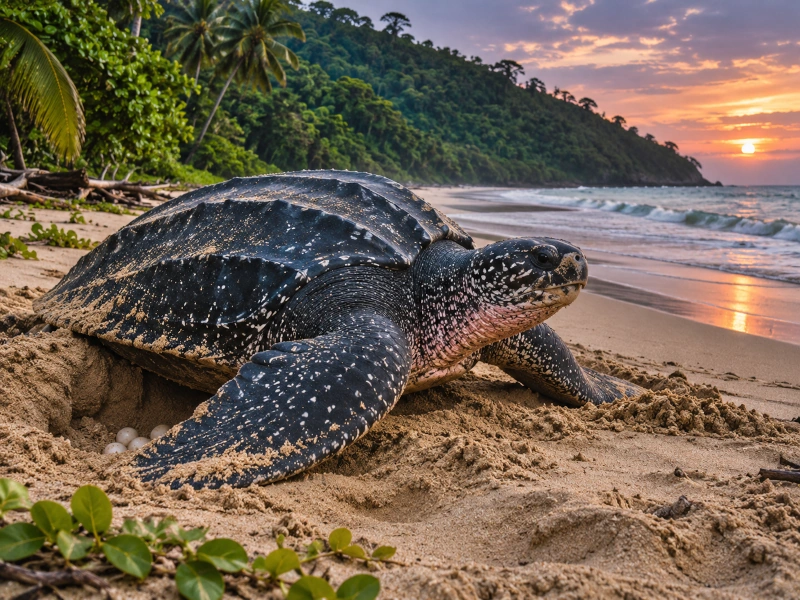
Great Nicobar Island has recorded significant marine turtle nesting activity during the 2025–26 breeding season, reaffirming its ecological importance within the Indian Ocean region. According to nesting records maintained by the Andaman and Nicobar Islands Forest Department, Galathea Beach recorded 889 leatherback turtle nests and 108 Olive Ridley turtle nests between November 2025 and March 2026. The findings highlight the importance of Great Nicobar’s coastal ecosystems in supporting the reproductive cycles of marine turtles and conserving India’s marine biodiversity.
The Forest Department recorded a combined total of 997 nests belonging to the two marine turtle species at the monitored site. The figures represent documented nesting events rather than the number of individual turtles, as female marine turtles may deposit multiple clutches of eggs during a breeding season. The records provide valuable information for researchers and conservation authorities assessing the ecological significance of the island’s nesting habitats.
Great Nicobar’s Significance for Leatherback Turtle Conservation
The leatherback turtle (Dermochelys coriacea) is the world’s largest living marine turtle species and is distinguished by its flexible, leathery shell, prominent longitudinal ridges and extensive migratory capabilities. Unlike other marine turtles possessing rigid external shells, leatherbacks have a specialised body structure adapted to deep-water diving and long-distance oceanic movement. Their diet consists predominantly of gelatinous marine organisms, including jellyfish, making them an important component of marine food webs.
Great Nicobar’s coastal habitats provide suitable environmental conditions for leatherback turtles to come ashore and deposit their eggs. The island’s sandy beaches, tropical coastal vegetation and location within the eastern Indian Ocean contribute to its significance as a marine turtle breeding habitat. The documentation of 889 leatherback nests during a single breeding season reinforces the importance of maintaining the ecological integrity of these coastal ecosystems.
Galathea Bay as an Important Marine Turtle Nesting Habitat
Located along the southern coastline of Great Nicobar Island, Galathea Bay has long been recognised for its marine turtle nesting activity. The surrounding terrestrial and marine ecosystems support diverse wildlife, including several species characteristic of the Andaman and Nicobar archipelago. The Government of Andaman and Nicobar Islands identifies the region as an important nesting habitat for giant leatherback turtles.
The availability of suitable nesting beaches is fundamental to the long-term survival of marine turtle populations. Beach characteristics, sand temperature, moisture levels, coastal vegetation and artificial lighting can influence nesting behaviour and reproductive success. Systematic monitoring of these environmental conditions, alongside nesting records, is therefore essential for developing effective conservation strategies.
India’s Nationwide Marine Turtle Assessment
The latest coverage of Great Nicobar’s nesting records comes alongside the release of a nationwide marine turtle assessment undertaken by the Wildlife Institute of India (WII). The Ministry of Environment, Forest and Climate Change released the assessment on 23 November 2026, highlighting the importance of scientific monitoring in strengthening marine wildlife conservation. The study was conducted under the Ministry’s Development of Wildlife Habitats scheme.
The assessment covered three nesting seasons between 2022 and 2025, examining approximately 1,300 kilometres of India’s coastline across 360 beach stretches. Researchers documented the nesting status of four marine turtle species, providing a scientific foundation for identifying important breeding habitats and developing conservation measures. The nationwide assessment and the Forest Department’s subsequent 2025–26 nesting records for Great Nicobar represent separate but complementary sources of information.
Scientific Monitoring and Long-Term Conservation
The Government of India has established institutional mechanisms to support marine turtle research and conservation across the Andaman and Nicobar Islands. A dedicated research unit established by the Wildlife Institute of India undertakes sea turtle research and monitoring activities within the archipelago. These initiatives form part of broader efforts to improve scientific understanding of marine turtle populations, nesting behaviour and habitat requirements.
Long-term monitoring is particularly important for migratory species such as leatherback turtles, whose life cycles extend across national maritime boundaries. Scientific documentation of nesting activity, hatchling emergence, reproductive success and population movement can help researchers evaluate conservation outcomes over extended periods. Maintaining consistent monitoring protocols also enables conservation authorities to identify emerging threats and develop appropriate interventions.
Protecting Coastal Habitats and Marine Biodiversity
The nesting records from Galathea Beach underline the importance of protecting coastal habitats against disturbances that could affect marine turtle reproduction. Marine pollution, entanglement in fishing equipment, artificial illumination, coastal habitat alteration and climate-related environmental changes are among the challenges confronting marine turtles. Addressing these pressures requires coordination between scientific institutions, forest departments, coastal management authorities and local stakeholders.
India’s marine conservation framework includes the National Marine Turtle Action Plan and measures intended to protect ecologically sensitive coastal habitats. The government has also stipulated environmental safeguards and scientific monitoring requirements in connection with the Great Nicobar Island development project. The effective implementation and independent scientific evaluation of these measures remain important for ensuring that infrastructure development does not compromise the island’s marine biodiversity.
Strengthening India’s Marine Conservation Efforts
The documentation of 889 leatherback turtle nests and 108 Olive Ridley turtle nests during the 2025–26 breeding season provides valuable evidence of Great Nicobar’s continuing importance as a marine turtle nesting habitat. Although a single season’s nesting figures cannot independently establish a long-term population recovery, they contribute to the scientific understanding of reproductive activity within the region. Continued monitoring will be necessary to assess nesting trends, hatchling survival and the effectiveness of conservation interventions.
Great Nicobar’s marine biodiversity represents an important component of India’s natural heritage and its wider ecological responsibilities within the Indian Ocean. Sustained scientific research, effective habitat protection and evidence-based coastal management can contribute towards safeguarding these remarkable migratory species. The latest nesting records reinforce the importance of integrating marine biodiversity conservation into India’s long-term vision for sustainable island development.
References
- Department of Environment and Forests, Andaman and Nicobar Administration — Marine turtle nesting records for Galathea Beach, November 2025–March 2026, disclosed through an RTI response and reported on 21 September 2026.
- Ministry of Environment, Forest and Climate Change, Press Information Bureau — Pan-India Assessment and Monitoring of Marine Turtles, 23 November 2026.
- Wildlife Institute of India — Marine turtle population assessment, habitat research and monitoring programmes.
- Andaman and Nicobar Administration — Official information on Galathea National Park and leatherback turtle nesting habitats.
- Ministry of Environment, Forest and Climate Change — Parliamentary response concerning the Great Nicobar Island Project and marine turtle conservation measures, July 2024.
- Press Information Bureau — Great Nicobar Island Project and environmental safeguards, 1 May 2026.
You may also like
-
Endangered Ganges River Dolphin Sighted in Arunachal Pradesh’s Siang River System
-
Rare Daurian Starling Returns to Kerala’s Punchakkari Wetlands
-
Indian Scientists Identify Seven Potential Humpback Whale Hotspots
-
Pathanamthitta Biodiversity Survey Records Barn Swallow and 130 Bird Species
-
Captive-Bred Indian Vulture Travels 10,767 Km, Makes First Recorded Appearance in Latur
