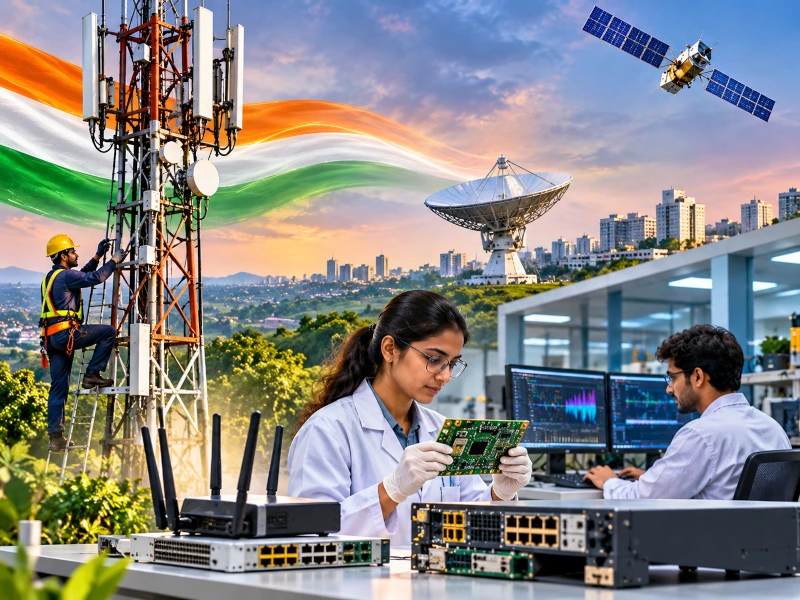
India is strengthening its indigenous telecommunications ecosystem through domestic research, technological entrepreneurship and the commercialisation of locally developed products. Union Minister for Communications Jyotiraditya M. Scindia chaired the Telecom Startups and MSME Conclave 2026 at Bharat Mandapam, New Delhi, on November 24, 2026. Organised by the Department of Telecommunications (DoT), the conclave focused on connecting Indian technology developers with investors, industrial enterprises, academic institutions and policymakers.
From Technology Consumer to Technology Developer
India’s expanding telecommunications market provides domestic enterprises with opportunities to develop, validate and commercialise new communication technologies. Addressing the conclave, Scindia highlighted the increase in internet connections from 25 crore to 110 crore and broadband connections from 6 crore to 104 crore. He described the telecommunications sector as an important example of India’s transformation from a consumer of technology into a technology developer.
The scale of India’s domestic telecommunications market offers a substantial environment for evaluating emerging technologies under diverse operational conditions. Developing solutions for urban, rural, industrial and remote environments can help Indian enterprises build products suited to different connectivity requirements. These capabilities could subsequently support their participation in international markets.
Developing Indigenous Telecommunications Technologies
The conclave addressed five technological domains: radio access and core networks, applications, chipsets, security and technical standards. Together, these represent important components of the telecommunications value chain, extending from semiconductor design and communication infrastructure to software and network management. Indigenous capabilities across these domains can help India reduce technological dependencies and strengthen domestic intellectual property creation.
Radio Access Networks (RAN) connect mobile devices to telecommunications infrastructure, while core networks manage connectivity, authentication and data transmission. Domestic development of these technologies, alongside communication chipsets and network security systems, provides opportunities for Indian enterprises to participate in higher-value segments of the industry. Building expertise across these interconnected fields is also important for developing future-generation telecommunications systems.
Eleven exhibition stalls provided participating startups and MSMEs with opportunities to present their products to potential customers, investors and policymakers. Debjani Ghosh, Distinguished Fellow at NITI Aayog and Chief Architect of the NITI Frontier Tech Hub, delivered the keynote address, emphasising the importance of cooperation between institutions in supporting technology-oriented entrepreneurship.
Indian Innovations Recognised at Emerging Technologies Hackathon 2026
The conclave also recognised the winners of the Emerging Technologies Hackathon 2026, conducted by Telecom Centres of Excellence India (TCoE India). The competition attracted more than 2,870 registrations and 620 applications across nine technological domains. Participants included industrial enterprises, startups, academic institutions and students developing solutions for emerging technological requirements.
Entra Innovations LLP received the first prize for VAAYU, a domestically designed system-on-chip for tyre-pressure sensing. The innovation demonstrates the relevance of indigenous semiconductor design to connected mobility and automotive electronics. Integrating sensing and communication capabilities into specialised chipsets represents an important area of technological development as vehicles increasingly incorporate intelligent electronic systems.
Dawniens International Private Limited received the second prize for Cablesmith, a robotic optical patch panel designed to enable remote management of fibre connections. The technology addresses an important operational requirement in fibre-optic infrastructure, where managing physical connections can involve manual intervention. Automation in this area could help improve network management and operational efficiency.
The joint third prize was awarded to IIT Bombay’s Team DRISTI for KAVACH, a security engine for private 5G networks, and the Military College of Telecommunication Engineering’s Team RUDRA for VajraLink, a drone communication solution designed to resist jamming. These innovations illustrate the growing relevance of domestic telecommunications research to industrial cybersecurity, secure connectivity and defence applications.
Government Support for Indigenous Telecom Research
The Department of Telecommunications is implementing several initiatives to support domestic technology development, including the Telecom Technology Development Fund (TTDF), the Technology Development and Investment Promotion (TDIP) Scheme and the establishment of 100 5G Use Case Labs. These initiatives address different stages of technological development, from research and experimentation to product evaluation and deployment. Such institutional support is particularly relevant to smaller enterprises developing technologies that require specialised testing infrastructure.
The government’s Digital Communication Innovation Square initiative has also supported domestic enterprises developing communication products and specialised technological solutions. Its beneficiaries include companies working on wireless communication systems, cloud-native 5G infrastructure, industrial artificial intelligence, digital twins and indigenous radio-frequency technologies. Supporting the transition from research prototypes to commercially viable products remains an important component of building a sustainable telecommunications industry.
Private Networks and Regulatory Sandboxes
Policy frameworks under the Telecommunications Act, 2023, provide mechanisms for enterprise-specific connectivity and controlled experimentation with emerging technologies. Captive Non-Public Networks enable organisations to develop dedicated communication infrastructure suited to their operational requirements, while regulatory sandboxes provide opportunities to evaluate innovative solutions under prescribed conditions. These mechanisms can help technology developers assess performance and identify implementation challenges before wider deployment.
Private telecommunications networks have potential applications in manufacturing facilities, logistics centres, mines, ports, research campuses and other industrial environments. Dedicated connectivity can support industrial automation, connected machinery, remote monitoring and specialised communication requirements. Developing indigenous solutions for such applications could create commercial opportunities extending beyond conventional public mobile networks.
Opportunities for India’s Defence and Strategic Sectors
The recognition of innovations addressing private network security and interference-resistant drone communications highlights the intersection between telecommunications research and strategic technological requirements. Secure and reliable communications are important to unmanned systems, defence infrastructure, emergency response and critical industrial operations. Domestic expertise in these areas can contribute to strengthening India’s technological resilience.
Collaboration between academic institutions, defence research establishments, startups and industrial enterprises can help translate specialised communication research into practical applications. However, successful demonstrations and innovation awards represent stages in technological development rather than confirmation of operational deployment. Further testing, qualification and commercial adoption remain important to the eventual utilisation of such technologies.
Building a Globally Competitive Telecommunications Industry
India’s telecommunications transformation increasingly encompasses semiconductor development, network architecture, optical communications, industrial connectivity and cybersecurity. Developing indigenous intellectual property across these areas can help Indian enterprises move beyond equipment assembly towards original product design and technology ownership. Participation in international standardisation processes can further support compatibility with global telecommunications systems.
The continued development of India’s indigenous telecommunications ecosystem will depend on sustained research investment, access to testing infrastructure, industrial collaboration and market opportunities for domestic innovators. By connecting its extensive domestic market with scientific expertise and entrepreneurial capabilities, India has an opportunity to establish itself as a significant contributor to next-generation communications technologies. The Telecom Startups and MSME Conclave 2026 represents another step towards building a technologically capable, commercially sustainable and globally competitive Indian telecommunications industry.
References
- Ministry of Communications, Press Information Bureau — Telecom Startups and MSME Conclave 2026, November 24, 2026, 5:12 PM. PIB Release ID: 2340846.
- Ministry of Communications, Press Information Bureau — Announcement of Telecom Startups and MSME Conclave 2026, November 23, 2026. PIB Release ID: 2340401.
- Department of Telecommunications — Digital Communication Innovation Square (DCIS), official programme information.
- Department of Telecommunications — Spectrum Regulatory Sandbox, official regulatory framework.
You may also like
-
Farrukhabad Exports First Consignment of Frozen Vegetables to Qatar
-
India’s Unincorporated Services Sector Records 33% Employment Growth
-
India Targets USD 40–45 Billion Space Economy Within a Decade
-
Edayur Chilli: Kerala’s Distinctive Mild Chilli and Its Geographical Indication Heritage
-
ISRO Pushes Indigenous Satellite Manufacturing and Semiconductor Self-Reliance
