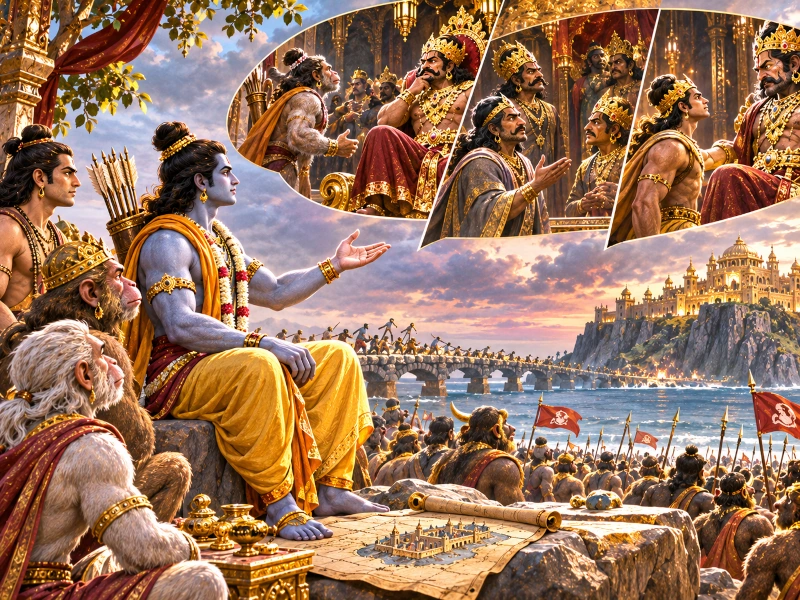
Ramayana Diplomacy Series | Vālmīki Rāmāyaṇa | Yuddha Kāṇḍa, Sargas 6–20, 35–42 | Related Background: Sundara Kāṇḍa, Sargas 50–52
Introduction: Diplomacy Before the Final Confrontation
The Vālmīki Rāmāyaṇa contains profound lessons concerning diplomacy, political leadership, military strategy and the responsibilities of rulers when confronted with serious disputes. Among its most significant examples is Rāma’s approach towards Rāvaṇa before the commencement of the decisive battle for Laṅkā. Although Rāma possesses formidable military capabilities and commands a powerful alliance of Vānara forces, the epic presents a sequence of warnings, diplomatic communications and opportunities through which Rāvaṇa could have prevented the destruction of his kingdom by returning Sītā.
The diplomatic dimension of this confrontation extends beyond a simple choice between peace and war. Rāma’s objective is the recovery of Sītā, who has been abducted and held captive by Rāvaṇa. The conflict therefore arises from a specific act of aggression for which a clear remedy exists. By returning Sītā, Rāvaṇa could remove the immediate cause of hostilities and avoid exposing Laṅkā to a devastating military confrontation.
The Yuddha Kāṇḍa records the progression from strategic consultation and military preparation to a final formal message delivered by Aṅgada, the son of Vāli. Before that mission, Hanumān had already conveyed warnings to Rāvaṇa during his visit to Laṅkā, while Vibhīṣaṇa and other advisers repeatedly urged the king to reconsider his actions. These communications differed in authority and purpose, but together they established that Rāvaṇa had opportunities to understand the consequences of continuing to hold Sītā.
The central diplomatic principle emerging from this episode is that military power should be supported by clearly defined political objectives, effective communication and an opportunity for the adversary to remove the cause of conflict before force becomes the decisive instrument.
The narrative also demonstrates that diplomacy does not require a ruler to abandon legitimate demands. Rāma does not compromise upon Sītā’s return. Instead, he communicates the consequences of continued resistance while maintaining the military capability necessary to enforce his position.
The Strategic Background: A Conflict Created by Rāvaṇa’s Decision
The origins of the confrontation lie in Rāvaṇa’s abduction of Sītā during Rāma’s exile in the Daṇḍaka forest. The abduction transforms a personal act of aggression into a political and military crisis involving two powerful centres of authority.
Rāvaṇa rules Laṅkā, a wealthy and extensively fortified kingdom protected by the surrounding ocean and defended by formidable Rākṣasa warriors. His position provides considerable military advantages, particularly against adversaries attempting to reach the island from the mainland. These advantages contribute to his confidence that Rāma will be unable to challenge his authority effectively.
Rāma, however, gradually develops the political and military resources necessary to confront Laṅkā. His alliance with Sugrīva provides access to the Vānara forces, while Hanumān’s reconnaissance establishes Sītā’s location and reveals important information about the kingdom’s defences.
The resulting situation presents Rāvaṇa with a clear strategic choice. He can return Sītā and remove the immediate cause of the dispute, or he can retain her and confront a growing military coalition determined to secure her release.
The first principle of strategic diplomacy is that a ruler must distinguish between the political objective responsible for a dispute and the military consequences of refusing to resolve it.
Rāvaṇa possesses sufficient authority to reverse the original decision, but his personal determination prevents him from accepting the diplomatic alternative. His refusal gradually transforms an avoidable dispute into a conflict threatening the survival of his kingdom.
Hanumān’s Mission: The First Direct Warning to Rāvaṇa
The diplomatic process begins before the principal events of the Yuddha Kāṇḍa. During his mission to Laṅkā, Hanumān discovers Sītā in the Aśoka grove and subsequently appears before Rāvaṇa.
In Sundara Kāṇḍa, Sarga 51, Hanumān explains Rāma’s circumstances, his alliance with Sugrīva and the military capabilities available to the coalition. He also communicates Sugrīva’s counsel and warns Rāvaṇa that retaining Sītā will bring grave consequences upon Laṅkā.
Hanumān’s message combines several important diplomatic functions. He establishes the identity and capabilities of the opposing leadership, explains the circumstances that have produced the dispute and identifies the action necessary to prevent further confrontation.
His warning is not an attempt to secure territory, wealth or political concessions from Laṅkā. The essential demand is the restoration of Sītā.
Hanumān also reminds Rāvaṇa that his previous achievements, spiritual practices and extraordinary powers do not protect him from the consequences of an unjust action. The message therefore combines moral reasoning with a realistic warning about military escalation.
The strategic significance of Hanumān’s communication lies in its combination of a specific demand, an assessment of the opposing alliance’s capabilities and a warning concerning the costs of continued resistance.
The mission also demonstrates that diplomatic communication can occur alongside intelligence gathering. Hanumān has already observed important aspects of Laṅkā and identified Sītā’s location before addressing Rāvaṇa.
However, the epic distinguishes Hanumān’s role from the later formal mission of Aṅgada. Hanumān’s audience includes counsel conveyed from Sugrīva and warnings concerning Rāma’s response, while Aṅgada subsequently delivers Rāma’s explicit ultimatum immediately before the battle.
Effective diplomatic communication depends upon clearly conveying the adversary’s choices, but its success ultimately requires the receiving leadership to evaluate the message rather than reject it because its conclusions are unwelcome.
Rāvaṇa responds with anger and orders Hanumān’s execution, demonstrating his unwillingness to accept criticism or acknowledge the danger created by his actions.
The Protection of Envoys: Diplomacy Requires Recognised Rules
The reaction to Hanumān’s message creates another important diplomatic episode. In Sundara Kāṇḍa, Sarga 52, Rāvaṇa orders Hanumān to be killed, but Vibhīṣaṇa intervenes and argues that executing an envoy is contrary to established principles governing the treatment of messengers.
Vibhīṣaṇa explains that even when an envoy delivers an offensive or unwelcome message, the ruler should not respond by killing the messenger. His argument recognises the distinction between the individual communicating a position and the political authority responsible for that position.
This distinction is fundamental to the functioning of diplomacy. Envoys must be able to communicate demands, warnings and proposals without becoming immediate targets of retaliation merely because the recipient dislikes their message.
The diplomatic significance of Vibhīṣaṇa’s intervention is the recognition that communication between adversaries requires protection for those entrusted with carrying messages, even when relations between their rulers have become hostile.
Rāvaṇa abandons the order to execute Hanumān but imposes another punishment by ordering his tail to be set on fire. The subsequent destruction caused by Hanumān demonstrates how the mishandling of an envoy can deepen an existing confrontation rather than contribute to its resolution.
The episode also anticipates the later mission of Aṅgada, who faces an attempt at seizure after delivering Rāma’s ultimatum.
The treatment of diplomatic representatives is therefore not merely a matter of courtesy; it is a practical requirement for preserving channels of communication during serious international disputes.
Vibhīṣaṇa’s Counsel: The Diplomatic Alternative Within Laṅkā
The Yuddha Kāṇḍa provides further evidence that Rāvaṇa had opportunities to avoid war through the advice of his own ministers and relatives.
In Sargas 6–16, Rāvaṇa consults his military commanders and political advisers concerning the approaching threat. Several commanders respond with declarations of confidence, emphasising their strength and previous military achievements. Vibhīṣaṇa, however, offers a fundamentally different assessment.
He argues that Rāvaṇa should return Sītā to Rāma and prevent an unnecessary confrontation. His counsel is based upon an understanding of Rāma’s capabilities, the circumstances surrounding the dispute and the potential consequences for Laṅkā.
Vibhīṣaṇa recognises that the proposed war is not required to defend the kingdom against an unavoidable act of aggression. The conflict arises because Rāvaṇa refuses to correct the action that originally provoked Rāma.
The fundamental diplomatic lesson is that the most effective means of preventing war may be to remove the grievance responsible for the confrontation rather than prepare military forces to defend an unsustainable political position.
Vibhīṣaṇa’s recommendation is particularly important because it comes from within Laṅkā’s ruling establishment. He is not an external adversary attempting to weaken the kingdom. He is a member of Rāvaṇa’s own family who recognises that the ruler’s decision threatens the welfare of the state.
Nevertheless, Rāvaṇa rejects the advice and ultimately drives Vibhīṣaṇa from Laṅkā.
The rejection demonstrates how political pride can prevent diplomatic solutions even when their practical advantages are recognised by experienced advisers.
A ruler who interprets recommendations for restraint as evidence of weakness or disloyalty risks eliminating the very alternatives that could preserve the security and prosperity of his kingdom.
Rāma Accepts Vibhīṣaṇa: Diplomacy Extends Beyond the Enemy Ruler
After leaving Laṅkā, Vibhīṣaṇa approaches Rāma and seeks refuge. The circumstances create an important security dilemma because Vibhīṣaṇa is the brother of the opposing ruler and possesses knowledge of Laṅkā’s military affairs.
In Yuddha Kāṇḍa, Sargas 17–18, Rāma consults his allies concerning whether Vibhīṣaṇa should be accepted. Different members of the Vānara leadership express concerns about possible deception, while Hanumān offers a more favourable assessment of Vibhīṣaṇa’s intentions.
Rāma ultimately decides to grant refuge to Vibhīṣaṇa.
The decision reveals that Rāma’s approach to the conflict is not based upon indiscriminate hostility towards everyone associated with Laṅkā. He distinguishes between Rāvaṇa’s actions and the conduct of an individual who has rejected those actions and sought protection.
The strategic significance of Rāma’s decision is that political and military leadership must distinguish between an adversary’s ruling authority and individuals within that state who may support a different course of action.
Vibhīṣaṇa’s acceptance also produces important military consequences. His knowledge of Laṅkā and its leading commanders subsequently assists Rāma’s forces during the campaign.
However, the central importance of the episode lies in Rāma’s willingness to consider the circumstances and intentions of someone who has crossed from the opposing side.
Effective diplomacy can create opportunities for political realignment by recognising that the interests and judgments of individuals within an opposing kingdom are not necessarily identical to those of its ruler.
The contrast with Rāvaṇa is striking. Rāvaṇa drives away an adviser who warns him against a dangerous decision, while Rāma accepts that same individual after examining the circumstances of his departure.
Military Preparation and Diplomatic Restraint
Rāma’s approach also demonstrates that preparation for military action does not necessarily eliminate the possibility of diplomacy.
Following the formation of his alliance with Sugrīva, Rāma advances towards Laṅkā with a substantial army. The construction of the bridge across the ocean removes the geographical barrier upon which Rāvaṇa’s security had partly depended.
Once the army reaches Laṅkā, Rāma and his commanders examine the city’s defensive arrangements and prepare for the possibility of a major battle.
These preparations substantially change the strategic environment. Rāvaṇa can no longer assume that the ocean will prevent an opposing army from reaching his capital. The military threat has become immediate and visible.
Nevertheless, Rāma still sends Aṅgada to communicate his demands before the full-scale assault begins.
The military and diplomatic significance of this decision is that credible force can support negotiation by demonstrating the consequences of refusal while leaving the adversary an opportunity to avoid those consequences.
Rāma does not suspend military preparations while awaiting an uncertain diplomatic outcome. His army remains capable of proceeding with the campaign if Rāvaṇa refuses to comply.
At the same time, the existence of that army does not prevent him from sending a final message.
The episode illustrates a form of statecraft in which diplomacy and military preparedness serve a clearly defined objective rather than operate as mutually exclusive alternatives.
Negotiation is most effective when the political demand is clear, the consequences of refusal are credible and the receiving side retains a genuine opportunity to choose compliance before military action follows.
Aṅgada’s Mission: Rāma’s Final Message Before War
The most decisive diplomatic communication occurs in Yuddha Kāṇḍa, Sarga 41, when Rāma sends Aṅgada, the son of Vāli, to the court of Rāvaṇa. By this stage, the Vānara army has reached Laṅkā, its commanders have examined the city’s defences, and preparations for the assault are substantially complete.
Rāma nevertheless chooses to communicate directly with Rāvaṇa through an authorised representative before the general battle begins. Aṅgada is instructed to enter Laṅkā, approach the king and deliver a message explaining the consequences of continued resistance.
Unlike Hanumān’s earlier warning, Aṅgada’s mission represents an explicit ultimatum from Rāma himself. The message is severe. Rāma condemns Rāvaṇa’s conduct, demands Sītā’s restoration and warns that refusal will result in military confrontation and the destruction of Rāvaṇa’s power.
The message also identifies Vibhīṣaṇa as the person who will assume authority over Laṅkā after Rāvaṇa’s defeat. This adds a political dimension to the military warning by demonstrating that the collapse of Rāvaṇa’s rule would not necessarily mean the disappearance of Laṅkā as a kingdom.
The strategic importance of Aṅgada’s mission lies in its combination of a final opportunity for compliance, a credible threat of military action and a clearly communicated political consequence if Rāvaṇa refuses to resolve the dispute.
The message is not an open-ended invitation to negotiate every aspect of the conflict. Rāma’s essential demand remains unchanged: Sītā must be returned. The diplomatic opportunity concerns Rāvaṇa’s willingness to comply with that demand before the conflict proceeds to decisive military action.
An effective ultimatum must clearly distinguish between the action required to avoid confrontation and the consequences that will follow if the demand is rejected.
The Vālmīki Rāmāyaṇa specifically records that Aṅgada communicates Rāma’s message without adding to or diminishing its substance. This detail is significant because diplomatic representatives must accurately convey the intentions of the authority they represent.
The mission thus illustrates the importance of message integrity, authorised representation and clarity in diplomatic communication.
Rāvaṇa’s Response: The Rejection of the Final Opportunity
Rāvaṇa’s response to Aṅgada demonstrates the continuing failure of diplomacy within Laṅkā’s political leadership. Rather than examining the demand or considering the consequences of refusal, he becomes enraged and orders his attendants to seize the envoy.
The decision represents another example of Rāvaṇa’s inability to distinguish between the communication of an opposing position and an attack upon his personal authority.
Aṅgada allows the Rākṣasa attendants to seize him before displaying his extraordinary strength. He escapes their grasp, leaps upon the palace and damages its structure before returning to Rāma’s forces.
The encounter ends without a diplomatic settlement.
The central diplomatic failure is that Rāvaṇa rejects the opportunity to reconsider his position and attempts to use coercion against the messenger rather than address the demand conveyed through him.
The outcome also demonstrates the limits of military intimidation in diplomacy. Rāvaṇa possesses substantial forces and an imposing royal court, but the attempted seizure of Aṅgada fails to weaken Rāma’s determination or alter the military situation.
Instead, the episode further confirms the inability of Laṅkā’s leadership to respond rationally to an increasingly serious strategic threat.
Diplomatic communication fails when political leaders treat every demand for reconsideration as an intolerable challenge to their prestige, even when accepting the demand could avert a far greater national disaster.
With Aṅgada’s mission unsuccessful, the opportunity for a settlement before the general assault is effectively lost. Sarga 42 describes the ensuing siege of Laṅkā and the commencement of major fighting.
Diplomacy and Deterrence: Rāma’s Combination of Negotiation and Military Strength
Rāma’s approach provides an important illustration of the relationship between diplomatic negotiation and military deterrence.
Throughout the preparations for the campaign, Rāma maintains a consistent objective. He seeks Sītā’s return and holds Rāvaṇa responsible for the abduction. His position does not change merely because the opposing kingdom possesses extensive fortifications or powerful military commanders.
At the same time, Rāma does not rely upon verbal warnings alone. His alliance with Sugrīva, the mobilisation of the Vānara army, the crossing of the ocean and the deployment of forces around Laṅkā establish the practical military capability necessary to enforce his demands.
The combination is significant because diplomatic warnings are more likely to influence an adversary when they are supported by credible capabilities.
The strategic principle demonstrated by Rāma’s approach is that diplomacy and military power are complementary instruments of statecraft when both are directed towards a legitimate and clearly defined objective.
Rāma’s military preparations strengthen the credibility of his position, while his decision to send Aṅgada preserves an opportunity for Rāvaṇa to comply before the full-scale assault.
This does not make the ultimatum a negotiation between equal claims. The epic presents Sītā’s abduction as the wrongdoing that must be corrected. Rāma’s demand is therefore directed towards reversing that action rather than obtaining unrelated political concessions.
The distinction is central to understanding the diplomatic character of the episode.
The purpose of credible military pressure should be to secure a defined political outcome, not to allow the possession of military strength to become an objective in itself.
Rāma’s conduct also demonstrates that the existence of superior military capabilities does not eliminate the value of communication. Even after his forces reach Laṅkā, he considers it appropriate to make his position known through an authorised representative.
The Contrast Between Rāma and Rāvaṇa: Two Approaches to Political Decision-Making
The diplomatic developments preceding the war reveal a striking contrast between the leadership methods of Rāma and Rāvaṇa.
Rāma consults his allies, evaluates intelligence and accepts individuals who offer genuine assistance. His decision to grant refuge to Vibhīṣaṇa follows a discussion in which different advisers express their assessments of the risks and benefits.
Rāvaṇa also possesses ministers, commanders and formal mechanisms of consultation. Yet he repeatedly dismisses advice that challenges his personal wishes.
Vibhīṣaṇa recommends returning Sītā, while Malyavān subsequently advises Rāvaṇa to seek peace as the danger to Laṅkā becomes increasingly serious. These recommendations offer opportunities for reconsidering the political decision responsible for the conflict.
Rāvaṇa rejects them.
The contrast reveals that the quality of political leadership depends not merely upon the existence of advisers or institutions but upon the ruler’s willingness to make effective use of their judgment.
The fundamental principle of political leadership is that strength must be accompanied by the capacity to recognise strategic realities, consider informed advice and correct decisions that threaten the long-term interests of the state.
Rāma’s consultations contribute to the development of a coordinated military and political strategy. Rāvaṇa’s rejection of independent counsel progressively narrows his available choices.
By the time Aṅgada delivers the final message, Rāvaṇa has already dismissed several opportunities to avoid confrontation.
The failure of diplomacy in Laṅkā is therefore not primarily a failure of communication. It is a failure of political judgment by a ruler who repeatedly refuses to act upon warnings that accurately identify the dangers facing his kingdom.
Modern Diplomatic Parallel: The Gulf Crisis and United Nations Security Council Resolution 678
A useful modern comparison can be found in the international response to Iraq’s invasion of Kuwait in August 1990.
Following the invasion, the United Nations Security Council adopted Resolution 660 on 2 August 1990, condemning the invasion and demanding Iraq’s immediate and unconditional withdrawal from Kuwait.
As Iraq continued its occupation, the Security Council adopted additional measures intended to secure compliance and restore Kuwait’s sovereignty.
On 29 November 1990, the Security Council adopted Resolution 678, providing Iraq with a final opportunity to implement the relevant resolutions. The resolution authorised member states cooperating with Kuwait to use all necessary means if Iraq failed to comply by 15 January 1991.
Iraq did not meet the deadline. Coalition military operations began on 16 January 1991, followed by a ground offensive in February.
The historical circumstances differ substantially from the Rāmāyaṇa. The Gulf Crisis involved sovereign states, the United Nations Charter, international law and a multinational military coalition, while Rāma’s confrontation with Rāvaṇa belongs to the political and moral framework of the ancient epic.
Nevertheless, the comparison illustrates a common diplomatic structure: a specific grievance, a clearly communicated demand for corrective action, an opportunity for compliance and an explicit warning that continued refusal would result in the use of force.
The strategic parallel lies in the principle that coercive diplomacy can establish a clear choice between compliance with a defined demand and the consequences of continued resistance.
Both episodes demonstrate that issuing an ultimatum does not guarantee a peaceful settlement. Its effectiveness depends upon the recipient’s willingness to evaluate the consequences and reconsider the policy responsible for the confrontation.
The ultimate value of an ultimatum lies not merely in demonstrating the sender’s determination but in preserving a final opportunity to achieve the political objective without resorting to the threatened military action.
Strategic and Diplomatic Lessons for Modern Statecraft
Rāma’s approach towards Rāvaṇa provides several important lessons concerning the management of international disputes, the conduct of diplomacy and the responsible employment of military power.
The first concerns the importance of a clearly defined objective. Rāma’s central demand is the return of Sītā. His diplomatic communications and military preparations are directed towards securing that outcome. Effective statecraft requires political leaders to define the objective they seek before determining which diplomatic or military instruments should be employed to achieve it.
The second concerns the role of communication before military confrontation. Hanumān’s warning, Vibhīṣaṇa’s counsel and Aṅgada’s final mission provide successive opportunities for Rāvaṇa to understand the consequences of his decisions. A government contemplating the use of force should ensure that its demands and the consequences of refusal have been communicated clearly whenever circumstances permit.
The third concerns diplomatic credibility. Rāma’s military preparations demonstrate that the warnings delivered by his representatives are supported by substantial capabilities. Diplomatic demands become more credible when political determination is matched by the practical capacity to carry out the stated consequences of non-compliance.
The fourth concerns the treatment of envoys. Both Hanumān and Aṅgada encounter hostility while delivering messages to Rāvaṇa. Their experiences demonstrate the dangers of allowing anger towards an adversary to determine the treatment of diplomatic representatives. The protection of channels of communication is essential because even hostile states may require the ability to exchange warnings, proposals and conditions for ending a dispute.
The fifth concerns the importance of political alternatives. Rāma’s acceptance of Vibhīṣaṇa demonstrates his willingness to distinguish between Rāvaṇa’s rule and the future of Laṅkā. A successful strategy must consider not only how an opposing ruler may be defeated but also how political stability can be restored after the immediate conflict has ended.
The sixth concerns the relationship between diplomacy and intelligence. Hanumān’s reconnaissance provides Rāma with knowledge of Sītā’s location and Laṅkā’s military circumstances. Vibhīṣaṇa subsequently contributes further information about the kingdom. Diplomatic and military decisions become more effective when they are informed by reliable intelligence concerning the adversary’s capabilities, intentions and internal political circumstances.
The seventh concerns the danger of allowing personal ambition to determine national policy. Rāvaṇa repeatedly refuses to return Sītā despite warnings that his decision could bring destruction upon Laṅkā. The responsibilities of political leadership require rulers to distinguish personal desires from the security and welfare of the state, particularly when continued resistance threatens the lives and resources of the population.
Finally, the episode demonstrates the importance of recognising when diplomacy has reached its limits. Rāma communicates his demands, maintains military preparedness and sends Aṅgada with a final message. When Rāvaṇa rejects the ultimatum, the conflict proceeds to battle. The responsible employment of force requires clarity of purpose, consideration of available alternatives and an understanding that military action must remain connected to the political objective it is intended to achieve.
Conclusion: Negotiation as an Instrument of Responsible Leadership
Rāma’s approach towards Rāvaṇa before the great war in Laṅkā represents one of the significant examinations of diplomacy and military statecraft in the Vālmīki Rāmāyaṇa.
The conflict arises from Rāvaṇa’s abduction of Sītā, an action that creates a clear grievance and an equally clear opportunity for resolution. By returning Sītā, Rāvaṇa could remove the immediate cause of the confrontation and prevent the destruction that eventually overtakes his kingdom.
The narrative presents several stages of communication before the decisive battle. Hanumān warns Rāvaṇa of the consequences of retaining Sītā. Vibhīṣaṇa repeatedly recommends returning her and avoiding war. Malyavān subsequently advises peace as the military danger intensifies. Finally, Rāma sends Aṅgada to communicate an explicit ultimatum after his army has reached Laṅkā.
These efforts do not succeed because Rāvaṇa refuses to reconsider the decision responsible for the crisis.
The resulting war demonstrates that diplomatic opportunities cannot prevent conflict when the receiving leadership consistently rejects reasonable corrective action.
The central lesson of Rāma’s approach is that the possession of military strength does not eliminate the responsibility to communicate demands, consider peaceful alternatives and provide an adversary with an opportunity to prevent unnecessary destruction.
Rāma’s conduct also illustrates that diplomacy need not involve abandoning a principled position. His demand remains consistent throughout the confrontation, while his military preparations ensure that continued refusal carries credible consequences.
The contrast with Rāvaṇa demonstrates the importance of political judgment. One leader combines consultation, alliance-building, intelligence and military preparedness with a final diplomatic message. The other possesses formidable power but repeatedly rejects opportunities to resolve the dispute through a decision within his own authority.
The enduring principle of statecraft is that wise leadership requires the ability to combine firmness of purpose with diplomatic restraint, ensuring that force is employed in pursuit of a clearly defined objective rather than as an expression of anger, prestige or personal ambition.
The Rāmāyaṇa therefore presents negotiation not as a sign of weakness but as an essential instrument of responsible political leadership.
The greatest achievement of diplomacy is not merely the communication of demands but the creation of conditions in which a just political objective can be secured without the destruction that accompanies war.
Through Rāma’s final message to Rāvaṇa, the epic preserves a lesson that remains relevant to modern international relations: military power provides the capacity to act, but strategic wisdom determines when to negotiate, when to exercise restraint and when the use of force becomes necessary to secure a legitimate objective.
Scriptural References: Vālmīki Rāmāyaṇa, Sundara Kāṇḍa, Sargas 50–52, concerning Hanumān’s audience with Rāvaṇa, his warning and Vibhīṣaṇa’s intervention regarding the treatment of envoys; Yuddha Kāṇḍa, Sargas 6–16, concerning Rāvaṇa’s consultations and Vibhīṣaṇa’s advice; Sargas 17–20, concerning Vibhīṣaṇa’s acceptance by Rāma and the treatment of Rāvaṇa’s envoy Śuka; Sargas 35–36, concerning Malyavān’s advice for peace; and Sargas 40–42, particularly Sarga 41, concerning Aṅgada’s mission and Rāma’s final ultimatum before the general battle.
Source verification: The central diplomatic sequence is supported by the Vālmīki Rāmāyaṇa, particularly Yuddha Kāṇḍa, Sarga 41, which explicitly records Rāma’s demand for Sītā’s return and the consequences of refusal. The modern comparison is supported by United Nations Security Council Resolutions 660 and 678 and the United Nations’ historical account of the Iraq–Kuwait conflict. Sanskrit Documents
You may also like
-
The Council of Ministers: How Kauṭilya Evaluated Advice, Secrecy and Decision-Making
-
The Sacred Groves of India: Traditional Protection and Modern Biodiversity Conservation
-
Indra Loses Svarga to Bali: Strategic Withdrawal, Political Defeat and the Preservation of Military Power
-
India and France Strengthen Counter-Terrorism Cooperation
-
The Nair Military System: Organisation, Training and Changing Warfare Traditions in Kerala
