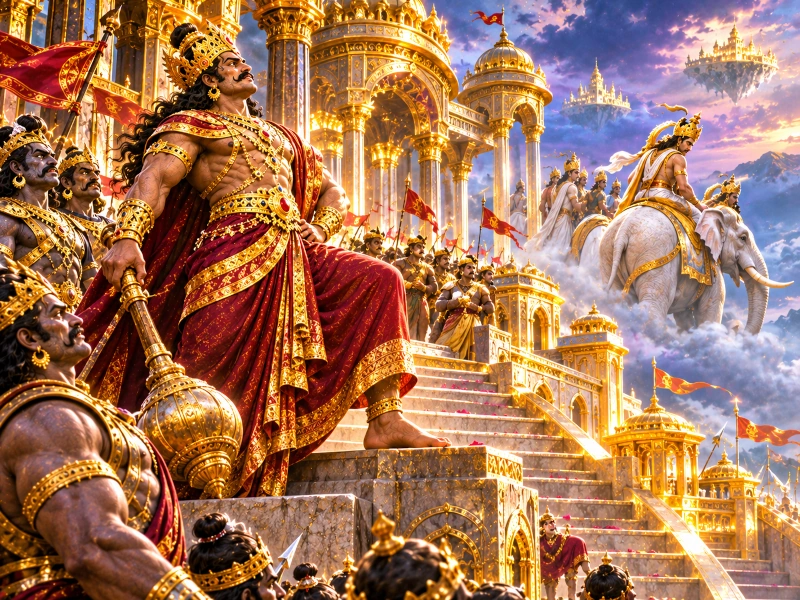
Ancient Warfare Strategies from the Purāṇas | Śrīmad Bhāgavata Purāṇa | Skandha 8, Chapter 15
Introduction: When the Gods Abandoned Their Kingdom
The Śrīmad Bhāgavata Purāṇa contains several remarkable accounts of military conflict between the Devas and Asuras, illustrating the importance of strategic judgment, political authority, military preparedness and the changing balance of power between rival kingdoms. Among these narratives, the loss of Svarga by Indra to the Asura ruler Mahābali presents an especially significant example of a military confrontation in which the outcome was determined not by a decisive battle but by the recognition of overwhelming strategic superiority.
The episode, described in Skandha 8, Chapter 15, follows Bali’s restoration after an earlier defeat by Indra. Supported by Śukrācārya and the descendants of Bhṛgu, Bali rebuilds his strength and undertakes a campaign against the celestial kingdom. His renewed military power is so formidable that Indra, despite his previous victory over Bali, recognises that the Devas may no longer possess the capability to resist him successfully.
Rather than immediately confronting the advancing Asura army, Indra consults Bṛhaspati, the spiritual preceptor of the Devas. Bṛhaspati advises him to abandon Svarga temporarily and preserve his forces until circumstances become more favourable. Indra accepts this recommendation, and Bali subsequently occupies the celestial capital.
The central military significance of this episode lies in the distinction between territorial defeat and the destruction of military power. Indra loses control of his kingdom, but by withdrawing rather than fighting an unwinnable battle, he preserves the possibility of eventual recovery.
The narrative also demonstrates that an attacking commander can achieve a major political objective through the concentration of superior strength without necessarily destroying the defending army. Bali’s conquest therefore illustrates the effectiveness of overwhelming military pressure, while Indra’s decision reveals the strategic value of restraint.
The Strategic Background: Bali’s Recovery After Defeat
The circumstances leading to Bali’s conquest of Svarga originate in the earlier conflict between the Devas and Asuras following the distribution of Amṛta during the Samudra Manthana.
In the great battle described in Chapters 10 and 11 of the eighth Skandha, Bali commanded the Asura forces against Indra’s celestial army. Despite possessing extraordinary military capabilities and employing powerful weapons and supernatural illusions, Bali ultimately fell when Indra struck him with the Vajra.
The defeat temporarily removed Bali as a major military threat.
However, the Bhāgavata Purāṇa subsequently describes his restoration through the intervention of Śukrācārya and the descendants of Bhṛgu. Having regained his life and strength, Bali placed himself under their guidance and received their support in preparing another campaign.
The Bhṛgu priests conducted the Viśvajit sacrifice, through which Bali obtained extraordinary military equipment, including a magnificent chariot, powerful weapons, inexhaustible quivers and celestial armour.
These developments transformed the military balance between the Devas and Asuras.
The first strategic lesson is that the defeat of an enemy commander does not necessarily eliminate the long-term threat if that commander retains access to the institutions, resources and leadership support required to rebuild military strength.
Indra had previously defeated Bali in direct combat, but the circumstances governing their next confrontation were fundamentally different.
Bali’s restoration demonstrated that military power is not permanently determined by the outcome of a single battle. A defeated force can recover, reorganise and return with capabilities that exceed those it previously possessed.
Bali’s Advance: Concentrating Military Strength Against the Celestial Capital
Having restored his military capabilities, Bali assembled a powerful army and advanced directly towards Svarga, the kingdom ruled by Indra.
The Bhāgavata Purāṇa describes Bali entering his magnificent chariot, accompanied by formidable Daitya commanders and an immense military force. The advancing army created an overwhelming impression of strength as it approached the celestial capital.
Bali’s objective was not merely to defeat individual Deva warriors. His campaign was directed towards the political centre of their authority.
Svarga represented the seat of Indra’s sovereignty, the centre of celestial administration and the symbolic foundation of Deva supremacy.
By concentrating his forces against this objective, Bali threatened the political structure supporting Indra’s rule.
The military principle demonstrated by Bali’s advance is that an offensive becomes strategically decisive when it threatens a centre of political authority whose loss can transform the balance of power between opposing states.
The Asura ruler understood that the occupation of Indra’s capital would constitute a much greater achievement than an isolated battlefield victory.
His forces surrounded the celestial city, and the sounding of his conch created fear among its inhabitants.
The episode demonstrates how the concentration of military power can influence the defender’s calculations before direct combat begins.
A sufficiently credible threat against a strategically important objective can compel an adversary to reconsider resistance even before the attacking force has inflicted major battlefield losses.
Bali’s army thus created both a military threat and a political crisis for Indra.
Indra Recognises the Changed Balance of Power
Indra’s response to the approaching Asura army provides one of the most important elements of the narrative.
Rather than assuming that his earlier victory over Bali guaranteed another success, Indra recognises that the restored Asura commander possesses extraordinary strength.
In Chapter 15, Verses 24–27, Indra approaches Bṛhaspati and expresses concern about Bali’s renewed power. He asks how his former adversary has acquired such formidable capabilities and acknowledges the possibility that the Devas may be unable to resist him.
This response demonstrates a significant quality of military leadership.
Indra does not allow his previous victory to determine his assessment of the present situation. Instead, he recognises that the balance of power has changed and seeks an explanation before committing his forces.
The strategic significance of Indra’s conduct is that military commanders must continuously reassess enemy capabilities rather than rely upon assumptions derived from earlier victories.
A force that was previously defeated may return with stronger equipment, improved organisation, new allies or greater institutional support.
Indra’s consultation reflects an understanding that the effectiveness of military power depends upon current circumstances rather than historical prestige.
The most dangerous assumption in warfare is that an adversary defeated in the past must remain inferior in the future.
By seeking Bṛhaspati’s judgment, Indra demonstrates the importance of recognising uncertainty and obtaining informed advice before undertaking a potentially decisive military confrontation.
Bṛhaspati’s Assessment: Identifying the Source of Enemy Strength
Bṛhaspati explains that Bali’s extraordinary power originates from the blessings and support of the descendants of Bhṛgu.
The Asura ruler’s renewed strength is therefore not simply the result of his personal abilities. It is supported by a powerful spiritual and institutional foundation that has significantly altered his position.
Within the religious framework of the Purāṇa, this support possesses extraordinary potency. From the perspective of strategic analysis, the episode illustrates the importance of identifying the underlying sources of an adversary’s military strength.
Bṛhaspati does not confine his assessment to the size of Bali’s army or the weapons available to his commanders. He examines the circumstances that have enabled Bali to regenerate his capabilities and acquire an exceptional advantage.
The central intelligence principle is that understanding an enemy’s military strength requires examining the institutions, resources and relationships that sustain that strength, rather than evaluating combat forces in isolation.
The distinction is important because military capabilities depend upon more than weapons and personnel. They are sustained by systems of leadership, training, material support, political authority and institutional legitimacy.
Bṛhaspati’s assessment identifies why Bali has become exceptionally formidable and why the Devas cannot expect to overcome him through their existing capabilities.
His advice consequently reflects an understanding of the difference between the immediate appearance of military power and the deeper sources from which that power emerges.
The Decision Not to Fight: Strategic Restraint Before a Decisive Battle
After explaining Bali’s strength, Bṛhaspati advises Indra that the Devas should not engage the Asura army under the prevailing circumstances.
He recommends that they abandon Svarga temporarily and remain concealed until the conditions supporting Bali’s superiority change.
This recommendation is remarkable because it requires the ruler of the celestial kingdom to surrender his capital without attempting a decisive defensive battle.
In conventional political terms, the abandonment of a capital represents a severe loss of authority and prestige. Yet Bṛhaspati recognises that fighting under overwhelmingly unfavourable conditions could produce an even greater disaster.
The choice is therefore not between victory and defeat, but between two different forms of loss.
Indra can attempt to retain Svarga through immediate military confrontation, risking the destruction of his forces, or he can surrender the territory temporarily while preserving the possibility of future recovery.
The fundamental strategic principle demonstrated by Bṛhaspati’s advice is that a commander must distinguish between the importance of defending territory and the feasibility of defending it successfully.
A capital may possess immense political and symbolic significance, but its importance does not automatically justify the sacrifice of an army when the military balance makes victory unattainable.
Bṛhaspati’s recommendation prioritises the survival of the Devas over the immediate possession of Svarga.
The preservation of military capability can become a greater strategic priority than retaining territory when continued resistance would destroy the forces necessary for eventual recovery.
This principle lies at the heart of defensive military strategy.
Indra’s Withdrawal: Political Defeat Without Military Destruction
Indra accepts Bṛhaspati’s advice and withdraws from Svarga with the other Devas.
The Bhāgavata Purāṇa records that the celestial forces conceal themselves, leaving the kingdom available for Bali’s occupation.
The decision is particularly significant because Indra is not driven from the capital after losing a final decisive battle during Bali’s renewed campaign.
Instead, he withdraws because the military balance has become unfavourable and his adviser has concluded that resistance would be futile.
The military significance of Indra’s withdrawal lies in the deliberate preservation of combat capability through the avoidance of an engagement that offered little prospect of success.
This distinction separates strategic withdrawal from the collapse of an army.
An uncontrolled retreat generally results from the disintegration of defensive positions or the inability to maintain military cohesion. A deliberate withdrawal, by contrast, may preserve leadership, personnel and the ability to conduct future operations.
The Purāṇic account does not describe detailed withdrawal routes, rear guards or logistical arrangements. Its emphasis is upon Indra’s acceptance of strategic advice and the decision to avoid battle.
Nevertheless, the military reasoning remains clear.
Indra loses the immediate political contest over Svarga, but he avoids the destruction of his forces.
A ruler may temporarily surrender political control over a strategic centre while preserving the military and institutional strength required to recover that centre under more favourable circumstances.
The episode demonstrates that military judgment cannot be assessed solely according to the territory retained at a particular moment.
Bali Occupies Svarga: Conquest Through Superior Military Pressure
With Indra and the Devas having withdrawn, Bali enters and occupies the celestial capital.
Chapter 15, Verse 33, describes Bali taking possession of the heavenly kingdom and bringing the three worlds under his authority.
The conquest represents a remarkable reversal of political and military fortunes.
Bali, who had previously fallen before Indra’s Vajra, now controls the very kingdom once ruled by his victorious opponent.
The achievement is especially significant because it occurs without the destruction of Indra’s army in a final decisive battle.
Bali’s conquest demonstrates that overwhelming military superiority can produce major political results by compelling an opponent to abandon a strategic objective rather than forcing him into direct combat.
The Asura ruler’s victory therefore operates at several levels. Militarily, his forces establish control over the celestial capital. Politically, Indra loses the seat of his authority. Psychologically, the advance demonstrates the inability of the Devas to resist the newly strengthened Asura army.
Bali also acquires the prestige associated with possessing Svarga.
The episode illustrates the difference between defeating an enemy’s forces and defeating an enemy’s immediate political position.
Territorial control can change through coercive military pressure even when the defending army remains intact, demonstrating that political defeat and battlefield destruction are not necessarily identical outcomes.
Bali’s success represents an important example of strategic victory through the credible concentration of force.
The Political Consequences: An Asura Ruler Assumes Celestial Authority
Bali’s occupation of Svarga is not presented merely as a temporary battlefield achievement. The Bhāgavata Purāṇa describes him exercising authority over the conquered realm and enjoying the prosperity associated with his new position.
The descendants of Bhṛgu subsequently conduct numerous sacrifices on his behalf, strengthening the religious and ceremonial dimensions of his authority.
Within the Purāṇic narrative, these developments show that Bali’s conquest involves both the acquisition of territory and the establishment of a new political order.
This distinction is significant because military control and political authority are closely connected but not identical.
An attacking force may occupy a strategic centre, yet the durability of its success depends upon its ability to establish authority and maintain the conditions necessary for continued rule.
The strategic significance of Bali’s occupation lies in the transformation of military superiority into political sovereignty over the conquered realm.
The narrative also demonstrates that the political consequences of conquest can extend beyond the defeat of the previous ruler.
By occupying Svarga, Bali alters the established relationship between the Devas and Asuras and temporarily reverses their positions within the celestial order.
However, the subsequent appearance of Lord Viṣṇu as Vāmana demonstrates that Bali’s supremacy is not permanent.
The larger Purāṇic narrative therefore distinguishes between the ability to acquire power and the ability to retain it indefinitely.
Military conquest can establish political authority, but the long-term durability of that authority depends upon factors extending beyond the strength of the victorious army.
Strategic Patience: Why Bṛhaspati Advised Indra to Wait
Bṛhaspati’s advice contains another important element beyond the immediate recommendation to withdraw.
He explains that Bali’s extraordinary strength is connected with the favour of the Bhṛgu priests and indicates that the conditions sustaining his supremacy will not remain unchanged forever.
The recommendation is therefore not simply to abandon Svarga without any prospect of return.
It is to preserve the Devas while awaiting a transformation in the circumstances that currently favour Bali.
This introduces the concept of strategic patience.
A defending force confronting overwhelming superiority may be unable to reverse the situation immediately. However, the balance of power can change through developments affecting the adversary’s leadership, resources, alliances or institutional support.
The central principle of strategic patience is that an army should not sacrifice itself in an unfavourable confrontation when preserving its capabilities offers the possibility of achieving its objectives under more advantageous conditions.
Bṛhaspati’s reasoning demonstrates an understanding that military strength is dynamic rather than permanent.
The forces supporting Bali’s supremacy may eventually weaken or change, creating opportunities that do not exist during the immediate crisis.
Indra’s withdrawal consequently preserves the ability to benefit from such changes.
Strategic endurance depends upon the capacity to survive an unfavourable phase of conflict without allowing temporary political losses to become irreversible military destruction.
This principle is particularly relevant to prolonged conflicts in which the balance of power may evolve over time.
Modern Military Parallel: Napoleon’s Occupation of Moscow in 1812
An instructive historical comparison can be found in Napoleon Bonaparte’s invasion of Russia in 1812.
During the campaign, French forces advanced deep into Russian territory with the objective of compelling the Russian Empire to accept Napoleon’s political demands.
The Russian army, under commanders including Mikhail Kutuzov, avoided the destruction of its main forces through a series of withdrawals. Following the Battle of Borodino in September 1812, Kutuzov chose to abandon Moscow rather than risk another major battle that could destroy the remaining Russian army.
Napoleon entered Moscow on 14 September 1812, achieving the immediate objective of occupying one of Russia’s most important cities.
However, the occupation did not produce the political settlement he expected. The Russian leadership did not surrender, and the French army faced growing logistical difficulties as the campaign continued.
Napoleon eventually withdrew from Moscow in October 1812. The subsequent retreat devastated the Grande Armée.
The comparison with Indra’s withdrawal from Svarga is strategic rather than historical or moral. The two narratives differ considerably in their circumstances, political systems and methods of warfare.
Nevertheless, both demonstrate the distinction between occupying a major city and achieving a durable strategic victory.
The common military principle is that the abandonment of a political centre can preserve a defending army while denying the attacker the decisive destruction of forces necessary to secure a lasting victory.
Kutuzov’s decision to preserve the Russian army, despite the political significance of Moscow, illustrates the importance of evaluating military survival against the risks of defending a particular location.
The subsequent failure of Napoleon’s campaign also demonstrates that the occupation of an important city does not automatically secure the political compliance of the defending state.
The strategic value of territory must therefore be assessed in relation to the wider military campaign, the survival of defending forces and the political objectives that occupation is intended to achieve.
Military Lessons from Indra’s Loss of Svarga
The episode offers several enduring principles relevant to military command, strategic intelligence and the relationship between political authority and battlefield decisions.
The first concerns the changing balance of power. Indra had previously defeated Bali, but the Asura ruler subsequently returned with extraordinary strength. A previous victory cannot be treated as a permanent guarantee of superiority because military capabilities can change through recovery, reorganisation and the acquisition of new sources of support.
The second concerns strategic intelligence. Indra seeks Bṛhaspati’s explanation for Bali’s renewed strength before committing his forces to battle. Accurate military assessment requires understanding not only an enemy’s visible capabilities but also the institutions and resources responsible for sustaining them.
The third concerns the preservation of forces. Bṛhaspati recommends withdrawal because continued resistance would expose the Devas to an unfavourable confrontation. A commander must recognise when the preservation of fighting strength is more valuable than the immediate defence of territory.
The fourth concerns political prestige. Svarga represents the centre of Indra’s authority, yet he accepts its temporary loss rather than allow political considerations to dictate an unwinnable battle. Political leadership must distinguish the symbolic importance of a location from the military consequences of attempting to retain it under unfavourable conditions.
The fifth concerns the employment of overwhelming force. Bali concentrates his restored military strength against the celestial capital and compels the Devas to withdraw. A powerful offensive can achieve strategic objectives through the threat of superior force when the defender concludes that resistance would impose unacceptable costs.
The sixth concerns strategic patience. Bṛhaspati understands that Bali’s strength depends upon circumstances that may eventually change. The ability to preserve military capabilities during an unfavourable period can create opportunities for recovery when the balance of power shifts.
The seventh concerns the difference between immediate success and lasting supremacy. Bali occupies Svarga, but the wider narrative eventually describes the restoration of Indra’s authority through the intervention of Vāmana. The capture of a political centre may represent a major military achievement, but the durability of conquest depends upon the broader conditions supporting the new ruler’s authority.
Finally, the episode demonstrates the importance of informed consultation. Indra’s decision is guided by Bṛhaspati’s assessment rather than by anger or the desire to protect his personal prestige. The willingness to accept difficult strategic advice is one of the defining qualities of responsible military and political leadership.
Conclusion: When Losing Territory Preserves the Possibility of Victory
Indra’s loss of Svarga to Bali represents one of the most instructive examples of political and strategic reversal in the Śrīmad Bhāgavata Purāṇa.
Bali, previously defeated by Indra, returns with extraordinary strength after receiving the support of Śukrācārya and the descendants of Bhṛgu. His renewed campaign threatens the celestial capital with overwhelming military power, compelling Indra to reassess the feasibility of resistance.
Recognising that the circumstances have changed, Indra seeks Bṛhaspati’s advice and accepts the recommendation to withdraw.
Bali consequently occupies Svarga and establishes his authority over the celestial kingdom.
The episode therefore presents two different forms of strategic judgment. Bali demonstrates the effectiveness of rebuilding military strength and concentrating overwhelming power against a politically decisive objective. Indra demonstrates the wisdom of preserving forces when the conditions for successful defence no longer exist.
The central military lesson is that territorial defeat does not necessarily constitute the destruction of a state’s military power, just as territorial conquest does not automatically guarantee permanent strategic supremacy.
Indra’s withdrawal preserves the Devas while allowing the balance of power to evolve. Bali’s conquest demonstrates that superior military pressure can achieve major political objectives without requiring the complete destruction of an opposing army.
The subsequent restoration of Indra’s authority through the Vāmana episode provides the larger narrative with an additional lesson concerning the temporary nature of political supremacy.
The greatest strategic achievement of a defending commander may sometimes be the preservation of his army rather than the retention of a capital that cannot be successfully defended.
Through Bali’s advance and Bṛhaspati’s counsel, the Bhāgavata Purāṇa demonstrates that military leadership requires more than courage, weapons and determination. It demands an accurate understanding of the changing balance of power, the ability to distinguish immediate losses from irreversible defeat and the wisdom to preserve capabilities for future opportunities.
The enduring principle of warfare is that victory belongs not merely to those who can conquer territory, but also to those who understand when to advance, when to withdraw and how to preserve the strength necessary to recover what has been lost.
Scriptural References: Śrīmad Bhāgavata Purāṇa, Skandha 8, Chapter 11, concerning Bali’s earlier defeat by Indra; Chapter 15, Verses 3–13, concerning Bali’s restoration and renewed military preparations; Verses 19–23, concerning the advance upon and encirclement of the celestial capital; Verses 24–31, concerning Indra’s consultation with Bṛhaspati and the assessment of Bali’s strength; and Verses 32–33, concerning the withdrawal of the Devas and Bali’s occupation of Svarga. The subsequent restoration of Indra’s authority is described in Chapter 23.
You may also like
-
The Council of Ministers: How Kauṭilya Evaluated Advice, Secrecy and Decision-Making
-
The Sacred Groves of India: Traditional Protection and Modern Biodiversity Conservation
-
Rāma’s Approach to Rāvaṇa: The Role of Negotiation Before the Use of Force
-
The Nair Military System: Organisation, Training and Changing Warfare Traditions in Kerala
-
The Duties of an Envoy: Diplomatic Representation and Political Intelligence in Ancient India
