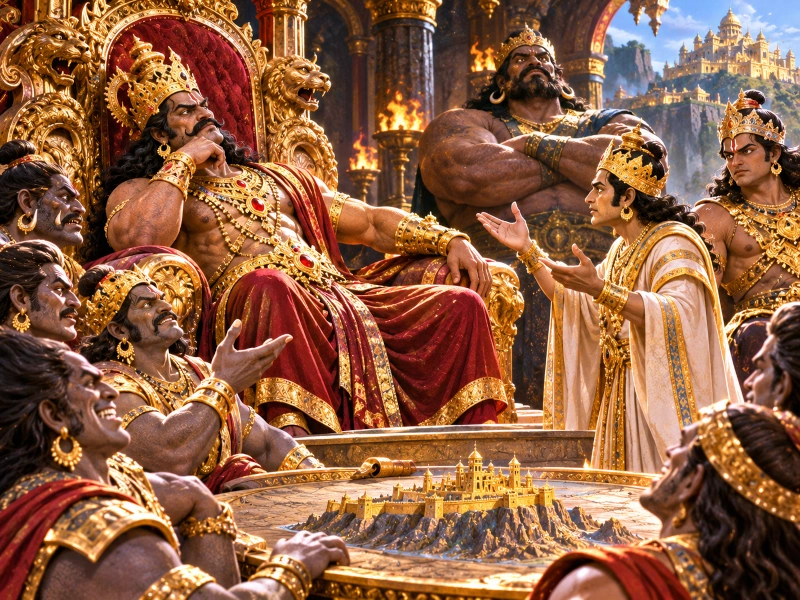
Ramayana Diplomacy Series | Vālmīki Rāmāyaṇa | Yuddha Kāṇḍa, Sargas 6–16
Introduction: When a Powerful Kingdom Fails to Govern Its Own Decisions
The Vālmīki Rāmāyaṇa presents several important examinations of political leadership, diplomacy, military strategy and the responsibilities of ministers entrusted with advising a ruler. Among these, the deliberations conducted by Rāvaṇa and his council of ministers before the great war in Laṅkā provide a particularly revealing study of the consequences of defective collective decision-making.
Described in Yuddha Kāṇḍa, Sargas 6–16, the consultations take place after Hanumān’s successful reconnaissance of Laṅkā, his discovery of Sītā and the destruction he inflicted upon parts of the fortified city. Rāvaṇa recognises that the security of his kingdom has been compromised and that Rāma, supported by Sugrīva and the Vānara army, is preparing for a military campaign against him. The situation requires a careful assessment of the enemy’s capabilities, Laṅkā’s defensive preparedness and the diplomatic alternatives available to prevent a potentially devastating conflict.
Rāvaṇa convenes his ministers and military commanders to discuss the emerging threat. Yet the proceedings reveal a serious contradiction. Although the king acknowledges the importance of collective deliberation, many of his advisers respond with extravagant assurances of victory rather than a realistic evaluation of the military situation. Vibhīṣaṇa, who offers a contrasting assessment and recommends restoring Sītā to Rāma, finds his counsel increasingly unwelcome.
The central strategic lesson of this episode is that the existence of a council does not guarantee effective collective decision-making. Consultation becomes meaningless when political authority encourages agreement, discourages dissent and refuses to reconsider policies that threaten the security of the state.
The consequences of these failures extend beyond Rāvaṇa’s personal fate. His inability to distinguish between reassuring speeches and informed strategic advice eventually contributes to the destruction of Laṅkā’s military leadership, the loss of powerful warriors and the collapse of his rule.
The Strategic Crisis: Hanumān Exposes Laṅkā’s Vulnerabilities
The immediate background to Rāvaṇa’s consultation is Hanumān’s extraordinary mission to Laṅkā. Having crossed the ocean, Hanumān entered the fortified kingdom, located Sītā in the Aśoka grove and gathered valuable information about the city’s defences and military capabilities. His subsequent confrontation with the Rākṣasa forces resulted in considerable destruction and demonstrated that Laṅkā’s formidable fortifications were not sufficient to prevent a determined adversary from penetrating its territory.
Rāvaṇa acknowledges these developments when addressing his ministers in Sarga 6. He recognises that a single Vānara has entered a city regarded as exceptionally difficult to penetrate, discovered Sītā and inflicted damage upon important locations and military personnel. The episode represents a serious intelligence and security failure for the kingdom, particularly because the intruder has returned with knowledge that could assist an approaching enemy army.
The military implications were substantial. Hanumān’s mission had demonstrated that the ocean surrounding Laṅkā did not constitute an absolute barrier, while his reconnaissance provided Rāma’s forces with valuable knowledge of the kingdom they intended to confront. These developments required the Rākṣasa leadership to reconsider assumptions concerning geographical security and the effectiveness of its defensive arrangements.
The first strategic failure confronting Laṅkā was the inability to translate an unmistakable security warning into a realistic reassessment of its military position.
Rāvaṇa was aware that the situation had become dangerous. Nevertheless, the subsequent deliberations reveal that much of the political and military leadership remained excessively confident in the kingdom’s ability to defeat Rāma.
Rāvaṇa’s Understanding of Consultation: A Principle He Failed to Practise
One of the most striking features of Sarga 6 is that Rāvaṇa himself explains the importance of consultation in political decision-making. Addressing his ministers, he distinguishes between rulers who seek informed advice before undertaking important actions and those who proceed according to their own judgment without adequately considering alternative perspectives.
Rāvaṇa recognises that the most capable decision-maker consults knowledgeable ministers, trusted associates and other persons concerned with the welfare of the state. He also discusses the quality of collective deliberation, observing that sound decisions emerge when advisers carefully examine a problem and arrive at a well-considered conclusion.
These observations reveal that Rāvaṇa was not unfamiliar with the principles of political administration. He understood the theoretical importance of collective judgment and recognised that complex decisions required the involvement of experienced counsellors.
The contradiction emerges in his subsequent conduct. Although he publicly endorses deliberation, he ultimately refuses to accept advice that challenges his determination to retain Sītā. The council is therefore unable to perform the function that Rāvaṇa himself identifies as essential to successful leadership.
The strategic significance of this contradiction is that institutional procedures are ineffective when rulers accept consultation in principle but reject its consequences whenever informed advice conflicts with their personal preferences.
A government may possess elaborate councils, experienced officials and formal mechanisms for consultation, yet still suffer serious strategic failures if its leadership does not permit those institutions to influence decisions.
Rāvaṇa’s council demonstrates that effective governance requires more than the outward appearance of deliberation. It requires the willingness to examine evidence, consider competing arguments and modify policies when circumstances demand reconsideration.
The Ministers’ Response: Military Confidence Replaces Strategic Assessment
The responses of Rāvaṇa’s ministers in Sargas 7 and 8 reveal a dangerous pattern of excessive confidence. Rather than concentrating upon Hanumān’s successful penetration of Laṅkā and the demonstrated capabilities of Rāma, several commanders emphasise their previous victories, extraordinary strength and ability to destroy the approaching enemy.
The Rākṣasa leaders repeatedly assure Rāvaṇa that they possess sufficient power to defeat Rāma, Lakṣmaṇa, Sugrīva and the Vānara forces. Their speeches celebrate the military achievements of Laṅkā and offer confident declarations concerning the outcome of any future confrontation.
These assurances reflect the kingdom’s genuine military strength, but they do not adequately address the strategic questions raised by recent events. The commanders do not present a comprehensive assessment of Rāma’s capabilities, the consequences of prolonged warfare or the possibility of resolving the crisis through diplomacy.
Instead, the discussions increasingly resemble demonstrations of loyalty and personal courage.
The fundamental military weakness of these responses is the substitution of confidence for capability assessment. A commander’s willingness to fight does not establish that the proposed war is necessary, achievable or consistent with the long-term interests of the state.
The distinction between bravery and judgment is especially important in military affairs. Courage may inspire soldiers and sustain resistance under difficult conditions, but successful command also requires the ability to identify risks, recognise enemy strengths and evaluate the probable consequences of battle.
The ministers’ repeated assurances create an environment in which Rāvaṇa hears what he wishes to believe. As confidence becomes the dominant language of the council, the possibility of genuine strategic reassessment diminishes.
A council that rewards reassuring predictions while neglecting uncomfortable evidence risks transforming collective deliberation into a mechanism for reinforcing the ruler’s existing assumptions.
The Problem of Flattery: When Loyalty Becomes a Strategic Liability
The behaviour of Rāvaṇa’s ministers raises a wider question concerning the responsibilities of political and military advisers. Their duty is not merely to express loyalty to the ruler but to protect the interests of the kingdom through informed and independent counsel.
Several of the commanders respond to the approaching threat by recalling past victories and promising to destroy the enemy. Their arguments appear intended to strengthen Rāvaṇa’s confidence, yet they provide little evidence that the kingdom has adequately evaluated the military situation.
The danger of such conduct lies in its influence upon political judgment. When a ruler is surrounded by advisers who consistently affirm his decisions, he may gradually lose the ability to distinguish between genuine support and exaggerated reassurance. The absence of disagreement can create an illusion of consensus even when serious strategic weaknesses remain unresolved.
The diplomatic lesson is that loyalty to a ruler must not be confused with loyalty to every decision made by that ruler. Genuine service to the state sometimes requires advisers to oppose policies that threaten its security or prosperity.
Flattery becomes especially dangerous during a military crisis because decisions taken under conditions of excessive confidence may expose an entire population to consequences that extend far beyond the political leadership.
Rāvaṇa’s ministers possessed considerable military experience, but their unwillingness to challenge the central assumption behind the proposed confrontation weakened the quality of collective decision-making.
The council consequently failed to establish a clear distinction between the question of whether Laṅkā could fight and the more important question of whether Laṅkā should fight.
The ability to wage war is a military capability; the decision to wage war is a political responsibility that must be guided by strategic necessity and the welfare of the state.
Kumbhakarṇa’s Intervention: Consultation After the Decision Has Been Made
The deliberations acquire another important dimension when Kumbhakarṇa, Rāvaṇa’s powerful brother, is informed of the circumstances surrounding Sītā’s abduction. In Sarga 12, Kumbhakarṇa criticises Rāvaṇa for undertaking such a consequential action without properly consulting his advisers beforehand.
Kumbhakarṇa argues that the king should have examined the implications of his decision before abducting Sītā rather than seeking advice only after creating a dangerous political and military crisis. His criticism identifies a major procedural failure in Rāvaṇa’s administration.
The issue was not simply that the ruler had made an unwise decision. It was that he had bypassed the opportunity for informed consultation at the stage when advice could have prevented the crisis from developing.
Kumbhakarṇa’s intervention illustrates a fundamental principle of governance: strategic consultation must precede major decisions rather than become an exercise in managing the consequences of actions already undertaken.
This distinction remains important in diplomacy and military planning. Once a state has initiated a hostile action, its available choices may become significantly narrower. Political commitments, military deployments and public expectations can make reconsideration increasingly difficult.
Kumbhakarṇa nevertheless assures Rāvaṇa that he will fight on his behalf. His response therefore combines criticism of the original decision with a commitment to defend his brother.
This creates an important distinction between the evaluation of policy and the obligations of military loyalty. Kumbhakarṇa recognises that the abduction was improperly considered, but his willingness to participate in the subsequent war does not resolve the underlying strategic error.
A commander’s promise to fight courageously cannot compensate for the political leadership’s failure to determine whether the conflict should have been initiated in the first place.
Vibhīṣaṇa’s Counsel: The Case for Diplomatic Resolution
Vibhīṣaṇa provides the clearest alternative to the arguments advanced by the more aggressive members of Rāvaṇa’s council. In Sargas 9, 10 and 14, he repeatedly urges his brother to abandon the confrontation and return Sītā to Rāma.
His recommendations are grounded in both moral reasoning and strategic calculation. Vibhīṣaṇa recognises that Sītā’s abduction has created the central cause of the conflict and that restoring her would remove the immediate grievance motivating Rāma’s campaign.
He also warns that Rāma possesses extraordinary military capabilities and that Laṅkā’s powerful warriors should not assume they can defeat him merely because they have prevailed against other adversaries.
Vibhīṣaṇa’s advice therefore differs fundamentally from the assurances offered by the other commanders. Rather than concentrating upon Laṅkā’s previous military achievements, he evaluates the present situation and considers the consequences of continued hostility.
The central diplomatic significance of Vibhīṣaṇa’s counsel is his recognition that the most effective means of protecting Laṅkā may be to remove the cause of war rather than prepare for a confrontation whose consequences could be catastrophic.
Returning Sītā would require Rāvaṇa to abandon his personal objective, but it would also offer a path towards preventing the destruction of his kingdom.
Vibhīṣaṇa’s argument demonstrates that diplomatic compromise need not constitute military weakness. When a conflict arises from an unjustifiable action, correcting that action may be the most effective means of restoring security.
The strategic purpose of diplomacy is not merely to postpone warfare but to identify solutions that protect essential interests without exposing the state to unnecessary military risks.
Assessing the Enemy: Vibhīṣaṇa Challenges the Council’s Assumptions
One of Vibhīṣaṇa’s most important contributions appears in Sarga 14, where he challenges the assumption that Laṅkā’s military commanders can easily defeat Rāma.
Prahasta and other warriors express confidence in their ability to confront the approaching enemy. Vibhīṣaṇa responds by emphasising Rāma’s exceptional combat capabilities and warning that the confidence of the Rākṣasa commanders is not supported by a realistic understanding of their opponent.
His argument is particularly significant because it concentrates upon the relative strength of the opposing forces rather than the prestige of individual commanders.
Vibhīṣaṇa also explains the responsibilities of a proper counsellor. He maintains that an adviser must understand the strength of the enemy, evaluate the capabilities of his own side and consider whether the military balance is improving, deteriorating or remaining unchanged before recommending a course of action.
This represents one of the clearest principles of military intelligence in the episode: strategic advice must emerge from a comparative assessment of friendly and enemy capabilities rather than from assumptions of superiority.
The distinction is essential because military strength is relative. A powerful kingdom may possess formidable armies, fortifications and experienced commanders, yet still face an adversary whose capabilities make direct confrontation extremely dangerous.
Vibhīṣaṇa’s warning also demonstrates the importance of examining recent operational evidence. Hanumān’s successful mission had already exposed vulnerabilities in Laṅkā’s defences, while Rāma’s previous victories provided additional evidence of his battlefield effectiveness.
The failure of Rāvaṇa’s council was not the absence of information about the adversary but the unwillingness of influential decision-makers to incorporate that information into their assessment of the war.
Indrajit’s Opposition: Generational Confidence and the Rejection of Caution
The disagreement within Rāvaṇa’s council becomes increasingly pronounced when Indrajit, Rāvaṇa’s son and one of Laṅkā’s most formidable warriors, challenges Vibhīṣaṇa’s advice.
In Sarga 15, Indrajit criticises Vibhīṣaṇa’s warnings and portrays his caution as inconsistent with the courage expected of the Rākṣasa leadership. Having achieved remarkable victories in earlier conflicts, Indrajit expresses confidence that Rāma and Lakṣmaṇa can also be defeated.
His argument reflects the influence of previous military success upon current strategic judgment. Indrajit possesses extraordinary combat abilities, but his confidence does not adequately address the differences between earlier adversaries and the emerging threat posed by Rāma.
Vibhīṣaṇa responds by questioning the wisdom of such confidence and warning against allowing youthful pride and insufficient understanding to determine the kingdom’s course.
The military lesson is that past victories establish experience but do not guarantee success against a different adversary operating under different circumstances.
The exchange also demonstrates how strategic disagreement can deteriorate when advisers begin questioning one another’s courage or loyalty rather than examining the evidence supporting their recommendations.
A council intended to evaluate military options becomes ineffective when caution is treated as cowardice and aggressive declarations are accepted as proof of competence.
Responsible military leadership must preserve the distinction between questioning the feasibility of war and refusing to defend the state. An adviser who identifies the dangers of confrontation may be contributing more to national security than one who promises victory without adequate analysis.
Rāvaṇa’s Final Response: The Collapse of Collective Decision-Making
The failure of the council reaches its decisive stage in Sarga 16, when Rāvaṇa harshly rebukes Vibhīṣaṇa and questions his loyalty.
Rather than examining the substance of his brother’s advice, Rāvaṇa interprets the disagreement as evidence of hostility and betrayal. He expresses suspicion towards relatives and portrays Vibhīṣaṇa’s warnings as the conduct of someone who does not genuinely support his rule.
This response marks the complete breakdown of meaningful consultation.
Vibhīṣaṇa has repeatedly argued that returning Sītā would protect Laṅkā from unnecessary destruction. He has explained the danger posed by Rāma and attempted to distinguish the kingdom’s welfare from Rāvaṇa’s personal ambitions. Yet these arguments are dismissed because they conflict with the ruler’s preferred decision.
The greatest political failure of the council occurs when disagreement over strategy is transformed into an accusation of disloyalty. At that point, the ruler ceases to evaluate advice according to its merits and begins judging advisers according to their willingness to agree.
Faced with Rāvaṇa’s rejection, Vibhīṣaṇa decides to depart from Laṅkā with four companions.
Before leaving, he again warns his brother of the danger facing the kingdom and urges him to protect himself and his people.
Vibhīṣaṇa’s departure is particularly significant because it represents more than the loss of one political adviser. Laṅkā loses a senior member of its ruling family who possesses knowledge of its internal affairs, military capabilities and political vulnerabilities.
By rejecting an experienced adviser and driving him from the kingdom, Rāvaṇa transforms an internal political disagreement into a strategic vulnerability.
The consequences become evident in the subsequent narrative, when Vibhīṣaṇa seeks refuge with Rāma and eventually assists him during the campaign against Laṅkā.
The Strategic Cost of Losing Independent Advisers
Vibhīṣaṇa’s departure illustrates an important consequence of political systems that suppress independent advice. When knowledgeable officials are repeatedly dismissed or publicly humiliated, the state risks losing individuals whose experience and institutional knowledge are essential to national security.
The danger becomes particularly severe when the departing adviser possesses intimate knowledge of military arrangements, command structures and strategic weaknesses.
Vibhīṣaṇa’s subsequent association with Rāma demonstrates how the failure to accommodate legitimate internal disagreement can alter the balance of information between opposing sides.
Although the Rāmāyaṇa presents Vibhīṣaṇa’s decision within a wider moral framework, the episode also contains a clear lesson in political and military administration.
The suppression of informed dissent can weaken a state twice: first by depriving its leadership of accurate advice, and then by creating circumstances in which valuable institutional knowledge is lost to an adversary.
This does not mean that every disagreement must determine government policy. Political leadership must ultimately make decisions and accept responsibility for their consequences. However, the ability to reject advice responsibly requires that the advice first be examined according to its evidence, reasoning and relevance.
Rāvaṇa fails to maintain this distinction. He does not merely decline to adopt Vibhīṣaṇa’s recommendations; he rejects the legitimacy of the adviser himself.
The resulting loss of counsel further reduces Laṅkā’s capacity for strategic reassessment.
Diplomatic Significance: The Failure to Separate Personal Ambition from National Interest
The most important diplomatic weakness revealed by the council is the inability of Laṅkā’s leadership to distinguish Rāvaṇa’s personal determination to retain Sītā from the broader interests of the kingdom.
The central dispute does not arise from an unavoidable struggle for territory, resources or national survival. It originates in Rāvaṇa’s abduction of Sītā and his refusal to restore her to Rāma.
Vibhīṣaṇa recognises that resolving this grievance would remove the immediate cause of the approaching war. His proposal therefore represents a diplomatic alternative directly connected to the preservation of Laṅkā’s security.
The other ministers, however, largely concentrate upon Rāvaṇa’s military strength and the ability of the Rākṣasa commanders to defeat the enemy.
Their reasoning fails to address whether the kingdom possesses a legitimate or strategically necessary objective that justifies the anticipated costs of war.
The fundamental diplomatic principle is that the personal preferences of political leadership must not be allowed to redefine the national interest when doing so exposes the state and its population to unnecessary conflict.
The council also demonstrates the importance of offering political leaders viable alternatives before a military crisis becomes irreversible. Vibhīṣaṇa provides such an alternative by recommending the restoration of Sītā, but Rāvaṇa refuses to consider it.
Diplomacy is most effective when it remains available as a genuine policy option rather than being dismissed merely because negotiation would require political leadership to reconsider an earlier decision.
Modern Strategic Parallel: The Decision-Making Failures Before the Iraq War of 2003
A useful modern comparison can be drawn from the decision-making processes that preceded the United States-led invasion of Iraq in March 2003. The episode remains the subject of extensive historical and political examination, particularly concerning the interpretation of intelligence, the evaluation of military risks and the relationship between political objectives and expert advice.
The invasion was justified by participating governments through several arguments, including claims concerning Iraqi weapons of mass destruction and the perceived security threat posed by Saddam Hussein’s government. Subsequent investigations established serious deficiencies in important intelligence assessments concerning Iraq’s alleged weapons programmes.
The United States Senate Select Committee on Intelligence examined failures in pre-war intelligence assessments, while the British Iraq Inquiry, commonly known as the Chilcot Inquiry, investigated the United Kingdom’s involvement in the conflict.
Published in July 2016, the Chilcot Inquiry concluded that the United Kingdom joined the invasion before peaceful options had been exhausted and found serious shortcomings in the assessment and planning of the intervention.
The inquiry also examined the government’s preparation for the consequences of military action, including the difficulties associated with the post-invasion administration and security of Iraq.
The historical circumstances differ substantially from the Rāmāyaṇa narrative. The Iraq War involved modern international institutions, intelligence agencies, military alliances and complex political circumstances, while Rāvaṇa’s council concerned the response of a monarch to an approaching enemy following the abduction of Sītā.
Nevertheless, both episodes provide grounds for examining how political leadership evaluates intelligence, considers diplomatic alternatives and incorporates competing assessments into decisions concerning war.
The shared strategic lesson is that military action must be preceded by rigorous examination of the underlying intelligence, the political objectives being pursued, the alternatives to confrontation and the consequences likely to follow the initial operation.
The comparison also demonstrates that effective collective decision-making depends upon more than the existence of advisers and formal consultation procedures. Decision-makers must remain willing to challenge assumptions and consider evidence that complicates their preferred course of action.
Strategic Lessons for Modern Political and Military Leadership
The deliberations of Rāvaṇa’s council reveal several enduring principles of political administration, military command and diplomatic decision-making.
The first concerns the quality of consultation. Rāvaṇa correctly describes the importance of collective judgment, yet his inability to accept disagreement prevents the council from functioning effectively. The value of a decision-making institution must be measured by its capacity to examine alternatives and correct flawed assumptions, not merely by the number or seniority of the officials participating in it.
The second concerns the responsibilities of advisers. Many of Rāvaṇa’s ministers emphasise their strength and previous achievements, while Vibhīṣaṇa concentrates upon the actual threat and the consequences of war. An effective adviser must distinguish between what political leadership wishes to hear and what the available evidence indicates is necessary for the security of the state.
The third concerns the timing of consultation. Kumbhakarṇa’s criticism reveals that Rāvaṇa sought extensive advice only after initiating the action that created the crisis. Strategic consultation must take place before consequential decisions are implemented, when meaningful alternatives remain available and the costs of reconsideration are comparatively limited.
The fourth concerns intelligence assessment. Vibhīṣaṇa repeatedly emphasises the demonstrated capabilities of Rāma, challenging assumptions based upon the past victories of Laṅkā’s commanders. Sound military planning requires a realistic comparison of friendly and enemy capabilities, including the possibility that a previously successful force may encounter an adversary it cannot defeat.
The fifth concerns the management of disagreement. Rāvaṇa’s response to Vibhīṣaṇa demonstrates how the suppression of dissent can destroy internal trust and drive valuable advisers away from the political establishment. Disagreement over policy must not automatically be interpreted as disloyalty, because independent advice is essential to detecting strategic errors before they become national disasters.
Finally, the episode reveals the importance of subordinating personal ambition to the welfare of the kingdom. Rāvaṇa’s determination to retain Sītā eventually exposes Laṅkā to a war that could have been avoided through the diplomatic course repeatedly recommended by Vibhīṣaṇa. The ultimate responsibility of political leadership is to protect the long-term security and prosperity of the state, even when doing so requires abandoning a personally desired objective.
Conclusion: The Council That Could Not Prevent a War
Rāvaṇa’s council of ministers represents one of the most significant examinations of failed collective decision-making in the Vālmīki Rāmāyaṇa. The kingdom possessed powerful military commanders, experienced ministers and an established system of consultation. Its ruler was familiar with the principles of deliberation and publicly acknowledged the importance of informed advice.
Yet these advantages proved insufficient because the council was unable to challenge the assumptions governing Rāvaṇa’s decisions.
The majority of the military commanders responded to the emerging crisis with assurances of strength and victory. Kumbhakarṇa recognised that the original decision had been taken without adequate consultation, but nevertheless promised to fight. Vibhīṣaṇa provided the clearest strategic and diplomatic alternative by recommending the return of Sītā and warning against a confrontation with Rāma.
Rāvaṇa rejected that advice and drove Vibhīṣaṇa from Laṅkā.
The subsequent war demonstrated the consequences of these decisions. Laṅkā’s formidable military establishment suffered devastating losses, its leading commanders fell in battle and Rāvaṇa’s rule ultimately came to an end.
The central lesson of the episode is that powerful kingdoms can be brought to ruin not merely by the strength of their enemies but by the failure of their own leadership to recognise danger, accept informed counsel and correct strategic mistakes.
The Rāmāyaṇa also demonstrates that consultation is not an obstacle to decisive leadership. Properly conducted, it strengthens political authority by ensuring that major decisions are informed by experience, intelligence and a realistic understanding of their consequences.
The strength of a ruler is therefore not measured by the number of ministers who agree with him, but by his willingness to listen to those who possess the knowledge and courage to challenge him when the interests of the kingdom are at stake.
Through the contrasting voices of Rāvaṇa’s ministers, Kumbhakarṇa, Indrajit and Vibhīṣaṇa, the epic preserves an enduring principle of statecraft: collective decision-making becomes effective only when political authority is guided by independent judgment, responsible consultation and the recognition that the welfare of the state must always take precedence over personal ambition.
The lasting diplomatic lesson is that wise governance requires institutions in which honest counsel can influence decisions before conflict becomes unavoidable.
A kingdom is best protected not by a council that promises victory, but by a council capable of recognising when diplomacy, restraint and the correction of an earlier mistake can prevent the need for war altogether.
Scriptural Reference: Vālmīki Rāmāyaṇa, Yuddha Kāṇḍa, Sargas 6–16, particularly Sarga 6 concerning Rāvaṇa’s principles of consultation; Sargas 7–8 concerning the assurances of his military commanders; Sargas 9–10 concerning Vibhīṣaṇa’s warnings; Sarga 12 concerning Kumbhakarṇa’s criticism; Sarga 14 concerning Vibhīṣaṇa’s assessment of Rāma’s capabilities; Sarga 15 concerning Indrajit’s opposition; and Sarga 16 concerning Vibhīṣaṇa’s departure from Laṅkā.
You may also like
-
Bali’s Conquest of Svarga: Military Leadership, Strategic Recovery and the Defeat of Indra’s Celestial Forces
-
India–Malaysia Joint Military Exercise Harimau Shakti–VI Begins in Malaysia with Focus on Counter-Terrorism and Drone Warfare
-
India and Japan Strengthen Strategic Partnership with Focus on Defence, Semiconductors and Critical Minerals
-
The Saptāṅga Theory: Why Kauṭilya Considered the State a System of Seven Interdependent Elements
-
Over 1,500 Megalithic Burial Structures and Rare Female Stone Figures Identified in Telangana
