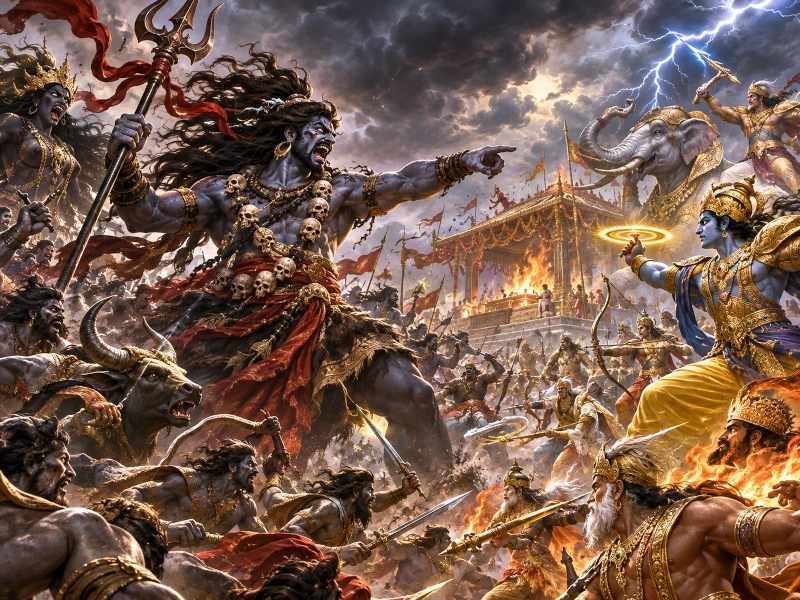
The destruction of Dakṣa’s yajña was not accomplished without resistance. As Vīrabhadra and the terrifying armies of Śiva advanced upon the sacrificial enclosure, the confrontation developed into an extraordinary battle involving some of the most powerful gods and celestial warriors described in the Śiva Purāṇa.
Indra, Agni, Yama, Varuṇa, Kubera and other divine guardians became involved in the defence of the sacrifice. Their intervention transformed the campaign from an assault upon a ceremonial gathering into a major conflict between organised celestial forces.
At the centre of the confrontation stood Vīrabhadra, the formidable commander created from Śiva’s fury after Satī’s death. Opposing him were warriors endowed with divine weapons, supernatural abilities and authority over different aspects of the universe.
The battle is particularly significant for its depiction of command decisions, the deployment of powerful individual warriors, the intervention of reserves and the decisive consequences of leadership on the battlefield.
The Gods Prepare for Battle
As Vīrabhadra approached, Dakṣa sought the protection of the gods assembled at his sacrifice. Although Viṣṇu had warned him about the consequences of insulting Śiva, the celestial defenders prepared to confront the advancing army.
Indra mounted his elephant, while other gods took their respective divine vehicles. Agni rode his goat, Yama his buffalo, Varuṇa his crocodile and Vāyu his deer. Kubera prepared his celestial chariot, while numerous other divine beings assembled for battle.
The mobilisation brought together warriors possessing different powers and methods of combat. Their combined strength represented a formidable defensive force, particularly when supported by the spiritual authority of the priests conducting the sacrifice.
Dakṣa expressed his confidence in the gods and reminded them that their support had encouraged him to undertake the great ceremony. Their presence had become essential to his ability to preserve the sacrifice.
The defending army was therefore drawn into a conflict whose political and spiritual origins lay primarily in Dakṣa’s conduct. Their commitment to protecting the ceremony placed them directly in the path of Śiva’s advancing forces.
The First Engagement: Divine Weapons Against Śiva’s Gaṇas
The battle began with a violent clash between the celestial warriors and Śiva’s attendants. Conches sounded, drums thundered and the opposing formations attacked with sharp weapons, iron clubs, spears and tridents.
The gods initially achieved success. The Śiva Purāṇa attributes the early reversal suffered by Śiva’s attendants partly to the power of Bhṛgu’s incantations, which strengthened the defenders and enabled them to drive back sections of the attacking force.
This initial engagement reveals an important feature of the conflict. Although Vīrabhadra’s army possessed overwhelming supernatural strength, its advance was not entirely uninterrupted. The gods were capable of resisting, inflicting damage and temporarily disrupting the offensive.
However, the defenders failed to convert their success into a decisive victory. The appearance of Vīrabhadra at the front of the battle altered the balance of power.
Seeing his warriors retreat, Vīrabhadra ordered certain attendants to withdraw and brought forward stronger formations mounted upon bulls. He then advanced with his trident and personally attacked the celestial defenders.
His intervention restored momentum to the assault. The gaṇas renewed their attacks, and the gods began suffering severe losses.
From a military perspective, the episode illustrates the importance of a commander’s ability to recognise a deteriorating tactical situation and respond through the commitment of fresh forces.
The Battle Turns Against the Gods
As Vīrabhadra’s forces pressed forward, the fighting became increasingly intense. Śiva’s attendants attacked the gods and associated celestial warriors with an extraordinary variety of weapons.
The Śiva Purāṇa describes the defenders being struck by javelins, spears, tridents, swords and iron clubs. The severity of the attacks eventually caused many celestial warriors to abandon the battlefield.
Indra and the principal guardians of the directions continued to resist, but their forces had suffered a serious deterioration in cohesion. The divine army was no longer capable of maintaining the broad defensive front with which the battle had begun.
Recognising their predicament, the surviving commanders approached Bṛhaspati, the preceptor of the gods, and sought his advice regarding the possibility of victory.
Bṛhaspati’s response was decisive. He reminded them that their participation in Dakṣa’s sacrifice had been unwise and warned that the destruction of the ceremony could no longer be prevented.
His counsel exposed a fundamental weakness in the defenders’ position. They had committed themselves to protecting an undertaking whose underlying legitimacy had already been challenged, and their superior individual powers could not resolve that contradiction.
Vīrabhadra Challenges the Celestial Commanders
With the defending army weakened, Vīrabhadra advanced and openly challenged the gods. He addressed Indra, Agni, Varuṇa, Yama, Kubera and the other divine warriors, inviting them to confront him.
His challenge was accompanied by a fierce attack with arrows that wounded the celestial commanders and forced them to retreat in different directions.
The retreat cleared the way for Vīrabhadra and his attendants to approach the entrance of the sacrificial chamber. The attackers had broken through the principal defensive formations and were now threatening the ceremony itself.
At this stage, the battle had reached a critical point. Dakṣa’s protectors were no longer fighting to prevent the approach of the enemy army. They were attempting to avert the final destruction of the very objective they had undertaken to defend.
The sages assembled at the sacrifice appealed to Viṣṇu, recognising that the remaining defenders were unable to stop Vīrabhadra.
Viṣṇu then emerged to confront the commander of Śiva’s army.
Viṣṇu and Vīrabhadra: A Confrontation Between Divine Powers
The encounter between Viṣṇu and Vīrabhadra forms one of the most remarkable portions of the narrative. Although the two stood on opposing sides of the battlefield, their confrontation was not presented as an expression of permanent hostility between Śiva and Viṣṇu.
Vīrabhadra initially challenged Viṣṇu for remaining at Dakṣa’s sacrifice despite the insult offered to Śiva. He questioned why Viṣṇu had undertaken to protect an enterprise that had provoked such divine anger.
Viṣṇu explained that he was not an enemy of Śiva. He had responded to Dakṣa’s repeated appeals because Dakṣa was his devotee. His presence at the sacrifice arose from that relationship rather than from hostility towards Śiva.
Vīrabhadra accepted this explanation and acknowledged the essential unity between Śiva and Viṣṇu expressed in the Purāṇic narrative. Nevertheless, both prepared to demonstrate their power in battle.
The exchange is significant because it separates battlefield opposition from fundamental enmity. Two powerful figures could confront one another while recognising a deeper relationship beyond the immediate conflict.
This distinction also prevents the episode from being understood as a simple struggle between rival divine traditions. The Śiva Purāṇa frames the confrontation within a larger theological understanding in which the apparent conflict ultimately serves the restoration of order.
The Duel and the Return of the Celestial Warriors
As the confrontation began, Vīrabhadra mounted his divine chariot, armed himself with powerful weapons and roared a challenge. Viṣṇu responded by sounding his conch, Pāñcajanya.
The sound of Viṣṇu’s conch had an immediate effect upon the battlefield. Gods who had previously fled returned to the fighting, encouraged by the presence and leadership of Viṣṇu.
The renewed engagement produced a series of individual confrontations between the celestial commanders and Śiva’s attendants.
Indra fought Nandin, one of Śiva’s foremost attendants. Indra struck Nandin with his thunderbolt, while Nandin retaliated with his trident, injuring Indra in the chest. Both warriors continued fighting with great determination.
Agni engaged Aśman, and Kubera confronted Kūṣmāṇḍapati. Other commanders of Śiva’s army fought against the guardians of the directions, creating a battlefield composed of simultaneous engagements between powerful champions.
These duels reveal a distinctive characteristic of Purāṇic warfare. Large armies provided the setting, but the actions of exceptional individual warriors could determine the course of particular engagements and influence the morale of entire formations.
The struggle between Viṣṇu and Vīrabhadra eventually became the centre of the conflict. The Śiva Purāṇa describes their exchange of powerful weapons and extraordinary displays of martial strength. Viṣṇu’s weapons encountered the influence of Śiva’s power, and the confrontation ultimately ended without the successful defence of Dakṣa’s sacrifice.
The Destruction of the Sacrificial Defences
With the celestial defenders unable to prevent the advance, Vīrabhadra’s forces overwhelmed the remaining resistance. The battle culminated in the destruction of the sacrificial arrangements and the punishment of those whom the narrative identifies as responsible for supporting Dakṣa’s conduct.
Vīrabhadra seized Dakṣa and severed his head, casting it into the sacrificial fire. The act marked the complete collapse of the authority under which the ceremony had been organised.
The Śiva Purāṇa also describes punishments inflicted upon several participants, including the humiliation or injury of divine beings and sages who had opposed Śiva’s attendants.
The destruction extended beyond the defeat of individual warriors. The sacrificial enterprise itself was dismantled, making the original objective of the defenders impossible to achieve.
Having accomplished his mission, Vīrabhadra returned to Śiva. The victorious commander was received with approval and honoured for carrying out the divine command.
The expedition thus ended not with the occupation of territory or the establishment of a new kingdom, but with the elimination of the immediate cause of confrontation.
The Warcraft Lessons: Leadership, Reserves and the Limits of Defensive Power
The battle between Vīrabhadra and the gods offers several strategic observations when examined as a Purāṇic account of warfare.
The first concerns the value of decisive battlefield leadership. When sections of Śiva’s army were initially repelled, Vīrabhadra personally intervened and restored the attack. His presence transformed a temporary setback into a renewed offensive, demonstrating how command decisions can determine whether an army recovers from adversity.
The second principle is the importance of maintaining reserves. Vīrabhadra’s decision to move stronger formations into the front ranks enabled his army to overcome resistance that had temporarily halted its advance. The sequence illustrates the military value of retaining forces capable of restoring momentum at a critical moment.
The third principle concerns morale. The defenders were repeatedly influenced by the presence or absence of powerful leaders. The retreat of the gods following Vīrabhadra’s attacks demonstrated the fragility of their confidence, while the sound of Viṣṇu’s conch encouraged their return to battle.
The fourth principle is that superior weapons and exceptional individual warriors do not necessarily guarantee victory. The celestial defenders possessed divine weapons and extraordinary abilities, yet their combined strength could not preserve Dakṣa’s sacrifice.
The fifth principle concerns the relationship between military action and political or moral legitimacy. Dakṣa’s defenders were powerful, but the purpose for which they fought was compromised by the events that had caused the confrontation. The narrative suggests that strength alone cannot sustain an undertaking whose foundation has been undermined by arrogance and injustice.
Finally, the conflict demonstrates how the commitment of additional forces can expand the scale of a confrontation without necessarily changing its outcome. The involvement of Indra, the guardians of the directions and Viṣṇu transformed the fighting into a major celestial engagement, but Vīrabhadra’s original mission remained unchanged.
Victory, Restraint and the Restoration of Harmony
The conclusion of the narrative is as important as the battle itself. Following the destruction of the sacrifice, the gods eventually approached Śiva and sought reconciliation.
Śiva responded with compassion and restored Dakṣa to life, replacing his severed head with that of a goat. The other injured participants also received relief, and the sacrifice was subsequently completed with proper recognition of Śiva.
This restoration gives the narrative a meaning beyond military victory. The destructive campaign exposed the consequences of arrogance, while its aftermath demonstrated that punishment need not prevent reconciliation.
Vīrabhadra’s battlefield success did not create an enduring conflict between the principal divine powers. Instead, the restoration of Dakṣa and the completion of the sacrifice re-established the harmony that had been disturbed.
The episode therefore presents two complementary dimensions of authority: the power to punish violations of order and the wisdom to restore peace after the purpose of punishment has been fulfilled.
In the Ancient Warcraft tradition, Vīrabhadra’s confrontation with the gods illustrates the decisive influence of battlefield leadership, the effective commitment of reserves, the psychological importance of command presence and the limitations of military strength when the cause being defended lacks a secure moral foundation.
You may also like
-
Aṅgada and Rāvaṇa: Why Diplomatic Negotiations Fail When Leaders Reject Reality
-
Aṅgada’s Mission to Laṅkā: Rāma’s Final Diplomatic Initiative Before War
-
Shiva Destroys Tripura: The Three Flying Fortresses and the Strategy of a Single Decisive Strike
-
The Immunity of Diplomatic Envoys: Vibhīṣaṇa’s Defence of Hanumān Before Rāvaṇa
-
Andhaka’s War Against Shiva: The Battle of Endless Regeneration and Strategic Adaptation
