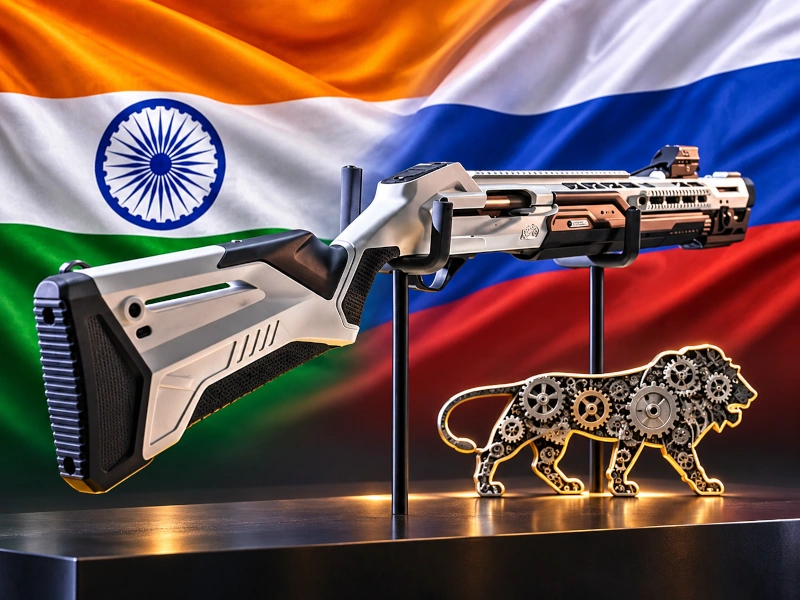
Russia’s Kalashnikov Concern has signed a licensing agreement with an Indian partner for the local manufacture of its MP-155 semi-automatic shotgun, expanding Indo-Russian defence-industrial cooperation into the growing field of counter-drone weaponry. The agreement will enable production of the Russian-designed firearm in India with technical support from Kalashnikov, strengthening the potential for domestic manufacturing of close-range weapons used against small unmanned aerial vehicles (UAVs).
Kalashnikov President Alan Lushnikov confirmed the agreement on 2 November 2026 while addressing journalists at Patriot Park in the Moscow region. According to Russia’s TASS news agency, Lushnikov stated that the company had signed a licensing contract for manufacturing the MP-155 in India and would support its implementation. The development follows growing international interest in relatively inexpensive weapons capable of countering small drones on modern battlefields.
MP-155: From Hunting Shotgun to Counter-Drone Weapon
The MP-155 is a 12-gauge, gas-operated, semi-automatic shotgun developed by Russia’s Izhevsk Mechanical Plant. Introduced in 2012 as a civilian hunting firearm, the weapon has subsequently attracted attention for its effectiveness against small, low-flying drones, particularly first-person-view (FPV) drones and commercially available quadcopters adapted for military operations.
Unlike conventional rifles, which fire individual projectiles, shotguns can discharge cartridges containing multiple pellets. These pellets spread after leaving the barrel, increasing the area covered by a single shot and offering a practical advantage when engaging small aerial targets moving at relatively short distances.
Kalashnikov has developed a specialised counter-drone configuration of the MP-155 intended to engage low-flying aerial targets at distances of approximately 50 to 100 metres, according to the manufacturer’s reported specifications. This makes the weapon particularly relevant for close-range protection of military personnel, vehicles, defensive positions and sensitive installations.
The shotgun’s semi-automatic operating mechanism also allows successive shots without manually cycling the action after each discharge. Its relatively straightforward mechanical design and established manufacturing base make the MP-155 a potential option for supplementing more sophisticated counter-drone systems.
Growing Importance of Close-Range Counter-Drone Defence
The increasing use of inexpensive drones in contemporary conflicts has transformed battlefield requirements, particularly at the tactical level. Small FPV drones equipped with explosive payloads can threaten infantry positions, armoured vehicles, logistics convoys and artillery installations, often approaching at low altitudes that complicate early detection and interception.
Electronic warfare systems, specialised interceptors and conventional air-defence weapons remain important elements of counter-drone protection. However, the widespread deployment of relatively inexpensive UAVs has also encouraged the development of complementary close-range defensive capabilities.
Shotguns such as the MP-155 offer an additional defensive option when hostile drones approach within visual and engagement range. Their utility is particularly associated with the final layer of a broader counter-UAV defensive arrangement, where personnel require weapons that can be deployed rapidly against nearby aerial threats.
The adaptation of the MP-155 reflects a wider shift in military technology, where established weapon systems are being modified to address new threats rather than relying exclusively on expensive and technologically complex solutions.
Licensed Production to Expand Indo-Russian Defence Manufacturing Cooperation
The agreement represents another development in India’s long-standing defence-industrial relationship with Russia. Under the licensing arrangement announced by Kalashnikov, an Indian manufacturer will undertake local production of the MP-155 with support from the Russian company.
Licensed manufacturing can provide opportunities to develop domestic production expertise, strengthen industrial supply chains and expand the availability of specialised equipment through Indian manufacturing facilities.
The announcement builds upon Kalashnikov’s existing engagement with Indian companies in the small-arms sector. However, the company has not publicly identified the Indian partner involved in the MP-155 agreement, the proposed manufacturing location, production quantities or the timetable for commencing operations.
It has also not specified whether Indian production will initially cover the standard MP-155 shotgun, the specialised counter-drone configuration or multiple variants. The precise scope of technology transfer and any associated ammunition manufacturing arrangements have similarly not been disclosed.
Building on the AK-203 Manufacturing Partnership
Kalashnikov already has an established presence in India’s defence manufacturing sector through Indo-Russian Rifles Private Limited (IRRPL), the joint venture responsible for manufacturing AK-203 assault rifles at Korwa in Uttar Pradesh’s Amethi district.
The AK-203 programme was established to support domestic production of modern assault rifles for the Indian Armed Forces, incorporating progressive localisation of components and manufacturing processes.
The December 2021 contract provides for the manufacture of more than six lakh AK-203 rifles in India, making it one of the most significant Indo-Russian small-arms manufacturing initiatives.
The new MP-155 licensing agreement extends Kalashnikov’s announced manufacturing cooperation with India into a different category of firearms. Although the company already participates in the AK-203 joint venture, there has been no confirmation that the MP-155 will be manufactured through the same industrial arrangement.
Earlier Agreements for Counter-Drone Weapons
The latest agreement follows Kalashnikov’s efforts to expand its presence in India’s counter-drone equipment market.
During the India Homeland Security Expo in New Delhi in June 2026, the Russian manufacturer announced agreements with Indian partners covering the supply of anti-drone shotguns, specialised cartridges and pistols.
Kalashnikov’s representatives indicated that these products were intended for delivery before the end of 2026, reflecting growing interest in weapons designed to address emerging security requirements.
The November licensing agreement represents a further development beyond the earlier supply arrangements by introducing the prospect of manufacturing the MP-155 directly in India.
The move also highlights the growing importance of combining imported defence technology with domestic industrial capabilities, particularly in specialised equipment categories where operational requirements are evolving rapidly.
Strengthening India’s Counter-Drone Defence Ecosystem
India has been expanding its domestic capabilities in unmanned aerial systems and counter-UAV technologies, with public-sector organisations, private defence manufacturers and technology startups developing detection systems, electronic countermeasures, interceptor drones and other defensive solutions.
The MP-155 licensing agreement introduces another potential manufacturing opportunity within this broader defence ecosystem, concentrating on relatively simple firearms adapted for close-range engagements against aerial threats.
Domestic production could support the availability of such equipment for authorised defence and security users while creating opportunities for Indian manufacturers to develop expertise in specialised small-arms production.
The agreement also demonstrates the continued evolution of India-Russia defence cooperation from equipment procurement towards local production and industrial collaboration.
As drones become increasingly important in modern warfare, the development of layered defensive capabilities incorporating electronic, kinetic and conventional weapons is emerging as an important military requirement. The proposed manufacture of the MP-155 in India adds a new dimension to this expanding field of defence technology and industrial cooperation.
You may also like
-
Paras Semiconductors Partners with US Firm BroadPak to Develop Advanced Chip Packaging Capabilities in India
-
Indian Navy’s Largest Agniveer Batch of Over 3,300 Trainees to Graduate from INS Chilka on November 13
-
IAF Advances High-Altitude Surveillance Capabilities as India Develops Indigenous Stratospheric Platforms
-
Indian Navy and XINFINITI Aerospace Developing Indigenous Drone for Automated Aircraft Inspections
-
INS Surat Arrives in Oman for Naseem Al Bahr 2026, Strengthening India’s Maritime Security Partnership
