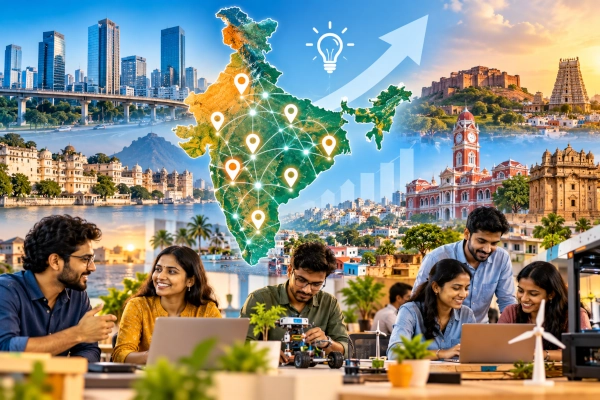
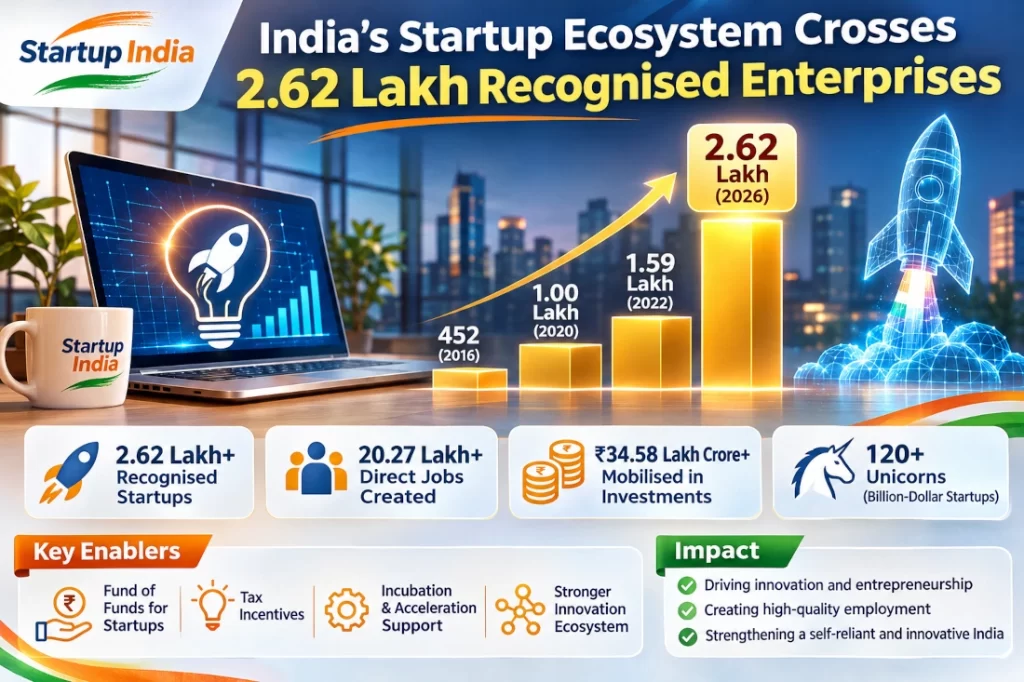
India’s startup ecosystem has crossed 2.62 lakh enterprises recognised by the Department for Promotion of Industry and Internal Trade (DPIIT), reinforcing the country’s position as the world’s third-largest startup ecosystem. The milestone, highlighted by the Government of India on National Entrepreneurship Day on 9 November 2026, reflects the rapid expansion of innovation-driven enterprises, employment generation and entrepreneurship across the country.
According to the Ministry of Skill Development and Entrepreneurship and the Press Information Bureau, DPIIT-recognised startups have generated more than 25 lakh jobs as of October 2026. The government also reported that more than 55,200 startups were recognised during the financial year 2025–26, the highest number recorded in a single financial year since the launch of the Startup India initiative in 2016.
The expansion reflects a broader transformation in India’s entrepreneurial landscape, with technology-led enterprises, manufacturing startups, rural businesses and women-led ventures contributing to economic development. Government initiatives supporting access to finance, incubation, mentorship and market opportunities have played an important role in encouraging new enterprises across sectors.
From Fewer Than 500 Startups to Over 2.62 Lakh
India’s startup ecosystem has undergone substantial expansion over the past decade. According to the government’s National Entrepreneurship Day backgrounder, the number of recognised startups has increased from fewer than 500 in 2014 to more than 2.62 lakh in November 2026.
The Startup India initiative, launched on 16 January 2016, established a national framework for encouraging innovation, simplifying regulatory procedures, supporting entrepreneurship and facilitating access to capital.
During FY 2025–26, more than 55,200 startups received DPIIT recognition, representing the highest annual recognition figure since the initiative began. The number of newly recognised startups increased by 51.6% compared with FY 2024–25, indicating continued growth in entrepreneurial activity.
The government has also highlighted the increasing participation of Indian startups in public markets, their expanding international visibility and their growing contribution to employment and industrial development.
Startups Generate More Than 25 Lakh Jobs
Employment generation has emerged as one of the most significant contributions of India’s expanding startup ecosystem.
According to government figures released on 9 November 2026, recognised startups had generated more than 25 lakh jobs by October 2026. Direct employment created during FY 2025–26 increased by 36.1% compared with the preceding financial year.
Startup employment spans a diverse range of industries, including information technology, financial services, manufacturing, healthcare, biotechnology, agriculture, logistics and digital commerce.
Technology-driven businesses have created opportunities for software developers, engineers, researchers and specialised professionals, while enterprises in manufacturing and services have contributed to demand for skilled and semi-skilled workers.
The employment impact also extends to emerging industrial clusters and smaller cities, where new enterprises are creating opportunities for local talent and supporting regional economic activity.
Entrepreneurship Expands Beyond Metropolitan Cities
One of the most important developments in India’s startup ecosystem is the increasing geographical spread of entrepreneurship.
According to the government’s latest assessment, approximately 52% of recognised startups originate from non-metropolitan cities, demonstrating that innovation and enterprise creation are no longer concentrated primarily in established metropolitan centres.
Tier-II and Tier-III cities are attracting entrepreneurs because of their expanding talent pools, comparatively lower operating costs, improving digital infrastructure and access to regional markets.
The government identified Maharashtra, Karnataka, Uttar Pradesh, Delhi and Gujarat among the leading regions for recognised startups and direct employment generation as of 31 March 2026.
The spread of entrepreneurship into smaller cities is also supporting the development of local industrial ecosystems, where technology companies, educational institutions, manufacturing enterprises and service providers can participate in innovation-led economic growth.
Women Entrepreneurs Play a Growing Role
Women are increasingly participating in India’s expanding entrepreneurial ecosystem, both as founders and as business leaders.
Government figures indicate that more than 1.07 lakh recognised startups had at least one woman director or partner as of March 2026. This represented approximately 48% of recognised startups at that time.
The Startup India Seed Fund Scheme has also supported women-led enterprises. Of the 4,194 startups approved for assistance under the scheme, 2,147 were women-led ventures.
Government programmes focusing on entrepreneurship development, financial inclusion, mentorship and access to credit are contributing to greater participation by women in enterprise creation.
The expansion of women-led entrepreneurship is particularly significant in smaller cities and rural regions, where locally established businesses can strengthen household incomes, create employment and support community-level economic development.
₹20,000 Crore Fund of Funds Framework Supports Startup Financing
Access to long-term capital remains a major component of India’s startup development strategy.
The original Fund of Funds for Startups, established under the Startup India Action Plan, has a corpus of ₹10,000 crore and is managed by the Small Industries Development Bank of India (SIDBI). The programme channels investment through SEBI-registered Alternative Investment Funds, which subsequently invest in eligible startups.
In April 2026, the government notified Startup India Fund of Funds 2.0 with a separate corpus of ₹10,000 crore. The expanded framework places particular emphasis on deep technology, innovative manufacturing and early-growth-stage enterprises.
As of October 2026, SIDBI had committed ₹12,623 crore to 166 Alternative Investment Funds under the government’s startup investment framework. These funds had invested ₹28,254 crore in 1,475 startups.
The programme is intended to strengthen the availability of domestic risk capital and encourage investment in enterprises developing new technologies, products and industrial capabilities.
Credit Guarantee Scheme Facilitates ₹1,662 Crore in Startup Loans
The Credit Guarantee Scheme for Startups provides an additional financing mechanism by facilitating collateral-free loans through eligible financial institutions.
Operational since April 2023, the scheme is designed to improve access to credit for startups that require financing for business expansion, technology development and commercial operations.
During FY 2025–26, the government increased the maximum guarantee cover per borrower from ₹10 crore to ₹20 crore, expanding the financing capacity available under the programme.
The annual guarantee fee was also reduced to 1% for 27 identified Champion Sectors, including aerospace and defence, biotechnology, railways, tourism, hospitality and financial services.
As of October 2026, the scheme had guaranteed 532 loans worth ₹1,662.71 crore to startups collectively employing 41,637 people.
These measures complement equity-based financing by providing enterprises with additional options to meet their working capital and expansion requirements.
Seed Funding Strengthens Early-Stage Innovation
The Startup India Seed Fund Scheme is another important initiative supporting entrepreneurs during the earliest stages of business development.
With a corpus of ₹945 crore, the programme provides financial assistance for proof-of-concept development, prototype creation, product trials, market entry and commercialisation.
According to the latest government figures, ₹775.67 crore had been approved for 4,194 startups through 244 incubators across 32 States and Union Territories.
The beneficiaries included 2,147 women-led startups and 2,356 enterprises from Tier-II and Tier-III cities, demonstrating the programme’s role in extending early-stage financial support beyond established startup centres.
Seed funding is particularly important for research-intensive and technology-driven enterprises, which often require substantial product development and testing before generating commercial revenue.
By connecting startups with incubators, technical expertise and early-stage capital, the programme supports the transition from innovative concepts to commercially viable products and services.
Deep Technology and Digital Innovation Gain Momentum
India’s startup ecosystem is expanding into increasingly sophisticated technological sectors, supported by specialised government initiatives and research institutions.
The Ministry of Electronics and Information Technology has established several programmes to encourage entrepreneurship in artificial intelligence, robotics, blockchain, the Internet of Things, healthcare technology and other emerging areas.
As of 9 November 2026, the MeitY Startup Hub supported an ecosystem comprising more than 6,149 startups, 518 incubators and 329 laboratories across India.
The Technology Incubation and Development of Entrepreneurs programme, known as TIDE 2.0, operates through 51 incubators located in academic institutions and national research organisations.
The programme encourages technology-driven solutions in healthcare, education, agriculture, financial inclusion, infrastructure, transportation and environmental sustainability.
Another initiative, GENESIS, has a budgetary allocation of ₹490 crore over five years and aims to support approximately 1,600 technology startups, particularly in Tier-II and Tier-III cities.
These programmes are helping connect India’s research institutions, technology entrepreneurs and industrial enterprises while encouraging the commercial development of indigenous innovations.
Atal Innovation Mission Builds the Next Generation of Entrepreneurs
Entrepreneurship development is also being supported through initiatives encouraging innovation among students and young researchers.
The Atal Innovation Mission, launched in 2016 under NITI Aayog, promotes innovation and entrepreneurial thinking across schools, universities, research institutions and industry.
The government’s approval of Atal Innovation Mission 2.0 in November 2024 provided an outlay of ₹2,750 crore up to March 2028.
The expanded programme aims to strengthen participation in innovation activities, improve support for startups and encourage entrepreneurship in regions with emerging innovation ecosystems.
By promoting problem-solving, scientific experimentation and enterprise development among younger generations, the initiative supports the creation of a broader national innovation culture.
The development of entrepreneurial skills at an early stage is also helping connect education with technological innovation and future industrial requirements.
Rural Entrepreneurship Supports Inclusive Economic Growth
India’s entrepreneurial expansion is increasingly visible in rural regions, where government programmes are supporting the establishment of small enterprises and locally relevant businesses.
The Start-up Village Entrepreneurship Programme, implemented under the Deendayal Antyodaya Yojana–National Rural Livelihoods Mission, aims to help rural households establish and expand enterprises.
According to government figures, the programme had supported approximately 4.32 lakh rural enterprises by June 2026.
The initiative provides business development assistance, training and institutional support to entrepreneurs undertaking activities suited to local economic conditions.
In August 2026, the government also launched the second National Campaign on Entrepreneurship under the rural livelihoods mission, focusing on strengthening women’s entrepreneurship and supporting the broader objective of expanding income-generating opportunities among rural households.
These initiatives demonstrate the complementary roles of innovation-driven startups and grassroots entrepreneurship in India’s economic development.
Entrepreneurship and India’s Viksit Bharat 2047 Vision
The expansion of India’s startup ecosystem to more than 2.62 lakh recognised enterprises represents a significant milestone in the country’s transition towards an increasingly innovation-driven economy.
Government initiatives supporting venture capital, credit guarantees, seed funding, incubation and technological research have helped establish an institutional framework for enterprise creation across diverse sectors.
The creation of more than 25 lakh jobs, the growing participation of women entrepreneurs and the expansion of startups beyond major metropolitan centres demonstrate the increasing reach of this ecosystem.
With new opportunities emerging in deep technology, manufacturing, biotechnology, artificial intelligence, electronics and rural enterprise development, Indian startups are becoming important contributors to technological capability, employment generation and domestic value creation.
As India works towards the Viksit Bharat 2047 vision, the continued expansion of entrepreneurship is expected to strengthen innovation, support industrial competitiveness and create new opportunities for economic participation across the country.
You may also like
-
HSBC Upgrades Indian Equities to Overweight, Citing Resilient Earnings and Attractive Valuations
-
Paras Semiconductors Partners with US Firm BroadPak to Develop Advanced Chip Packaging Capabilities in India
-
India’s $220 Billion Chemical Industry Targets $1 Trillion by 2040 as Manufacturing Capacity Expands
-
Indian Railways Plans Four-Track Expansion on Seven Major Corridors to Add Over 1,000 Trains
-
AstraZeneca to Introduce Advanced Breast Cancer Medicine Datverzo in India in November
