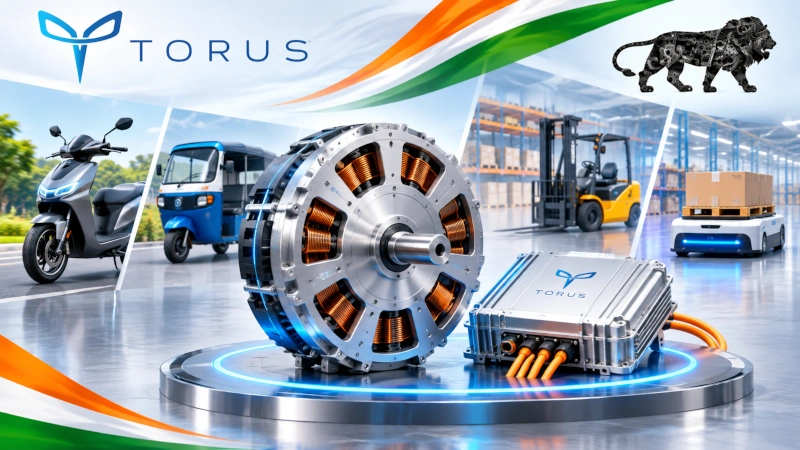
Chennai, November 5, 2026: Indian deep-technology startup Torus Motion, formerly known as Torus Robotics, is developing indigenous axial-flux electric motors and intelligent motor-control systems designed to improve the performance, efficiency and compactness of electric vehicles and industrial machinery. Based in Chennai, Tamil Nadu, the company has established a portfolio of advanced electric propulsion technologies intended for applications ranging from two-wheelers and three-wheelers to autonomous industrial vehicles, agricultural machinery and material-handling equipment.
The company’s technology focuses on an alternative electric motor architecture that offers advantages in power density, weight reduction and packaging flexibility compared with conventional radial-flux motors. By combining proprietary axial-flux motor designs with advanced electronic controllers, Torus Motion is developing integrated electric drive systems tailored to the requirements of different vehicle manufacturers and industrial equipment producers.
The development represents an important contribution to India’s emerging electric mobility and precision engineering ecosystem, where domestic startups are increasingly moving beyond vehicle assembly into the design and manufacture of critical propulsion components. Torus Motion’s work is particularly relevant to the localisation of electric powertrains, an area that requires specialised expertise in electromagnetic design, power electronics, thermal management and embedded control systems.
Indigenous Axial-Flux Technology Offers Compact Electric Propulsion
The central technology developed by Torus Motion is its axial-flux electric motor, which uses a different electromagnetic configuration from conventional radial-flux machines.
In a conventional radial-flux motor, the magnetic field generally acts radially between the rotor and stator. An axial-flux motor instead directs the magnetic field substantially parallel to the motor’s rotational axis, allowing the active electromagnetic components to be arranged in a comparatively flat, disc-shaped configuration.
This arrangement can provide advantages where available installation space, motor weight and power density are important design considerations. Axial-flux technology is particularly relevant to electric vehicles and industrial machines that require compact propulsion systems capable of delivering substantial torque.
According to Torus Motion, its proprietary motor architecture can achieve a considerably smaller physical footprint than conventional designs while maintaining high efficiency. The company describes its motors as being up to 50% more compact than comparable traditional electric motors, depending on the application and configuration.
The compact architecture can provide manufacturers with greater flexibility when designing electric vehicles, particularly where battery placement, passenger space, cargo capacity and vehicle weight must be carefully balanced.
By developing this technology domestically, Torus Motion is contributing to India’s capability to manufacture specialised electric propulsion components rather than relying exclusively on imported motor designs and integrated powertrain systems.
V1 Motor Series Targets Two-Wheelers and Light Electric Vehicles
Torus Motion has developed its V1 series of axial-flux motors for applications requiring compact dimensions, moderate power output and efficient electric propulsion.
The V1 series is offered in air-cooled and liquid-cooled configurations, with voltage options of 48V, 60V and 72V. These configurations allow manufacturers to integrate the motors with different battery systems and vehicle architectures.
According to the company’s published specifications, the air-cooled V1 motor delivers peak power of up to 7 kW and peak torque of up to 36 Nm. The liquid-cooled version increases the available peak power to 9 kW and peak torque to 40 Nm.
The company lists motor efficiency of up to 95% for these configurations, alongside IP67-rated protection against dust and water ingress under specified test conditions.
The V1 platform is intended for applications including electric motorcycles, light three-wheelers, golf carts, automated guided vehicles, go-karts and compact agricultural machinery.
These applications require propulsion systems that combine efficient power delivery with compact mechanical packaging. The availability of different cooling and voltage configurations allows the motors to be adapted to vehicles with varying performance and operating requirements.
V2 Series Expands Technology into Heavy-Duty Industrial Applications
Building upon its compact motor technology, Torus Motion has developed the V2 series for applications requiring higher power and torque.
The V2 series is designed for larger electric three-wheelers, cargo vehicles, industrial forklifts, electric tow tugs and other specialised machinery.
The air-cooled V2 configuration provides peak power of up to 15 kW and torque of up to 55 Nm, while the liquid-cooled version is rated for peak power of up to 20 kW and torque of up to 60 Nm.
These specifications position the V2 series for applications involving greater mechanical loads and demanding operating conditions.
Industrial vehicles such as forklifts and tow tractors require reliable torque delivery, controlled acceleration and efficient operation across repeated work cycles. Compact electric motors can help manufacturers optimise equipment dimensions while accommodating the batteries, mechanical systems and control electronics required for industrial operations.
Torus Motion’s V2 programme demonstrates the company’s efforts to extend indigenous axial-flux technology beyond personal electric mobility into industrial electrification.
The availability of higher-power motor configurations also creates opportunities for engineering companies developing specialised vehicles and machinery suited to Indian manufacturing, logistics and agricultural requirements.
Intelligent Motor Controllers Form an Integrated Powertrain Architecture
An important component of Torus Motion’s technology portfolio is its TESC Gen 5 intelligent motor controller platform, developed to operate with different electric motor architectures.
Electric motor controllers regulate the electrical power supplied to a motor, influencing torque delivery, rotational speed, acceleration and energy consumption. Their performance is therefore central to the overall efficiency and operating characteristics of an electric drivetrain.
Torus Motion has developed four controller families designated TESC 100, TESC 300, TESC 500 and TESC 700, covering applications from lightweight electric vehicles to more demanding industrial equipment.
The controllers support several motor technologies, including brushless DC motors, permanent magnet synchronous motors, axial-flux motors and interior permanent magnet motors. This compatibility allows the company’s electronic control technology to be used across different propulsion configurations.
The TESC platform incorporates the company’s Intelligent Current Sense Control algorithm, which is designed to optimise electrical current delivery and improve motor operating efficiency.
According to Torus Motion, the algorithm can provide an efficiency improvement of approximately 10% in specified applications. The controllers also support regenerative braking, allowing electric vehicles to recover a portion of their kinetic energy during deceleration.
Additional features include automotive-grade CAN communication, over-the-air software updates, integrated connectivity functions and monitoring capabilities that support maintenance and vehicle diagnostics.
The combination of motor hardware and intelligent electronic controls enables Torus Motion to offer complete powertrain solutions rather than individual propulsion components alone.
Integrated Drive Systems Target India’s Electric Three-Wheeler Market
Torus Motion has developed integrated electric powertrain packages specifically intended for L3 and L5 category three-wheelers.
Electric three-wheelers form an important segment of India’s electric mobility market, particularly in passenger transportation, last-mile delivery and urban commercial operations.
The company’s L3 powertrain package combines a V1 axial-flux motor with a TESC controller, mounting hardware, wiring systems and supporting integration components.
For larger L5 vehicles, Torus Motion offers an integrated system incorporating a V2 motor, intelligent controller, dual-speed automatic gearbox, digital speedometer and throttle system.
The dual-speed gearbox is intended to provide flexibility between high-torque operating conditions and more efficient cruising speeds. This arrangement is particularly relevant to commercial vehicles that must transport passengers or cargo across varying road conditions.
By supplying an integrated powertrain package, the company aims to simplify the engineering requirements faced by electric vehicle manufacturers, allowing them to incorporate propulsion systems without independently developing every motor, controller and associated component.
The approach could be particularly useful for smaller Indian vehicle manufacturers seeking domestically engineered electric propulsion technologies suited to their production requirements.
Autonomous Vehicles and Industrial Robots Provide New Applications
Beyond electric road vehicles, Torus Motion is developing propulsion solutions for automated guided vehicles and unmanned ground vehicles used in industrial environments.
These systems require accurate control over motor speed, torque and movement because their operation may involve autonomous navigation, positioning and material transportation.
The company’s integrated drive packages can incorporate axial-flux motors with planetary or cycloidal drive mechanisms, motor controllers and communication systems.
Its controller architecture supports coordinated control of multiple wheels, allowing individual electric drives to be managed through a common control framework.
The technology is relevant to warehouse automation, factory logistics, autonomous material-handling systems and specialised robotic vehicles.
Torus Motion is also targeting electric forklifts, pallet-handling equipment and industrial tow tugs, where efficient propulsion systems can support the electrification of equipment traditionally powered by internal combustion engines.
These applications demonstrate the broader potential of indigenous electric motor technology across industrial automation and manufacturing infrastructure.
Agricultural and Marine Electrification Expand Potential Applications
Torus Motion’s product portfolio also includes electric propulsion solutions intended for agricultural machinery and marine applications.
In agriculture, compact electric motors can support the development of micro-tractors, mechanised equipment and specialised vehicles used for farm operations.
Electric propulsion offers potential advantages in applications requiring controlled low-speed movement, particularly when equipment operates for relatively short periods or within defined working areas.
The company’s motor configurations are also suitable for selected electric marine applications, including small boats and watercraft.
These sectors illustrate the versatility of the underlying axial-flux architecture, which can be adapted to different operating conditions through appropriate motor sizing, cooling arrangements and electronic controls.
Developing a common technology platform for multiple industries can also support manufacturing efficiency by allowing engineering expertise and selected components to be applied across different product categories.
Chennai Startup Strengthens India’s Domestic Electric Motor Ecosystem
Torus Motion’s development activities contribute to the growth of India’s indigenous electric propulsion industry, an increasingly important component of the country’s manufacturing ecosystem.
Electric motors, electronic controllers and associated drive components represent critical technologies for electric mobility and industrial electrification.
Developing these systems domestically creates opportunities for Indian companies involved in precision machining, electromagnetic materials, power electronics, embedded software, mechanical engineering and industrial testing.
The company has received support and recognition through several Indian innovation and startup programmes, including StartupTN, the MeitY Startup Hub, SINE IIT Bombay and other technology development initiatives.
Its evolution from Torus Robotics into Torus Motion reflects a broader focus on electric propulsion technology and its applications across automotive and industrial sectors.
The company’s emphasis on proprietary motor architectures and intelligent controllers also illustrates how Indian deep-technology enterprises are developing products that address specialised engineering requirements rather than concentrating exclusively on software-driven business models.
Indigenous Electric Propulsion Supports Make in India
The development of advanced electric motor technology is increasingly important to India’s efforts to expand domestic manufacturing capabilities.
As electric mobility adoption increases, manufacturers require efficient propulsion systems suited to different vehicle categories, battery architectures and operational conditions.
Indigenous motor designs and intelligent controllers can support greater domestic value addition while creating opportunities to develop specialised components and engineering services within India.
Torus Motion’s axial-flux technology addresses this requirement through a portfolio extending from compact two-wheeler motors to higher-power systems for industrial equipment.
The company’s integrated approach combines mechanical design, electromagnetic engineering, intelligent power electronics and application-specific software within a common technology ecosystem.
This capability is relevant not only to electric vehicle manufacturers but also to industrial automation companies, agricultural equipment producers and developers of autonomous machinery.
Torus Motion’s work demonstrates the expanding contribution of Indian startups to advanced electric propulsion technologies. By developing compact axial-flux motors, intelligent controllers and integrated powertrain systems in Chennai, the company is strengthening domestic expertise in technologies central to electric mobility and industrial electrification.
The initiative contributes to India’s broader objectives of increasing indigenous manufacturing, developing high-value engineering capabilities and creating a more competitive electric vehicle supply chain under Make in India and Atmanirbhar Bharat.
You may also like
-
India’s Non-Fossil Power Capacity Reaches 308 GW as Vice President Highlights Clean Energy Progress
-
Indian Space Startup PierSight Advances Antenna Testing for Varuna 2.0 Maritime Surveillance Satellite
-
India and Italy Explore Expanded Textile Manufacturing, Technology and Investment Partnerships
-
Rekise Marine Advances Indigenous MPAUV and Jalkapi Autonomous Submarine Programmes with Sea Trials in Goa
-
Hyderabad Startup Perceptyne Develops Semi-Humanoid Robotic Platform for Precision Industrial Automation
