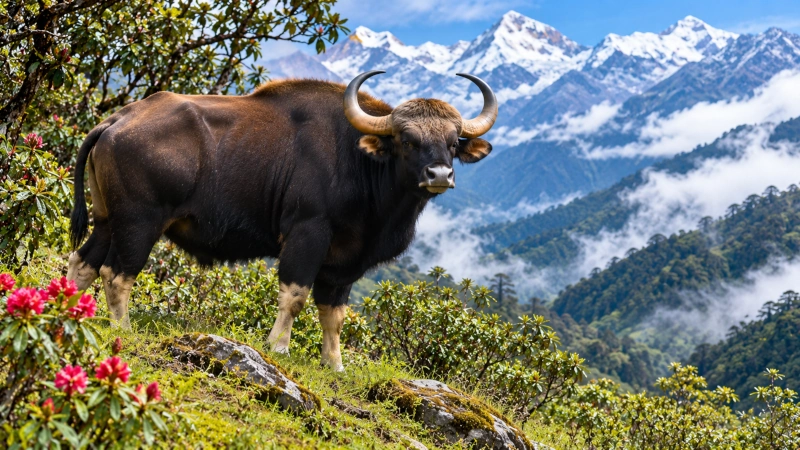
Scientists from the Wildlife Institute of India (WII) have documented the presence of a gaur (Bos gaurus) at an elevation of 3,542 metres in Pangolakha Wildlife Sanctuary, Sikkim, providing significant new scientific evidence of the species’ ability to inhabit high-altitude Himalayan landscapes. The observation forms part of an extensive camera-trap study conducted across eastern Sikkim between February 2023 and May 2026, which recorded 30 mammal species and identified several previously undocumented elevational and geographical distribution records.
The findings, published in the peer-reviewed Journal of Threatened Taxa on 26 October 2026, provide new insights into mammalian biodiversity across the eastern Himalayas. The research documented five new elevational range records and six first photographic records for eastern Sikkim, highlighting the ecological importance of mountain forests and protected landscapes that connect India with neighbouring Bhutan and Tibet.
Gaur Photographed at 3,542 Metres in Pangolakha Wildlife Sanctuary
The gaur, commonly called the Indian bison, is the world’s largest wild cattle species and is generally associated with tropical and subtropical forests, grasslands and wooded habitats. Although the animal is widely distributed across parts of South and Southeast Asia, most documented populations occur at considerably lower elevations.
Researchers recorded the gaur at 3,542 metres above sea level in Pangolakha Wildlife Sanctuary, substantially exceeding the species’ commonly documented upper elevational range of approximately 2,800 metres. The study identifies the observation as an important high-altitude photographic record, expanding scientific knowledge of the environmental conditions under which this large herbivore can occur.
The discovery is particularly significant because gaur are large-bodied grazing and browsing mammals that require suitable vegetation, water resources and access to relatively extensive habitats. Their presence at such elevations suggests that parts of the eastern Himalayan landscape provide ecological conditions capable of supporting species traditionally associated with lower and middle mountain forests.
Pangolakha Wildlife Sanctuary is situated in eastern Sikkim near the international boundary with Bhutan. Its forests and mountain habitats form part of a wider ecological landscape supporting numerous mammals, including large carnivores and threatened species. The sanctuary’s geographical position also makes it important for maintaining wildlife movement between protected areas across national boundaries.
Tiger Recorded at 3,966 Metres in Another Significant Finding
The research also documented a tiger (Panthera tigris) at an elevation of 3,966 metres in the Kyongnosla region of eastern Sikkim. The observation represents one of the highest documented elevational records for tigers in the Himalayan region and contributes to growing scientific evidence of the species’ ability to use mountainous habitats.
Although tigers are frequently associated with lowland forests, grasslands and riverine ecosystems, previous research has established their presence in several high-altitude Himalayan landscapes. Camera-trap observations from India and Bhutan have demonstrated that these large carnivores can move through remote mountain forests where suitable habitat and prey are available.
The presence of both gaur and tiger at unusually high elevations provides valuable information about the ecological relationships between large herbivores and predators in mountain environments. Gaur are among the potential prey species of tigers, although the photographic records alone do not establish direct interactions between the animals observed during the survey.
Other notable observations included sambar at 3,050 metres, clouded leopard at 3,189 metres and spotted linsang at 2,939 metres. Researchers also documented red panda and golden jackal at elevations reaching 4,100 metres, demonstrating the remarkable diversity of mammals inhabiting eastern Sikkim’s high-altitude landscapes.
Scientists Conduct More Than 20,000 Camera-Trap Nights of Field Research
The study was conducted by a research team comprising Pooja Pant, Gaurav Sonker, Anuj Joshi, Mukesh Kumar, Vineet Kumar Dubey, Govindan Veeraswami Gopi and Sambandam Sathyakumar, with researchers affiliated with the Wildlife Institute of India and the Academy of Scientific and Innovative Research.
The investigation involved 64 camera-trap stations deployed across an elevational gradient ranging from approximately 1,800 to 4,200 metres. Between February 2023 and May 2026, the equipment accumulated 20,411 camera-trap nights, providing an extensive photographic record of mammals using the landscape.
Camera traps are automated photographic devices that record animals when movement activates their sensors. They are particularly valuable in mountainous environments where dense vegetation, rugged terrain and the elusive behaviour of many species make conventional wildlife observations difficult.
The survey covered three important protected areas: Pangolakha Wildlife Sanctuary, Kyongnosla Alpine Sanctuary and Fambonglho Wildlife Sanctuary. Researchers also investigated adjoining unprotected forest landscapes to develop a broader understanding of mammalian distribution and habitat use.
The resulting photographic evidence enabled scientists to document species occurring at elevations where their presence had previously been poorly understood. The research also demonstrated the importance of sustained scientific monitoring in revealing biodiversity within remote habitats that receive relatively limited field investigation.
Eastern Himalayas Provide Suitable Habitats at Unusually High Elevations
One important aspect of the findings concerns the ecological characteristics of the eastern Himalayas. Compared with many mountain landscapes in the central and western Himalayas, the eastern Himalayan region experiences greater monsoon rainfall and generally supports forest vegetation at higher elevations.
Researchers observed that forest habitats in eastern Sikkim extend to approximately 4,000 metres above sea level. These environmental conditions may allow species normally associated with lower elevations to occupy suitable habitats considerably higher in the mountains.
The presence of continuous forest cover, diverse vegetation and connected mountain landscapes could help explain the occurrence of gaur, tigers and other mammals at the elevations documented during the study.
The research also examined the possibility that changing environmental conditions, including climate-related alterations in vegetation and temperature, may influence wildlife distribution. However, the authors emphasised that new photographic records do not necessarily demonstrate recent upward movement of animal populations.
Some of these species may have occupied high-altitude habitats for extended periods without being documented because earlier surveys were limited in geographical coverage or duration. The latest findings therefore provide an important scientific baseline for future investigations into mammalian distribution and environmental change.
Wildlife Corridors Connect India’s Himalayan Habitats with Bhutan and Tibet
The findings also highlight the conservation importance of maintaining ecological connectivity between protected areas in eastern Sikkim and adjoining landscapes across international boundaries.
Pangolakha Wildlife Sanctuary and surrounding forest regions form part of a broader Himalayan ecological network that supports the movement of large mammals. These landscapes provide habitat connections between India, Bhutan and Tibet, making them relevant to transboundary wildlife conservation.
Earlier camera-trap investigations have documented tiger movement between Sikkim and Bhutan, demonstrating the importance of protecting natural corridors used by wide-ranging carnivores. The latest study expands understanding of the mammalian diversity associated with these connected mountain habitats.
Maintaining ecological connectivity allows wildlife to move between feeding areas, breeding habitats and seasonal ranges. Such movement is especially important for species requiring extensive territories or access to habitats distributed across different elevations.
The research also demonstrates that conservation planning cannot be limited exclusively to designated protected areas. Adjoining unprotected forests may provide important movement routes and supporting habitats, contributing to the ecological continuity of the wider Himalayan landscape.
Indian Wildlife Research Expands Knowledge of Himalayan Biodiversity
The study represents an important contribution to India’s scientific understanding of mammalian biodiversity in the eastern Himalayas. By documenting 30 species across a wide elevational gradient, researchers have produced valuable information about wildlife distribution in one of the country’s most ecologically significant mountain regions.
The unusually high-altitude records of gaur and tiger are particularly noteworthy because they reveal the importance of forest habitats that have received relatively limited scientific investigation. The observations also demonstrate the effectiveness of camera-trap technology in collecting reliable evidence from difficult mountain terrain.
The research provides a foundation for examining how habitat availability, vegetation patterns, landscape connectivity and changing environmental conditions influence mammalian distribution. Long-term monitoring of the same locations can help scientists distinguish established habitat use from changes occurring over time.
The findings also reinforce the importance of combining protected-area management with scientific research across neighbouring forest landscapes. Understanding where animals occur, how they use different habitats and how they move between protected areas is essential for conserving Himalayan biodiversity.
Through this extensive field investigation, scientists from the Wildlife Institute of India have expanded the documented distribution of several mammal species in eastern Sikkim. The study highlights the remarkable biodiversity of India’s Himalayan ecosystems and provides new scientific knowledge to support wildlife conservation and ecological research across the region.
You may also like
-
Chhattisgarh Plans to Reintroduce 50 Blackbucks into Gomarda Wildlife Sanctuary After Five Decades
-
Zoological Survey of India Plays Major Role in Landmark Global Coral Reef Assessment
-
National Zoological Park Records 46 Bird Species During 67th Foundation Day Celebrations
-
Scientists Discover New Microscopic Land Snail Species in Maharashtra’s Western Ghats
-
Thousands of Butterflies Migrate Across Tamil Nadu as Northeast Monsoon Arrives
