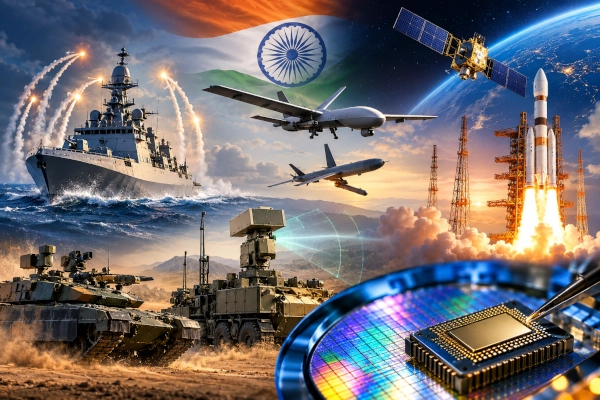
India has announced significant developments in indigenous defence innovation, military procurement and advanced space electronics, reinforcing its efforts to strengthen domestic technological capabilities. On 26 October 2026, the Indian Navy’s SWAVLAMBAN 2026 seminar, the Defence Acquisition Council’s approval of advanced military systems and new procurement notices from the Indian Space Research Organisation (ISRO) highlighted the country’s expanding requirements for sophisticated technologies.
The developments cover naval innovation, autonomous combat systems, long-range kamikaze drones, advanced anti-missile defences and specialised semiconductor components. Although the announcements concern different organisations and procurement programmes, they reflect a broader effort to build domestic capabilities in technologies essential to national security and space exploration.
The Defence Acquisition Council (DAC), chaired by Defence Minister Rajnath Singh, approved capital acquisition proposals worth approximately ₹2.12 lakh crore on 26 October. Around 82% of the proposed procurement value is expected to be sourced from Indian industry, creating substantial opportunities for public-sector defence manufacturers, private companies, startups and specialised technology developers.
SWAVLAMBAN 2026 Strengthens India’s Naval Innovation Ecosystem
The Indian Navy organised the fifth edition of its Naval Innovation and Indigenisation Seminar, SWAVLAMBAN 2026, at the Manekshaw Centre in New Delhi on 26–27 October. The event brought together representatives from the Armed Forces, defence industries, startups, micro, small and medium enterprises, research institutions and investors.
Organised in collaboration with the Defence Innovation Organisation and the Society of Indian Defence Manufacturers, the seminar focused on translating indigenous technological research into operational military capabilities. Its theme, Strength and Power through Innovation and Indigenisation, emphasised the importance of developing advanced systems within India’s defence-industrial ecosystem.
Addressing the seminar on 26 October, Defence Minister Rajnath Singh called for a new phase of technological self-reliance, described as Aatmanirbharta 2.0. He stressed the importance of developing advanced technologies, strengthening research and development, and creating resilient domestic supply chains.
The Defence Minister highlighted artificial intelligence, quantum technologies and unmanned systems as areas requiring sustained scientific research and industrial collaboration. He also emphasised that India’s defence innovation strategy must address future military requirements while encouraging technologies suitable for civilian and military applications.
An important element of the discussions concerned supply-chain resilience. The Defence Minister called for a time-bound roadmap to identify critical technologies, domestic manufacturing requirements and essential raw materials. Such planning is intended to reduce strategic vulnerabilities associated with dependence on foreign suppliers.
Indian Navy Reports Major Progress Under iDEX Innovation Programmes
Chief of the Naval Staff Admiral Krishna Swaminathan highlighted the progress achieved through the Indian Navy’s engagement with the Innovations for Defence Excellence (iDEX) initiative.
According to the Navy Chief, the number of Navy-specific iDEX challenges has increased from 20 in 2022 to 229 in 2026. These challenges account for approximately 35% of all iDEX challenges undertaken across the defence sector.
The Navy has also secured Acceptance of Necessity approvals for 41 cases valued at more than ₹3,500 crore. Additionally, 25 contracts worth over ₹1,900 crore have been signed under its innovation and indigenisation initiatives.
These figures represent cumulative progress reported at SWAVLAMBAN 2026 rather than new procurement approvals or contracts awarded exclusively on 26 October.
The expanding iDEX programme provides Indian startups and technology companies with opportunities to address operational challenges identified by the Armed Forces. The initiative encourages the development of indigenous solutions through collaboration among military users, research institutions and private enterprises.
The Navy’s growing emphasis on autonomous systems, robotics, artificial intelligence and quantum sensing demonstrates how emerging technologies are becoming increasingly important to maritime surveillance, reconnaissance and combat operations.
Indian Army Advances Indigenous Kamikaze Drone Procurement
In a separate development on 26 October, the Defence Acquisition Council approved several procurement proposals intended to strengthen the Indian Army’s operational capabilities.
Among the systems receiving Acceptance of Necessity approval were long-range kamikaze drones, surveillance unmanned aerial vehicles, integrated surveillance-and-strike systems and an Unmanned Aerial System Brick Long Range capability.
Kamikaze drones, also known as loitering munitions, combine features of unmanned aircraft and precision-guided weapons. Unlike conventional reconnaissance drones, these systems are designed to identify or receive information about targets and engage them using an onboard warhead.
Long-range loitering munitions can provide military formations with additional options for precision engagement without requiring a conventional aircraft to remain close to the target area. Their usefulness depends on factors such as endurance, navigation accuracy, targeting capability, electronic warfare resistance and integration with military command systems.
The Army’s proposed acquisition of surveillance UAVs and integrated surveillance-and-strike systems also reflects the increasing importance of connecting battlefield reconnaissance with precision engagement capabilities.
Such systems can support the collection of information about enemy movements, provide situational awareness and assist military commanders in making timely operational decisions.
The DAC approval establishes an in-principle procurement requirement. It does not confirm that contracts have been awarded or that particular manufacturers have been selected.
Counter-Drone Systems Become an Important Battlefield Requirement
The Defence Acquisition Council also approved the proposed procurement of Platform Based Counter Unmanned Aerial Systems for the Indian Army.
Counter-drone technologies have become increasingly important as unmanned aircraft are used for reconnaissance, surveillance and attacks against military installations and mobile formations.
Modern counter-UAS capabilities may employ combinations of detection sensors, tracking equipment, electronic countermeasures and interception technologies. The configuration depends on the type of threat, operational environment and protection requirements.
According to the Ministry of Defence, the proposed platform-based systems are intended to improve the survivability of tanks on the modern battlefield.
The proposed acquisition highlights the need to protect mechanised formations against emerging aerial threats while maintaining mobility and combat effectiveness.
For Indian defence manufacturers, the requirement creates potential opportunities in radar technology, electro-optical sensors, electronic warfare equipment, command systems and specialised counter-drone solutions.
However, the Ministry of Defence has not identified the companies that will eventually supply these systems.
Indian Navy Advances Advanced Anti-Missile Decoy Procurement
The Defence Acquisition Council also approved the Indian Navy’s proposal to procure Active Offboard Decoy Systems (AODS).
These systems are designed to improve the protection of naval vessels against modern anti-ship missiles. They form part of the broader range of defensive technologies used to counter weapons capable of detecting and tracking warships.
Unlike defensive systems that rely entirely on equipment installed aboard a vessel, offboard decoys operate away from the ship. Their purpose is to influence an incoming missile’s targeting process and reduce the likelihood of a successful strike against the protected platform.
Active offboard decoys can incorporate electronic technologies intended to present misleading target information to hostile missile seekers. Their effectiveness depends on the threat environment, system configuration and integration with the ship’s wider defensive capabilities.
The Ministry of Defence stated that the proposed systems would strengthen the credibility of the Navy’s anti-missile defence, particularly against modern anti-ship missiles.
The acquisition requirement is relevant to India’s naval electronics and electronic warfare industries. Developing such systems requires expertise in radio-frequency engineering, electronic countermeasures, embedded electronics and system integration.
The DAC approval also covered other major naval platforms intended for indigenous design and construction. These platforms are expected to strengthen the Navy’s maritime operational capabilities.
The government has not announced an AODS supplier or awarded a contract under the approval.
ISRO Seeks Advanced Semiconductor Technologies for Space Applications
Alongside the defence announcements, ISRO published several procurement notices on 26 October 2026 covering specialised semiconductor technologies, electronic components and advanced manufacturing services.
The requirements were issued through ISRO centres, including the Space Applications Centre in Ahmedabad and the Vikram Sarabhai Space Centre in Thiruvananthapuram.
Among the important notices was a requirement for foundry services supporting the development of indium phosphide monolithic microwave integrated circuits, commonly known as InP MMICs.
Indium phosphide is a semiconductor material used in specialised high-frequency electronic applications. Its properties make it suitable for certain microwave and millimetre-wave devices where high-speed signal processing and radio-frequency performance are important.
MMICs integrate multiple microwave circuit functions into compact semiconductor devices. Such components have applications in satellite communication systems, high-frequency receivers and advanced electronic instruments.
ISRO’s Space Applications Centre also published a procurement notice for foundry services supporting metamorphic high-electron-mobility transistor-based MMIC development.
These requirements demonstrate the organisation’s continuing demand for sophisticated semiconductor design and fabrication services.
The notices do not establish that ISRO has completed indigenous production of the specified components. They represent procurement opportunities associated with ongoing technology-development requirements.
ISRO Expands Requirements for Millimetre-Wave Electronics
Another procurement notice published by the Space Applications Centre on 26 October concerned fabrication and testing services for the development of millimetre-wave mixers and multipliers.
Millimetre-wave electronics operate at very high frequencies and are important in specialised communication, sensing and scientific applications.
Frequency mixers are used to translate signals between different frequency ranges, while frequency multipliers generate higher-frequency signals from lower-frequency inputs.
These components can support the development of sophisticated receivers, transmitters and measurement instruments used in space-related systems.
Their fabrication requires precise semiconductor processing, specialised materials and advanced testing equipment capable of characterising signals at very high frequencies.
The procurement requirement illustrates the technical demands associated with developing high-performance electronic systems for India’s space programme.
It also demonstrates the importance of specialised manufacturing and testing infrastructure within the wider electronics industry.
Vikram Sarabhai Space Centre Seeks Space-Grade MRAM
The Vikram Sarabhai Space Centre issued a procurement notice on 26 October for space-grade magnetoresistive random-access memory, commonly known as MRAM.
MRAM is a non-volatile memory technology that stores information using magnetic states rather than relying entirely on conventional charge-storage mechanisms.
Unlike volatile memory technologies, non-volatile memory can retain stored information when electrical power is removed.
This characteristic makes MRAM relevant to applications requiring reliable data retention, rapid access and efficient power management.
Space electronics must also operate under demanding environmental conditions, including substantial temperature variations, vibration during launch and exposure to radiation.
Components intended for space applications therefore require appropriate qualification and testing to establish their suitability for the intended mission environment.
The VSSC procurement notice indicates a requirement for memory components designed for such specialised applications. It does not, by itself, confirm development of an indigenous MRAM manufacturing process.
Defence and Space Programmes Share Critical Electronics Requirements
Although military systems and spacecraft perform different functions, both depend on advanced electronics and highly specialised engineering capabilities.
Modern surveillance drones require navigation equipment, communication systems, sensors and embedded processors. Naval electronic warfare systems use sophisticated radio-frequency technology and signal-processing equipment.
Satellite systems similarly depend on high-frequency communication components, reliable memory devices, precision electronics and specialised materials.
These overlapping requirements create opportunities for Indian companies developing semiconductor devices, microwave components, advanced sensors and electronic manufacturing services.
The technologies are not necessarily interchangeable, however. Defence and space applications impose different operational, environmental and qualification requirements.
For example, electronic components used aboard spacecraft may require specialised radiation tolerance and long-term reliability characteristics. Military systems must meet requirements associated with their intended operational environments, including electromagnetic interference, mechanical stress and hostile electronic activity.
Nevertheless, sustained investment in semiconductor fabrication, packaging, testing and advanced electronic design can strengthen the industrial foundation supporting both sectors.
ISRO’s procurement notices and the Armed Forces’ emerging equipment requirements illustrate the range of capabilities needed to support India’s expanding strategic technology programmes.
New Opportunities for Defence PSUs, Private Companies and Startups
The developments announced on 26 October highlight the growing importance of collaboration among government research establishments, public-sector manufacturers and private industry.
Defence public sector undertakings such as Bharat Electronics Limited, Hindustan Aeronautics Limited, Bharat Dynamics Limited and major Indian shipyards possess established capabilities across defence electronics, aerospace manufacturing, missile systems and naval platforms.
Private companies and startups are also developing expertise in unmanned systems, robotics, advanced sensors, electronic warfare technologies and specialised engineering services.
The new procurement approvals could create opportunities across these industries. However, the DAC announcements do not identify specific companies as contract recipients.
The distinction is important because Acceptance of Necessity represents an early administrative stage in the defence acquisition process. Subsequent stages may involve detailed procurement procedures, technical evaluations, commercial negotiations and contractual approvals.
Meanwhile, the iDEX framework provides a mechanism for identifying innovative technologies and supporting their development through collaboration with the Armed Forces.
At SWAVLAMBAN 2026, the Indian Navy also emphasised engagement with investors and venture capitalists to help promising defence enterprises secure financing and scale their technologies.
This approach recognises that technological development must be supported by manufacturing capacity, reliable supply chains, testing infrastructure and access to capital.
Advanced Research and Domestic Supply Chains Gain Strategic Importance
Defence Minister Rajnath Singh’s call for Aatmanirbharta 2.0 placed particular emphasis on the relationship between advanced research, industrial production and national security.
Developing sophisticated military equipment requires more than assembling finished systems. It involves establishing capabilities in critical materials, semiconductor devices, software, sensors, propulsion technologies and precision manufacturing.
Dependence on imported components can create vulnerabilities when supplies face disruption or access to specialised technologies becomes restricted.
The Defence Minister therefore stressed the importance of identifying critical technologies and developing clear timelines for achieving greater domestic self-reliance.
He also called for stronger collaboration among industry, academic institutions and research organisations to accelerate the development of technologies relevant to future military requirements.
The expanding requirements of ISRO and the Armed Forces demonstrate why investments in high-end electronics, advanced materials and indigenous manufacturing are becoming increasingly important.
A stronger domestic supply chain can support long-term technological development while providing opportunities for Indian enterprises to participate in more sophisticated segments of aerospace and defence production.
Building an Integrated Defence and Space Technology Ecosystem
The announcements of 26 October 2026 reflect India’s expanding technological requirements across defence and space.
SWAVLAMBAN 2026 demonstrated the Indian Navy’s efforts to connect operational requirements with indigenous innovation. The Defence Acquisition Council’s approvals identified new requirements for surveillance drones, long-range loitering munitions, counter-drone equipment and advanced naval missile defences.
At the same time, ISRO’s procurement notices highlighted continuing demand for specialised semiconductor technologies, millimetre-wave electronics and space-grade memory components.
Together, these developments illustrate the growing importance of domestic capabilities in autonomous systems, precision electronics, advanced manufacturing and strategic research.
The next phase of progress will depend on converting research programmes and procurement approvals into qualified technologies, competitive industrial products and operational systems.
As India’s defence and space programmes expand, sustained cooperation among research institutions, public-sector enterprises, private manufacturers and startups will play an important role in strengthening the country’s technological independence and long-term industrial capabilities.
References
1. Ministry of Defence, Government of India — 26 October 2026
Raksha Mantri Calls for Aatmanirbharta 2.0, Next Leap in Defence Self-Reliance, at SWAVLAMBAN 2026.
Official PIB release covering SWAVLAMBAN 2026, indigenous defence innovation, iDEX progress and the Defence Minister’s address.
https://www.pib.gov.in/PressReleseDetailm.aspx?PRID=2328590&lang=1®=3
2. Ministry of Defence, Government of India — 26 October 2026
DAC Clears Capital Acquisition Proposals Worth Rs 2.12 Lakh Crore for Defence Forces.
Official PIB release covering the Indian Army’s surveillance UAVs, long-range kamikaze drones, counter-UAS systems and the Indian Navy’s Active Offboard Decoy Systems.
https://www.pib.gov.in/PressReleasePage.aspx?PRID=2328486&lang=1®=3
3. Ministry of Defence, Government of India — 24 October 2026
Indian Navy’s Flagship Event SWAVLAMBAN 2026 to Focus on Emerging Technologies and Indigenous Defence Capabilities.
Official background information on the seminar’s objectives, participating organisations and innovation priorities.
https://www.pib.gov.in/PressReleseDetailm.aspx?PRID=2328089&lang=1®=3
4. Government of India — Central Public Procurement Portal, 26 October 2026
ISRO procurement notices published by the Space Applications Centre, Vikram Sarabhai Space Centre and UR Rao Satellite Centre.
https://eprocure.gov.in/epublish/app
four procurement notices were published on 26 October 2026.
You may also like
-
Indian Space-Tech Startup SpectraGaze Raises ₹3.7 Crore to Develop Indigenous Infrared Sensors
-
India’s Kaynes Space Partners with WISeSat to Develop Quantum-Secure Satellites
-
India Advances Tracked Artillery Procurement, Creating Opportunities for Domestic Defence Manufacturers
-
DAC Approves ₹20,000 Crore Procurement of 200 Light Multi-Role Helicopters for Indian Army and Air Force
-
HAL Demonstrates Maximum-Weight Autorotation Landing Capability of Indigenous Light Utility Helicopter
