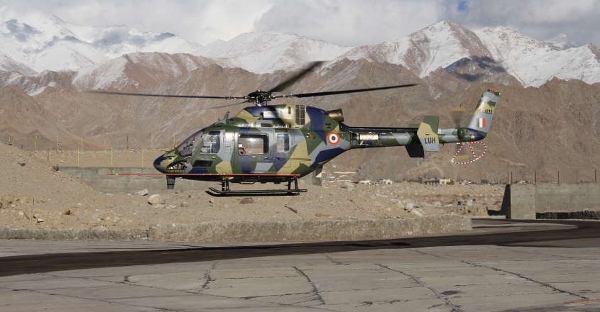
Hindustan Aeronautics Limited (HAL) has successfully demonstrated the autorotation landing capability of its indigenously developed Light Utility Helicopter (LUH) at maximum all-up weight, marking an important milestone in the aircraft’s ongoing flight-testing and military certification programme. The demonstration represents a significant step towards validating the helicopter’s emergency landing characteristics under demanding operating conditions.
The development was reported on 26 October 2026, following an announcement by HAL highlighting its continuing efforts to strengthen the safety, reliability and operational performance of the indigenous helicopter. The demonstration forms the first part of a series of tests aimed at evaluating and improving the LUH’s emergency recovery capabilities.
The Light Utility Helicopter is being developed to meet the operational requirements of the Indian Army and Indian Air Force, particularly for missions in mountainous regions and other challenging environments. The aircraft is expected to progressively replace the ageing Cheetah and Chetak helicopters currently operated by the armed forces.
Demonstrating Emergency Landing Capability at Maximum Weight
The latest demonstration focused on autorotation, an essential emergency flight procedure that allows a helicopter to descend and land in a controlled manner following a loss of engine power.
Unlike conventional powered flight, autorotation relies on airflow passing upward through the main rotor during descent to maintain rotor rotation. This enables the pilot to retain a degree of control over the helicopter’s flight path and use the energy stored in the rotating blades to reduce the rate of descent before touchdown.
The manoeuvre is particularly important for single-engine helicopters, where the loss of engine power requires pilots to respond rapidly and execute a controlled emergency descent.
HAL conducted the demonstration at the helicopter’s maximum all-up weight, which includes the combined weight of the aircraft, crew, fuel and payload within the applicable operating limits. Evaluating autorotation performance under this loading condition helps engineers assess the helicopter’s handling characteristics, rotor energy management and landing behaviour under demanding circumstances.
Successful completion of the demonstration provides valuable flight-test data for assessing the aircraft’s emergency recovery performance. However, the demonstration does not establish that every emergency landing scenario has been validated or that the helicopter has received final military certification.
Indigenous Helicopter Designed for Challenging Indian Conditions
The Light Utility Helicopter is a new-generation, three-tonne-class, single-engine helicopter designed and developed by HAL’s Rotary Wing Research and Design Centre.
The helicopter has been developed to undertake a range of military and utility missions, including reconnaissance, surveillance, personnel transportation, logistical support, casualty evacuation and operations in high-altitude regions.
One of the aircraft’s principal design objectives is to provide the Indian armed forces with a modern light helicopter capable of operating in the demanding geographical and climatic conditions encountered across the country.
The LUH is particularly relevant to military operations in the Himalayan region, where difficult terrain, high-altitude landing sites and rapidly changing weather conditions impose considerable demands on helicopters and their crews.
The aircraft is powered by a Safran Ardiden 1U turboshaft engine, rated at approximately 750 kilowatts. The helicopter incorporates modern avionics, a glass cockpit, composite rotor blades and a Health and Usage Monitoring System designed to support operational reliability and maintenance.
HAL has also incorporated crashworthy design features and advanced flight systems intended to improve aircraft safety and operational effectiveness.
Continued Research into Autorotation Characteristics
The latest demonstration forms part of a broader programme to understand and improve the LUH’s autorotation performance.HAL has previously initiated specialised research into the helicopter’s autorotation characteristics in collaboration with the Indian Institute of Technology Madras.
According to HAL’s procurement disclosures, an order was placed with IIT Madras in September 2024 for an investigation into the helicopter’s height-velocity characteristics and autorotation behaviour.
The research involved developing a mathematical flight-dynamics model using aerodynamic data supplied by HAL’s Rotary Wing Research and Design Centre. Such investigations are important because the ability of a helicopter to execute a successful autorotation landing depends on several factors, including altitude, airspeed, rotor characteristics, aircraft weight and available landing conditions.
The height-velocity envelope identifies combinations of altitude and airspeed where a helicopter may have limited opportunities to complete a safe emergency landing following an engine failure. Research and flight testing in these areas help engineers understand the aircraft’s operational limitations and support the development of appropriate emergency procedures.
Progress Towards Military Certification
The Light Utility Helicopter has undergone an extensive development and evaluation programme involving ground testing, endurance testing, system integration and flight trials under different environmental conditions.
The Army variant received Initial Operational Clearance from the Centre for Military Airworthiness and Certification in February 2021, marking an important achievement in the helicopter’s development.
However, additional testing, system improvements and certification activities have continued as HAL prepares the aircraft for operational deployment. The ongoing programme includes efforts to refine autorotation characteristics and integrate an automatic flight control system intended to improve aircraft stability and reduce pilot workload.
The latest maximum-weight autorotation demonstration represents further progress in this process, although HAL has not publicly disclosed the detailed performance margins achieved during the test. Final military certification and subsequent operational induction will depend on completion of the remaining applicable requirements.
Strengthening India’s Indigenous Rotary-Wing Capability
The development of the Light Utility Helicopter forms an important component of India’s efforts to strengthen indigenous aerospace design, development and manufacturing capabilities.
The Indian armed forces have relied on Cheetah and Chetak helicopters for decades, particularly for reconnaissance, communication, transportation and logistical support missions in remote areas.
Although these helicopters have provided valuable service in difficult operational environments, their ageing technology and maintenance requirements have reinforced the need for modern replacements.
The LUH programme seeks to address this requirement through a domestically developed helicopter tailored to Indian operational conditions.
Beyond replacing older helicopters, the programme is contributing to the development of indigenous expertise in helicopter aerodynamics, rotor systems, flight controls, avionics integration, testing and airworthiness certification.
The experience gained through the LUH programme could also support future helicopter development initiatives undertaken by HAL and the broader Indian aerospace industry.
The successful demonstration of autorotation landing capability at maximum all-up weight represents another step in the indigenous helicopter’s development. As further trials and certification activities continue, the programme remains an important element of India’s efforts to modernise its military helicopter fleet and strengthen domestic aerospace capabilities.
References:
- RNA Defence, 26 October 2026 – HAL Tests LUH Emergency Landing Capability at Maximum Weight as Certification Continues.
https://www.rnamedia.in/defence-industry/hal-tests-luh-emergency-landing-capability-at-maximum-weight-as-certification-continues/25125 - Hindustan Aeronautics Limited (HAL) – Official Website.
https://hal-india.co.in/ - Hindustan Times, 13 October 2026 – Light Utility Helicopter Enters Final Stages of Certification.
https://www.hindustantimes.com/india-news/light-utility-helicopter-enters-final-stages-of-certificationofficials-101791900286409.html
You may also like
-
India Advances Tracked Artillery Procurement, Creating Opportunities for Domestic Defence Manufacturers
-
DAC Approves ₹20,000 Crore Procurement of 200 Light Multi-Role Helicopters for Indian Army and Air Force
-
Indian Navy’s First Training Squadron Arrives in Colombo to Strengthen Maritime Cooperation
-
Indian Navy Launches First Indigenous Sullage Barge, Begins Construction of Two More Vessels in Thane
-
Indian Navy’s Next Generation Offshore Patrol Vessel Srishti Launched at Goa Shipyard
