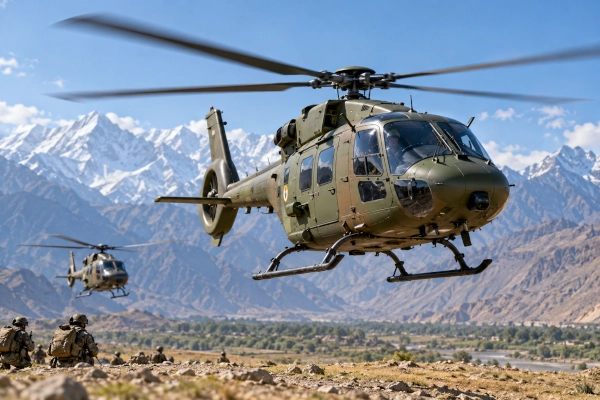
India has taken a major step towards modernising its military helicopter fleet, with the Defence Acquisition Council (DAC) granting in-principle approval for the procurement of Light Multi-Role Helicopters (LMRH) for the Indian Army and Indian Air Force. The proposed acquisition, reportedly involving 200 helicopters at an estimated cost of ₹20,000 crore, is intended to strengthen reconnaissance, surveillance, combat support and emergency response capabilities while replacing ageing Cheetah and Chetak helicopters.
The approval was granted during a meeting of the Defence Acquisition Council chaired by Defence Minister Rajnath Singh on 26 October 2026. The meeting cleared capital acquisition proposals worth approximately ₹2.12 lakh crore for the Indian armed forces, covering helicopters, artillery systems, air defence equipment, unmanned aerial vehicles and advanced military platforms.
According to the Ministry of Defence, the council accorded Acceptance of Necessity (AoN) to the proposed acquisitions, providing the administrative approval required to advance the procurement process. The Light Multi-Role Helicopter programme forms an important component of the broader effort to modernise India’s military aviation capabilities.
Defence officials cited by news agency ANI indicated that the helicopter acquisition would involve approximately 200 aircraft, with an estimated programme value of ₹20,000 crore. While the Ministry of Defence has officially confirmed the LMRH procurement approval, the precise quantity and financial valuation were not separately specified in its announcement.
New Helicopters for the Indian Army and Indian Air Force
The proposed Light Multi-Role Helicopters are intended to meet a wide range of operational requirements across the Indian Army and Indian Air Force.
According to the Ministry of Defence, the helicopters will undertake reconnaissance and surveillance, combat-related missions, search and rescue operations involving military personnel, and humanitarian assistance and disaster relief activities.
These capabilities are particularly important for the Indian armed forces, which operate across diverse geographical environments ranging from high-altitude Himalayan regions to deserts, forests and coastal areas.
Light helicopters provide essential mobility in locations where larger aircraft may face operational limitations. Their relatively compact dimensions and operational flexibility make them useful for reconnaissance, transportation, communications support and emergency evacuation missions.
The acquisition is expected to strengthen the armed forces’ ability to conduct these operations using modern aircraft equipped with improved avionics, navigation systems and mission equipment.
Detailed technical specifications, including engine configuration, payload capacity, operating ceiling and mission-system requirements, will depend on the final procurement documentation and selection process.
Replacing the Ageing Cheetah and Chetak Helicopter Fleets
One of the principal objectives of the proposed procurement is to replace the ageing Cheetah and Chetak helicopters that have served the Indian armed forces for several decades.
These helicopters have played an important role in military operations, particularly in mountainous and remote regions where aviation support is essential for sustaining forward deployments.
The Cheetah helicopter has been extensively employed for high-altitude missions, including operations in the Himalayan region. Its ability to operate in difficult terrain has made it a valuable platform for reconnaissance, logistical assistance and personnel transportation.
The Chetak helicopter has similarly supported training, reconnaissance, communication and general utility missions across the armed forces.
However, the continued operation of these older aircraft presents challenges associated with maintenance, availability, ageing components and limitations in their original designs.
The proposed Light Multi-Role Helicopter programme is intended to introduce modern replacements capable of undertaking similar missions with improved operational effectiveness and contemporary aviation technology.
The acquisition will also contribute to the gradual modernisation of India’s light helicopter fleet, reducing dependence on aircraft designs that entered service several decades ago.
Major Opportunity for Indian Aerospace Manufacturing
A significant feature of the proposed procurement is its emphasis on manufacturing the helicopters in India.
According to defence officials quoted in media reports, the acquisition is expected to involve Indian aerospace companies working with international helicopter manufacturers to establish domestic production and assembly capabilities.
Among the potential industry combinations identified in defence reporting are Tata Advanced Systems Limited in partnership with Airbus and Adani Defence and Aerospace in association with Leonardo.
American manufacturer Bell has also been mentioned as a potential participant in the competition.
However, these companies have not been formally selected for the programme, and no manufacturing contract has been awarded.
Reports indicate that the proposed acquisition could be divided between two successful bidders, potentially resulting in the establishment of separate helicopter assembly and manufacturing facilities in India.
Such an arrangement, if adopted, could encourage competition, expand industrial capacity and strengthen the domestic aerospace manufacturing ecosystem.
The final procurement structure, industrial participation requirements and manufacturing arrangements will be determined through the subsequent acquisition process.
Strengthening India’s Private-Sector Aerospace Industry
The Light Multi-Role Helicopter programme could provide an important opportunity for Indian private-sector companies to expand their involvement in military aviation manufacturing.
India’s aerospace industry has traditionally relied heavily on Hindustan Aeronautics Limited for the development and production of military aircraft and helicopters.
However, the government has increasingly encouraged private-sector participation in defence manufacturing through industrial partnerships, technology collaboration and domestic production initiatives.
Large-scale helicopter manufacturing requires specialised capabilities in aerostructures, mechanical systems, avionics integration, electrical equipment, precision engineering, testing and maintenance support.
Establishing production facilities for the LMRH programme could create opportunities for Indian manufacturers, component suppliers and engineering companies to participate in the helicopter supply chain.
Industrial partnerships may also support workforce training, technical skill development and the expansion of domestic maintenance, repair and overhaul capabilities.
The extent of indigenous manufacturing and technology transfer will depend on the contractual arrangements and procurement conditions eventually approved by the government.
Part of ₹2.12 Lakh Crore Defence Modernisation Programme
The Light Multi-Role Helicopter acquisition was among several major proposals approved by the Defence Acquisition Council during its meeting on 26 October 2026.
The council accorded Acceptance of Necessity to capital acquisition proposals worth approximately ₹2,12,000 crore for the Indian Army, Indian Navy and Indian Air Force.
For the Indian Army, the approvals included High Mobility Vehicles, Self-Propelled Tracked Gun Systems, Gun Shot Response Systems, Very Short-Range Air Defence Systems and platform-based Counter-Unmanned Aerial Systems.
The council also approved proposals involving long-range unmanned aerial systems, surveillance drones, integrated surveillance and strike systems, and long-range kamikaze drone systems.
For the Indian Navy, the approvals included Active Offboard Decoy Systems and other major naval platforms intended to strengthen maritime combat capabilities.
The Indian Air Force received approvals for helicopters, air defence systems, weapons and Mobile X-Band Doppler Weather Radar Systems.
According to the Ministry of Defence, approximately 82 per cent of the proposed acquisitions are expected to be sourced from Indian industry.
This emphasis on domestic procurement reflects the government’s continuing efforts to strengthen India’s defence industrial base and expand indigenous manufacturing capabilities.
Acceptance of Necessity Marks the Beginning of Procurement
Although the DAC approval represents an important milestone, the Light Multi-Role Helicopter programme has not yet reached the contract-award stage.
Acceptance of Necessity is an in-principle administrative approval that establishes the requirement for a proposed defence acquisition and permits the procurement process to advance.
The subsequent stages may include the issuance of procurement documents, submission of bids, technical evaluation, field trials where applicable, commercial negotiations and final government approval.
Only after these procedures are completed can contracts be concluded with the selected manufacturers. Consequently, the approval does not mean that 200 helicopters have already been ordered or that production and delivery schedules have been finalised.
The programme’s eventual cost, participating manufacturers, delivery timelines and domestic manufacturing arrangements will become clearer as the acquisition process progresses.
Advancing India’s Military Aviation Capabilities
The proposed acquisition of 200 Light Multi-Role Helicopters represents a significant effort to address the Indian armed forces’ longstanding requirement for modern light utility aircraft.
The programme is expected to improve operational flexibility across a broad range of missions while facilitating the gradual replacement of older helicopter platforms.
Its emphasis on domestic manufacturing could also encourage greater participation by Indian aerospace companies and support the development of specialised industrial capabilities.
For the Indian Army and Indian Air Force, the proposed helicopters would provide additional aviation resources for surveillance, reconnaissance, operational support and emergency response activities.
The Defence Acquisition Council’s approval on 26 October 2026 marks an important step towards fulfilling these requirements.
As the programme advances through the procurement process, its implementation will be closely linked to India’s broader objectives of military modernisation, industrial development and greater self-reliance in defence manufacturing.
1. Ministry of Defence – Press Information Bureau, 26 October 2026
DAC Clears Capital Acquisition Proposals Worth ₹2.12 Lakh Crore for Defence Forces.
https://www.pib.gov.in/PressReleasePage.aspx?PRID=2328486
2. The Economic Times, 27 October 2026
Defence Ministry Clears ₹2.12 Lakh Crore Military Acquisitions, Including 200 Helicopters.
https://economictimes.indiatimes.com/news/defence/defence-ministry-clears-2-12-lakh-crore-military-acquisitions-including-200-helicopters/articleshow/135218276.cms
3. DD India, 26 October 2026
DAC Clears Defence Acquisition Proposals Worth ₹2.12 Lakh Crore; 82% Procurement from Indian Industry.
https://ddindia.co.in/2026/10/dac-clears-defence-acquisition-proposals-worth-rs-2-12-lakh-crore-82-procurement-from-indian-industry
You may also like
-
India Advances Tracked Artillery Procurement, Creating Opportunities for Domestic Defence Manufacturers
-
HAL Demonstrates Maximum-Weight Autorotation Landing Capability of Indigenous Light Utility Helicopter
-
Indian Navy’s First Training Squadron Arrives in Colombo to Strengthen Maritime Cooperation
-
Indian Navy Launches First Indigenous Sullage Barge, Begins Construction of Two More Vessels in Thane
-
Indian Navy’s Next Generation Offshore Patrol Vessel Srishti Launched at Goa Shipyard
