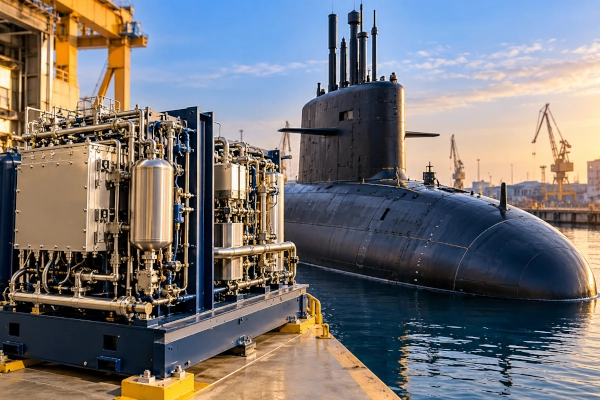
India has achieved an important milestone in its indigenous submarine technology programme with the inauguration of the Setting to Work Phase-2 (STW-2) activity for the Air Independent Propulsion (AIP) Energy Module developed by the Defence Research and Development Organisation (DRDO). The development marks another step towards equipping the Indian Navy’s diesel-electric submarines with an advanced propulsion-support system capable of extending their underwater endurance.
The programme, led by DRDO’s Naval Materials Research Laboratory (NMRL), seeks to reduce the dependence of conventional submarines on atmospheric oxygen during submerged operations. The latest milestone brings the indigenous AIP Energy Module closer to its planned integration aboard a Kalvari-class submarine in early 2027, subject to the successful completion of the remaining tests and validation procedures.
DRDO Inaugurates Second Phase of AIP System Testing at L&T Hazira
The inauguration ceremony took place on October 24, 2026, at Larsen & Toubro’s A. M. Naik Heavy Engineering Complex in Hazira, Gujarat. The facility serves as an important industrial centre for the development, assembly and testing activities associated with the indigenous AIP programme.
Defence Secretary and Chairman of DRDO Rajesh Kumar Singh attended the ceremony virtually as the chief guest. Vice Admiral B. Sivakumar, Chief of Materiel of the Indian Navy, and Dr R. Balamuralikrishnan, Director General (Naval Systems & Materials), DRDO, participated in the event at the Hazira facility.
The commencement of STW-2 represents progress in preparing the AIP Energy Module for its next stage of operational validation. During this phase, engineers will energise the module for power generation and undertake rigorous testing to establish its readiness for integration with the submarine platform.
The testing programme will follow protocols prescribed by the Indian Navy, with particular emphasis on the reliability, performance and safety of the hydrogen-based fuel-cell technology employed in the system.
Understanding India’s Indigenous Air Independent Propulsion Technology
Air Independent Propulsion technology enables conventional diesel-electric submarines to generate electrical power while submerged without relying continuously on atmospheric oxygen. This capability addresses a major operational limitation of traditional diesel-electric submarines, which must periodically approach the surface or use a snorkel to operate their diesel generators and recharge their batteries.
India’s indigenous AIP programme uses fuel-cell technology developed by NMRL. A fuel cell generates electricity through an electrochemical reaction between hydrogen and oxygen. Unlike conventional combustion-based power generation, this process produces electrical energy without burning fuel in an engine.
The electricity generated by an AIP system can support a submarine’s propulsion and onboard electrical requirements, allowing it to remain submerged for longer periods while reducing the frequency of snorkelling operations.
Conventional submarines equipped with AIP retain their diesel-electric propulsion architecture but gain an additional source of underwater electrical power. Although AIP does not provide the sustained high-power performance of nuclear propulsion, it offers significant advantages for extended submerged operations at suitable operating speeds.
Enhancing the Underwater Endurance of Kalvari-Class Submarines
The planned integration of India’s indigenous AIP system with a Kalvari-class submarine represents an important technological upgrade for the Indian Navy’s conventional underwater fleet.
The Kalvari-class submarines, based on the Scorpene design, were constructed in India by Mazagon Dock Shipbuilders Limited (MDL) under Project-75 through technology cooperation with France’s Naval Group. These submarines form an important component of India’s underwater combat capability and support a wide range of maritime security missions.
Their diesel-electric propulsion systems rely on onboard batteries for submerged operations. Recharging these batteries through diesel generators requires access to atmospheric oxygen, ordinarily obtained through snorkelling. This operational requirement can increase the possibility of detection by hostile surveillance systems.
An AIP-equipped submarine can reduce its need to snorkel by generating additional electrical power underwater. The resulting improvement in submerged endurance can support prolonged patrols, underwater surveillance and other missions that benefit from remaining concealed.
For the Indian Navy, the indigenous AIP programme therefore offers a pathway to improving the operational effectiveness of existing conventional submarines through the integration of domestically developed technology.
Indian Navy and DRDO Focus on Safety and System Validation
Addressing the inauguration ceremony, DRDO Chairman Rajesh Kumar Singh congratulated the scientists, engineers and industrial partners associated with the programme. He praised their scientific perseverance and the cooperation between research institutions and Indian industry that has brought the indigenous AIP system to its present stage of development.
The DRDO Chairman also acknowledged the Indian Navy’s contribution throughout the programme, particularly its involvement in testing and validation at successive stages. The Navy’s participation has helped align the system’s development with operational requirements and the demanding safety standards associated with submarine equipment.
Singh emphasised the importance of maintaining the programme’s momentum towards the Navy’s planned induction timelines. At the same time, he stressed that the stringent safety culture required for hydrogen and fuel-cell systems must remain uncompromised during subsequent development and testing activities.
The emphasis on safety reflects the complex engineering requirements of operating fuel-cell-based power systems within the confined environment of a submarine. Hydrogen handling, electrical system reliability and the integration of multiple onboard subsystems require careful evaluation before the equipment can be accepted for installation.
AIP Energy Module Scheduled for Power Generation Trials
The next stage of the programme will involve energising the indigenous AIP Energy Module for power production. Engineers will subject the system to comprehensive trials in accordance with the Indian Navy’s testing protocols.
These activities will provide an opportunity to evaluate the module’s power generation performance and verify the safe operation of its associated systems. The results will form part of the technical assessment required before the equipment advances to submarine integration.
Following successful completion of the prescribed testing programme, the AIP Energy Module is scheduled for handover to Mazagon Dock Shipbuilders Limited in early 2027. The shipyard will undertake the subsequent integration activities aboard a Kalvari-class submarine.
The distinction between the present milestone and the planned integration is significant. The inauguration of STW-2 marks the beginning of a further testing phase rather than the completion of submarine installation or operational induction.
Indigenous AIP Programme Strengthens India’s Defence Manufacturing Ecosystem
The development of an indigenous Air Independent Propulsion system demonstrates the growing cooperation between DRDO laboratories, Indian defence manufacturers and the Indian Navy in developing advanced maritime technologies.
NMRL’s role in developing the AIP technology, Larsen & Toubro’s participation in industrial implementation and MDL’s planned involvement in submarine integration illustrate the complementary capabilities required for a complex naval engineering programme.
Such cooperation allows research institutions to translate laboratory-developed technologies into engineered systems suitable for demanding defence applications. It also strengthens domestic expertise in fuel-cell engineering, specialised materials, system integration, power management and safety validation.
The indigenous development of these capabilities aligns with India’s broader efforts to strengthen self-reliance in critical defence technologies. Submarine propulsion and underwater power generation are particularly important areas because they involve specialised engineering expertise, rigorous testing requirements and long-term maintenance considerations.
Successful integration of the AIP system would provide India with greater domestic capability to support and upgrade advanced equipment installed aboard its conventional submarine fleet.
Towards Indigenous AIP Integration in 2027
The inauguration of Setting to Work Phase-2 at Hazira marks a substantial step in India’s effort to introduce indigenous Air Independent Propulsion technology into the Indian Navy’s conventional submarine fleet.
With the AIP Energy Module approaching its power generation trials, the programme has entered a critical stage that will determine its readiness for transfer to Mazagon Dock Shipbuilders Limited. The planned integration aboard a Kalvari-class submarine in early 2027 provides the next major milestone for the development effort.
The progress achieved by DRDO, the Indian Navy and participating industrial partners reflects India’s expanding capabilities in sophisticated underwater technologies. As the programme advances through testing and integration, it will further strengthen the technological foundation supporting the country’s long-term maritime security and indigenous submarine development ambitions.
References
1. Press Information Bureau, Ministry of Defence, Government of India.
Indigenous AIP system for Indian Navy’s diesel-electric submarines achieves key milestone with inauguration of Setting to Work Phase-2 Activity.
Published: October 24, 2026, 6:53 PM IST.
Official website: https://pib.gov.in
2. Defence Research and Development Organisation (DRDO).
Naval Materials Research Laboratory — Indigenous Air Independent Propulsion technology development.
Official website: https://drdo.gov.in
3. Mazagon Dock Shipbuilders Limited.
Project-75 and Kalvari-Class Submarine Construction Programme.
Official website: https://mazagondock.in
You may also like
-
Zen Technologies Introduces Indigenous Hyper-Strike Falcon AI-Guided Counter-Drone Interceptor
-
L&T and Germany’s SCHOTTEL Expand Partnership for Controllable Pitch Propeller Systems in Indian Shipbuilding
-
India to Train 60,000 Civil Defence Volunteers Across 12 States and UTs with Indian Army Support
-
Indian Army’s Northern Command Opens 75-Day Defence Technology Internship Programme for Young Innovators
-
India Emerges as Major Arms Supplier to Europe, Defence Secretary Highlights Surge in Ammunition Exports
