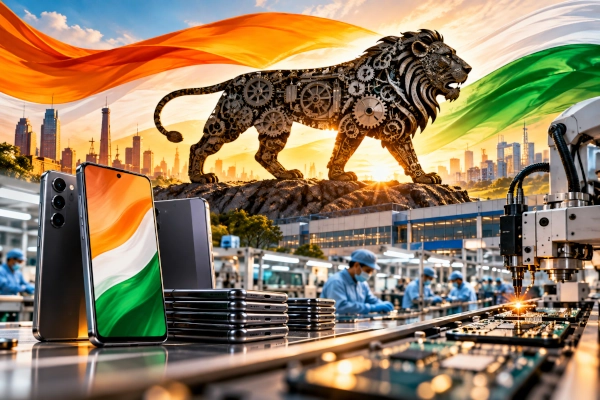
India is preparing to enter a new phase of electronics manufacturing, with Union Minister for Electronics and Information Technology Ashwini Vaishnaw expressing confidence that the country will have mobile phones designed and manufactured domestically and sold under Indian-owned brands by October 2028.
Speaking at a summit in New Delhi on 23 October 2026, Vaishnaw highlighted India’s growing technological capabilities and its ambition to move beyond manufacturing products for international companies towards developing globally competitive indigenous brands. The announcement reflects the government’s broader strategy to strengthen domestic product design, research, intellectual property ownership and advanced electronics manufacturing.
The initiative builds upon India’s rapid transformation into one of the world’s largest mobile phone manufacturing centres. The next stage seeks to establish stronger Indian ownership across the electronics value chain, including product development, technology, manufacturing and branding.
Ashwini Vaishnaw Sets October 2028 Goal for Homegrown Mobile Phone Brands
Addressing the summit, Ashwini Vaishnaw expressed confidence that India would develop mobile phones designed and manufactured in the country and marketed under Indian-owned brands by October 2028. The minister’s remarks highlighted the transition India is seeking from large-scale electronics production towards domestic ownership of technology and finished products.
India already manufactures mobile phones for several international brands, supported by an extensive network of factories, component suppliers and electronics manufacturing service providers. However, manufacturing a product in India does not necessarily mean that its underlying design, intellectual property or brand belongs to an Indian company.
The government’s next objective is to strengthen Indian participation in these higher-value activities. This involves encouraging domestic companies to develop their own product designs, undertake research and development, create intellectual property and compete in domestic and international markets.
Vaishnaw’s announcement represents an industry-development ambition rather than confirmation that a particular new brand has completed product development or announced a commercial launch for October 2028.
India Emerges as World’s Second-Largest Mobile Phone Manufacturer
India has established itself as the world’s second-largest mobile phone manufacturer by production volume, reflecting the expansion of domestic manufacturing over the past decade.
According to the Ministry of Electronics and Information Technology, approximately 99.2% of mobile phones used in India are now manufactured domestically. The country has also transformed from a net importer of mobile phones into a net exporter, supported by sustained investments in manufacturing facilities, supply chains and industrial infrastructure.
The government’s official assessment indicates that electronics manufacturing has expanded approximately sevenfold since FY 2014–15, while electronics exports have increased elevenfold over the same period.
Mobile phones have played an important role in this transformation. The expansion of domestic assembly and manufacturing operations has created employment opportunities, attracted industrial investment and supported the development of an increasingly extensive electronics supply chain.
Smartphones also emerged as India’s leading individual exported product category in 2025, according to the government’s August 2026 announcement. This development demonstrates the growing importance of mobile phone manufacturing within India’s export economy.
The next challenge is to deepen the country’s domestic contribution to the technology, design and components used in these products.
Government Launches ₹62,500 Crore Mobile Phone Manufacturing Scheme
The Union Government has introduced the Mobile Phone Manufacturing Scheme (MPMS) with a budgetary outlay of ₹62,500 crore to strengthen India’s mobile manufacturing ecosystem and encourage the development of Indian-owned brands.
The Union Cabinet approved the scheme on 15 July 2026, and the Ministry of Electronics and Information Technology formally notified it on 21 August 2026.
The five-year programme will operate from FY 2026–27 to FY 2030–31. It aims to expand manufacturing capacity, improve global competitiveness, increase domestic value addition and strengthen the resilience of India’s electronics supply chains.
Unlike manufacturing incentives focused primarily on production volumes, the new programme also recognises the importance of developing Indian-owned brands and intellectual property.
The scheme establishes two distinct target segments. The first supports mobile phone manufacturing, while the second specifically encourages the development and expansion of Indian mobile phone brands.
This structure allows the government to support the continued growth of large-scale manufacturing while directing additional incentives towards companies seeking to develop domestic product ownership and design capabilities.
New Incentives Encourage Indian-Owned Technology and Intellectual Property
An important feature of the Mobile Phone Manufacturing Scheme is its emphasis on genuine Indian ownership of mobile phone brands, product design and intellectual property.
Under the scheme, eligible Indian mobile phone brands can receive an incentive of 5% on qualifying sales. An additional incentive of 3% is available for Indian design and research and development activities.
These provisions aim to encourage companies to move beyond contract manufacturing and develop their own technological capabilities.
The scheme also establishes eligibility requirements for companies seeking support under its Indian-brand segment. Applicants must be incorporated in India, hold their intellectual property and trademarks within the country, and maintain management control with Indian citizens.
More than 51% of the company’s shareholding must be held by Indian citizens. Eligible businesses must also possess in-house research and development and design capabilities in India.
The Ministry has emphasised that genuine ownership of design and intellectual property is essential. Simply assembling imported products and marketing them under an Indian name would not automatically satisfy the scheme’s requirements.
These conditions seek to ensure that government incentives encourage the development of substantial domestic technological capabilities and commercially competitive Indian enterprises.
Domestic Component Manufacturing Becomes a Major Priority
India’s electronics manufacturing strategy increasingly focuses on strengthening the domestic production of components and subassemblies used in mobile phones.
While the country has developed substantial manufacturing capacity for finished devices, many sophisticated electronic components continue to depend on international supply chains. Increasing domestic value addition is therefore essential for retaining a greater share of manufacturing value within India.
The Mobile Phone Manufacturing Scheme provides an additional incentive of up to 1.5% for the domestic sourcing of specified components and subassemblies. The incentive applies when qualifying domestically sourced components are incorporated into at least 25% of the mobile phone units manufactured during a financial year, subject to the scheme’s conditions.
This provision encourages manufacturers to expand procurement from Indian suppliers and support the development of local component production facilities.
Important elements of the mobile phone supply chain include printed circuit boards, display assemblies, camera modules, battery systems, electronic connectors and other precision components.
Developing competitive domestic manufacturing capabilities in these areas can strengthen supply-chain resilience, generate industrial employment and support the emergence of specialised Indian electronics companies.
The government’s broader Electronics Components Manufacturing Scheme also contributes to this objective by encouraging investment in critical parts of the electronics manufacturing ecosystem.
Indigenous Mobile Brands Could Strengthen India’s Electronics Value Chain
The development of Indian-owned mobile phone brands would represent a further stage in the country’s electronics industrialisation.
Large-scale manufacturing creates value through production, assembly, logistics and component procurement. However, product development, engineering, intellectual property, software integration and branding can contribute additional economic value.
Companies that own their product designs and intellectual property can exercise greater control over product development, technology choices and long-term market strategies.
For Indian enterprises, establishing competitive domestic brands would require sustained investment in engineering, industrial design, software development, quality assurance, supply-chain management and after-sales services.
Success would also depend on developing products that meet consumer expectations for performance, reliability, affordability and technological innovation.
The government’s incentive framework seeks to support this transition by encouraging companies to build the capabilities necessary to compete beyond manufacturing services.
The development of indigenous brands could also create opportunities for Indian engineering firms, electronics startups, design laboratories and component manufacturers to participate in a more integrated domestic technology ecosystem.
Semiconductor Development Supports India’s Mobile Manufacturing Ambitions
India’s ambitions in mobile phone design and manufacturing are closely connected with its efforts to strengthen domestic semiconductor capabilities.
During the 23 October summit, Vaishnaw expressed confidence that India would become a major international centre for semiconductor design. His remarks reflected the government’s emphasis on developing advanced technological capabilities alongside large-scale electronics production.
Modern mobile phones depend on sophisticated semiconductor technologies for processing, communications, memory management, power control and other functions.
Although India possesses considerable semiconductor design expertise, the development of a complete semiconductor ecosystem requires investment in fabrication, packaging, testing, materials, equipment and specialised research.
The government’s semiconductor programmes seek to strengthen these capabilities and expand domestic participation in global semiconductor supply chains.
In July 2026, the Union Government approved the next phase of its semiconductor development programme, commonly referred to as Semicon 2.0, with an allocation of ₹1,27,500 crore.
The programme supports the wider development of India’s semiconductor ecosystem, including design, manufacturing, advanced packaging, materials, equipment, research and talent development.
Stronger semiconductor capabilities can complement the emergence of indigenous mobile phone brands by creating opportunities for closer integration between product designers, chip developers and electronics manufacturers.
Mobile Phone Manufacturing Scheme Targets ₹39 Lakh Crore in Production
The Ministry of Electronics and Information Technology expects the Mobile Phone Manufacturing Scheme to support cumulative mobile phone production of approximately ₹39 lakh crore during its five-year implementation period.
The scheme is also projected to generate around 60,000 direct employment opportunities, reflecting the scale of investment and industrial expansion envisaged under the programme.
These figures represent government projections for the scheme’s implementation period rather than production or employment already achieved.
The programme seeks to expand manufacturing output while strengthening the domestic supply chain and increasing the economic value generated within India.
The earlier Production Linked Incentive Scheme for Large Scale Electronics Manufacturing played an important role in expanding the country’s mobile phone industry. Its tenure concluded on 31 March 2026.
The new Mobile Phone Manufacturing Scheme builds on that foundation while placing greater emphasis on Indian-owned brands, research, product design and domestic value addition.
This transition reflects the changing priorities of India’s electronics industry as the country seeks to move from manufacturing expansion towards stronger technological capabilities.
Indigenous Electronics Manufacturing Creates Opportunities for Indian Startups
The development of Indian-owned mobile phone brands could create new opportunities for domestic technology startups and specialised engineering companies.
Mobile phone development requires expertise across several fields, including embedded systems, industrial design, wireless communications, software engineering, artificial intelligence, battery technologies and precision electronics.
Indian startups already operate in many of these technological areas. A stronger domestic mobile phone ecosystem could encourage collaboration between emerging companies, established manufacturers, research institutions and technology service providers.
The government’s emphasis on domestic intellectual property ownership also creates incentives for businesses to develop original technologies rather than depend exclusively on imported designs.
At the same time, building a successful mobile phone brand requires capabilities beyond engineering. Companies must establish reliable manufacturing partnerships, distribution networks, customer support systems and sustained product-development programmes.
The new policy framework provides incentives for developing some of these foundations while allowing Indian enterprises to pursue commercially competitive business models.
India Moves from Electronics Assembly Towards Indigenous Product Development
India’s mobile phone manufacturing sector has undergone a major transformation under the Make in India initiative. The expansion of domestic manufacturing facilities has reduced dependence on imported finished devices and established the country as an important participant in global electronics supply chains.
The government’s next phase focuses on increasing the technological and economic value generated within India.
This involves strengthening domestic component production, encouraging research and development, developing Indian-owned intellectual property and supporting companies capable of marketing their own products.
During the October summit, Vaishnaw highlighted India’s progress across several manufacturing sectors, including mobile phones, drones, railway equipment and advanced technologies.
He also emphasised the need to balance technological innovation with human safety, particularly in artificial intelligence. The minister called for a human-centric approach in which people retain control over AI systems and their outcomes.
These remarks reflected the broader relationship between technological innovation, domestic industrial capabilities and responsible development.
For the mobile phone industry, the government’s approach seeks to combine manufacturing scale with stronger domestic design expertise and intellectual property ownership.
India Sets Course for Globally Competitive Homegrown Mobile Brands
The target of developing Indian-designed, Indian-manufactured and Indian-owned mobile phone brands by October 2028 represents an important ambition within India’s technology and manufacturing strategy.
The country has already established substantial capabilities in mobile phone production, with domestic factories meeting most of the national market’s requirements and contributing significantly to exports.
The ₹62,500 crore Mobile Phone Manufacturing Scheme now seeks to build upon these achievements by encouraging greater domestic value addition, original product design and Indian ownership of intellectual property.
The parallel development of semiconductor capabilities, electronics components and research infrastructure provides additional support for this industrial transition.
Achieving the government’s ambitions will require sustained cooperation among manufacturers, component suppliers, technology companies, research institutions and policymakers.
India’s expanding electronics ecosystem provides a foundation for this effort. By strengthening indigenous design, technological innovation and domestic manufacturing, the country is advancing towards a more integrated electronics industry capable of creating and marketing globally competitive products under Indian-owned brands.
References
- Akashvani News, Prasar Bharati. India to Have Homegrown Mobile Brands by 2028: Electronics and IT Minister. Published 24 October 2026.
https://newsonair.gov.in/india-to-have-homegrown-mobile-brands-by-2028-electronics-and-it-minister/ - Ministry of Electronics and Information Technology, Press Information Bureau. Government Notifies ₹62,500 Cr Mobile Phone Manufacturing Scheme to Boost Global Competitiveness and Deepen Domestic Value Addition. Published 21 August 2026. Release ID: 2302098.
https://www.pib.gov.in/PressReleaseIframePage.aspx?PRID=2302098 - Union Cabinet, Press Information Bureau. Cabinet Approves Mobile Phone Manufacturing Scheme (MPMS). Published 15 July 2026. Release ID: 2284789.
https://www.pib.gov.in/PressReleasePage.aspx?PRID=2284789 - Ministry of Electronics and Information Technology. Mobile Phone Manufacturing Scheme – Official Government Portal.
https://mpms.meity.gov.in/ - Press Information Bureau, Government of India. India’s Mobile Manufacturing Sector: Production, Exports, Domestic Value Addition and MPMS. Official government factsheet, August 2026.
https://www.pib.gov.in/FactsheetDetails.aspx?ModuleId=16&NoteId=150923&id=150923
You may also like
-
BHEL–Coal India Joint Venture Begins Construction of ₹25,016 Crore Indigenous Coal Gasification Project in Odisha
-
Zen Technologies Introduces Indigenous Hyper-Strike Falcon AI-Guided Counter-Drone Interceptor
-
L&T and Germany’s SCHOTTEL Expand Partnership for Controllable Pitch Propeller Systems in Indian Shipbuilding
-
PM Modi to Inaugurate RBI’s Tier IV Data Centre and Cybersecurity Training Institute in Bhubaneswar
-
India Creates 11 Crore Digital Farmer IDs Five Months Ahead of Target, Strengthening AgriStack Infrastructure
