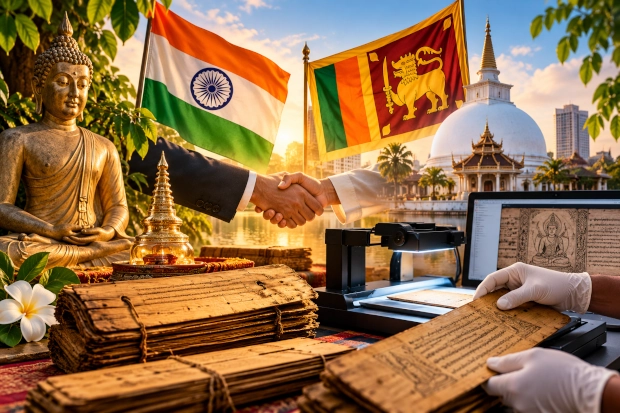
India and Sri Lanka have taken an important step towards preserving their shared civilisational heritage through the launch of a manuscript digitisation initiative at the historic Gangaramaya Temple in Colombo. The project, undertaken under the South Asian Manuscript Histories and Textual Archive (SAMHiTA), aims to preserve ancient Buddhist manuscripts and make their historical, religious and philosophical knowledge accessible to future generations.
The initiative is being implemented by the India International Centre (IIC), New Delhi, with grant assistance from the Government of India. Gangaramaya Temple has become the first institution in Sri Lanka to partner with SAMHiTA, marking an important expansion of India’s international efforts to document and preserve South Asia’s manuscript heritage.
Under an agreement signed in July 2026, the project will digitise 100 ancient manuscripts preserved at the temple. A team of local experts is undertaking the work, which is expected to be completed by the end of November 2026.
The initiative reflects the longstanding Buddhist and cultural connections between India and Sri Lanka while demonstrating how modern digital technologies can protect valuable historical knowledge.
Gangaramaya Temple Becomes Sri Lanka’s First SAMHiTA Partner
The Gangaramaya Temple in Colombo has become the first Sri Lankan institution to collaborate with the SAMHiTA initiative. The partnership focuses on preserving valuable manuscripts that document religious traditions, philosophy, languages and cultural practices developed and transmitted across generations.
Gangaramaya is an important centre of Buddhist religious, educational and cultural activity in Sri Lanka. Its manuscript collections form part of a wider tradition of preserving Buddhist teachings and historical knowledge through handwritten texts.
The collaboration brings together the temple’s manuscript holdings and the preservation expertise associated with the India International Centre’s international archival initiative. By combining institutional cooperation with digital documentation, the project seeks to protect fragile manuscripts while preserving the information they contain.
The initiative also establishes a foundation for expanding manuscript preservation activities to other religious, educational and cultural institutions across Sri Lanka. Such cooperation can help identify historically important collections and encourage their systematic documentation.
One Hundred Ancient Manuscripts to Be Digitised
The first phase of the project involves the digitisation of 100 ancient manuscripts preserved at Gangaramaya Temple. The agreement covering this work was signed in July 2026, and local experts are carrying out the digitisation with support from India.
The manuscripts contain valuable information concerning religious traditions, philosophical thought, languages and historical cultural practices. These records form part of the intellectual inheritance preserved through Buddhist institutions and traditional manuscript collections.
Digitisation allows the contents of manuscripts to be recorded in electronic form, reducing the need for repeated physical handling of delicate originals. High-quality digital copies can also support scholarly examination and provide an additional means of safeguarding historical information.
The work is expected to be completed by the end of November 2026. Its completion will represent an important step towards documenting the temple’s manuscript collection and preserving the knowledge contained within these historical records.
What Is the SAMHiTA Project?
The South Asian Manuscript Histories and Textual Archive, commonly known as SAMHiTA, is an initiative of the India International Centre and its International Research Division. The project receives support from the Ministry of External Affairs, Government of India.
SAMHiTA seeks to create a relational database and digital archive of manuscripts originating from India and the wider South Asian region that are preserved in libraries, archives, universities and other repositories outside India.
The name SAMHiTA derives from the Sanskrit word Samhita, meaning a collection or compilation. The name reflects the project’s objective of bringing together manuscript information scattered across different institutions and geographical regions.
South Asia possesses an extensive manuscript tradition covering subjects such as medicine, mathematics, philosophy, architecture, literature, religion and the arts. For centuries, scholars recorded and transmitted knowledge through handwritten texts in different languages and scripts.
Many manuscripts originating from the Indian subcontinent are now preserved in collections across Asia, Europe and North America. SAMHiTA works with institutional partners to document these materials and bring information about them together through a common digital platform.
The project therefore extends beyond the physical preservation of manuscripts. It also seeks to reconnect dispersed collections with the wider intellectual traditions from which they originated.
Preserving the Knowledge of Ancient Buddhist Manuscripts
Buddhist monasteries and temples have played an important role in preserving religious literature, philosophical texts and historical records across South Asia.
Sri Lanka has maintained a particularly important tradition of Buddhist scholarship and manuscript preservation. Monastic institutions have transmitted religious teachings and commentarial literature through generations of scholars, teachers and scribes.
Many traditional manuscripts were written on palm leaves, a material widely used across South and Southeast Asia before the widespread availability of modern paper. Such manuscripts required careful preparation, writing and preservation to ensure that their contents could survive over long periods.
Palm-leaf manuscripts are vulnerable to damage from moisture, insects, biological deterioration and repeated handling. Their preservation therefore requires appropriate storage conditions, careful conservation and accurate documentation.
Digitisation offers an additional layer of protection by creating electronic records of the surviving texts. Although digital copies cannot replace the historical and material value of the original manuscripts, they can reduce unnecessary handling and preserve information for research and future study.
The SAMHiTA collaboration at Gangaramaya Temple contributes to this wider effort by documenting manuscripts connected with Sri Lanka’s Buddhist intellectual and cultural heritage.
India’s Manuscript Heritage Extends Across the World
India’s manuscript traditions developed over many centuries through a combination of oral transmission and handwritten textual preservation. Scholars recorded knowledge in several languages, including Sanskrit, Tamil, Odia and Bengali, using regional scripts and different writing materials.
According to the India International Centre’s SAMHiTA documentation, manuscripts originating from the Indian subcontinent travelled to regions such as Tibet, Central Asia, Japan, Thailand and Bhutan from the early centuries of the Common Era.
These movements accompanied religious exchanges, scholarly travel, cultural interactions and the transmission of philosophical and scientific knowledge.
During later centuries, additional manuscript collections reached European institutions through scholarly exchanges, collecting activities and colonial-era movements of cultural materials.
Consequently, important elements of South Asia’s intellectual heritage are now distributed across libraries, universities, monasteries and archival institutions in different parts of the world.
SAMHiTA aims to connect these dispersed collections through systematic cataloguing and digital documentation. The initiative seeks to help researchers identify manuscripts, understand their historical relationships and examine their contribution to the development of South Asian knowledge traditions.
SAMHiTA Creates a Digital Platform for Researchers and Scholars
A central objective of SAMHiTA is the creation of a digital archive that brings together information about South Asian manuscripts preserved in different international collections.
The initiative works towards consolidating manuscript descriptions, institutional records and related information within a common research framework. This approach can help scholars examine connections between texts, authors, traditions and historical locations that would otherwise remain separated across individual repositories.
SAMHiTA also collaborates with the PANDiT Project, the Prosopographical Database of Indic Texts and Records. The database supports research into South Asian intellectual history by organising information concerning texts, individuals and related historical records.
By linking manuscript information with wider scholarly resources, the project seeks to improve the accessibility and usefulness of historical collections.
The initiative’s international approach is particularly important because the preservation of South Asian manuscripts is not confined to any single country. Many texts have survived through the efforts of institutions and communities located far from the places where they were originally composed.
Digital documentation provides a means of connecting these collections while supporting collaboration among researchers, archivists and cultural institutions.
Ministry of External Affairs Supports International Heritage Preservation
The Government of India supports SAMHiTA through the Ministry of External Affairs as part of its broader cultural and heritage cooperation initiatives.
The Ministry’s Development Partnership Administration includes a division responsible for heritage restoration projects undertaken with partner countries. Established in January 2020, DPA-IV serves as a nodal mechanism for India’s international heritage restoration activities.
India’s heritage cooperation programmes extend across several countries, including Sri Lanka, Myanmar, Vietnam and Bhutan. These initiatives contribute to the preservation of historical monuments, cultural sites and traditional knowledge associated with longstanding civilisational connections.
SAMHiTA expands this engagement into manuscript preservation and digital documentation. Through the initiative, India supports the protection of intellectual heritage that has historical connections with the Indian subcontinent and its neighbouring regions.
The collaboration with Gangaramaya Temple demonstrates how cultural diplomacy can operate through practical conservation work and institutional partnerships.
Rather than focusing exclusively on historical monuments, such initiatives also recognise the importance of preserving written knowledge, religious literature and traditional intellectual systems.
Buddhist Heritage Strengthens India–Sri Lanka Cultural Relations
India and Sri Lanka share longstanding Buddhist and civilisational connections that have shaped their religious, cultural and intellectual interactions over many centuries.
The transmission of Buddhism from the Indian subcontinent to Sri Lanka established enduring relationships between religious institutions, scholars and communities. Buddhist literature, monastic traditions and philosophical teachings became important elements of this shared heritage.
Historical links associated with the introduction and development of Buddhism in Sri Lanka continue to occupy an important place in the cultural understanding of both countries.
The SAMHiTA initiative adds a contemporary dimension to these relationships by using digital technology to preserve manuscript collections that reflect the region’s shared intellectual history.
The partnership also illustrates the role of cultural institutions in strengthening bilateral relations. Cooperation between research organisations, temples, scholars and conservation specialists can complement government-level diplomatic engagement by producing lasting educational and cultural resources.
Through its support for manuscript digitisation, India is contributing to the preservation of a heritage that remains important to communities in both countries.
SAMHiTA Opens New Opportunities for South Asian Manuscript Preservation
The collaboration at Gangaramaya Temple represents an important step in expanding SAMHiTA’s manuscript preservation activities into Sri Lanka.
The digitisation of 100 manuscripts will create a foundation for documenting historically important texts and safeguarding their contents for future generations. The involvement of local experts also strengthens cooperation between Indian and Sri Lankan institutions engaged in cultural preservation.
Beyond the initial collection, the initiative aims to encourage additional institutions in Sri Lanka to participate in the preservation and documentation of their manuscript holdings.
Such partnerships can contribute to a broader understanding of the region’s religious, philosophical and literary traditions while supporting future academic research.
The project also demonstrates the growing role of digital technology in protecting historical knowledge. By connecting traditional manuscript collections with modern archival systems, institutions can improve the long-term preservation and scholarly accessibility of valuable cultural records.
The India–Sri Lanka SAMHiTA collaboration brings together shared history, modern technology and institutional cooperation. As the digitisation work progresses, it will strengthen the preservation of Buddhist manuscript heritage and contribute to a growing international effort to safeguard South Asia’s intellectual inheritance.
References
- Akashvani News, Prasar Bharati. India and Sri Lanka Strengthen Cultural Ties Through Shared Buddhist Heritage. Published 23 October 2026.
https://newsonair.gov.in/india-and-sri-lanka-strengthen-cultural-ties-through-shared-buddhist-heritage/ - India International Centre – SAMHiTA Project. South Asian Manuscript Histories and Textual Archive. Official project website.
https://samhita.iicdelhi.in/ - India International Centre – SAMHiTA. About SAMHiTA: Project Objectives, International Manuscript Collections and Ministry of External Affairs Support.
https://samhita.iicdelhi.in/about-samhita - India International Centre – SAMHiTA. Ministry of External Affairs Mandate and International Heritage Preservation.
https://samhitadev.iicdelhi.in/funding-agency
You may also like
-
Yavana in the Mahabharata: Greek Connections, Pandava Campaigns and the Warriors of Kurukshetra
-
ASI Uses Ground-Penetrating Radar to Investigate Ancient Buddhist Stupa at Ujjain After Nearly 90 Years
-
Pahlava: The Parthian World Beyond India’s Northwestern Frontiers in the Mahabharata
-
Namami Gange in 2026: 368 Projects Completed, 4,339 MLD Sewage Treatment Capacity Created as Ganga Rejuvenation Advances
-
ASI’s Kashipur Archaeological Site Reveals Ancient Govisana, Gupta-Era Temples and Mahabharata Traditions
