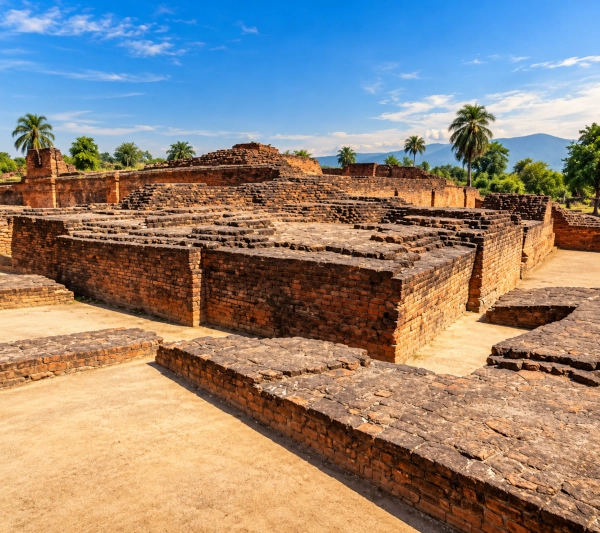
The Archaeological Survey of India’s excavated site at Dronasagar in Kashipur, Uttarakhand, preserves important evidence of ancient settlements, temple architecture and cultural activity extending from the Painted Grey Ware period to the early medieval era. Located in Udham Singh Nagar district, the archaeological complex has historical associations with the ancient settlement of Govisana and longstanding local traditions connected with Guru Dronacharya and the Pandavas of the Mahabharata.
Official records maintained by the Archaeological Survey of India’s Dehradun Circle document the discovery of substantial temple structures, pottery, ornaments and other archaeological remains during earlier excavations. These discoveries establish Kashipur as an important centre for understanding the development of settlements, religious architecture and cultural traditions in the Kumaon region of northern India.
Ancient Kashipur and the Historical City of Govisana
Kashipur occupies an important place in the archaeological history of Uttarakhand. The Archaeological Survey of India records that Alexander Cunningham, the first Director-General of the ASI, identified Kashipur with Kiu-pi-shwang-na, a settlement mentioned in the accounts of the Chinese Buddhist traveller Xuanzang. The name was subsequently rendered in Sanskrit as Govisana.
Xuanzang travelled across India during the seventh century CE and documented numerous religious establishments, cities and regional kingdoms. His writings remain an important historical source for understanding the geography and cultural conditions of ancient India.
Cunningham’s identification connected the archaeological remains at Kashipur with the settlement described in Xuanzang’s account. He also identified the remains of a substantial ancient structure at Bhim-Gaja, the highest point within the archaeological site.
The identification of Govisana provides an important historical framework for studying Kashipur. Archaeological investigations have subsequently revealed evidence of occupation across different periods, contributing to the reconstruction of the region’s ancient settlement history.
Archaeological Survey of India Conducted Excavations Across Several Decades
The Archaeological Survey of India undertook major excavations at Kashipur during 1939–40, 1965–66 and the 1970s. These investigations primarily sought to uncover the architectural layout of the ancient temple complex identified at the site.
The excavations revealed substantial structural remains belonging to a temple that developed through three major construction phases. Archaeologists identified changes in the building’s layout and the addition of architectural components during successive historical periods.
The official excavation record explains that the earlier investigations concentrated on establishing the temple’s architectural plan rather than uncovering the complete sequence of human occupation. Consequently, the archaeological deposits preserve opportunities for further research into the site’s cultural development.
These earlier investigations established the importance of Kashipur as a location where archaeological evidence can contribute to understanding ancient religious architecture and settlement patterns.
Gupta-Period Temple Reveals Three Phases of Construction
One of the most significant discoveries at Kashipur concerns the remains of a temple complex whose earliest identified construction phase belongs to the Gupta period.
According to ASI records, the original structure appears to have consisted of a substantial brick-built elevated platform, possibly supporting a sanctum. The construction reflects the architectural practices associated with early temple development in northern India.
During a subsequent phase, probably in the sixth or seventh century CE, builders added two surrounding walls to the original structure. These additions transformed the architectural arrangement and expanded the religious complex.
The successive modifications eventually produced an extensive Panchayatana-style temple complex. The Panchayatana arrangement represents an important development in Indian temple architecture, generally involving a principal shrine accompanied by subsidiary shrines arranged around it.
The remains at Kashipur provide valuable evidence of the evolution of religious architecture from the Gupta period into the early medieval centuries. They also demonstrate the importance of the region in the development of ancient Indian temple-building traditions.
Painted Grey Ware Indicates an Earlier Phase of Human Settlement
The archaeological significance of Kashipur extends beyond its Gupta-period temple remains. The Archaeological Survey of India records that pottery recovered from the site indicates occupation extending from the Painted Grey Ware period to the early medieval era.
Painted Grey Ware is a distinctive ceramic tradition associated with settlements across parts of northern India during the early Iron Age. The pottery generally consists of fine grey vessels decorated with painted geometric patterns.
Archaeologists use such pottery to identify cultural phases and understand settlement patterns in the upper Ganga-Yamuna region and neighbouring areas. Its distribution provides evidence of communities that occupied northern India during the period preceding the emergence of many historically documented urban centres.
The presence of Painted Grey Ware at Kashipur therefore indicates human activity at the site substantially earlier than the surviving Gupta-period temple structures.
However, the identification of this pottery does not establish a direct connection with any specific event described in the Mahabharata. Archaeological interpretation requires the examination of material remains, their stratigraphic context and their relationship with other datable evidence.
Coins, Ornaments and Everyday Objects Reveal Ancient Cultural Activity
Excavations at Kashipur have recovered a variety of artefacts that provide information about the people who occupied the settlement during different historical periods.
According to the ASI’s official excavation records, the accumulated brick debris around the temple contained copper coins, copper and glass bangles, copper rings, terracotta objects, stone beads, nails and chisels.
These discoveries offer evidence of activities extending beyond the religious functions of the temple complex. Ornaments and beads indicate aspects of personal adornment, while metal implements provide information about tools and material technologies used by earlier communities.
Coins can contribute to the chronological study of archaeological deposits when their identification and context are securely established. Pottery and other household objects can similarly assist researchers in understanding changing cultural practices and patterns of occupation.
Together, the discoveries demonstrate that Kashipur preserves archaeological material associated with different aspects of ancient settlement life.
Drona Sagar and the Mahabharata Traditions of Kashipur
Kashipur also possesses an important place in the cultural traditions associated with the Mahabharata. The nearby Drona Sagar is traditionally linked with Guru Dronacharya, the teacher of the Pandavas and Kauravas.
According to local tradition, Dronacharya lived and taught in the region, while the Pandavas created Drona Sagar as an offering of guru dakshina to their teacher. The association has remained part of the cultural identity of Kashipur and continues to influence the significance attached to the site.
The Government of India’s tourism information on Kashipur acknowledges these traditions and identifies Drona Sagar among the locations associated with the Pandavas.
Such traditions form an important component of India’s cultural geography, where historical settlements, sacred landscapes and literary narratives often remain closely connected.
The archaeological evidence documented at Kashipur independently establishes the antiquity and historical importance of the settlement. The Mahabharata association, meanwhile, represents a longstanding cultural tradition that requires separate archaeological and historical examination.
Understanding the Cultural Sequence of Ancient Kashipur
One of the important questions concerning Kashipur is how the settlement developed from its earliest known occupation phases into the historically documented periods represented by its temple remains.
Archaeologists study cultural sequences by examining the arrangement of deposits, the relationship between structures and the distribution of artefacts across different layers. These observations help establish how settlements changed over time.
At Kashipur, the recovery of Painted Grey Ware alongside material from later historical periods indicates that the site preserves evidence spanning a considerable chronological range.
The earlier excavations were primarily concerned with understanding the temple’s architecture. As the ASI’s documentation explains, they did not establish the complete cultural sequence of the settlement.
Further scientific investigation of the archaeological deposits can therefore contribute to a more detailed understanding of Kashipur’s early occupation, settlement continuity and architectural development.
Archaeological Heritage of Uttarakhand’s Kumaon Region
The Govisana mound is among the archaeological sites protected by the Archaeological Survey of India in Uttarakhand. Its preservation is important because the site contains structural and cultural remains associated with several historical periods.
The National Monuments Authority identifies the archaeological remains at Dronasagar, also known as the Govishana Mound, as a protected heritage location within Kashipur. The official documentation records the site’s geographical setting and the relationship between the protected archaeological area and the adjacent Drona Sagar Lake.
Preservation of such sites supports both scientific research and the protection of India’s cultural inheritance. Archaeological remains can suffer damage from uncontrolled construction, encroachment and disturbance of buried deposits.
The continued protection and scientific documentation of Govisana will help preserve material evidence of the region’s ancient settlement history for future generations.
Kashipur’s Archaeological Evidence Strengthens Understanding of Ancient India
The archaeological discoveries at Kashipur provide a valuable record of cultural development extending from the Painted Grey Ware period to the early medieval centuries. The remains of a Gupta-period temple, its subsequent architectural expansion and the recovery of coins, ornaments and other artefacts demonstrate the historical importance of the settlement.
The site’s identification with ancient Govisana adds another dimension to its significance by connecting material evidence with historical geographical accounts preserved through Xuanzang’s travels.
At the same time, the traditions surrounding Guru Dronacharya and the Pandavas remain an enduring part of Kashipur’s cultural heritage. Together, archaeological research and the careful documentation of traditional associations contribute to a fuller understanding of the region’s historical identity.
The preservation and scientific study of Kashipur’s archaeological landscape will continue to enrich knowledge of ancient Indian settlements, temple architecture and cultural history while safeguarding an important part of Uttarakhand’s heritage.
References
- Archaeological Survey of India, Dehradun Circle: Excavation – Kashipur, District Udham Singh Nagar. Official documentation of earlier excavations, temple construction phases, Painted Grey Ware and recovered antiquities.
https://asidehraduncircle.in/excavation.html - Archaeological Survey of India, Dehradun Circle: Excavated Site at Dronasagar (Mauza Ujjan Kashipur). Official protected monument information and archaeological history.
https://asidehraduncircle.in/usnagar.html - National Monuments Authority, Government of India: Heritage Byelaws – Archaeological Site and Remains, Dronasagar (Govishana Mound), Kashipur, Udham Singh Nagar, Uttarakhand. Official heritage documentation.
- Ministry of Tourism, Government of India: Incredible India – Kashipur. Historical information on Kashipur, Drona Sagar and the local traditions associated with the Pandavas.
https://www.prod.incredibleindia.gov.in/content/incredible-india-v2/en/destinations/kausani/kashipur.html - Ministry of Culture, Government of India, July 20, 2026: Excavation of Sites by ASI. Parliamentary information on archaeological excavations and scientific examination of recovered materials.
https://www.pib.gov.in/PressReleasePage.aspx?PRID=2286588
You may also like
-
Parasika in the Mahabharata: Tracing the Persian Lands Through Modern Iran
-
Kapisa: The Ancient Kingdom North of Kabul at the Gateway of the Hindu Kush
-
Lampaka: The Mountain Kingdom of Laghman on the Kabul River Frontier
-
Navaratri and Ayurveda: The Nine Divine Medicinal Plants Associated with Navadurga
-
Bahlika: The Ancient Bactrian Realm of Balkh in the Mahabharata
