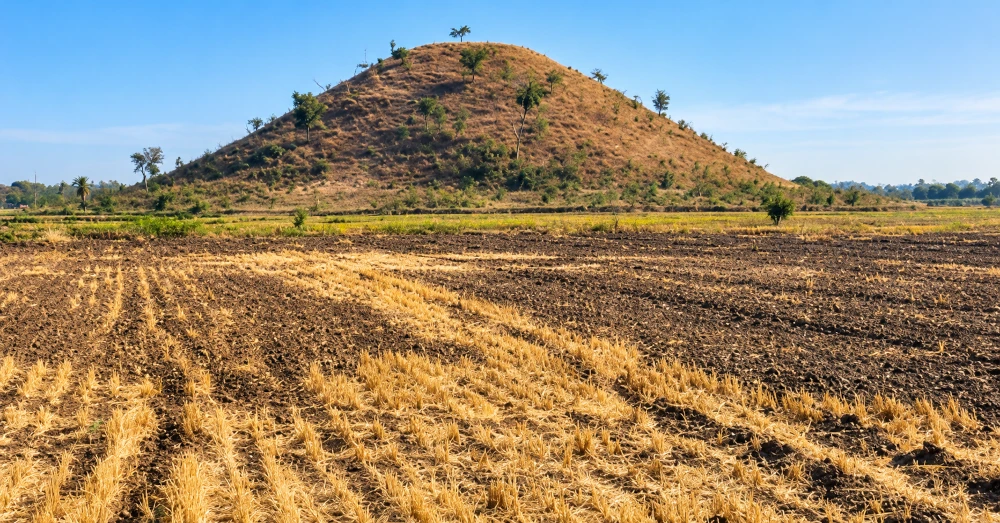
The Archaeological Survey of India (ASI), in collaboration with the Madhya Pradesh State Archaeology Department and Maulana Azad National Institute of Technology (MANIT), Bhopal, has undertaken a ground-penetrating radar survey at the ancient Vaishya Tekri mound in Ujjain. The investigation aims to examine underground archaeological remains associated with a large Buddhist stupa first investigated nearly nine decades ago.
The survey marks a renewed scientific effort to understand one of the most intriguing archaeological sites in central India. Earlier investigations conducted in 1938–39 identified substantial remains of a Buddhist stupa, prompting suggestions that the ancient monument could have been larger than the famous Great Stupa at Sanchi. The latest investigation uses modern geophysical technology to examine the mound without immediately disturbing its archaeological deposits.
Archaeologists Return to Vaishya Tekri After Nearly Nine Decades
Vaishya Tekri is an ancient archaeological mound located near Ujjain in Madhya Pradesh. The site attracted scientific attention during excavations undertaken by the Archaeology Department of the erstwhile Gwalior State in 1938–39.
Those investigations uncovered the remains of an unusually large Buddhist stupa and associated structures. The excavators documented substantial brickwork and architectural features suggesting that the mound contained an important ancient religious monument.
However, the investigation remained incomplete. Historical accounts indicate that excavation activities were suspended after several workers reportedly lost consciousness during an incident attributed to a possible underground gas release.
The interruption left important questions concerning the monument’s dimensions, construction techniques and historical chronology unresolved. Archaeologists have now returned to the site using scientific methods capable of investigating underground features without immediately undertaking extensive excavation.
Ancient Stupa May Have Been Larger Than Sanchi
One of the most significant aspects of Vaishya Tekri is the enormous size attributed to the ancient Buddhist structure.
According to measurements recorded during the 1938–39 investigations, the stupa was estimated to have a base approximately 350 feet in diameter and a height of around 100 feet. These dimensions exceed those traditionally associated with the Great Stupa at Sanchi, whose principal dome and architectural components represent one of India’s most celebrated examples of Buddhist heritage.
The early excavation report described an unusually massive construction that differed from other monuments examined by archaeologists at the time. Investigators also identified smaller associated stupas and substantial brick remains.
These findings suggest that Vaishya Tekri may have formed part of an important Buddhist religious complex. However, the historical measurements require further scientific examination before researchers can establish the monument’s original dimensions with confidence.
The renewed investigation therefore offers an opportunity to clarify the scale and arrangement of the ancient structure using modern archaeological techniques.
Ground-Penetrating Radar Reveals Features Beneath the Surface
The recent investigation employs ground-penetrating radar, commonly known as GPR, to examine the internal structure of the mound.
Ground-penetrating radar uses electromagnetic pulses transmitted into the ground. When these signals encounter materials with different physical properties, such as soil, brick, stone or underground cavities, part of the energy returns to the surface.
Specialised instruments record these reflections, allowing researchers to construct profiles of subsurface features. Archaeologists can then examine the resulting data to identify areas that may contain buried walls, foundations, cavities or other structural remains.
At Vaishya Tekri, specialists from MANIT Bhopal worked with archaeological authorities to conduct the survey. The investigation sought to identify variations beneath the mound that could help explain the arrangement of the ancient monument.
The technology is particularly useful because it allows archaeologists to investigate sensitive sites without immediately removing soil or disturbing preserved structures. However, radar signals require careful interpretation, and identifying an underground anomaly does not automatically establish that it represents a human-made structure.
MANIT Scientists to Analyse Underground Survey Data
Following the field investigation, specialists from Maulana Azad National Institute of Technology are expected to analyse the radar data and prepare a technical assessment for the authorities.
The analysis may help identify locations where buried structural features are likely to occur. Researchers can also examine differences in the depth, orientation and distribution of subsurface anomalies to develop a preliminary understanding of the mound’s internal arrangement.
Such information can assist archaeologists in determining where future investigations may be most productive. It also helps reduce unnecessary disturbance of archaeological deposits by allowing excavation plans to focus on areas supported by geophysical evidence.
Reports published in October 2026 indicate that the radar scanning was completed earlier in the month. The detailed interpretation of the findings remains important before any claims about newly identified structures can be established.
Ujjain’s Historical Association with Emperor Ashoka
Vaishya Tekri has attracted considerable interest because of Ujjain’s historical connections with the Mauryan Empire and Emperor Ashoka.
Known in antiquity as Ujjayini, the city served as an important political and commercial centre of Avanti. Its location connected northern India with the Deccan through significant overland trade routes.
Historical traditions associate Ashoka with Ujjain during his early political career, before he became emperor of the Mauryan Empire. The region subsequently developed an important place in the history of Buddhism.
Some researchers have proposed that the monument at Vaishya Tekri may date to the Mauryan period and could be connected with Ashoka’s patronage of Buddhist institutions. The interpretation draws partly on the monument’s architectural characteristics and the historical importance of Ujjain during that period.
However, the available archaeological evidence has not conclusively established that Ashoka commissioned the structure. Determining its precise date and patronage requires further examination of construction materials, stratigraphy and other datable archaeological evidence.
The current investigation provides an opportunity to examine these historical questions through modern scientific methods rather than relying exclusively on earlier interpretations.
Earlier Excavations Revealed Remarkable Construction Techniques
The 1938–39 excavations documented an unusually substantial brick structure beneath the mound. Archaeologists encountered large bricks and architectural arrangements that differed from those found at several other Buddhist monuments.
The early investigators described the structure as possessing distinctive engineering characteristics. They also recovered archaeological material, including punch-marked coins, which contributed to discussions about the site’s possible antiquity.
Such discoveries are important because construction techniques, brick dimensions and associated artefacts can provide clues about the period during which a monument was built.
Nevertheless, individual objects cannot establish a monument’s precise construction date without considering the archaeological deposits in which they were found. A coin, for example, may have entered a site during a later phase of occupation or modification.
Further investigation of Vaishya Tekri could therefore help researchers distinguish between the monument’s original construction and possible subsequent alterations.
Modern Technology Strengthens Archaeological Conservation
The use of ground-penetrating radar at Vaishya Tekri reflects a growing emphasis on scientific methods in Indian archaeology.
Traditional excavation remains essential for studying buried structures and recovering archaeological material. However, excavation permanently changes the original arrangement of the deposits being investigated.
Non-invasive techniques allow researchers to gather preliminary information while preserving much of the archaeological context. Ground-penetrating radar, magnetometry, electrical resistivity surveys and other geophysical methods can help identify areas requiring closer examination.
These technologies also improve the planning of archaeological projects by providing information about possible structural features before excavation begins.
At Vaishya Tekri, the collaboration between archaeological authorities and engineering researchers demonstrates how scientific institutions can contribute to heritage investigations. Combining archaeological expertise with advanced geophysical analysis can improve the documentation and preservation of historically important sites.
Madhya Pradesh Plans Further Archaeological Investigation
The Madhya Pradesh government has expressed interest in supporting renewed archaeological investigations and the conservation of Vaishya Tekri.
Earlier reports indicated that the Archaeological Survey of India had submitted a proposal for further excavation. Archaeological authorities also highlighted the need for detailed scientific examination before undertaking extensive restoration activities.
A major excavation would require careful planning because the mound contains substantial buried remains whose original arrangement is not yet fully understood. Researchers would need to establish the monument’s structural condition, construction phases and archaeological chronology before deciding how best to expose and conserve its surviving components.
The ongoing scientific assessment can provide information to guide these decisions. Preserving the site while investigating its history will remain an important consideration as the project progresses.
Ujjain’s Buddhist Heritage Receives Renewed Attention
Ujjain is widely recognised for its religious and cultural significance, particularly its association with Mahakaleshwar Jyotirlinga and the historical traditions of ancient Avanti.
The investigation at Vaishya Tekri draws attention to another important dimension of the city’s heritage: its place in the history of Buddhism and ancient Indian religious architecture.
If further archaeological studies establish the monument’s original scale and construction history, the findings could substantially expand understanding of Buddhist architecture in central India.
The site also offers opportunities for studying the relationship between ancient urban centres, religious institutions and regional trade networks during the Mauryan and subsequent periods.
The renewed investigation may therefore contribute not only to the history of a single monument but also to a broader understanding of Ujjain’s development as a major centre of ancient Indian civilisation.
Scientific Investigation Opens a New Chapter in Ujjain’s Archaeological History
The ground-penetrating radar survey at Vaishya Tekri represents an important step towards resolving questions left unanswered since the excavations of 1938–39.
By combining the archaeological expertise of ASI and the Madhya Pradesh State Archaeology Department with MANIT’s geophysical capabilities, the investigation provides a scientific approach to examining the mound’s hidden structures.
The earlier discovery of a massive Buddhist stupa establishes the site’s importance, while its possible Mauryan association and remarkable dimensions make further research particularly valuable.
As specialists analyse the radar findings and archaeological authorities consider the next stages of investigation, Vaishya Tekri offers an opportunity to deepen understanding of ancient Indian architecture, Buddhist heritage and the historical significance of Ujjain.
The renewed scientific attention also reinforces the importance of preserving archaeological sites while employing modern research technologies to uncover India’s rich historical and cultural inheritance.
References
- Archaeological Department of Gwalior State, 1938–39: Annual Administration Report documenting the original investigations at Vaishya Tekri, Ujjain.
- Archaeological Survey of India: Ancient India, Volume 9, containing archaeological documentation relevant to Vaishya Tekri and its early investigations.
https://nmma.nic.in/nmma/NAS1/nmma_doc/AI/Ancient%20India%209.pdf - National Monuments Authority, Government of India: Official heritage protection documentation concerning the Ancient Mound, Vaishya Tekri, Ujjain.
https://www.nma.gov.in/ - The Times of India, October 2026: ASI Conducts GPR Survey to Revive Study of Ujjain’s Vaishya Tekri Stupa.
- Naidunia, October 4, 2026: Following Ground-Penetrating Radar Scanning of Vaishya Tekri, MANIT Specialists to Prepare Technical Report.
- The Indian Express, August 17, 2026: Ashoka-Era Stupa, Bigger Than Sanchi: 90 Years On, Ujjain Mound Comes Under Renewed Focus.
You may also like
-
Yavana in the Mahabharata: Greek Connections, Pandava Campaigns and the Warriors of Kurukshetra
-
India and Sri Lanka Launch SAMHiTA Manuscript Digitisation Project to Preserve Ancient Buddhist Heritage
-
Pahlava: The Parthian World Beyond India’s Northwestern Frontiers in the Mahabharata
-
Namami Gange in 2026: 368 Projects Completed, 4,339 MLD Sewage Treatment Capacity Created as Ganga Rejuvenation Advances
-
ASI’s Kashipur Archaeological Site Reveals Ancient Govisana, Gupta-Era Temples and Mahabharata Traditions
