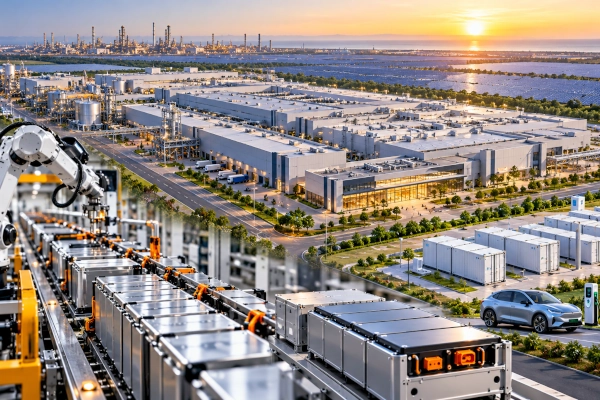
Reliance Industries Limited (RIL) is developing one of the world’s largest integrated battery manufacturing facilities at Jamnagar in Gujarat, with plans to establish an annual production capacity of 120 gigawatt-hours (GWh). The ambitious project forms part of the company’s Dhirubhai Ambani Green Energy Giga Complex and represents a major investment in India’s advanced battery manufacturing, renewable energy storage and clean technology industries.
The battery gigafactory will initially have an annual manufacturing capacity of 40 GWh, with commissioning planned in phases during 2026. Reliance has subsequently expanded its long-term capacity target to 120 GWh annually, positioning the facility among the world’s major lithium iron phosphate (LFP) battery manufacturing projects.
Addressing shareholders at Reliance Industries’ 49th Annual General Meeting on June 19, 2026, Director Anant Ambani confirmed that equipment for the initial manufacturing phase had reached the site and that the company was preparing to commission the facility. The announcement represents an important step towards establishing large-scale domestic production of batteries used in renewable energy storage, electric mobility and industrial applications.
Reliance Targets 120 GWh Battery Manufacturing Capacity at Jamnagar
Reliance’s battery manufacturing project has evolved considerably as the company expands its ambitions in advanced energy storage technologies. Earlier development plans envisaged a manufacturing capacity of 30 GWh annually, which was subsequently increased to 40 GWh, with provisions for further expansion to 100 GWh.
During the company’s June 2026 Annual General Meeting, Reliance announced that it had raised its planned annual battery manufacturing capacity to 120 GWh. The expanded target reflects the company’s intention to establish a large-scale manufacturing platform capable of serving India’s growing demand for electricity storage and advanced battery systems.
The initial 40 GWh phase will include battery cell manufacturing and Battery Energy Storage System (BESS) production. Reliance confirmed that the necessary production equipment had been delivered to Jamnagar, allowing the company to advance installation and commissioning activities.
According to the company’s FY 2025–26 disclosures, civil construction had been completed for the battery manufacturing facilities, with equipment installation and commissioning activities progressing. Reliance expects production to ramp up during the second half of 2026, beginning with lithium iron phosphate battery technology.
At its planned full capacity, the Jamnagar facility would position Reliance among the world’s largest manufacturers of LFP batteries, creating a major new domestic production base for advanced energy storage technologies.
Dhirubhai Ambani Green Energy Giga Complex Spans 5,000 Acres
The battery factory forms part of the Dhirubhai Ambani Green Energy Giga Complex, which Reliance is developing across approximately 5,000 acres in Jamnagar. The integrated complex is designed to bring together several major clean energy manufacturing activities within a single industrial ecosystem.
According to Reliance’s FY 2025–26 Annual Report, the complex encompasses approximately 44 million square feet of manufacturing and operational built-up area. The development includes facilities for solar photovoltaic manufacturing, advanced batteries, electrolysers and green chemical production.
The integrated manufacturing approach is intended to connect renewable electricity generation with energy storage and the production of low-carbon fuels and industrial chemicals. By establishing related manufacturing facilities at one location, Reliance aims to improve operational coordination, strengthen industrial supply chains and create opportunities for greater efficiency across different clean energy technologies.
Jamnagar already serves as a major industrial centre for Reliance, housing its globally significant petroleum refining and petrochemical operations. The development of the new energy complex represents a substantial expansion of the region’s industrial capabilities into solar energy, battery manufacturing and emerging clean technologies.
Reliance has identified the project as a central component of its strategy to achieve net-zero carbon emissions from its operations by 2035.
Lithium Iron Phosphate Batteries to Form the Core of Production
The Jamnagar battery gigafactory will initially focus on lithium iron phosphate technology, commonly known as LFP. This battery chemistry has become increasingly important for stationary energy storage systems and electric mobility applications because of its thermal stability, durability and suitability for repeated charging and discharging cycles.
LFP batteries use lithium iron phosphate as the cathode material and are widely employed in utility-scale battery storage installations. Compared with several nickel-based lithium-ion battery chemistries, LFP technology offers advantages in thermal stability and typically avoids the use of nickel and cobalt in the cathode.
These characteristics make LFP batteries particularly suitable for large-scale electricity storage applications, where safety, operating life and cost are important considerations.
Reliance plans to develop an integrated battery manufacturing ecosystem covering battery chemicals, cells, packs and containerised energy storage solutions. The company is also establishing battery recycling capabilities as part of its broader energy storage strategy.
This approach will allow Reliance to participate in multiple stages of the battery value chain rather than concentrating exclusively on cell assembly. Domestic manufacturing of cells and related components can support the development of specialised suppliers, materials processing capabilities and associated industrial services.
The company has stated that its objective is to develop battery solutions with globally competitive lifecycle costs, supporting large-scale adoption across electricity generation, industrial energy systems and transportation.
Battery Energy Storage Systems to Support Round-the-Clock Renewable Electricity
One of the principal applications of Reliance’s battery manufacturing programme will be the development of large-scale Battery Energy Storage Systems.
Solar and wind power generation depend on environmental conditions, creating differences between electricity generation and consumption throughout the day. Battery storage systems help address these variations by storing electricity when renewable generation is available and releasing it when demand increases or generation declines.
Utility-scale battery systems can also support grid stability, improve the management of electricity supply and reduce the need for conventional backup generation in suitable applications.
Reliance intends to manufacture containerised battery storage systems designed for large renewable energy projects, industrial electricity requirements and grid-connected applications.
The company’s integrated strategy combines solar power generation with battery storage to create renewable electricity systems capable of supplying power beyond daylight hours.
During the June 2026 Annual General Meeting, Anant Ambani described large-scale battery manufacturing as an important component of India’s energy security and the development of affordable round-the-clock renewable electricity.
By manufacturing batteries domestically and integrating them with its renewable energy projects, Reliance aims to establish a large-scale supply chain for energy storage equipment and associated technologies.
Jamnagar Battery Factory to Support Massive Renewable Energy Project in Kutch
Reliance’s battery manufacturing programme is closely connected to its renewable energy development in the Kutch region of Gujarat.
The company is developing a large-scale renewable energy hub across approximately 5,50,000 acres in Kutch, with plans to integrate solar electricity generation and battery storage infrastructure.
The project is designed to provide renewable electricity for industrial applications and support the production of green hydrogen and other clean energy products.
Reliance has stated that the integrated renewable energy platform is being developed to generate more than 40 billion units of green electricity annually once fully operational. This is equivalent to approximately 40 terawatt-hours of electricity, representing a substantial contribution to the company’s planned renewable energy requirements.
A dedicated electricity transmission corridor between Kutch and Jamnagar is also under construction. Reliance has awarded engineering, procurement and construction contracts for the transmission infrastructure that will connect the renewable generation facilities with its industrial operations.
The company has established ambitious targets for the pace of renewable energy infrastructure deployment, including the installation of up to 55 megawatts of solar modules and 150 megawatt-hours of battery containers per day during peak deployment.
The Kutch renewable energy project and the Jamnagar battery gigafactory are designed to operate as complementary components of Reliance’s broader clean energy ecosystem.
Reliance Expands Solar Manufacturing to 20 GW Annually
Alongside battery manufacturing, Reliance is developing an integrated solar photovoltaic manufacturing platform at Jamnagar.
The company has commissioned solar cell and module manufacturing lines based on advanced heterojunction technology, commonly known as HJT. This technology combines crystalline silicon with thin-film layers to improve solar cell performance and energy conversion efficiency.
At the June 2026 Annual General Meeting, Reliance reported that its manufacturing facilities had produced nearly 1 GW of HJT solar modules.
The company also confirmed that its HJT solar cells and modules had achieved recognition under India’s Approved List of Models and Manufacturers framework.
Reliance is working towards establishing 20 GW of annual integrated solar photovoltaic manufacturing capacity. The planned manufacturing chain will include polysilicon, ingots, wafers, solar cells, modules and glass.
The combination of solar manufacturing and battery production is central to Reliance’s integrated energy strategy. Solar panels generate electricity during periods of sunlight, while battery systems store energy for later use.
Developing both technologies within India can strengthen domestic manufacturing capabilities across different stages of the renewable energy supply chain.
Sodium-Ion Technology Adds Another Dimension to Battery Development
Reliance is also pursuing sodium-ion battery technology as part of its long-term energy storage strategy.
The company acquired UK-based Faradion, a developer of sodium-ion battery technology, to strengthen its capabilities in alternative battery chemistries.
Sodium-ion batteries use sodium-based materials rather than lithium as the principal charge-carrying element. Sodium is relatively abundant and widely available, making the technology attractive for applications where material availability and cost are important considerations.
Although sodium-ion technology generally offers lower energy density than leading lithium-ion battery chemistries, it has potential applications in stationary energy storage and selected mobility segments.
Reliance has stated that it is accelerating the commercialisation of sodium-ion battery technology alongside its planned LFP manufacturing capabilities.
The development of multiple battery chemistries can help the company address different storage requirements while strengthening its technological capabilities in emerging energy systems.
The company’s immediate large-scale manufacturing programme, however, remains centred on LFP batteries, with sodium-ion technology forming part of its wider research and commercialisation strategy.
Battery Recycling to Become Part of the Integrated Manufacturing Ecosystem
Reliance’s battery manufacturing plans also include recycling facilities intended to support material recovery and the development of a more circular battery supply chain.
Battery recycling is becoming increasingly important as the deployment of electric vehicles and stationary energy storage systems expands. Used batteries contain materials that can potentially be recovered and processed for reuse in new battery products.
An integrated recycling system can help reduce waste, improve material utilisation and support the long-term sustainability of battery manufacturing.
For India, recycling capabilities are particularly relevant because the country relies on international supply chains for several battery-related raw materials and processed components.
Developing domestic expertise in recycling, materials recovery and battery chemistry can strengthen the resilience of the country’s energy storage manufacturing industry.
By incorporating recycling into its broader manufacturing plans, Reliance aims to develop capabilities extending across production, deployment and end-of-life material recovery.
Large-Scale Battery Production to Strengthen India’s Energy Security
The development of a 120 GWh battery manufacturing platform has implications for India’s energy security and industrial development.
As renewable electricity generation expands, energy storage is becoming an increasingly important component of power infrastructure. Large battery installations can help electricity utilities manage demand fluctuations, integrate renewable generation and strengthen the reliability of electricity supply.
Domestic manufacturing of battery cells and energy storage systems can also reduce dependence on imported finished batteries, although the extent of supply-chain localisation will depend on domestic availability of raw materials, processed chemicals and specialised manufacturing components.
The establishment of a large manufacturing ecosystem creates opportunities for Indian engineering companies, equipment suppliers, chemical manufacturers and technology developers to participate in the battery value chain.
Advanced battery production also requires specialised expertise in electrochemistry, precision manufacturing, automation, electronics, thermal management and quality assurance.
The Jamnagar project can therefore contribute to the development of technical skills, specialised employment and supporting industries as manufacturing activities expand.
Reliance’s broader green energy programme is intended to create more than 2,00,000 employment opportunities across its integrated clean energy ecosystem, according to the company’s FY 2025–26 disclosures.
Reliance’s Battery Gigafactory Marks a Major Expansion of India’s Clean Energy Manufacturing
Reliance Industries’ planned 120 GWh battery gigafactory represents a major step towards establishing world-scale energy storage manufacturing capabilities in India.
The initial 40 GWh manufacturing phase, targeted for commissioning during 2026, will provide the foundation for the company’s expanded production plans. With manufacturing equipment delivered and construction activities advanced, Reliance is moving towards large-scale production of battery cells and energy storage systems at Jamnagar.
The project forms part of a much larger industrial transformation that includes integrated solar manufacturing, renewable electricity generation, battery recycling, green hydrogen and advanced energy technologies.
By combining battery manufacturing with large renewable energy installations in Gujarat, Reliance is developing an ecosystem designed to support round-the-clock clean electricity and reduce dependence on imported energy equipment.
The planned expansion to 120 GWh annually would establish Jamnagar as one of the world’s major centres for lithium iron phosphate battery production. It would also strengthen India’s position in advanced energy storage manufacturing, supporting the country’s transition towards greater energy self-reliance and a more diversified industrial economy.
References
- Reliance Industries Limited. Chairman’s Statement at the 49th Annual General Meeting. June 19, 2026. Details of the 40 GWh initial battery manufacturing phase and the expanded 120 GWh annual capacity target.https://www.ril.com/sites/default/files/2026-06/SE_Chairmans_Statement_signed.pdf
- Reliance Industries Limited. Integrated Annual Report 2025–26. Information on the Dhirubhai Ambani Green Energy Giga Complex, battery manufacturing, solar production and clean energy development.https://www.ril.com/ar2025-26/
- Reliance Industries Limited. New Energy and New Materials. Official information on battery gigafactories, LFP technology, sodium-ion batteries, recycling and renewable energy integration.https://www.ril.com/businesses/new-energy-materials
- Reliance Industries Limited. Q4 FY 2025–26 Media and Analyst Call Transcript. April 24, 2026. Updates on the construction, equipment installation and commissioning of the battery manufacturing facilities.https://www.ril.com/sites/default/files/2026-04/24042026_RIL_Media_Analyst_Call_Transcript_Q4_FY2026.pdf
- Reliance Industries Limited. Progress Report on New Energy Ecosystem. January 16, 2026. Updates on battery manufacturing infrastructure, equipment delivery and renewable energy projects.https://www.ril.com/sites/default/files/2026-01/SE_16012026_IP.pdf
You may also like
-
OSTO Launches AI-Native Cybersecurity Platform for Indian Startups and SMEs
-
Cosmochute Develops Reusable Lunar Robotics Platform, Raises $1.5 Million to Advance Moon Exploration
-
BHEL Approves ₹500 Crore Expansion of Thermal and Nuclear Power Equipment Manufacturing at Haridwar
-
HAL’s Indigenous Light Utility Helicopter Nears Final Certification, First 12 Deliveries Targeted for FY 2027–28
-
India’s Exports to US Rise to $50.81 Billion in April–September 2026 Despite Tariff Disruptions
