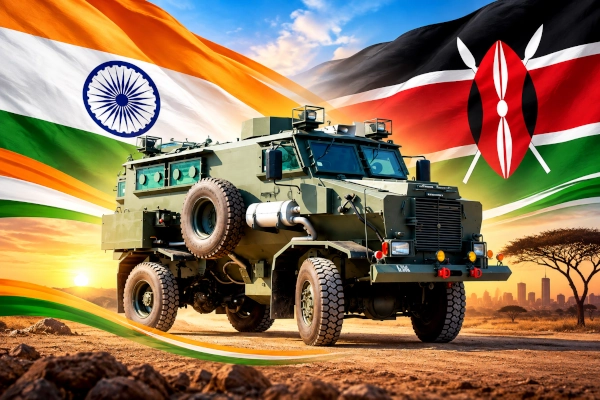
India has reportedly offered to supply mine-resistant, ambush-protected (MRAP) vehicles to the Kenya Defence Forces (KDF) as part of its expanding defence cooperation with the East African nation. The proposed supply would strengthen Kenya’s military mobility and personnel protection capabilities, particularly during counterterrorism operations and deployments in areas affected by landmines and improvised explosive devices (IEDs).
Kenyan news outlet Kenyans.co.ke reported the development, highlighting the potential role of Indian-manufactured armoured vehicles in addressing Kenya’s security requirements.
The reported proposal comes as India continues to expand its defence industrial partnerships with African countries, offering domestically manufactured military equipment, technology cooperation and training opportunities. Kenya and India have already established a comprehensive defence cooperation framework covering military training, maritime security, defence industry collaboration and counterterrorism.
Indian Armoured Vehicles Presented for Kenyan Military Requirements
According to the Kenyan media, representatives of the Kenya Defence Forces were introduced to several Indian-manufactured armoured vehicle platforms for possible evaluation. The reported discussions focused on mine-resistant vehicles capable of providing enhanced protection to military personnel operating in high-risk environments.
Indian public sector and private defence manufacturers have developed different categories of protected mobility vehicles designed for troop transportation, military patrols and operations in areas exposed to explosive threats.
Among the vehicles highlighted in the reports is the Medium Bullet-Proof Vehicle developed by BEML Limited, a defence public sector enterprise under India’s Ministry of Defence. BEML has been promoting its protected mobility solutions in international markets, including Africa, as part of its expanding defence equipment portfolio.
The reports also identify Tata and Bharat Forge among Indian manufacturers pursuing opportunities in the African armoured vehicle market. Both companies have developed military vehicle platforms intended to meet the operational requirements of modern armed forces.
These developments reflect India’s growing ability to offer a range of domestically manufactured armoured vehicles to international customers seeking alternatives for military modernisation.
BEML, Tata and Bharat Forge Expand India’s Armoured Vehicle Capabilities
India’s defence industry has developed considerable expertise in protected military mobility through public sector manufacturers and private engineering companies.
BEML Limited manufactures specialised military vehicles, high-mobility platforms and equipment for the Indian Armed Forces. Its Medium Bullet-Proof Vehicle forms part of the company’s protected vehicle offerings, designed to provide enhanced security for personnel operating in challenging environments.
Tata Advanced Systems has also established capabilities in armoured vehicle development, including the Wheeled Armoured Platform (WhAP) 8×8. The platform represents India’s efforts to develop modern wheeled armoured vehicles incorporating mobility, protection and mission-specific configurations.
The WhAP programme has strengthened India’s presence in the international armoured vehicle market, particularly following Tata’s reported success in securing a major armoured vehicle manufacturing programme in Morocco. The North African partnership provides an example of how Indian defence manufacturers are expanding their international production and supply networks.
Bharat Forge, through its defence manufacturing operations, has developed the Kalyani M4, a protected mobility vehicle intended for military transportation and operations in demanding environments. The vehicle reflects the company’s investments in indigenous armoured vehicle manufacturing and advanced protection technologies.
The platforms developed by these manufacturers cover different operational categories. Their availability demonstrates the breadth of India’s protected mobility capabilities, ranging from mine-protected transport vehicles to larger wheeled armoured platforms.
Mine-Resistant Vehicles Could Support Kenya’s Counterterrorism Operations
Mine-resistant, ambush-protected vehicles are designed to improve the survivability of military personnel travelling through areas exposed to explosive threats and hostile attacks.
Unlike conventional military transport vehicles, MRAP platforms incorporate specialised protection features intended to reduce the effects of mine blasts and improvised explosive devices. Their construction typically includes reinforced armour, elevated ground clearance and vehicle structures designed to redirect explosive forces away from personnel compartments.
These features are particularly important during military patrols, convoy movements and troop transportation in regions where armed groups employ roadside explosives.
Kenya continues to face security challenges associated with militant activity, particularly in areas bordering Somalia. The Kenya Defence Forces and security agencies conduct counterterrorism and border security operations to address threats associated with extremist groups operating in the region.
The importance of protected mobility was highlighted by a reported incident on October 9, 2026, when a suspected roadside explosive device struck a government vehicle along the Saretho–Dadaab road in Garissa County. Kenyan media reported that the attack killed the Hagadera Sub-County Police Commander and his driver.
Such incidents demonstrate the operational challenges faced by security personnel travelling through vulnerable areas. Mine-protected vehicles can provide an additional layer of protection during military and security operations, although their effectiveness depends on vehicle design, protection standards and the nature of the explosive threat.
The reported Indian proposal therefore aligns with Kenya’s wider efforts to strengthen military mobility and improve personnel protection during counterterrorism operations.
India and Kenya Strengthen Defence Cooperation Through Official Engagements
The reported vehicle proposal follows a series of officially documented defence engagements between India and Kenya during 2026.
On January 20, 2026, India’s Secretary for Defence Production, Sanjeev Kumar, led a defence delegation to Kenya’s Defence Headquarters following the third Kenya–India Defence Seminar and Exhibition held in Nairobi on January 19.
According to Kenya’s Ministry of Defence, the delegation met senior Kenyan military officials to discuss strengthening bilateral defence cooperation. The engagement highlighted collaboration in military training, information sharing, medical services and other areas of mutual interest.
The discussions demonstrated the importance both countries attach to expanding their defence relationship beyond traditional military exchanges.
India’s participation also reflected its interest in developing stronger defence industry partnerships with Kenya, including opportunities for equipment cooperation and industrial engagement.
Fourth Joint Defence Coordination Committee Meeting Expands Cooperation
India and Kenya further strengthened their military partnership during the fourth India–Kenya Joint Defence Coordination Committee meeting held at Defence Headquarters in Nairobi on February 25, 2026.
The meeting was co-chaired by Major General Fredrick Leuria, Kenya’s Assistant Chief of the Defence Forces responsible for Operations, Plans, Doctrine and Training, and Amitabh Prasad, Joint Secretary for International Cooperation in India’s Ministry of Defence.
According to Kenya’s Ministry of Defence, the two delegations reviewed bilateral cooperation under the existing defence cooperation agreement and the BAHARI Maritime Vision Document.
Discussions covered maritime security, counterterrorism, joint military training, professional military education, defence industry engagement, medical training, equipment support and border security.
The participating officials also reviewed progress in implementing earlier agreements and strengthening institutional cooperation between their armed forces.
Defence industry collaboration formed an important component of these discussions, providing an established framework within which potential military equipment partnerships can develop.
The meeting reaffirmed the commitment of both countries to expanding practical defence cooperation and supporting regional security.
August 2026 Talks Highlight Emerging Defence Technologies
Another significant bilateral engagement took place on August 10, 2026, when Kenya’s Chief of the Defence Forces, General Charles Kahariri, hosted India’s High Commissioner to Kenya, Dr Adarsh Swaika, at Defence Headquarters in Nairobi.
In an official statement issued on August 12, Kenya’s Ministry of Defence said the discussions focused on advancing cooperation in military training, intelligence sharing, professional exchanges and emerging technologies.
The two sides examined ways to strengthen the operational capabilities of the Kenya Defence Forces while addressing transnational security threats.
Counterterrorism and preparedness against asymmetric threats received particular attention during the meeting.
The discussions also covered maritime security and cooperation in protecting important shipping routes across the Western Indian Ocean.
These engagements underline the growing convergence between India’s defence manufacturing capabilities and Kenya’s requirements for military modernisation and regional security cooperation.
India Expands Defence Equipment Opportunities in Africa
Africa has emerged as an important market for India’s expanding defence manufacturing sector. Indian companies are increasingly pursuing opportunities to supply military vehicles, surveillance systems, defence electronics, naval equipment and other security-related technologies to African countries.
The Indian defence industry has developed a diversified manufacturing base capable of supplying equipment across several operational categories.
Public sector enterprises such as BEML and private manufacturers including Tata Advanced Systems and Bharat Forge have contributed to the development of India’s military vehicle manufacturing capabilities.
According to media, India is also exploring financing arrangements and export facilitation measures intended to improve the competitiveness of Indian defence equipment in African markets.
The report highlights increasing competition among international defence suppliers seeking to meet the requirements of African armed forces.
India’s approach combines indigenous manufacturing capabilities with established diplomatic relationships, military training cooperation and institutional defence engagements.
For African countries seeking to modernise their military equipment, the availability of Indian-manufactured platforms offers additional procurement options across different operational and technological categories.
The reported engagement with Kenya reflects this broader effort to strengthen India’s position as an international supplier of defence equipment.
BAHARI Maritime Vision Provides Wider Strategic Framework
India and Kenya share longstanding diplomatic, commercial and maritime ties supported by their geographical connection through the Indian Ocean.
Their formal defence cooperation framework includes a Memorandum of Understanding signed in July 2016, which established the foundation for expanding military collaboration.
The partnership subsequently developed through joint defence coordination meetings, military training programmes, naval engagements and defence industry exchanges.
In December 2023, the two countries adopted the BAHARI Maritime Vision during Kenyan President William Ruto’s visit to India. The initiative established a broader framework for strengthening maritime cooperation and security in the Indian Ocean region.
Both countries recognise the importance of protecting maritime trade routes, improving regional security and developing stronger defence capabilities.
Kenya’s position along the western Indian Ocean gives it an important role in regional maritime security, while India continues to strengthen partnerships with countries across the Indian Ocean region.
The proposed cooperation in protected military vehicles would complement these established partnerships by extending bilateral defence engagement into specialised land systems and personnel protection technologies.
Growing Opportunities for Indian Defence Manufacturing
The reported offer of mine-protected vehicles to Kenya reflects the increasing international interest in India’s expanding defence manufacturing capabilities.
Indian manufacturers now offer a broader portfolio of military vehicles incorporating protected mobility, specialised mission equipment and modern engineering technologies.
For Kenya, access to additional protected mobility platforms could strengthen the capabilities of military units responsible for counterterrorism, border security and operations in areas exposed to explosive threats.
For India’s defence industry, engagement with Kenya represents an opportunity to expand its international presence while supporting a longstanding strategic partner.
The continuing interaction between Indian defence manufacturers and the Kenya Defence Forces provides a foundation for exploring new areas of equipment cooperation and industrial collaboration.
As India and Kenya deepen their defence partnership through established bilateral mechanisms, cooperation in military technology and domestically manufactured equipment is becoming an increasingly important component of their relationship.
The reported proposal for mine-protected vehicles highlights the potential for further collaboration between the two countries, building on their shared commitment to military modernisation, counterterrorism cooperation and regional security.
References
1. . Kenyans.co.ke
Date: October 15, 2026
Title: India Offers KDF Mine-Resistant Vehicles Amid Security Concerns
Author: Nikkie Aisha
https://www.kenyans.co.ke/news/127872-india-offers-kdf-mine-resistant-vehicles-amid-security-concerns Kenyans
3. Ministry of Defence, Republic of Kenya
Date: January 20, 2026
Title: Indian Defence Delegation Visits Kenya Defence Headquarters
https://www.mod.go.ke/news/indian-defence-delegation-visits-kenya-defence-headquarters/ Ministry of Defence Kenya
4. Ministry of Defence, Republic of Kenya
Date: February 25, 2026
Title: KDF Hosts Indian Defence Delegation for 4th JDCC Engagement
https://www.mod.go.ke/news/kdf-hosts-indian-defence-delegation-for-4th-jdcc-engagement/ Ministry of Defence Kenya
5. Ministry of Defence, Republic of Kenya
Date: August 12, 2026
Title: Strengthening Kenya–India Defence Ties for Enhanced Security Cooperation
https://www.mod.go.ke/news/strengthening-kenya-india-defence-ties-for-enhanced-security-cooperation/ Ministry of Defence Kenya
6. Ministry of Defence, Republic of Kenya
Date: September 5, 2024
Title: Enhancing Kenya–India Military Relations
https://www.mod.go.ke/news/enhancing-kenya-india-military-relations/ Ministry of Defence Kenya
You may also like
-
BHEL Approves ₹500 Crore Expansion of Thermal and Nuclear Power Equipment Manufacturing at Haridwar
-
Reliance Building One of World’s Largest Battery Gigafactories in Jamnagar with 120 GWh Annual Capacity
-
HAL’s Indigenous Light Utility Helicopter Nears Final Certification, First 12 Deliveries Targeted for FY 2027–28
-
Tata Advanced Systems Reportedly Considering LAMV 4×4 Production in Morocco
-
Indian Navy Initiates Communication Systems Upgrade for Kamorta-Class Anti-Submarine Warfare Corvettes
