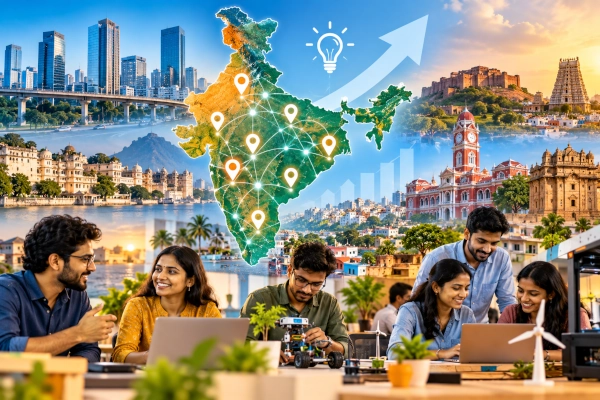
India’s startup ecosystem is undergoing a major geographical transformation, with entrepreneurship and technology-driven businesses expanding beyond established innovation centres such as Bengaluru, Hyderabad, Mumbai and Delhi-NCR. According to official government assessments, nearly 50% of DPIIT-recognised startups now originate from Tier-II and Tier-III cities, reflecting the growing participation of smaller cities and emerging regional business centres in India’s innovation economy.
The expansion marks an important development in India’s entrepreneurship landscape, which was once concentrated largely in major metropolitan cities with established technology industries, investment networks and research institutions. Improved digital connectivity, government-backed startup programmes, expanding educational infrastructure and the availability of institutional support have created opportunities for entrepreneurs to establish businesses in regions outside the traditional technology hubs.
The Department for Promotion of Industry and Internal Trade (DPIIT), under the Ministry of Commerce and Industry, has recorded substantial growth in recognised startups across the country. According to a Press Information Bureau assessment published in June 2026, India had crossed 2.3 lakh DPIIT-recognised startups, compared with approximately 350 startups before 2014. The Government also identified India as the world’s third-largest startup ecosystem, with more than 120 privately held companies valued above US$1 billion.
The decentralisation of entrepreneurship is particularly significant because startups can contribute to regional employment, local innovation and the commercial development of technologies addressing specific economic and social requirements. As more entrepreneurs establish businesses outside the major metropolitan centres, India’s startup economy is developing a wider geographical foundation.
Nearly Half of India’s Recognised Startups Emerge from Smaller Cities
The Government’s June 2026 assessment identifies the growing contribution of Tier-II and Tier-III cities as one of the important developments in India’s startup ecosystem. Nearly half of all recognised startups now originate from these locations, demonstrating that entrepreneurship is no longer concentrated exclusively in the country’s largest metropolitan economies.
Smaller cities often possess economic characteristics that differ from established technology centres. Many have strong connections with agriculture, manufacturing, traditional industries, educational institutions and regional service markets. These characteristics provide opportunities for entrepreneurs to develop products and services that address local commercial requirements while serving wider national markets.
The emergence of startups in these regions also creates possibilities for strengthening local supply chains and generating skilled employment closer to workers’ home districts. Businesses operating outside major metropolitan areas can draw upon regional expertise and develop commercial relationships with nearby industries, farmers, educational institutions and service providers.
However, the increasing number of recognised startups should not automatically be interpreted as evidence that every emerging city has developed an equally mature entrepreneurial ecosystem. Access to venture capital, experienced mentors, specialised infrastructure and larger commercial markets remains uneven across regions. The geographical expansion nevertheless demonstrates that innovation and enterprise formation are becoming more widely distributed across the country.
India Crosses 2.3 Lakh DPIIT-Recognised Startups in 2026
India’s startup ecosystem has expanded rapidly since the launch of the Startup India initiative on January 16, 2016. The programme was established to encourage innovation, support entrepreneurship, improve access to investment and create a more favourable environment for emerging businesses.
According to the Ministry of Commerce and Industry, India had more than 2.23 lakh recognised startups as of March 31, 2026. The Government recognised over 55,200 new startups during FY2025–26, the highest annual recognition figure recorded since the initiative began. This represented an increase of 51.6% compared with the preceding financial year.
A subsequent government assessment published in June 2026 placed the total number of recognised startups above 2.3 lakh. This growth reflects the increasing number of enterprises entering the formal startup ecosystem and obtaining recognition through DPIIT.
Government recognition provides eligible startups with access to specified support measures, subject to the requirements of individual programmes. These include opportunities involving funding, intellectual property assistance, public procurement and regulatory facilitation.
The expansion of recognised startups also reflects a broader change in India’s business environment. Entrepreneurship increasingly encompasses technology development, manufacturing, agriculture, healthcare, education, digital services and other sectors rather than remaining confined to conventional software and information technology businesses.
Startup India Reaches Emerging Regional Entrepreneurship Centres
The spread of recognised startups across India’s states and Union Territories demonstrates the growing geographical diversity of the ecosystem. Maharashtra, Karnataka, Uttar Pradesh, Delhi and Gujarat remained among the leading regions in terms of recognised startups and employment generation as of March 2026.
However, several states beyond the traditional technology centres have also recorded substantial participation. Uttar Pradesh had more than 21,960 recognised startups, while Tamil Nadu accounted for over 14,830 and Rajasthan had more than 8,100. Kerala recorded more than 8,620 recognised startups, highlighting the participation of entrepreneurs in different regional economies.
The figures reflect state-wide totals rather than the performance of individual Tier-II cities. Nevertheless, they demonstrate that startup development has expanded across regions with different industrial structures and economic characteristics.
The Government’s district-level initiatives seek to strengthen this expansion by identifying local entrepreneurial talent and providing institutional support. The objective is to ensure that opportunities for innovation are available beyond established metropolitan startup clusters.
As entrepreneurship spreads geographically, regional institutions can play an increasingly important role in connecting business ideas with technical expertise, financing opportunities and commercial markets.
Government’s District Outreach Programme Takes Startup India Beyond Metros
DPIIT has introduced district-level outreach initiatives to extend startup awareness and institutional support to regions with limited participation in the formal entrepreneurial ecosystem.
According to an official Ministry of Commerce and Industry announcement, the District Outreach Programme was designed to encourage the presence of at least one DPIIT-recognised startup in every district of the country. The programme placed particular emphasis on districts without recognised startups, including locations in the northeastern region.
The Government reported that approximately 95% district coverage had been achieved by the time of its January 2025 assessment. This demonstrated substantial geographical progress in extending the Startup India framework.
District outreach activities seek to connect aspiring entrepreneurs with information about recognition procedures, available support schemes and opportunities for developing businesses. Such initiatives are especially important in regions where entrepreneurs may lack access to established startup networks.
The wider availability of startup-related information can help students, first-time founders and local businesses understand the institutional support available for developing innovative products and services.
The district outreach approach also recognises that entrepreneurship can emerge from different economic environments. Local problems involving agriculture, healthcare, logistics, education and manufacturing may provide opportunities for businesses capable of developing practical solutions.
TEJAS Initiative Strengthens District-Level Entrepreneurship
The Startup India platform also identifies TEJAS as an initiative intended to unlock local innovation and strengthen entrepreneurial participation at the district level.
TEJAS focuses on identifying local talent, innovative ideas and potential entrepreneurs through workshops and ecosystem engagement. It seeks to improve awareness of government schemes while connecting aspiring founders with mentorship, incubation facilities, funding opportunities and market access.
The initiative places particular emphasis on encouraging participation by young people, women, students and first-time entrepreneurs. This approach recognises that entrepreneurship can be limited by inadequate information, weak institutional connections and the absence of experienced business guidance.
District-level workshops create opportunities for participants to learn about startup recognition, business development and available support mechanisms. They also help connect local entrepreneurs with organisations capable of assisting in the development of commercial enterprises.
The official TEJAS platform identifies district-level startup activity in locations such as Ranchi and East Singhbhum in Jharkhand, Begusarai and Muzaffarpur in Bihar, and Guna in Madhya Pradesh. These examples demonstrate the presence of recognised startups in regions outside India’s best-known technology centres.
The programme forms part of the broader effort to strengthen local entrepreneurship through structured institutional engagement rather than relying exclusively on startup activity in metropolitan cities.
Regional Startup Growth Creates New Employment Opportunities
The expansion of India’s startup ecosystem has also contributed to employment generation across different sectors and geographical regions. According to DPIIT figures released in April 2026, recognised startups had reported creating more than 23.36 lakh direct jobs as of March 31, 2026. During FY2025–26 alone, recognised startups reported generating more than 4.99 lakh direct employment opportunities.
The geographical spread of startup activity creates opportunities for employment outside India’s traditional commercial and technology centres. Businesses operating in emerging cities can recruit local graduates, engineers, technicians, designers and other professionals while supporting additional economic activities through their suppliers and service providers.
Regional entrepreneurship can also contribute to retaining skilled workers who might otherwise relocate to larger metropolitan cities in search of employment. When local businesses develop viable commercial operations, they can provide professional opportunities connected to the economic strengths and requirements of their regions.
The Government’s employment figures represent jobs reported by recognised startups and do not establish how many positions were created specifically in Tier-II and Tier-III cities. Nevertheless, the overall employment contribution demonstrates the growing economic significance of India’s startup sector.
Women Entrepreneurs Play an Increasing Role in India’s Startup Economy
Women’s participation has become an important feature of India’s expanding startup ecosystem. According to the Ministry of Commerce and Industry, more than 1.07 lakh recognised startups had at least one woman director or partner as of March 31, 2026, accounting for approximately 48% of all DPIIT-recognised startups.
The figures demonstrate substantial female participation in the ownership and management structures of recognised enterprises. They also highlight the potential of entrepreneurship programmes to support women seeking to establish businesses in emerging regional markets.
For women in smaller cities, access to business networks, funding information, incubation facilities and professional mentorship can be particularly important. District-level initiatives that provide such support can help aspiring entrepreneurs explore commercial opportunities without requiring them to relocate to established startup centres.
Under the Startup India Seed Fund Scheme, incubators have provided funding support to eligible startups, including women-led enterprises. The Government has also introduced broader financing and capacity-building measures intended to improve access to entrepreneurial opportunities.
The presence of a woman director or partner does not necessarily mean that an enterprise is majority-owned or controlled by women. However, the official figures provide evidence of substantial female representation within India’s formal startup ecosystem.
Startup India Seed Fund Scheme Supports Early-Stage Entrepreneurs
Access to initial financing remains one of the important requirements for entrepreneurs attempting to convert innovative ideas into commercially viable businesses. The Government has introduced the Startup India Seed Fund Scheme to provide financial assistance through selected incubators to eligible startups at an early stage of development.
According to the Ministry of Commerce and Industry’s April 2026 announcement, 219 incubators had been selected under the scheme, and its ₹945 crore corpus had been fully committed. These incubators had approved more than ₹605 crore in funding for over 3,400 startups.
The scheme supports activities associated with proof of concept, prototype development, product trials, market entry and commercialisation, subject to its eligibility requirements. Such assistance can be particularly important for startups that have developed promising ideas but have not yet established the commercial history required to attract conventional financing.
Incubators also provide access to institutional guidance and business-development services. For entrepreneurs in smaller cities, participation in an incubation programme can create connections with technical experts, potential customers and investors beyond the immediate local market.
The decentralisation of incubation facilities therefore forms an important part of efforts to extend entrepreneurship support beyond established technology hubs.
Government Expands Startup Credit and Investment Support
India’s startup financing framework includes several programmes intended to support enterprises at different stages of their development. The Fund of Funds for Startups, Startup India Seed Fund Scheme and Credit Guarantee Scheme for Startups address different financing requirements.
Under the Fund of Funds for Startups, the Government provides capital through eligible Alternative Investment Funds, which subsequently invest in startups. By the end of FY2025–26, more than ₹7,000 crore had been disbursed to over 135 Alternative Investment Funds, which had invested more than ₹26,900 crore in over 1,420 startups.
The Government also notified Startup India Fund of Funds 2.0 with a corpus of ₹10,000 crore to strengthen the availability of investment capital. These mechanisms are intended to expand financing opportunities for innovative enterprises while encouraging participation by professional investment institutions.
The Credit Guarantee Scheme for Startups supports debt financing by providing guarantees to eligible lending institutions. During FY2025–26, the Government increased the maximum guarantee cover per borrower from ₹10 crore to ₹20 crore and introduced other changes intended to improve credit availability. By the end of the financial year, more than 410 loans amounting to over ₹1,250 crore had been guaranteed.
These programmes operate nationally, although individual startups must meet the relevant eligibility and approval requirements. Their expansion can provide important financial pathways for enterprises emerging from regional entrepreneurship centres.
Government Promotes Incubation Facilities in Emerging Regions
The Government has also developed partnerships intended to expand startup support infrastructure in regions with relatively limited access to established entrepreneurial networks.
In April 2026, DPIIT signed a memorandum of understanding with Chamber India to strengthen connections among startups, investors, corporations and international business organisations. The partnership included plans to establish five incubation and startup support centres across India, with particular attention to Aspirational Districts, northeastern states and other emerging regions.
The proposed centres are intended to improve access to institutional support, business guidance and commercial networks. Such facilities can help regional entrepreneurs address challenges involving product development, market entry, regulatory requirements and investor engagement.
The collaboration also provides for support in areas such as export facilitation, intellectual property advisory services and business matchmaking. These services are relevant to startups seeking to move beyond their initial markets and develop relationships with larger commercial partners.
The initiative illustrates how the Government is attempting to strengthen the institutional foundations of regional entrepreneurship. The proposed incubation centres should, however, be distinguished from facilities already established and operational.
Startup Innovation Expands into Manufacturing and Deep Technology
India’s startup ecosystem increasingly includes enterprises working in manufacturing, artificial intelligence, biotechnology, agricultural technology, drones, space technology and other knowledge-intensive sectors. This expansion broadens the country’s entrepreneurial activity beyond conventional software applications and digital consumer services.
The development of technology-intensive startups often requires specialised infrastructure, research capabilities and access to technical expertise. Universities, research laboratories, technology parks and incubation centres can help provide the institutional environment required for such enterprises.
The Government’s support for innovation also includes measures intended to strengthen intellectual property creation. According to the April 2026 DPIIT assessment, recognised startups had filed more than 19,400 patent applications, with annual filings increasing from over 2,850 in FY2024–25 to more than 4,480 in FY2025–26.
Patent applications provide an indicator of formal intellectual property activity, although filing an application does not establish that a patent has been granted or that the underlying technology has achieved commercial success.
The growth of innovation-oriented enterprises creates opportunities for smaller cities with universities, engineering institutions and manufacturing capabilities to participate in advanced technology development.
Government e-Marketplace Opens Procurement Opportunities for Startups
Access to customers is essential for startup sustainability, particularly when an enterprise has developed a product or service but lacks an established commercial network.
The Government e-Marketplace (GeM) provides an online procurement platform through which eligible businesses, including recognised startups, can participate in government purchasing opportunities.
According to the Ministry of Commerce and Industry, more than 38,600 startups had been onboarded on GeM by the end of FY2025–26. During that financial year, government buyers placed more than 1.40 lakh orders with startups, with a reported value exceeding ₹19,190 crore.
Public procurement can provide startups with opportunities to demonstrate their products, establish commercial credentials and develop experience in serving institutional customers. For companies in emerging cities, digital procurement platforms can reduce certain geographical barriers that previously limited access to larger buyers.
Participation nevertheless depends on meeting applicable procurement requirements, product standards and other conditions. The availability of a national platform does not guarantee contracts, but it expands the potential market accessible to eligible enterprises.
Digital Infrastructure Supports Entrepreneurship Beyond Metropolitan Cities
The expansion of India’s digital infrastructure has helped create a more favourable environment for businesses operating outside major commercial centres. Broadband connectivity, digital payment systems and online business platforms allow enterprises to communicate with customers, coordinate suppliers and access services without maintaining a physical presence in every market.
Government assessments published in 2026 highlighted the rapid expansion of digital connectivity, including the availability of 5G services across 99.9% of India’s districts. The growth of telecommunications infrastructure has increased the potential for technology-enabled business operations across a wider geographical area.
For entrepreneurs in Tier-II and Tier-III cities, reliable digital services can support activities involving software development, online commerce, financial technology and remote professional services. They can also help conventional businesses use digital platforms to reach customers beyond their immediate surroundings.
However, connectivity alone does not establish a successful startup ecosystem. Regional entrepreneurs also require access to skilled personnel, reliable infrastructure, financing, mentorship and commercially viable markets.
The combination of digital infrastructure and institutional entrepreneurship support can help emerging cities participate more actively in India’s technology-driven economy.
Regional Startup Ecosystems Require Stronger Mentorship and Market Access
Despite the increasing geographical spread of recognised startups, access to business networks and institutional expertise remains an important consideration for entrepreneurs operating outside established innovation centres.
Startups often require assistance with business planning, intellectual property management, financial compliance, product development and customer acquisition. Enterprises pursuing specialised technologies may also need testing facilities, laboratories or industrial partners.
The Startup India framework seeks to address these requirements through incubation support, capacity-building programmes, funding schemes and partnerships with public and private institutions.
District-level initiatives such as TEJAS provide another mechanism for improving awareness and connecting first-time entrepreneurs with relevant resources.
The development of regional startup ecosystems will depend not only on increasing the number of recognised businesses but also on helping those enterprises remain operational, develop sustainable revenue and access wider markets.
Stronger institutional connections between educational establishments, industry associations, investors and emerging businesses can contribute to these objectives.
India’s Startup Expansion Supports More Balanced Regional Development
The growth of entrepreneurship beyond Bengaluru, Hyderabad and other established centres represents an important development in India’s wider economic transformation.
Nearly half of DPIIT-recognised startups originating from Tier-II and Tier-III cities demonstrates that enterprise formation is becoming geographically diverse. The expansion creates opportunities for regions with different economic strengths to participate in innovation, technology development and new business formation.
Government initiatives involving district outreach, incubation facilities, financial support and public procurement are intended to help strengthen this trend. Programmes such as TEJAS seek to connect local entrepreneurs with institutional resources, while Startup India’s national financing mechanisms provide opportunities for eligible enterprises at different stages of development.
The overall expansion of India’s recognised startup ecosystem beyond 2.3 lakh enterprises by June 2026 provides evidence of growing entrepreneurial participation. At the same time, long-term regional development will depend on business sustainability, access to financing, skilled employment and the commercial success of emerging enterprises.
As startup activity spreads across smaller cities and districts, India is developing a broader foundation for entrepreneurship that connects local talent with national markets and technological opportunities. Continued investment in innovation infrastructure, professional skills, financing and institutional partnerships can strengthen this expansion and support more inclusive economic development under the vision of Viksit Bharat 2047.
References
1. Press Information Bureau, Government of India
Ministry of Information and Broadcasting
Empowered Youth, Stronger Nation: India’s Vision for Viksit Bharat @ 2047
Published: June 13, 2026
Release ID: 2272408
https://www.pib.gov.in/PressReleasePage.aspx?PRID=2272408
2. Press Information Bureau, Government of India
Ministry of Commerce and Industry
Government Recognizes More Than 55,200 Startups During FY2025–26, Highest Ever in a Single Year Since Launch of Startup India Initiative
Published: April 17, 2026
Release ID: 2253019
https://www.pib.gov.in/PressReleasePage.aspx?PRID=2253019
3. Press Information Bureau, Government of India
Ministry of Commerce and Industry
DPIIT Signs MoU with Chamber India to Boost Startup Ecosystem and Strengthen Global Linkages
Published: April 30, 2026
Release ID: 2257064
https://www.pib.gov.in/PressReleasePage.aspx?PRID=2257064
4. Press Information Bureau, Government of India
Ministry of Commerce and Industry
Startup India: Initiatives, District Outreach Programme and Entrepreneurship Development
Release ID: 2093109
https://www.pib.gov.in/PressReleasePage.aspx?PRID=2093109
5. Startup India, Government of India
TEJAS — District-Level Entrepreneurship and Startup Ecosystem Development
https://www.startupindia.gov.in/content/sih/en/tejas.html
6. Press Information Bureau, Government of India
Ministry of Commerce and Industry
Startup India Recognises 2.07 Lakh Ventures, Creates 21.9 Lakh Jobs; Government Expands Funding Push Through Flagship Schemes
Published: February 13, 2026
Release ID: 2227597
https://www.pib.gov.in/PressReleasePage.aspx?PRID=2227597
7. Startup India, Government of India
Startup India — Eighth Anniversary Factbook
https://www.startupindia.gov.in/content/dam/invest-india/Factbook-100K-Recognitions.pdf
You may also like
-
NABARD Report Highlights Growing Strength of Women-Led Farmer Producer Organisations in India
-
Indian Banks Expected to Record 25.4% Profit Growth in Q2 FY27 as Lending Expands and Margins Prepare for Recovery
-
India Targets 1 Billion 5G Users by 2030 as Telecom Sector Prepares for Global 6G Leadership
-
GHCL Begins Production at 2,800-Tonne Bromine Manufacturing Facility in Gujarat
-
BHEL Awards ₹52.68 Crore Indigenous Gas Turbine Component Contract to Azad Engineering
