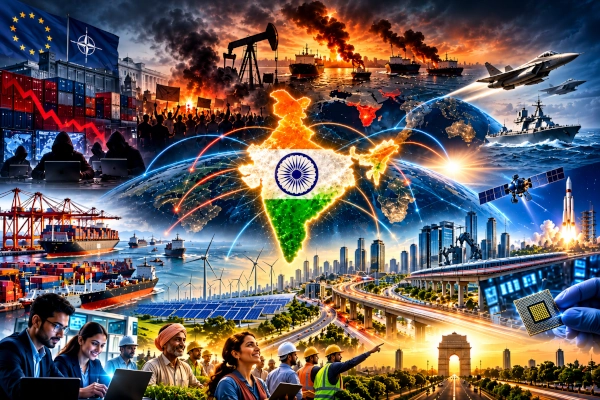
“War is the continuation of politics by other means.” — Carl von Clausewitz
The world is entering an era in which economic pressure has become one of the most consequential instruments of geopolitical competition. Trade restrictions, energy disruptions, financial sanctions, technology controls and competition over strategic resources increasingly influence relationships between nations. Countries no longer need to confront one another militarily to impose substantial economic costs or attempt to influence political decisions.
India stands at the centre of this changing international environment. As one of the world’s fastest-growing major economies, it is expanding its manufacturing capabilities, developing indigenous defence technologies, strengthening digital infrastructure and pursuing a foreign policy that places national interests above permanent alignment with any single power bloc. This growing independence has also exposed the country to disagreements with established economic and strategic powers.
In 2026, India faces a particularly complex combination of challenges. Energy disruptions in West Asia threaten industrial costs and inflation, American trade policies have complicated bilateral negotiations, and India’s continued partnership with Russia remains a source of disagreement with Washington. Meanwhile, competition for advanced technologies, critical minerals and defence contracts is intensifying across the international economy.
Despite these pressures, the World Bank projected India’s economic growth at 7.1% for FY2026–27 in its October 2026 assessment. This performance places India among the fastest-growing major economies during a period of considerable global uncertainty.
The central feature of India’s response is its determination to preserve strategic autonomy while expanding economic opportunities. Rather than allowing any single international relationship to determine its choices, New Delhi is seeking to develop the industrial, technological and financial capabilities necessary to negotiate from a position of greater strength.
Economic Warfare Has Become an Instrument of International Power
Economic competition has always influenced relations between countries, but globalisation has greatly expanded the instruments available for applying pressure. Modern manufacturing depends on international supply chains, energy markets connect distant economies, and advanced technologies frequently rely on components produced across several jurisdictions. This interdependence creates opportunities for cooperation while exposing countries to restrictions imposed elsewhere.
Financial sanctions can limit access to banking services, trade barriers can reduce export competitiveness, and restrictions on advanced technologies can delay industrial development. Energy disruptions may affect inflation, transport costs and industrial production far beyond the region where a conflict occurs. Governments can also use market access and investment approvals as instruments in broader diplomatic negotiations.
Such measures do not necessarily constitute warfare in a legal or military sense. Many are ordinary elements of international economic policy, while others represent deliberate attempts to influence another country’s decisions through coercion. Their cumulative effects, however, can resemble a sustained strategic confrontation in which economic resilience becomes as important as conventional military strength.
For India, the challenge is to participate fully in the international economy without developing excessive dependence on countries that may use commercial relationships to exert political pressure. This requires diversified partnerships, competitive domestic industries and institutions capable of managing external shocks.
Energy Disruptions Present a Direct Challenge to India’s Economic Stability
India’s reliance on imported crude oil makes energy security one of its most important economic priorities. Petroleum supports transportation, agriculture, manufacturing and numerous industrial processes, while natural gas plays a significant role in fertiliser production, electricity generation and several other sectors.
The conflict in West Asia has demonstrated how rapidly geopolitical tensions can affect the global energy market. Disruptions affecting shipping through the Strait of Hormuz create uncertainty for petroleum and liquefied natural gas supplies originating from major producing countries in the Persian Gulf.
For India, higher international energy prices can increase the import bill, place pressure on the rupee and raise costs throughout the economy. Manufacturing companies face higher expenses for transportation and production, while agricultural activity may become more expensive when fuel and fertiliser costs increase. Infrastructure projects can also experience additional expenditure through higher diesel, bitumen and construction-material prices.
Energy security therefore extends beyond the availability of crude oil. It involves maintaining reliable supply contracts, diversifying producing countries, developing strategic reserves and strengthening domestic refining and transportation infrastructure. India’s ability to sustain economic growth during international energy disruptions depends substantially on the effectiveness of these arrangements.
Russian Petroleum Remains an Important Element of India’s Strategic Autonomy
India’s continued energy relationship with Russia illustrates the relationship between economic requirements and independent foreign policy. Following Russia’s invasion of Ukraine in 2022, Western governments introduced extensive sanctions targeting Moscow’s financial institutions, energy industry and international commercial relationships.
India expanded purchases of Russian crude when commercially attractive supplies became available, arguing that its energy decisions must reflect the needs of its population and domestic economy. The policy subsequently generated criticism from Washington and several European governments, particularly as restrictions on Russian petroleum became an important instrument of Western foreign policy.
The disagreement raises a broader question concerning the autonomy of energy-importing nations. Countries that depend on international petroleum supplies must evaluate available sources according to price, reliability, refinery requirements and transportation costs. Restrictions imposed by other governments can complicate these decisions even when the importing country has not adopted the same sanctions.
India’s objective is not to replace dependence on one country with dependence on another. It is to preserve access to multiple suppliers, including Russia, West Asian producers and other international partners. Diversification reduces the risk that a single diplomatic dispute or supply interruption will determine the availability and cost of energy for the Indian economy.
India Is Exploring Arctic Energy Resources and Alternative Maritime Routes
India’s relationship with Russia extends beyond purchasing crude oil to participation in upstream production and discussions concerning future energy infrastructure. Indian public-sector companies hold substantial investments in Russian petroleum assets, including Vankorneft and Taas-Yuryakh, providing exposure to hydrocarbon production through long-term industrial partnerships.
Russia’s development of Arctic petroleum resources, including the Vostok Oil project, creates possibilities for additional cooperation. Both governments have also examined opportunities involving liquefied natural gas, maritime transportation and the Northern Sea Route, which connects Russia’s Arctic coastline with international shipping networks.
In September 2026, Rosneft announced the commencement of oil-loading operations at the Bukhta Sever Arctic terminal, marking a development in the Vostok Oil project. India and Russia have separately discussed specialised shipbuilding, icebreaker construction and the training of personnel for polar navigation.
These developments could eventually support additional energy transportation options serving Asian markets. However, no dedicated operational Arctic-to-India energy corridor has been officially established. Commercial viability will depend on shipping costs, ice-class vessels, financial arrangements, insurance and the regulatory environment affecting Russian energy exports.
The strategic importance of this cooperation lies in expanding India’s future options rather than promising an immediate replacement for established petroleum supply routes.
India Is Demanding Reciprocity in Trade Negotiations with the United States
India’s trade relationship with the United States presents a different form of economic challenge. Washington represents an important destination for Indian exports and a major source of investment and technology, while India’s expanding market offers substantial opportunities for American companies.
Nevertheless, the two countries have encountered disagreements over tariffs, agricultural market access, industrial products and the treatment of sensitive domestic sectors. These differences intensified as American trade measures became linked to broader geopolitical disputes, including India’s purchase of Russian energy.
In October 2026, Finance Minister Nirmala Sitharaman acknowledged that bilateral trade negotiations had reached a difficult stage, with limited room for further concessions. Her remarks reflected the challenges of reconciling competing economic priorities after extensive discussions.
For India, reciprocity means obtaining meaningful access to international markets while carefully evaluating the consequences of concessions made to foreign exporters. An agreement that substantially benefits one side at the expense of important domestic industries may create long-term economic difficulties despite providing short-term diplomatic advantages.
New Delhi’s negotiating position reflects the importance of India’s growing market. The country has incentives to expand bilateral trade, but its economic size also provides a basis for seeking balanced arrangements rather than accepting every proposal presented by a larger trading partner.
Agricultural and Dairy Markets Remain Important Negotiating Priorities
Agriculture is among the most sensitive components of India’s international trade policy because millions of households depend on farming and associated rural activities. India’s agricultural structure differs significantly from that of countries where production is concentrated among large, highly mechanised commercial enterprises.
A rapid opening of sensitive agricultural markets could expose small producers to competition that they may find difficult to absorb. Dairy presents similar concerns because India’s cooperative network and smallholder production system support rural incomes across numerous states.
Trade liberalisation can provide benefits through improved technology access, lower costs and greater competition. However, those benefits must be assessed alongside potential effects on employment, domestic production and rural economic stability.
India’s approach therefore involves seeking export opportunities while preserving appropriate safeguards for vulnerable sectors. The broader economic objective is to improve productivity and competitiveness so that Indian producers can participate more successfully in international markets without facing abrupt and disproportionate adjustment costs.
India’s Defence Procurement Decisions Demonstrate Strategic Independence
Defence acquisition represents another area in which India must balance operational requirements with international political relationships. Modern combat aircraft, missile systems and advanced military platforms involve long-term dependencies extending beyond the original purchase price.
Software upgrades, weapons integration, maintenance arrangements and access to critical components can influence how independently a country operates its military equipment. Procurement decisions must consequently consider technological sovereignty alongside performance and cost.
India has traditionally maintained relationships with several defence suppliers, including Russia, France, Israel and the United States. This approach allows the Armed Forces to evaluate competing technologies while reducing excessive dependence on one international partner.
The policy creates logistical challenges because equipment from different countries may require separate maintenance arrangements and supply chains. Nevertheless, it gives India greater negotiating flexibility and encourages foreign manufacturers to address requirements involving domestic production, technology transfer and indigenous weapons integration.
The expanding role of Indian defence companies is gradually strengthening this position by increasing the range of systems and components that can be manufactured within the country.
Trump’s F-35 Proposal and India’s Continued Rafale Engagement
During Prime Minister Narendra Modi’s February 2025 visit to Washington, President Donald Trump publicly raised the prospect of providing F-35 fifth-generation stealth fighters to India. The statement attracted considerable attention because the aircraft represents one of America’s most advanced military aviation platforms.
India has meanwhile continued its defence relationship with France through the Rafale programme. The Indian Air Force already operates Rafale fighters, while the Indian Navy has selected the Rafale Marine for carrier-based aviation. Discussions concerning additional aircraft and the integration of Indian weapons form part of the broader partnership.
These developments should not be interpreted as confirmation that India has formally rejected an American F-35 offer in favour of Rafale. No such direct procurement decision has been announced. They instead demonstrate that New Delhi continues to examine available options according to military requirements, industrial participation, technological access and long-term operational considerations.
The distinction reflects India’s preference for making defence decisions through national procurement processes rather than treating diplomatic proposals as predetermined acquisition commitments.
India Is Building Security Partnerships Without Accepting Permanent Military Dependence
India’s relationship with the United States differs fundamentally from the collective-defence arrangements maintained by European members of NATO. The transatlantic alliance has provided a security framework for its members for decades, with American military capabilities playing an important role in deterrence, intelligence and strategic operations.
NATO members retain their own national sovereignty, and several European countries maintain substantial independent defence industries. Nevertheless, the alliance’s reliance on American capabilities creates dependencies that have become subjects of debate within Europe.
India has chosen a different institutional framework. It cooperates with Washington through military exercises, technology programmes, equipment purchases and strategic dialogue without joining a mutual-defence treaty requiring it to participate in American military operations.
This arrangement preserves India’s ability to maintain defence cooperation with Russia, expand partnerships with France and Israel, and pursue independent policies in the Indo-Pacific.
Strategic autonomy also carries significant responsibilities because India must sustain its own military capabilities without relying on an American collective-defence guarantee. The expansion of indigenous defence manufacturing, missile development and naval shipbuilding therefore supports a wider national objective of maintaining independent security choices.
Indigenous Defence Manufacturing Is Reducing India’s Dependence on Foreign Suppliers
India’s defence-industrial expansion has become an important component of its economic and strategic resilience. Military imports create long-term obligations involving maintenance, spare parts, ammunition and technological upgrades. When essential components originate overseas, foreign export restrictions or diplomatic disagreements can affect the availability of critical equipment.
Programmes involving Tejas combat aircraft, Akash air-defence missiles, Pinaka rocket artillery, BrahMos missile systems and indigenous naval vessels demonstrate India’s progress in developing domestic manufacturing capabilities. Public-sector enterprises and private companies are increasingly contributing to aerospace engineering, advanced electronics, unmanned systems, precision manufacturing and military communications.
The economic benefits extend beyond defence production because specialised military technologies often require investments in materials science, electronics, software and industrial testing. These capabilities can support civilian manufacturing while generating opportunities for engineers, researchers and specialised suppliers. Nevertheless, India continues to depend on imports for certain advanced technologies, particularly high-performance aircraft engines and critical electronic components.
The country’s long-term objective is to move beyond assembling imported systems towards mastering the technologies that determine operational performance and industrial independence. Such capabilities strengthen India’s negotiating position with international defence manufacturers while creating opportunities for domestic innovation.
Semiconductor Technology Is Emerging as a New Arena of Economic Competition
Semiconductors have become essential to modern economic and military power. They support telecommunications networks, artificial intelligence, automobiles, industrial automation, financial infrastructure and advanced weapon systems. Countries possessing important semiconductor technologies can exercise considerable influence over international manufacturing networks.
The global industry remains geographically concentrated, with advanced fabrication, equipment manufacturing and critical materials distributed among a relatively small number of countries. Export controls and technology restrictions can therefore affect industrial development far beyond the countries directly involved in a geopolitical dispute.
India is responding through investments in semiconductor fabrication, assembly, testing, packaging and chip design. Government-supported projects and private-sector initiatives are intended to establish a domestic manufacturing ecosystem capable of supplying important segments of the electronics industry.
The development of semiconductor manufacturing requires sustained investment, specialised workforce skills and reliable access to sophisticated equipment. India cannot immediately eliminate its dependence on international suppliers, but greater domestic capability can reduce vulnerabilities and improve its participation in advanced technology value chains.
Global Supply-Chain Changes Are Creating Opportunities for Indian Industry
International companies are increasingly examining alternatives to concentrated manufacturing arrangements. The COVID-19 pandemic demonstrated the consequences of supply-chain disruption, while subsequent geopolitical tensions reinforced concerns about excessive dependence on individual production centres.
India has sought to attract companies looking to diversify their manufacturing operations through improvements in infrastructure, industrial incentives and efforts to simplify business procedures. Electronics, automobiles, pharmaceuticals, renewable-energy equipment and engineering products are among the sectors attracting attention.
The opportunity is significant because foreign investment can introduce advanced manufacturing processes, create employment and support the development of domestic suppliers. However, companies evaluate commercial considerations alongside geopolitical factors, including logistics expenses, regulatory predictability, electricity availability and workforce productivity.
India’s competitiveness will therefore depend on offering reliable industrial conditions rather than relying exclusively on international tensions to redirect investment. Continued improvements in transportation, energy infrastructure, technical education and manufacturing efficiency can help convert changing global supply chains into sustainable domestic production.
Critical Minerals Could Determine the Next Phase of Industrial Competition
The transition towards advanced electronics, renewable energy and electric mobility has increased the strategic importance of critical minerals. Lithium, cobalt, nickel, graphite and rare-earth elements are essential to numerous industrial technologies, including batteries, electric motors, semiconductors and defence systems.
Global production and processing capacity remain concentrated in relatively few countries. This creates risks when export restrictions, political disputes or transportation interruptions affect access to essential materials.
India has expanded efforts to identify domestic mineral deposits and establish overseas partnerships to secure reliable supplies. These initiatives are complemented by investment in processing technologies, recycling and the development of advanced materials.
Access to mineral resources alone does not guarantee industrial independence because raw materials frequently require sophisticated refining before they can enter manufacturing supply chains. Establishing domestic processing capacity is therefore as important as securing mining rights.
India’s growing requirements for batteries, electronics and defence equipment make critical mineral security an increasingly important part of its industrial policy.
Financial Sanctions and International Payment Systems Create Additional Vulnerabilities
The global financial system gives certain currencies, institutions and payment networks considerable influence over international commerce. The US dollar remains central to commodity trading, while cross-border transactions frequently depend on financial institutions operating under American and European regulatory frameworks.
Sanctions imposed on banks, companies or individuals can consequently affect commercial activities involving third countries. India’s experience with Russian energy transactions has highlighted the complications that arise when international financial restrictions intersect with legitimate economic requirements.
India and Russia have explored alternative settlement arrangements, including local-currency transactions, although trade imbalances and banking regulations have created practical difficulties. Such mechanisms require dependable financial institutions, adequate currency liquidity and commercial acceptance.
India’s broader objective is to strengthen its financial resilience without withdrawing from established international markets. Diversified payment options can provide additional flexibility, while stable institutions and prudent financial management remain essential to investor confidence.
The economic value of financial independence lies in preserving the ability to conduct lawful international commerce even when geopolitical disputes disrupt conventional arrangements.
Maritime Chokepoints Have Become Critical Economic Security Concerns
India’s international trade depends heavily on maritime transportation, making the security of major shipping routes an important national interest. Petroleum tankers, LNG carriers, container vessels and bulk cargo ships connect Indian industry with suppliers and customers across the world.
Disruptions affecting the Strait of Hormuz, Red Sea, Suez Canal or other maritime passages can increase transportation expenses and delay the movement of essential commodities. These consequences extend to exporters, manufacturers and households through higher costs and interrupted supply chains.
India is strengthening port infrastructure, maritime surveillance and naval capabilities while pursuing alternative international connectivity projects. The International North–South Transport Corridor and the Chennai–Vladivostok Eastern Maritime Corridor represent efforts to diversify transportation options and improve commercial links with Eurasian markets.
Such initiatives require substantial infrastructure investment and international cooperation before they can provide dependable alternatives to established routes. Their strategic significance lies in gradually expanding India’s options and reducing the economic consequences of disruption in any single maritime corridor.
Special Intensive Revision of Electoral Rolls Is Not a New Constitutional Exercise
Domestic political stability influences investment, commercial activity and public confidence, making the controversy surrounding the Special Intensive Revision (SIR) of electoral rolls an important governance issue.
The Election Commission of India has the constitutional responsibility to maintain accurate electoral rolls by including eligible voters and identifying entries requiring correction or deletion. Population movement, deaths, changes in residence and duplicate registrations create a continuing need for electoral verification.
The current revision is not without historical precedent. In its order dated 24 June 2025, the Election Commission identified intensive revision exercises conducted during several earlier periods, including 1952–56, 1957, 1961, 1965, 1966, 1983–84, 1987–89, 1992, 1993, 1995, 2002, 2003 and 2004. These were not seven identical nationwide exercises, but they demonstrate that intensive verification has been part of India’s electoral administration for decades.
The reference to 2002 and 2003 is particularly relevant because those revisions provide important historical electoral records in several states. Electoral-roll maintenance has continued since then, although the timing and procedures of intensive exercises have varied.
Political parties across the spectrum have previously raised concerns about duplicate voters, inaccurate registrations and electoral-roll integrity. Removing invalid entries is therefore a legitimate administrative objective rather than an inherently partisan exercise.
However, the present controversy concerns the procedures used to verify eligibility and whether those procedures adequately protect the rights of genuine voters. Opposition parties have raised concerns about possible wrongful exclusions, while the Election Commission has maintained that the exercise is intended to improve electoral accuracy and includes mechanisms for correcting errors.
The distinction matters because the historical legitimacy of electoral revision does not automatically establish that every individual deletion or verification decision is correct. An effective revision must achieve both objectives: removing invalid entries and protecting the voting rights of eligible citizens.
Domestic Protests, Political Misinformation and Their Impact on Investor Confidence
Political protests are an essential feature of democracy, but they also carry a responsibility to present facts accurately and avoid creating unnecessary confusion among citizens. When political organisations deliberately misrepresent established procedures, exaggerate administrative disagreements or circulate incomplete information to gain public attention, they risk turning legitimate democratic participation into an instrument of political manipulation. Such campaigns can create mistrust in constitutional institutions, generate avoidable social tensions and divert public attention from substantive issues affecting national development.
The controversy surrounding the Special Intensive Revision (SIR) of electoral rolls illustrates the importance of informed political debate. Electoral-roll verification is not a new exercise, as the Election Commission of India has conducted intensive revisions on several occasions since independence, including during 2002–2004.
Identifying duplicate registrations, removing entries of deceased voters and ensuring that eligible citizens appear on electoral rolls are established responsibilities of electoral administration. Political parties across the spectrum have previously raised concerns about inaccurate voter lists.
Political competition should not come at the expense of public understanding or institutional credibility. Citizens deserve accurate explanations of government policies, their legal foundations and their possible consequences rather than selective narratives intended to generate outrage or secure short-term political advantages.
Mobilising people through misunderstandings can create avoidable disruptions to transportation, commerce and public services, placing additional burdens on ordinary workers, small businesses and families. Public protests should serve genuine public interests, not become opportunities to confuse citizens for political brownie points.
India Remains Among the Fastest-Growing Major Economies Despite Global Pressure
India’s continued economic expansion is one of the most important indicators of its resilience during a period of international uncertainty. The World Bank’s October 2026 assessment projected real GDP growth of 7.1% for FY2026–27, supported by domestic demand and exports.
The forecast places India among the world’s fastest-growing major economies, although rankings depend on the economies and measurement periods being compared. It does not establish that India has the highest growth rate among every country in the world.
Domestic consumption, services, infrastructure investment and expanding technological capabilities continue to support economic activity. India’s large internal market provides a degree of protection against external demand shocks because substantial economic activity depends on domestic households and businesses.
Nevertheless, higher energy prices, international financial volatility and weaker export demand remain significant risks. Employment generation, productivity improvements and rural income growth are also important for ensuring that economic expansion produces broad benefits.
India’s performance is therefore significant not because the economy is insulated from international pressure, but because it has continued to expand while confronting multiple external challenges.
UPI Demonstrates India’s Ability to Build Technology at National Scale
India’s Unified Payments Interface has become one of the country’s most visible achievements in digital public infrastructure. Developed by the National Payments Corporation of India, UPI allows individuals and businesses to conduct instant payments through an interoperable banking network.
During September 2026, UPI processed approximately 24.07 billion transactions valued at around ₹29.37 lakh crore, demonstrating the scale at which digital payments have become integrated into everyday economic activity.
The system has transformed financial transactions for small merchants, service providers and consumers by reducing dependence on cash and enabling payments through widely available mobile applications. Its interoperability allows competing financial technology companies to operate on a common infrastructure rather than requiring customers to remain within a single proprietary network.
UPI’s significance extends beyond convenience because it demonstrates India’s capacity to design and operate sophisticated domestic technology infrastructure. International interest in the platform has also created opportunities for payment connectivity with foreign partners.
Although UPI does not eliminate India’s dependence on international banking networks for global commerce, it strengthens domestic payment efficiency and provides a technological foundation for future financial innovation.
Highways and Infrastructure Are Transforming India’s Economic Geography
The expansion of India’s national highway network represents another major change in the country’s productive infrastructure. Government data show that the network increased from approximately 91,287 kilometres in 2014 to more than 1.46 lakh kilometres by 2023–24.
This expansion has been accompanied by investment in expressways, bridges, transport corridors and improved connectivity between industrial centres and markets. Better roads can reduce travel time, improve the reliability of freight movement and expand opportunities for businesses operating outside major metropolitan areas.
Infrastructure development also supports economic activity through demand for steel, cement, machinery, engineering services and construction employment. Improved connections between ports, industrial zones and inland production centres can help Indian manufacturers compete more effectively in international markets.
The long-term value of these investments depends on construction quality, efficient maintenance and integration with railways, logistics facilities and other transport systems.
India’s infrastructure programme is therefore an important part of its economic resilience because it addresses domestic inefficiencies that can otherwise weaken competitiveness during periods of international pressure.
Indian Startups Are Expanding the Country’s Technological Capabilities
India’s startup ecosystem has grown into an important source of technological innovation and industrial entrepreneurship. According to the Ministry of Commerce and Industry, more than 2.23 lakh startups had received government recognition by 31 March 2026, with recognised enterprises reporting over 23.36 lakh direct jobs.
The ecosystem increasingly includes companies working in aerospace, robotics, artificial intelligence, biotechnology, semiconductors, drones and advanced manufacturing. These sectors are important because technological dependence can become an economic vulnerability when foreign suppliers control essential products or intellectual property.
Indian space startups are developing launch vehicles, propulsion systems, satellite platforms and specialised payloads. Robotics companies are designing automated industrial equipment, while domestic semiconductor enterprises are pursuing chip design and associated technologies.
Such developments demonstrate the expansion of Indian entrepreneurship beyond traditional information technology services. However, startup recognition does not guarantee commercial success, and emerging companies must still overcome challenges involving financing, product qualification, manufacturing scale and international competition.
India’s long-term opportunity lies in converting domestic innovation into competitive products and sustainable industrial enterprises capable of serving both national and international markets.
India’s Growing Economic Strength Is Changing Its International Negotiating Position
India’s expanding market, manufacturing capabilities and strategic importance have increased its relevance to major international powers. Countries seeking access to Indian consumers, investment opportunities or defence partnerships must increasingly account for New Delhi’s economic priorities.
This creates additional negotiating flexibility in trade, technology and military procurement. India can examine competing commercial proposals, seek improved terms and maintain relationships with multiple international partners.
However, economic influence does not eliminate interdependence. India continues to rely on overseas markets for exports, foreign technology for important industrial applications and international suppliers for energy and critical materials.
The objective of strategic autonomy is therefore not complete economic separation from other countries. It is to ensure that international dependence remains diversified and manageable.
A country becomes more resilient when it possesses sufficient alternatives to respond to changing geopolitical circumstances without sacrificing essential domestic priorities.
Public Confidence in India’s Development Is an Important Political Factor
Public confidence influences economic expectations because households, businesses and investors make decisions partly according to their assessments of national stability and future opportunities.
Prime Minister Narendra Modi’s government has placed infrastructure expansion, digital financial inclusion, manufacturing growth and technological development at the centre of its economic agenda. The expansion of UPI, national highways, startup activity and domestic industrial capabilities provides visible evidence through which citizens can evaluate these policies.
Modi’s continued electoral leadership demonstrates substantial political support, while the Bharatiya Janata Party has emphasised his record in executive office as a foundation of its public mandate. On 6 October 2026, the Union Cabinet adopted a resolution marking 25 years since Modi first assumed executive office as Gujarat’s Chief Minister in 2001.
Nevertheless, public confidence should not be treated as uniform across India’s population. Citizens differ in their assessments of employment opportunities, household finances, governance, public services and economic development.
An Ipsos survey published in September 2026 reported relatively high levels of trust in several Indian professional and public institutions. However, this was not a direct measure of approval of Prime Minister Modi, and it cannot establish the proportion of Indians who trust him personally.
Political support is best assessed through election results and appropriately designed public opinion surveys. Economic indicators and infrastructure achievements provide important evidence of government performance, but they do not independently measure public approval.
The Economic Realities Shaping India’s Position in Global Competition
India faces a combination of international pressures and domestic economic requirements that must be managed simultaneously. Energy supply, defence technology, global market access and financial infrastructure each influence the country’s ability to preserve strategic independence.
| Strategic challenge | Economic significance | India’s response |
|---|---|---|
| Global energy disruptions | Higher import costs and inflation risks | Diversified suppliers, reserves and energy infrastructure |
| Restrictions affecting Russian oil | Greater complexity in sourcing and payments | Independent procurement decisions and lawful settlement arrangements |
| US trade negotiations | Tariffs and unequal market-access risks | Demands for balanced, reciprocal agreements |
| International defence competition | Long-term technological and supply dependencies | Diversified procurement and indigenous manufacturing |
| Advanced semiconductor restrictions | Vulnerability in critical electronics | Domestic fabrication, design and packaging capabilities |
| Critical mineral concentration | Risks to batteries and advanced industry | Overseas partnerships and domestic processing |
| Global supply-chain realignment | Competition for industrial investment | Infrastructure improvements and manufacturing incentives |
| Financial sanctions | Exposure to international banking restrictions | Payment diversification and financial resilience |
| Maritime chokepoints | Disruption to energy and merchandise trade | Maritime security and alternative transport corridors |
| Political and information interference | Potential institutional and economic instability | Evidence-based counterintelligence and financial regulation |
| Domestic economic development | Need for productivity, employment and infrastructure | Investment in highways, digital systems, industry and innovation |
These challenges demonstrate that India’s strategic position depends on more than the growth of GDP. Economic resilience requires reliable institutions, competitive industries, technological capabilities and the ability to respond to disruptions originating outside the country.
India’s Economic Resilience Is Becoming a Foundation of Strategic Independence
The international economic environment of 2026 has demonstrated how closely trade, energy, technology and national security are connected. A disruption in West Asian energy supplies can affect Indian manufacturing, while foreign technology restrictions can influence domestic industrial development. Trade negotiations and defence procurement decisions increasingly involve strategic considerations extending beyond ordinary commercial transactions.
India’s response has been to strengthen domestic capabilities while maintaining relationships with competing international powers. Continued cooperation with Russia, expanding defence engagement with France, commercial negotiations with the United States and stronger ties with other international partners reflect this effort to preserve flexibility.
The country’s domestic transformation is equally important. Digital payment infrastructure, highway development, industrial investment and the expansion of technology startups are creating capabilities that can support long-term economic competitiveness.
Political stability and public confidence remain essential to sustaining this progress. India must preserve institutional accountability and constitutional freedoms while maintaining effective safeguards against genuine foreign interference and unlawful disruption.
India’s growing importance in the global economy gives it greater freedom to defend its interests, negotiate reciprocal partnerships and pursue independent strategic choices. Its continued development of infrastructure, technology, manufacturing and national security capabilities is strengthening the foundations of an economy capable of withstanding external pressures while advancing towards a larger role in the international order.
References
- World Bank — 6 October 2026. India Development Update, October 2026. Economic growth projections and risks affecting India’s economy.
https://www.worldbank.org/en/news/press-release/2026/10/06/india-development-update-oct-2026 - Reuters — 5 October 2026. India–US Trade Talks Hit Plateau, Finance Minister Says.
https://www.reuters.com/world/india/india-us-have-reached-plateau-trade-talks-indian-finance-minister-says-2026-10-05/ - White House — 13 February 2025. United States–India Joint Leaders’ Statement. Bilateral cooperation in trade, defence and technology.
https://www.whitehouse.gov/briefings-statements/2025/02/united-states-india-joint-leaders-statement/ - Business Standard — 11 October 2026. US Yet to Formally Offer F-35 to India, Says IAF Chief AP Singh.
https://www.business-standard.com/external-affairs-defence-security/news/us-yet-to-formally-offer-f-35-to-india-says-iaf-chief-ap-singh-in-jodhpur-126101100261_1.html - Election Commission of India — 24 June 2025. Order on Special Intensive Revision of Electoral Rolls.
https://www.eci.gov.in/eci/public/api/document?id=17345 - Reuters — 11 October 2026. Protesters Seeking India Election Chief’s Ouster Detained.
https://www.reuters.com/world/asia-pacific/indian-capital-braces-second-day-protests-against-poll-chief-2026-10-11/ - National Payments Corporation of India — September 2026. UPI Monthly Product Statistics.
https://www.npci.org.in/product/upi/product-statistics - Ministry of Road Transport and Highways — 5 January 2024. Year-End Review of National Highway Development.
https://www.pib.gov.in/PressReleasePage.aspx?PRID=1993425 - Ministry of Commerce and Industry — 17 April 2026. Startup India Recognition and Employment Statistics.
https://www.pib.gov.in/PressReleasePage.aspx?PRID=2253019 - Reuters — 11 October 2026. Middle East War and High Debt Levels to Dominate IMF–World Bank Meetings.
https://www.reuters.com/world/china/middle-east-war-high-debt-levels-dominate-imf-world-bank-meetings-bangkok-2026-10-11/ - Ipsos — 30 September 2026. India Tops Ipsos Global Trustworthiness Index 2026.
https://www.ipsos.com/en-in/india-tops-ipsos-global-trustworthiness-index-2026 - The Indian Express — 6 October 2026. Union Cabinet Resolution on Narendra Modi’s 25 Years in Executive Office.
https://indianexpress.com/article/india/union-cabinet-resolution-narendra-modi-25-years-governance-gujarat-pm-10909514/ - Ministry of External Affairs — 5 December 2025. Joint Statement Following the 23rd India–Russia Annual Summit. Bilateral energy, maritime and strategic cooperation.
https://www.pmindia.gov.in/en/news_updates/joint-statement-following-the-23rd-india-russia-annual-summit/ - Ministry of Petroleum and Natural Gas. Government of India — Energy Security, Crude Oil Procurement and Strategic Petroleum Reserves.
https://mopng.gov.in/ - Ministry of Electronics and Information Technology. India Semiconductor Mission and Electronics Manufacturing Initiatives.
https://www.meity.gov.in/ - Ministry of Defence, Government of India. Defence Production and Indigenous Manufacturing Initiatives.
https://mod.gov.in/
You may also like
-
India-US Trade Deal Stalemate: Why Washington’s Tariff Pressure Has Failed to Secure an Agreement
-
US Double Standards in Foreign Policy: 16 Recent Cases Involving India, Russia, China and Global Trade
-
India’s Arctic Energy Ambitions: Russian Oil, LNG and a New Sea Route to Indian Ports
-
India and Russia Explore Joint Icebreaker Construction as Maritime Industrial Cooperation Expands
-
Nagri Dubraj Rice of Chhattisgarh — Dhamtari’s Fragrant Heritage Grain
