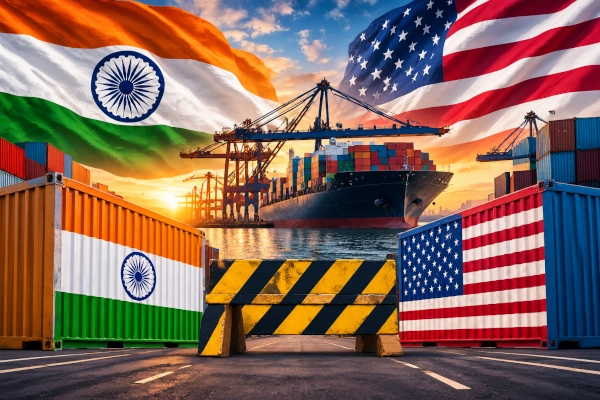
India and the United States remain unable to finalise their proposed bilateral trade agreement despite prolonged negotiations, high-level diplomatic engagement and a preliminary framework announced in February 2026. Disagreements over tariffs, agricultural market access, regulatory barriers and India’s energy trade with Russia have complicated negotiations, while changes in American tariff policy have raised fresh questions about the commercial value of previously discussed commitments.
The difficulties became more apparent during the first week of October 2026. On October 5, Finance Minister Nirmala Sitharaman acknowledged that India-US trade negotiations had reached a plateau, with both countries having limited room to offer further concessions. Commerce and Industry Minister Piyush Goyal subsequently indicated on October 10 that India would reassess the proposed interim agreement in light of changes in American tariff policy since the February framework was announced.
Although negotiations have not formally collapsed, the absence of a final agreement highlights the difficulty of reconciling Washington’s demands for greater market access with India’s economic priorities. The prolonged discussions also demonstrate that tariff pressure alone cannot resolve complex trade disputes involving national interests, agricultural livelihoods, energy security and long-term industrial development.
India-US Trade Negotiations Reach a Plateau After Prolonged Discussions
India and the United States launched negotiations for a Bilateral Trade Agreement following discussions between Prime Minister Narendra Modi and President Donald Trump in Washington on February 13, 2025. Both governments identified expanded market access, lower trade barriers, stronger supply chains and increased bilateral investment as important objectives of the proposed agreement.
The negotiations initially generated expectations of closer economic cooperation between two major trading partners. India sought improved access for its manufactured goods, pharmaceuticals, textiles and services, while Washington pursued greater opportunities for American agricultural products, industrial equipment, energy supplies and technology exports. Both countries also expressed interest in addressing regulatory barriers that affect businesses operating across their markets.
However, the negotiations became increasingly complicated as Washington introduced additional tariffs and connected trade measures to India’s purchases of Russian petroleum. The inclusion of energy and foreign-policy considerations expanded the discussions beyond conventional market-access negotiations, making agreement more difficult.
Speaking at an event in New Delhi on October 5, 2026, Finance Minister Nirmala Sitharaman indicated that negotiators had already examined the major issues extensively. Her assessment that the talks had reached a plateau suggested that the outstanding disagreements involved matters on which neither government was prepared to make substantial additional compromises.
February 2026 Interim Trade Framework Remains Incomplete
On February 6, 2026, India and the United States announced a framework for an interim agreement on reciprocal trade. The announcement represented an important diplomatic development because it established broad understandings on tariffs, market access and commercial cooperation while providing a foundation for a more comprehensive Bilateral Trade Agreement.
According to the official joint statement issued by both governments, India agreed in principle to reduce or eliminate tariffs on American industrial products and several agricultural commodities. The proposed agricultural concessions covered selected products, including dried distillers’ grains, sorghum, tree nuts, fruits and soybean oil. Washington, meanwhile, announced plans to reduce reciprocal tariffs on Indian products to 18% under the tariff arrangements then in force.
The framework also addressed technical standards, regulatory barriers, digital trade and supply-chain cooperation. Both countries expressed their intention to expand commerce in strategic sectors, including energy, aviation, advanced technologies and industrial manufacturing. India additionally outlined an intention to purchase approximately $500 billion worth of American goods over five years, although this represented a commercial objective rather than a collection of binding procurement contracts.
Despite these commitments, the February announcement did not constitute a completed and fully implemented trade agreement. Important provisions still required further negotiation, and the changing American tariff environment subsequently complicated the assumptions underlying the original framework. The distinction between a political understanding and an enforceable agreement has therefore become increasingly significant.
Changes in American Tariff Policy Complicate the Original Agreement
A major obstacle emerged when legal developments in the United States changed the tariff environment under which the February framework had been negotiated. The US Supreme Court invalidated the administration’s use of emergency economic powers to impose broad import tariffs, leading Washington to pursue alternative legal mechanisms for certain trade restrictions.
These developments affected the commercial calculations underlying the proposed agreement. A reduction from an earlier tariff rate may provide less benefit when the original tariff has been invalidated or replaced by a different measure. Indian negotiators must therefore assess the actual market-access advantages available under the revised American trade framework rather than rely entirely on commitments developed under previous conditions.
Commerce Minister Piyush Goyal addressed this issue on October 10, 2026, when he indicated that the proposed interim agreement would have to reflect circumstances that had changed since February. His remarks suggested that India was unwilling to finalise an agreement without reassessing whether its terms continued to provide meaningful commercial benefits.
For Indian exporters, predictable tariff treatment is more valuable than temporary concessions that could be altered through subsequent administrative or legal action. Businesses make investment, production and pricing decisions over extended periods, making regulatory stability an important consideration in international trade negotiations.
Russian Oil Purchases and America’s Own Diesel Deal with Moscow Expose Contradictions in Trade Policy
India’s purchases of Russian crude oil became a major source of disagreement in trade negotiations after Washington sought to restrict Moscow’s energy revenues during the Ukraine conflict. Indian refiners increased their purchases of discounted Russian petroleum to maintain affordable energy supplies, while the Indian government maintained that procurement decisions must reflect national economic requirements, domestic demand and prevailing international market conditions. Despite India’s dependence on imported crude oil, Washington linked its energy trade with Russia to broader commercial negotiations.
On August 6, 2025, President Donald Trump signed an executive order imposing an additional 25% tariff on Indian goods because of India’s continued purchases of Russian petroleum. The measure took effect on August 27, introducing substantial economic pressure into the bilateral trade relationship. Washington justified the decision by arguing that Russian energy revenues contributed to Moscow’s ability to sustain its military operations in Ukraine. India defended its position, emphasising that affordable petroleum was essential for transportation, agriculture, manufacturing and the broader economy.
However, a significant reversal emerged on October 9, 2026, when President Trump announced an agreement with Russian President Vladimir Putin to facilitate the supply of more than 300,000 metric tonnes of Russian diesel to the United States and international markets. Additional shipments were also proposed for subsequent months. The US Treasury temporarily relaxed relevant sanctions to facilitate the arrangement, which Washington justified as necessary to address rising diesel prices and fuel supply pressures. The announcement did not establish that all the proposed shipments had already been delivered.
The development attracted criticism within the United States itself. American lawmakers from both political parties questioned the decision, arguing that allowing Russian petroleum exports could provide Moscow with additional revenue despite Washington’s stated objective of restricting Russia’s ability to finance the Ukraine war. Ukrainian officials also criticised the agreement, warning that easing energy restrictions could weaken international pressure on Russia. The controversy demonstrated that the decision involved not merely domestic energy policy but also the credibility and consistency of American sanctions.
The contrast with India’s experience is particularly striking. Washington penalised Indian exports for purchasing Russian crude oil in the interest of national energy security, yet subsequently facilitated Russian diesel supplies when American fuel prices became a domestic economic concern. Although crude oil and refined diesel are different products, both transactions involve Russian petroleum revenues. The comparison raises a legitimate question about why energy affordability was treated as an unacceptable justification for India’s purchases but became an important consideration in Washington’s own decision.
The United States removed the additional Russian-oil-related tariff on Indian goods in February 2026, citing commitments concerning India’s energy purchases. Nevertheless, its October diesel agreement introduced a new complication into the broader debate over trade restrictions and energy security. For India, the episode reinforces the importance of ensuring that a future bilateral trade agreement provides predictable market access without allowing unrelated geopolitical disputes to repeatedly determine the treatment of Indian exports. A durable India-US economic partnership requires recognition that national energy security is a legitimate priority for both countries and that international trade arrangements must rest on transparent, consistently applied principles.
Agricultural Market Access Remains a Major Point of Disagreement
Agriculture presents one of the most sensitive areas in India-US trade negotiations because the two countries operate under substantially different economic and production conditions. The United States possesses a highly mechanised agricultural sector supported by advanced technology, large-scale commercial farms, extensive infrastructure and government assistance programmes. India’s agricultural economy, by contrast, includes millions of small and marginal farmers whose livelihoods depend on seasonal production, domestic market conditions and relatively limited financial resources.
Washington has sought improved access for American agricultural commodities, arguing that lower tariffs and fewer regulatory restrictions would expand commercial opportunities for US producers. The February 2026 trade framework included proposed concessions for selected agricultural products, but it did not establish unrestricted access for every American agricultural or dairy product.
India has traditionally maintained protections for sensitive agricultural sectors because sudden increases in imports could affect domestic producers, particularly when foreign suppliers benefit from economies of scale and government support. Agricultural negotiations therefore involve broader questions of farmer livelihoods, rural employment and food security in addition to consumer prices and commercial competition.
The challenge for negotiators is to identify market-access arrangements that provide opportunities for international trade without creating unacceptable disruption for domestic producers. This requires detailed consideration of individual products, tariff schedules, regulatory conditions and the potential economic effects on different sections of India’s agricultural economy.
Washington Seeks Greater Access to India’s Expanding Consumer Market
The United States has consistently sought to increase its exports to India while addressing the merchandise trade deficit between the two countries. India supplies the American market with pharmaceuticals, engineering goods, electronics, textiles, gems and other manufactured products, while the United States exports energy, aircraft, machinery, technology equipment and agricultural commodities to India.
Washington views India’s expanding consumer market and industrial sector as important opportunities for American companies. The February framework consequently included commitments intended to increase Indian purchases of US energy products, aircraft, technology equipment and other commodities. These proposals reflected the administration’s broader objective of reducing trade imbalances through higher American exports.
However, a merchandise trade deficit does not automatically establish that a trading relationship is unfair. Such imbalances can arise from differences in industrial competitiveness, production costs, consumer demand, investment patterns and the composition of traded products. Bilateral merchandise figures also do not capture the complete economic relationship, including services, investment income and other commercial flows.
For India, increased imports from the United States must remain consistent with domestic requirements and commercial viability. Purchasing additional American products can benefit Indian industries when those goods offer competitive technology, pricing or quality, but import commitments cannot substitute for genuine market demand or sound economic decision-making.
Regulatory Barriers and Digital Trade Add Further Complexity
Apart from tariffs and agriculture, the two countries continue to disagree over regulatory requirements affecting products and services. The Office of the United States Trade Representative has identified concerns involving medical-device pricing, technical standards, quality-control requirements, information technology products and agricultural regulations in its annual assessments of foreign trade barriers.
Washington argues that certain Indian measures increase compliance costs or restrict market access for American companies. India, meanwhile, maintains that domestic regulations serve legitimate objectives involving consumer protection, product quality, public health and industrial development. Resolving these differences requires distinguishing unnecessary commercial restrictions from regulations that governments consider essential for public welfare.
Digital trade introduces additional complications because both economies have substantial interests in information technology, software services, telecommunications and emerging digital industries. American companies seek predictable rules for cross-border operations, while India must ensure that international commercial arrangements remain consistent with its domestic data-protection, cybersecurity and telecommunications frameworks.
These issues cannot always be settled through simple tariff concessions because they affect the regulatory authority of national governments. A comprehensive agreement must therefore establish workable arrangements that support international business while preserving the legal responsibilities of both countries.
Uncertain American Tariffs Affect Indian Export Competitiveness
The United States remains one of India’s most important export destinations, making changes in American import duties particularly consequential for Indian manufacturers. Labour-intensive industries such as textiles, garments, leather goods and footwear are especially sensitive to tariff fluctuations because international buyers frequently compare suppliers on price, quality and delivery reliability.
Engineering manufacturers, electronics exporters and other industrial businesses also require predictable market conditions to support investment and long-term supply agreements. Uncertainty over future duties can complicate negotiations with overseas customers and affect decisions about expanding production capacity.
American trade investigations and the possibility of additional restrictions have contributed to this uncertainty. Even when new tariffs have not been imposed, businesses must account for potential changes in import costs when calculating prices and contractual obligations.
India’s interest in a trade agreement therefore extends beyond obtaining lower tariff rates at a particular moment. The government is seeking more predictable access to the American market so that exporters can make commercial decisions with greater confidence and compete effectively with suppliers from other countries.
India’s Economic Scale Strengthens Its Negotiating Position
India’s expanding economy provides important commercial opportunities for American companies, particularly in aerospace, energy, advanced manufacturing, technology and services. With a population exceeding 1.4 billion and growing industrial requirements, India represents a substantial potential market for American equipment, technology and investment.
The Indian market is especially relevant to American companies seeking opportunities in aircraft manufacturing, aviation services, energy infrastructure, semiconductors, industrial machinery and advanced electronic systems. Expansion in these sectors can create long-term relationships involving equipment purchases, maintenance services, technical collaboration and investment.
However, the economic relationship also creates dependencies for India. Indian exporters rely heavily on American customers in several sectors, while India’s information technology and professional services industries maintain extensive commercial relationships with US businesses. These connections make continued bilateral cooperation valuable to both governments.
The resulting interdependence means that neither country can evaluate the agreement solely through the concessions it seeks from the other. A sustainable arrangement must produce sufficiently balanced commercial benefits to encourage implementation and maintain the confidence of businesses operating across both markets.
India’s Expanding Global Trade Partnerships Provide Additional Opportunities
While negotiations with Washington remain unresolved, India has continued developing trade relationships with other major economies. The government has pursued agreements and negotiations involving the United Kingdom, European Union, Canada, Israel, Gulf countries and several other international partners.
On October 10, Commerce Minister Piyush Goyal indicated that India would begin negotiations for a preferential trade agreement with Mexico the following week. He also referred to continuing discussions with other countries and regional economic groupings, demonstrating India’s efforts to broaden its international commercial relationships.
These initiatives provide Indian exporters with opportunities to diversify markets, establish new supply-chain relationships and reduce excessive dependence on individual trading partners. Expanded access to multiple economies can also improve the resilience of Indian industries when tariff policies or demand conditions change in a particular market.
Diversification does not diminish the importance of the United States, which remains a major destination for Indian goods and services. Instead, India’s wider trade engagement provides additional commercial options while supporting its objective of developing a more competitive and internationally integrated economy.
Why Tariff Pressure Has Not Produced a Final Trade Agreement
Tariffs can influence commercial behaviour by increasing the cost of imported goods and encouraging governments to negotiate. However, their effectiveness depends on the economic interests involved, the availability of alternative markets and the willingness of governments to accept the requested concessions.
In the India-US negotiations, several unresolved issues extend beyond ordinary market access. Agricultural protections affect millions of livelihoods, energy procurement influences national economic stability, and regulatory agreements can shape domestic policy for years. These considerations make negotiations substantially more complicated than a straightforward exchange of tariff reductions.
Washington has sought to use access to its large consumer market as an incentive for greater Indian concessions. India has continued negotiations while seeking terms that protect sensitive sectors and deliver meaningful benefits to domestic exporters. Neither position has yet produced a complete agreement acceptable to both governments.
The prolonged stalemate illustrates that economic pressure does not automatically produce diplomatic agreement when the issues under discussion involve significant national priorities. A durable trade arrangement requires concessions that both parties consider commercially valuable and politically sustainable.
India’s Strategic Autonomy Remains Central to Its Economic Decisions
India’s foreign policy has traditionally emphasised strategic autonomy, allowing the country to maintain relationships with different international partners according to its security, economic and developmental requirements. This approach remains relevant to trade negotiations because commercial decisions increasingly intersect with energy security, advanced technology, defence cooperation and geopolitical competition.
India maintains significant economic and diplomatic relationships with the United States, Russia, European countries, Japan and other major powers. Each relationship serves different national interests, and cooperation with one partner does not necessarily require the abandonment of established arrangements with another.
Washington also makes trade and foreign-policy decisions according to its own national priorities. However, difficulties arise when commercial negotiations become linked to demands involving a partner’s broader international relationships, particularly when those demands affect energy supplies or other essential economic requirements.
For India, maintaining strategic autonomy does not mean avoiding trade agreements or resisting international cooperation. It means ensuring that such agreements support national development while preserving the flexibility needed to respond to changing economic and security conditions.
India-US Economic Cooperation Continues Despite Unresolved Negotiations
The absence of a final bilateral trade agreement has not brought commercial cooperation between India and the United States to a halt. American companies continue investing in India’s manufacturing, technology, aviation and services industries, while Indian businesses maintain substantial operations and customer relationships in the United States.
Both governments also share interests in strengthening supply chains, expanding advanced manufacturing and encouraging cooperation in emerging technologies. These areas provide opportunities for investment and industrial collaboration regardless of the immediate outcome of tariff negotiations.
Official statements issued following US Trade Representative Jamieson Greer’s visit to India in June 2026 recorded progress in discussions covering market access, digital trade and supply-chain resilience. The continuation of such engagements indicates that both countries recognise the long-term importance of their economic relationship.
Nevertheless, progress in individual sectors cannot substitute for resolving the broader disagreements that have delayed the agreement. Predictable tariff treatment, practical market-access commitments and acceptable regulatory provisions remain essential for translating diplomatic understandings into a durable commercial framework.
A Balanced Agreement Must Reflect the Economic Interests of Both Countries
The India-US trade negotiations have reached a stage where further progress depends on resolving difficult commercial and regulatory questions rather than repeating broad commitments to cooperation. Washington seeks increased exports, improved access to India’s domestic market and measures addressing its bilateral trade deficit. India seeks predictable access to American consumers while maintaining protections for sensitive sectors and preserving its economic policy flexibility.
The changing American tariff environment has made the negotiations more complicated by altering the commercial assumptions underlying the February 2026 framework. India’s decision to reassess the proposed agreement reflects the importance of evaluating actual economic benefits before accepting binding commitments.
The statements by Finance Minister Nirmala Sitharaman and Commerce Minister Piyush Goyal in October 2026 indicate that India remains engaged in negotiations while recognising the limitations of further concessions under the existing circumstances. The talks therefore remain an exercise in balancing competing economic priorities rather than a concluded diplomatic process.
The India-US trade stalemate demonstrates that access to a large market, supported by tariff pressure, does not guarantee agreement when the negotiating partner has significant economic interests of its own. India continues to pursue wider international trade relationships while seeking a bilateral arrangement that provides commercial stability and meaningful opportunities for its industries.
A sustainable agreement between India and the United States would strengthen two major economies through reciprocal market access, predictable trade rules and long-term investment opportunities. India’s expanding economic capabilities and diversified international partnerships provide a foundation for pursuing that cooperation while protecting its developmental priorities and strategic autonomy.
References
- Ministry of Commerce and Industry, Government of India — February 7, 2026. United States-India Joint Statement. Official framework for the proposed interim agreement covering tariffs, market access and economic cooperation.
https://www.pib.gov.in/PressReleasePage.aspx?PRID=2224783 - The White House — February 6, 2026. United States-India Joint Statement. Official American announcement outlining the interim trade framework and proposed bilateral commitments.
https://www.whitehouse.gov/briefings-statements/2026/02/united-states-india-joint-statement/ - Ministry of Commerce and Industry — June 24, 2026. Ambassador Jamieson Greer Leads U.S. Delegation to India for Bilateral Trade Agreement Talks. Official account of negotiations and areas of bilateral engagement.
https://www.pib.gov.in/PressReleasePage.aspx?PRID=2277411 - Office of the United States Trade Representative — March 31, 2026. 2026 National Trade Estimate Report on Foreign Trade Barriers. Official American assessment of tariff and regulatory barriers.
https://ustr.gov/sites/default/files/files/Press/Releases/2026/National%20Trade%20Estimate%20Report%202026.pdf - Akashvani News — October 10, 2026. India to Reassess US Interim Trade Deal Amid Changing Tariff Landscape: Piyush Goyal. Government broadcaster’s report on the Commerce Minister’s remarks.
https://newsonair.gov.in/ - Reuters — October 5, 2026. India-US Trade Talks Hit Plateau, Finance Minister Says, as Tariffs Narrow Room for Deal. Report on Finance Minister Nirmala Sitharaman’s assessment of negotiations.
https://www.reuters.com/world/india/india-us-have-reached-plateau-trade-talks-indian-finance-minister-says-2026-10-05/ - Reuters — October 6, 2026. Why Have India-US Trade Talks Stalled Again and What’s Next? Analysis of unresolved negotiations and changing tariff arrangements.
https://www.reuters.com/world/india/why-have-india-us-trade-talks-stalled-again-whats-next-2026-10-06/
You may also like
-
India’s Economic Warfare Challenge: Strategic Autonomy, Energy Security and the Rise of a Global Power
-
US Double Standards in Foreign Policy: 16 Recent Cases Involving India, Russia, China and Global Trade
-
India’s Arctic Energy Ambitions: Russian Oil, LNG and a New Sea Route to Indian Ports
-
India and Russia Explore Joint Icebreaker Construction as Maritime Industrial Cooperation Expands
-
Nagri Dubraj Rice of Chhattisgarh — Dhamtari’s Fragrant Heritage Grain
