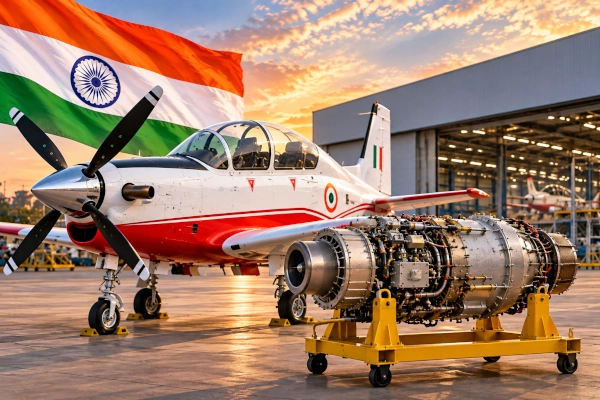
American aerospace manufacturer Honeywell Aerospace has announced an accelerated delivery schedule for TPE331-12B turboprop engines powering Hindustan Aeronautics Limited’s (HAL) indigenous HTT-40 basic trainer aircraft. The revised plan aims to address engine supply delays that have affected production of the aircraft intended for the Indian Air Force’s pilot training programme.
On October 8, 2026, Matt Milas, President of Defence and Space at Honeywell Aerospace, confirmed that the company had delivered four engines to HAL and expected to supply another four before December 2026. According to his statements reported by Mint, Honeywell plans to deliver a further eight engines by mid-2027, bringing the total number supplied directly to HAL to 16.
The revised schedule represents an important development for the HTT-40 programme, which has faced delays caused partly by disruptions in the international aerospace engine supply chain. Improved engine availability will support HAL’s efforts to increase aircraft production and fulfil its delivery commitments to the Indian Air Force.
Honeywell Targets Eight HTT-40 Engines by December 2026
Honeywell’s revised delivery plan follows efforts to address manufacturing and supply-chain constraints affecting the TPE331-12B engine programme.
During the October 8 media interaction, Milas stated that Honeywell had already supplied four engines and expected to double that number before the end of 2026. He also outlined plans for accelerated deliveries during 2027.
The company is working with its suppliers to improve component availability, resolve production bottlenecks and maintain a more predictable engine delivery schedule. These measures are intended to support aircraft manufacturing at HAL while reducing the impact of earlier disruptions.
In June 2026, Honeywell officially announced that it had delivered three TPE331-12B engines to HAL. The company described the deliveries as an important milestone in supporting India’s indigenous trainer programme and strengthening its longstanding aerospace partnership with HAL.
The October update indicates that the number of delivered engines has increased to four, with further supplies planned over the coming months.
Initial 16 Engines Form Part of Larger HAL-Honeywell Agreement
The accelerated deliveries form part of a broader agreement signed between HAL and Honeywell in July 2022 for the supply and manufacture of 88 TPE331-12B engines and associated kits, together with maintenance and technical support.
The agreement, valued at more than $100 million, provides for an initial batch of 16 engines to be manufactured and supplied directly by Honeywell. Subsequent arrangements envisage greater participation by HAL in engine assembly and related support activities in India.
According to Honeywell’s official June 2026 announcement, the programme includes plans to expand domestic maintenance, repair and overhaul capabilities for the engine family.
The initial 16-engine delivery programme previously had a completion timeline extending to 2029. Honeywell’s latest statements indicate that the company expects to complete this phase substantially earlier, with Mint reporting a mid-2027 target.
The proposed acceleration concerns the first 16 imported engines. It does not mean that all 88 engines and kits covered by the larger agreement will be delivered by that date.
Engine Supply Delays Have Affected HTT-40 Aircraft Production
The HTT-40 programme has encountered production difficulties partly because of delays in receiving its imported turboprop engines.
Honeywell was initially expected to begin delivering production engines in September 2025. However, supply-chain constraints affected the company’s ability to meet the planned schedule, contributing to delays in HAL’s aircraft production programme.
The interruption also affected HAL’s earlier target of delivering 12 HTT-40 aircraft during the 2025–26 financial year.
Aircraft engine availability is a critical requirement in aviation manufacturing. Completed airframes cannot progress through all stages of engine installation, ground testing, flight validation and customer acceptance without their designated powerplants.
An improved supply of TPE331-12B engines would therefore allow HAL to coordinate aircraft assembly, testing and delivery activities more effectively. Nevertheless, engine availability is only one element of the production process, which also depends on equipment integration, certification and aircraft acceptance.
The revised Honeywell schedule provides greater visibility for production planning and supports efforts to recover delays in the HTT-40 programme.
Indigenous HTT-40 to Strengthen Indian Air Force Pilot Training
The Hindustan Turbo Trainer-40 (HTT-40) is a fully aerobatic, tandem-seat basic trainer aircraft designed and developed by HAL’s Aircraft Research and Design Centre in Bengaluru.
The aircraft is intended to provide newly inducted military pilots with foundational flying skills before they progress to more advanced training platforms.
The Ministry of Defence signed a contract with HAL on March 7, 2023, for the procurement of 70 HTT-40 aircraft at a cost of ₹6,828.36 crore. The agreement also includes associated training equipment and simulators.
The HTT-40 incorporates a modern glass cockpit, advanced avionics, air-conditioning and zero-zero ejection seats, which can provide an emergency escape capability even when an aircraft is stationary on the ground.
According to the Ministry of Defence, the aircraft has a maximum speed of approximately 450 kilometres per hour and a service ceiling of six kilometres. Its four-bladed turboprop configuration provides the handling characteristics required for basic flying instruction.
The aircraft completed its maiden flight on May 31, 2016, and received system-level certification on June 6, 2022. Its development represents a significant achievement in India’s efforts to strengthen indigenous military aviation training capabilities.
Honeywell TPE331-12B Engine Supports Basic Flying Training
The HTT-40 uses Honeywell’s TPE331-12B turboprop engine, a member of the company’s established TPE331 family of aircraft propulsion systems.
The engine employs a single-shaft architecture that provides responsive throttle control, an important characteristic for aircraft used in basic flying instruction. Pilots undertaking initial training must learn precise engine management while practising take-offs, landings, aerobatic manoeuvres and emergency procedures.
Honeywell has highlighted the engine’s operating experience across military and civilian aviation. The TPE331 family has powered several aircraft types, including military training platforms such as the Short Tucano.
The company states that more than 13,000 engines from the TPE331 series have been delivered globally, accumulating over 122 million flight hours across different applications.
For HAL, selecting an established turboprop engine provides a propulsion system with a substantial operating history while allowing the company to concentrate its indigenous development efforts on the aircraft’s design, avionics, flight characteristics and integration.
HAL to Expand Local Engine Assembly and Maintenance Capabilities
Beyond the immediate delivery schedule, the HAL-Honeywell agreement includes provisions for expanding India’s participation in engine assembly and long-term technical support.
Honeywell confirmed in June 2026 that HAL would begin local assembly activities after the initial 16 engines were supplied directly by the American manufacturer. The programme also envisages expanding maintenance, repair and overhaul capabilities within India.
HAL already has experience with the TPE331 engine family through its longstanding cooperation with Honeywell. Earlier technology-transfer arrangements supported the manufacturing and repair of TPE331-5 engines used on the Dornier Do-228 aircraft.
This existing industrial relationship provides a foundation for introducing additional engine assembly and sustainment activities associated with the HTT-40.
Domestic maintenance capabilities can reduce dependence on overseas facilities for routine servicing, component replacement and engine overhaul. They also support faster turnaround times and improve the availability of aircraft throughout their operational service lives.
Local engine assembly under a licensed arrangement is distinct from developing an entirely indigenous propulsion system. Nevertheless, the programme can strengthen India’s manufacturing skills, technical infrastructure and experience in supporting advanced aircraft engines.
HTT-40 Programme Supports India’s Aerospace Manufacturing Ecosystem
The HTT-40 forms part of India’s wider effort to expand indigenous aircraft development and production under the Aatmanirbhar Bharat initiative.
The Ministry of Defence stated in 2023 that the trainer programme had approximately 56% indigenous content, with plans to increase this proportion beyond 60% through further localisation of components and subsystems.
HAL’s manufacturing programme also involves Indian private-sector companies and micro, small and medium enterprises supplying aerospace components, equipment and engineering services.
Production of the aircraft contributes to the development of domestic capabilities in airframe construction, avionics integration, precision manufacturing, aircraft testing and long-term technical support.
The inclusion of training simulators in the Indian Air Force’s procurement programme further broadens its industrial scope. These systems allow trainee pilots to practise procedures and emergency scenarios on the ground before undertaking corresponding exercises in flight.
A steady supply of engines will help HAL coordinate its domestic production network and maintain progress towards delivering the 70 aircraft contracted by the Ministry of Defence.
Accelerated Engine Deliveries Strengthen India’s Indigenous Trainer Programme
Honeywell’s revised delivery schedule marks a significant development in addressing one of the principal supply constraints affecting the HTT-40 programme.
The planned delivery of eight engines by December 2026, followed by eight additional engines by mid-2027, would complete the initial direct supply phase substantially earlier than previously anticipated. The revised targets remain dependent on Honeywell fulfilling its announced production and delivery commitments.
For HAL, the improvement provides an opportunity to stabilise aircraft manufacturing schedules and advance the introduction of the HTT-40 into the Indian Air Force’s training fleet.
The programme also demonstrates the importance of combining indigenous aircraft development with reliable international industrial partnerships and increasing domestic manufacturing capabilities.
With the HTT-40 progressing towards larger-scale production and HAL preparing to expand its engine assembly and maintenance activities, India continues to strengthen the industrial foundations of its military aviation training ecosystem. The accelerated engine deliveries will support this effort while helping the Indian Air Force acquire a modern, indigenously developed platform for training future military pilots.
References
- Honeywell Aerospace — June 11, 2026. Honeywell Aerospace Delivers First TPE331-12B Engines for Hindustan Aeronautics Limited HTT-40 Trainer Aircraft. Official announcement confirming three engine deliveries, the first 16-engine supply programme and plans for local assembly and maintenance.
https://www.honeywellaerospace.com/us/en/company/newsroom/2026/06/honeywell-delivers-first-tpe331-12b-engine-for-hindustan-aeronautics - Ministry of Defence, Press Information Bureau — March 7, 2023. Contracts for Procurement of 70 HTT-40 Basic Trainer Aircraft from HAL and Three Cadet Training Ships from L&T Signed.
https://www.pib.gov.in/PressReleasePage.aspx?PRID=1904828 - Ministry of Defence, Press Information Bureau — September 8, 2023. Deputy Chief of the Air Staff Flies the Hindustan Turbo Trainer HTT-40. Official information on aircraft development, performance and training capabilities.
https://www.pib.gov.in/PressReleasePage.aspx?PRID=1955532 - Ministry of Defence, Press Information Bureau — March 1, 2023. Union Cabinet Approves Procurement of 70 HTT-40 Basic Trainer Aircraft from HAL at a Cost of Over ₹6,800 Crore.
https://www.pib.gov.in/PressReleasePage.aspx?PRID=1903445 - Mint — October 8, 2026. Honeywell to Accelerate Engine Deliveries to HAL for Trainer Aircraft. Includes statements from Matt Milas, President of Defence and Space at Honeywell Aerospace, regarding the revised engine delivery schedule.
https://www.livemint.com/companies/news/honeywell-to-accelerate-engine-deliveries-to-hal-for-trainer-aircraft-11791460766261.html - Business Standard — October 8, 2026. Honeywell to Deliver Eight HTT-40 Aircraft Engines to HAL by End of 2026. Includes Honeywell management’s statements on engine deliveries, supply-chain improvements and the HAL manufacturing agreement.
https://www.business-standard.com/external-affairs-defence-security/news/honeywell-to-deliver-eight-htt-40-aircraft-engines-to-hal-by-end-of-2026-126100800899_1.html
You may also like
-
CG Power Strengthens India’s Semiconductor Manufacturing Ecosystem with ₹7,600 Crore Sanand Investment
-
India’s Tata WhAP 8×8 Debuts with 30 mm Unmanned Turret at Marrakech Air Show
-
Colombia Explores Indigenous BEL Counter-Drone Systems to Combat Drug Cartels and Strengthen India-Colombia Defence Cooperation
-
India Gifts Indigenous Zen Technologies Shooting Range to Kyrgyzstan, Strengthening Defence Cooperation
-
Zen Technologies Advances Indigenous AI-Powered Anti-Drone Systems as India Expands Defence Manufacturing Capabilities
