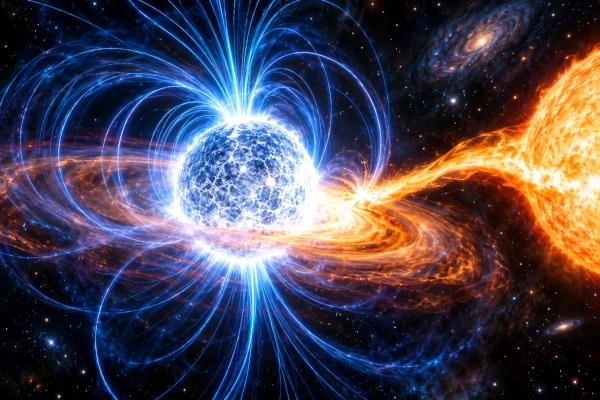
Researchers at the Indian Institute of Science (IISc), Bengaluru, have demonstrated through advanced computer simulations that extremely strong magnetic fields could allow certain white dwarf stars to grow substantially beyond the Chandrasekhar mass limit, a fundamental concept in astrophysics established by Indian-American Nobel laureate Subrahmanyan Chandrasekhar.
The study, announced by IISc on October 9, 2026, found that a magnetised white dwarf could theoretically reach approximately 2.4 times the mass of the Sun, significantly exceeding the conventional limit of about 1.4 solar masses. The findings offer a possible explanation for unusually massive stellar remnants and exceptionally luminous stellar explosions observed across the universe.
The research, conducted by scientists from IISc’s Department of Physics and international collaborators, was published in The Astrophysical Journal Letters. It examines how magnetic fields influence stellar evolution and whether stars can naturally develop into white dwarfs whose masses exceed the conventional theoretical boundary.
Understanding the Chandrasekhar Limit and White Dwarf Stars
White dwarfs are extremely dense stellar remnants formed when stars exhaust their nuclear fuel and shed their outer layers. Although their dimensions can be comparable to Earth’s, they may contain a mass approaching that of the Sun.
These objects remain stable because quantum mechanical effects generate a pressure known as electron degeneracy pressure. This pressure counteracts gravity and prevents the stellar remnant from collapsing under its own weight.
In the 1930s, Subrahmanyan Chandrasekhar demonstrated that there is an upper mass limit beyond which electron degeneracy pressure alone cannot maintain the stability of a white dwarf. For a typical non-rotating carbon-oxygen white dwarf without strong magnetic fields, this limit is approximately 1.4 solar masses.
The discovery became one of the foundations of modern stellar astrophysics. Chandrasekhar received the Nobel Prize in Physics in 1983 for his theoretical studies of the physical processes governing the structure and evolution of stars.
However, the conventional Chandrasekhar limit assumes particular physical conditions. Scientists have long investigated whether additional forces, including strong magnetic fields and rotation, could alter the maximum mass that a white dwarf can support.
IISc Simulations Reveal White Dwarfs Could Reach 2.4 Solar Masses
The IISc-led research provides new computational evidence that sufficiently strong internal magnetic fields can significantly influence the mass and stability of white dwarf stars.
In one simulation, researchers modelled a carbon-oxygen white dwarf that initially possessed a mass of approximately 1.02 solar masses. The stellar remnant had evolved from a main-sequence star with an initial mass eight times that of the Sun.
The scientists then simulated a binary system in which the white dwarf gradually accumulated additional matter from a companion star. The model used an accretion rate of approximately one-billionth of a solar mass per year.
As the white dwarf gained matter, its internal density increased and the star contracted. This contraction strengthened its magnetic field, allowing magnetic pressure to provide additional support against gravitational collapse.
Under the simulated conditions, the magnetised white dwarf reached a limiting mass of approximately 2.4 solar masses. A corresponding model without the strong magnetic field reached only about 1.4 solar masses.
The result suggests that the maximum stable mass of a white dwarf can depend on its magnetic properties rather than being governed solely by electron degeneracy pressure. The finding does not overturn Chandrasekhar’s classical calculation, which remains valid under its underlying assumptions.
Researchers Trace Stellar Evolution From Birth to White Dwarf Formation
An important contribution of the study is its examination of how an unusually massive, strongly magnetised white dwarf could develop through stellar evolution.
Earlier theoretical investigations had proposed that magnetic fields might support white dwarfs with masses exceeding the Chandrasekhar limit. However, demonstrating a physically plausible evolutionary route to such an object remained a significant scientific challenge.
To investigate this question, the researchers modified STARS, a stellar evolution computer code originally developed at the University of Cambridge. They incorporated additional physics describing magnetic fields and white dwarf cooling.
The modified framework allowed the scientists to follow stars through their main-sequence evolution, subsequent transformation into white dwarfs and later accumulation of matter within binary stellar systems.
Zenia Zuraiq, a doctoral researcher at IISc and the study’s first author, explained that the central challenge was establishing whether stars could evolve naturally into super-Chandrasekhar white dwarfs.
The simulations identified conditions under which such an evolutionary pathway is theoretically possible. This extends earlier work by connecting the proposed magnetic support mechanism with a model of the star’s development over time.
Professor Banibrata Mukhopadhyay’s Research Builds on a 2011 Investigation
The research was led by Professor Banibrata Mukhopadhyay of IISc’s Department of Physics, who serves as the study’s corresponding author.
According to IISc, the investigation originated in 2011 when Mukhopadhyay asked a summer research student to examine whether magnetic fields could permit white dwarfs to exceed the conventional Chandrasekhar limit.
The question developed into a longer research programme investigating the structure, stability and evolution of strongly magnetised compact stellar objects.
The latest paper brings together researchers from IISc and collaborating international institutions, combining theoretical astrophysics with computational stellar modelling.
The study, titled Super-Chandrasekhar White Dwarfs by the Evolution of Magnetized Main-sequence Stars: New Mass Limits from STARS Simulation, lists Zenia Zuraiq, Banibrata Mukhopadhyay, Achal Kumar, Arnab Sarkar, Alexander J. Hackett, Projjwal Banerjee and Christopher A. Tout as authors.
Their work contributes to a wider scientific effort to understand how magnetic fields affect the final stages of stellar evolution. Indian Institute of Science
Findings Could Help Explain Unusually Bright Type Ia Supernovae
One of the most important implications of the research concerns Type Ia supernovae, extremely energetic stellar explosions that play a major role in astronomical distance measurements.
A Type Ia supernova can occur when a carbon-oxygen white dwarf undergoes runaway thermonuclear burning. In one important formation scenario, the white dwarf gains matter from a companion until conditions allow carbon ignition.
Astronomers use the observed brightness and light-curve characteristics of Type Ia supernovae to estimate distances across the universe. These explosions are particularly valuable because their luminosities can be standardised using empirical relationships.
However, some Type Ia supernovae have displayed unusually high luminosities that challenge straightforward interpretations based on conventional white dwarf progenitor models.
Scientists have proposed several possible explanations for these unusually bright explosions, including the involvement of exceptionally massive white dwarfs.
The IISc simulations provide a possible mechanism through which strongly magnetised white dwarfs could grow beyond the classical mass limit before undergoing a thermonuclear event.
This could help researchers investigate the diversity of Type Ia supernova explosions and better understand the physical conditions of their progenitor stars.
The calculations do not establish that magnetic fields explain every unusually luminous Type Ia supernova. Other proposed mechanisms, including white dwarf mergers and different explosion pathways, remain important subjects of astrophysical research.
Magnetic Fields May Also Explain Unusual White Dwarf Sizes
Beyond the maximum mass of white dwarfs, the IISc study offers a potential explanation for unusual relationships between their mass and radius.
Under conventional white dwarf models, increasing mass generally leads to a smaller stellar radius. This occurs because stronger gravitational compression forces the dense stellar material into a more compact structure.
Astronomers have nevertheless observed some white dwarfs whose measured sizes differ from expectations based on standard mass-radius relationships.
The new simulations suggest that magnetic pressure could alter a star’s internal structure and help explain why certain white dwarfs exhibit larger radii than expected for their masses.
Such findings could provide additional ways to investigate the magnetic properties of compact stellar remnants.
Future comparisons between theoretical models and astronomical observations will be important for determining how frequently these effects occur and whether they can explain specific unusual white dwarf populations.
Research Could Improve Understanding of the Expanding Universe
The study also has implications for cosmology because Type Ia supernovae have played a central role in measuring the expansion history of the universe.
Astronomers compare the apparent brightness of these explosions with their standardised intrinsic luminosity to estimate the distances of remote galaxies. Such measurements contributed to the discovery that cosmic expansion is accelerating.
Understanding variations in Type Ia supernova properties is therefore important for improving the precision of astronomical distance measurements.
The IISc research suggests that magnetic fields and differences in progenitor mass may contribute to the diversity of these explosions. Incorporating such effects into theoretical models could help scientists refine their understanding of supernova formation and evolution.
Nevertheless, the study does not demonstrate that existing cosmological measurements are incorrect. Modern supernova distance estimates already incorporate empirical corrections, and the relationship between the new theoretical models and observed supernova populations requires further investigation.
Additional research into stellar magnetic fields, evolutionary pathways and explosion mechanisms will help determine the broader observational significance of these findings.
IISc Advances India’s Contribution to Fundamental Astrophysics
The latest research demonstrates the role of Indian institutions in investigating fundamental questions about the physical universe.
By combining stellar evolution modelling with magnetic-field physics, IISc researchers have developed a theoretical framework that explores how some of the densest stellar objects can evolve under extreme conditions.
The work also builds upon a scientific tradition closely associated with Subrahmanyan Chandrasekhar, whose calculations established the classical mass limit for white dwarf stars nearly a century ago.
The new study does not invalidate the Chandrasekhar limit. Instead, it identifies additional physical conditions under which white dwarfs could support substantially greater masses.
Its most important contribution lies in showing a possible evolutionary pathway from an ordinary main-sequence star to an exceptionally massive magnetised white dwarf.
As astronomical observations and computational methods continue to improve, the findings offer new opportunities to investigate compact stellar remnants, unusual supernova explosions and the physical processes governing stellar evolution.
The IISc-led research strengthens India’s contribution to theoretical astrophysics while advancing scientific understanding of how stars evolve, collapse and influence the wider universe.
References
- Indian Institute of Science, Bengaluru — October 9, 2026. Strong Magnetic Fields Could Allow White Dwarfs to Grow Beyond the Chandrasekhar Limit. Official IISc research announcement.
https://www.iisc.ac.in/events/strong-magnetic-fields-could-allow-white-dwarfs-to-grow-beyond-the-chandrasekhar-limit/ - The Astrophysical Journal Letters — 2026. Zenia Zuraiq, Banibrata Mukhopadhyay, Achal Kumar, Arnab Sarkar, Alexander J. Hackett, Projjwal Banerjee and Christopher A. Tout. Super-Chandrasekhar White Dwarfs by the Evolution of Magnetized Main-sequence Stars: New Mass Limits from STARS Simulation.
https://doi.org/10.3847/2041-8213/aea97e - Indian Institute of Science — Department of Physics. Professor Banibrata Mukhopadhyay’s research profile and work on compact stellar objects, white dwarfs and supernovae.
https://physics.iisc.ac.in/~bm/
You may also like
-
IIT Madras to Launch Global Mission to Map 100 Human Brains in 3D
-
3,898 Indian Scientists Feature in 2026 Global Top 2% Research Database; IISc Leads Indian Institutions
-
New Metal-free Porous Material can Help Produce Affordable Clean Energy
-
A Decade of Cosmic Flickering Reveals New Clues About A Rare Giant Binary Black Hole System
-
Indian Researchers Screen 94 Pea Lines to Identify High-Protein, Mineral-Rich Breeding Material
