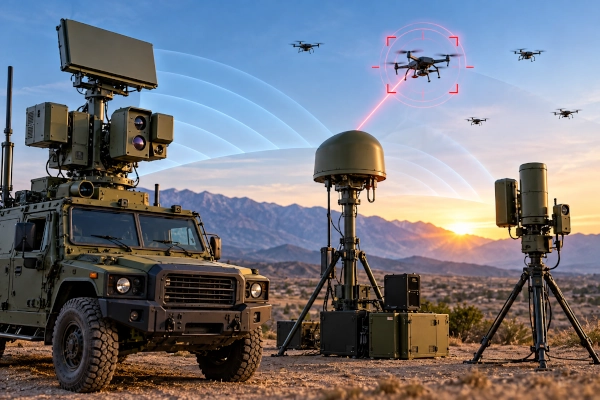
India’s indigenous counter-drone technology sector is advancing with Hyderabad-based Zen Technologies developing a new generation of artificial intelligence-powered anti-drone systems capable of detecting, tracking and neutralising hostile unmanned aerial vehicles (UAVs). The company’s expanding portfolio combines radar surveillance, electronic warfare, intelligent threat classification and multiple interception technologies to address emerging aerial threats.
On May 5, 2026, Zen Technologies unveiled a modular, AI-powered integrated anti-drone platform at the North Tech Symposium 2026 in Prayagraj. The company described it as India’s first fully integrated system of its kind, combining soft-kill and hard-kill countermeasures in vehicle-mounted, man-portable and stationary configurations. The announcement subsequently appeared on its official press release page dated May 8, 2026.
The development reflects India’s increasing emphasis on domestically designed defence technologies, particularly as drones and loitering munitions become more prominent in modern military operations. Zen Technologies has developed the platform under the Indigenous Design, Development and Manufacture (IDDM) framework, with the company retaining ownership of the underlying intellectual property.
Zen Technologies Develops AI-Powered Multi-Layered Anti-Drone Architecture
The new counter-drone platform integrates several detection and neutralisation technologies into a coordinated defence system. Its architecture combines radio-frequency sensors, radar, optical surveillance and an intelligent Data Fusion and Command Centre (DFCC) to identify and assess potential aerial threats.
According to the company’s official announcement, the system provides wideband coverage from 70 MHz to 12 GHz, supporting the detection and disruption of drone communication signals across multiple frequency bands. This capability is intended to address the variety of communication links used by commercial drones, modified UAVs and specialised military platforms.
Zen Technologies reports a surveillance capability exceeding 15 kilometres, with simultaneous tracking of more than 100 drones. Its indigenous high-sensitivity radar offers a stated detection range of up to 20 kilometres, including improved detection of smaller targets with low radar cross-sections.
These specifications represent the company’s announced capabilities. Actual detection and engagement performance depends on the target’s size, flight profile, electromagnetic environment and operating conditions.
Artificial Intelligence Enables Faster Drone Detection and Classification
Artificial intelligence plays a central role in the system’s threat identification and response architecture. The Data Fusion and Command Centre integrates information from multiple sensors to generate a consolidated picture of the surrounding airspace.
By analysing radar returns, radio-frequency emissions and optical observations, the system can assist operators in distinguishing potential hostile drones from other objects. AI-based classification also helps correlate information from different sensors and maintain target tracks as drones move through the monitored area.
This approach becomes particularly important when multiple UAVs approach simultaneously. Small drones can fly at low altitudes, use complex flight paths and present limited radar signatures, creating challenges for conventional surveillance systems.
Automated data processing can reduce the time required to identify potential threats and support faster operational decisions. However, AI-assisted detection does not eliminate the need for appropriate operator oversight, identification procedures and engagement authorisation.
Electronic Warfare and Hard-Kill Systems Provide Layered Protection
Zen Technologies has developed its platform around a combination of electronic countermeasures and physical interception technologies. This allows the system to respond to different categories of unmanned aerial threats rather than relying on a single method of neutralisation.
The soft-kill component incorporates radio-frequency jamming and Global Navigation Satellite System (GNSS) interference, including spoofing capabilities. These technologies aim to disrupt communication or navigation signals used by hostile drones.
The platform also supports integration with 7.62 mm and 12.7 mm Remote Controlled Weapon Stations (RCWS), air defence guns and kamikaze interceptor drones. These hard-kill options provide additional engagement methods when electronic countermeasures are ineffective or unsuitable.
Such flexibility is increasingly relevant because some UAVs can operate with limited external communication, including platforms using autonomous navigation or pre-programmed flight routes. Conventional radio-frequency jamming may not reliably neutralise these systems.
By combining electronic warfare with kinetic interception, the integrated architecture seeks to provide commanders with different response options according to the characteristics of the incoming threat.
Three Configurations Designed for Different Operational Environments
Zen Technologies has designed its integrated counter-drone platform for deployment across mobile, dismounted and fixed operational environments.
The vehicle-mounted configuration can integrate with tactical vehicles and other mobile platforms to support convoy protection and mobile area defence. It is intended for operations where military formations must maintain protection while moving between locations.
The man-portable configuration provides a lighter, rugged solution for personnel operating away from established military installations. It is designed to support patrols, forward deployments and counter-insurgency operations where heavier counter-drone equipment may prove impractical.
The stationary configuration focuses on the protection of military bases, strategic installations and other high-value infrastructure. Its design supports continuous surveillance and persistent monitoring of potential aerial threats.
These configurations allow the same broader counter-drone technology architecture to serve different operational requirements while maintaining common detection and command-and-control capabilities.
Zen Technologies Introduces High-Altitude Man-Portable Anti-Drone System
The company’s technological expansion continued on July 26, 2026, when it unveiled a High-Altitude Man-Portable Anti-Drone System (MPADS) to mark Kargil Vijay Diwas.
The indigenous system targets the operational challenges of mountainous and remote terrain, where conventional vehicle-mounted equipment can face significant mobility restrictions.
According to Zen Technologies, MPADS provides drone detection at ranges of up to five kilometres through continuous radio-frequency scanning across the 400 MHz to 6 GHz spectrum. Its omnidirectional jamming capability extends up to three kilometres and can disrupt drone command links and satellite navigation signals.
The system incorporates Zen’s RF-Based Drone Detector, which uses correlative interferometry and digital beamforming to determine the direction of potential drone threats. An integrated Data Fusion and Command Centre combines sensor information to support threat classification and operator decisions.
Designed for operation in difficult terrain, the equipment can be transported by soldiers, pack animals, all-terrain vehicles or unmanned ground vehicles. The company also specifies all-weather operation and the ability to detect multiple UAV threats.
The system addresses an important requirement for Indian forces operating in mountainous border regions, where mobility, equipment weight and rapid deployment are critical considerations.
Ministry of Defence Orders Support Indigenous Counter-Drone Development
Zen Technologies’ counter-drone business has also received support through procurement and modernisation contracts from the Ministry of Defence.
In November 2025, the company announced two Ministry of Defence contracts valued at approximately ₹289 crore, including GST, for upgrades to its existing Anti-Drone Systems.
The company stated that the upgrades incorporated operational feedback from frontline deployments, including experience gained during Operation Sindoor. The projects focused on improving existing capabilities to address evolving UAV threats.
Zen Technologies emphasised that domestic ownership of design and software capabilities enables faster modifications to deployed systems. Changes to detection algorithms, electronic warfare functions and hardware configurations can be undertaken without depending entirely on overseas equipment suppliers.
Chairman and Managing Director Ashok Atluri highlighted the importance of indigenous control over both hardware and software. He stressed that changing drone technologies require defence systems that can undergo rapid operational improvements.
The contracts demonstrate the importance of maintaining and upgrading counter-drone equipment after initial deployment. Unlike static defence infrastructure, electronic warfare and UAV interception technologies must adapt continually to changes in drone communication, navigation and operational methods.
Indigenous Counter-Drone Technology Strengthens India’s Defence Industrial Ecosystem
Zen Technologies’ developments reflect the expanding participation of Indian private companies in advanced defence electronics, surveillance and autonomous systems.
The company has combined its established experience in military training simulation with technologies covering radar, electronic warfare, AI-assisted sensing and remote weapon systems. Its Hyderabad-based research and manufacturing infrastructure supports the domestic development of specialised military equipment.
Indigenous control over critical technologies can provide operational advantages beyond local manufacturing. It allows defence organisations to introduce software updates, adapt equipment to new threats and integrate additional sensors or countermeasures according to changing requirements.
A domestic counter-drone ecosystem also creates opportunities for Indian companies specialising in semiconductors, embedded electronics, radio-frequency engineering, precision manufacturing, software development and artificial intelligence.
These capabilities support the objectives of Aatmanirbhar Bharat and Make in India, particularly in defence technologies where technological control, maintainability and long-term supply security are important considerations.
India Advances Towards a More Self-Reliant Counter-Drone Defence Architecture
The growth of low-cost drones, autonomous aerial platforms and coordinated UAV attacks has increased the importance of responsive, multi-layered counter-drone systems. Defence organisations increasingly require solutions that combine surveillance, electronic warfare and physical interception within a coordinated operational framework.
Zen Technologies’ AI-powered integrated platform, alongside its specialised high-altitude system, represents an expansion of India’s indigenous capabilities in this field. The developments demonstrate how domestic defence companies are responding to emerging operational requirements through research, product development and system integration.
The company’s continued investment in intelligent surveillance, electronic countermeasures and indigenous manufacturing strengthens India’s ability to develop and upgrade counter-drone technologies within the country.
As India expands its defence industrial capabilities, indigenous systems developed by companies such as Zen Technologies are contributing to a stronger national ecosystem for advanced military electronics, autonomous defence technologies and protection against emerging aerial threats.
References
- Zen Technologies Limited — May 5, 2026. On Operation Sindoor’s Anniversary, Zen Technologies Unveils India’s First AI-Powered Fully Integrated Anti-Drone System. Official company press release and stock exchange disclosure.
https://www.zentechnologies.com/assets/uploads/files/zen-technologies-unveiled-indias-first-ai-powered-integrated-anti-drone-system.pdf - Zen Technologies Limited — July 26, 2026. Zen Technologies Unveils India’s First High-Altitude Man-Portable Anti-Drone System for Modern Mountain Warfare. Official company press release.
https://www.zentechnologies.com/assets/uploads/files/zen-unveils-india-s-first-high-altitude-man-portable-anti-drone-system-on-kargil-vijay-diwas.pdf - Zen Technologies Limited — November 2, 2025. Zen Technologies Secures ₹289 Crore Ministry of Defence Order for Rapid Anti-Drone System Upgrades.
https://www.zentechnologies.com/assets/uploads/files/zen-technologies-secures-rs-289-crore-mod-order-for-rapid-anti-drone-systems-upgrades.pdf - Zen Technologies Limited — Official Product Information. Anti-Drone System: Counter Unmanned Aerial Systems (CUAS).
https://www.zentechnologies.com/anti-drone-system-counter-drone-cuas.php - Zen Technologies Limited — Official Corporate Press Releases.
https://www.zentechnologies.com/press-releases
You may also like
-
Colombia Explores Indigenous BEL Counter-Drone Systems to Combat Drug Cartels and Strengthen India-Colombia Defence Cooperation
-
India Gifts Indigenous Zen Technologies Shooting Range to Kyrgyzstan, Strengthening Defence Cooperation
-
Indian Army Hosts 65 Defence Attachés From 50 Countries, Showcases India’s Indigenous Defence Capabilities
-
Indian Navy Launches Next-Generation Offshore Patrol Vessel Shreyas (Yard 3040) at GRSE Kolkata
-
India to Strengthen Maritime Security and Defence Industrial Cooperation with Cyprus and Greece
