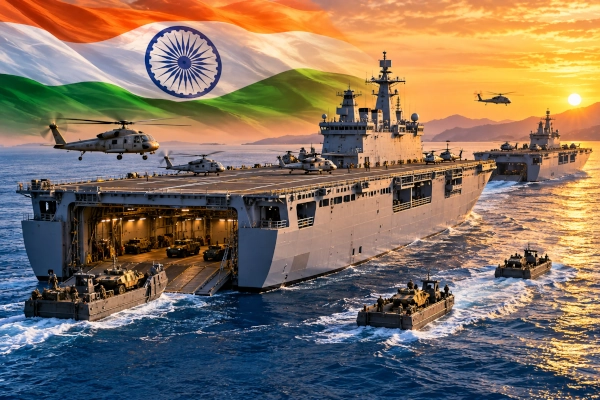
Indian engineering and defence manufacturing company Larsen & Toubro (L&T) has signed a strategic agreement with Spanish naval shipbuilder Navantia to collaborate on the Indian Navy’s proposed acquisition of four advanced amphibious assault ships. The partnership combines India’s growing naval shipbuilding capabilities with Spain’s experience in designing large warships capable of supporting amphibious operations, helicopter deployments and humanitarian missions.
Navantia officially announced the agreement on October 8, 2026, following the signing of a Memorandum of Understanding (MoU) in Madrid, Spain. The collaboration focuses on the Indian Navy’s Landing Platform Dock (LPD) programme, which envisages acquiring four large amphibious vessels to strengthen the Navy’s ability to transport military personnel, vehicles, helicopters and specialised equipment across maritime distances.
Although the Indian Navy identifies the requirement as an LPD programme, Navantia and L&T intend to offer ships incorporating Landing Helicopter Dock (LHD) capabilities. The proposed design will draw upon Navantia’s experience with Spain’s Juan Carlos I amphibious assault ship and Australia’s Canberra-class vessels, while L&T will contribute its domestic engineering, manufacturing and shipbuilding infrastructure.
The agreement establishes a framework for design cooperation, industrial participation and potential lifecycle support. However, the Indian Navy has not awarded a construction contract to the partnership, and the final vessel design, project value and delivery schedule remain to be determined.
Navantia and L&T Join Forces for Indian Navy’s Amphibious Ship Programme
The agreement brings together two companies with complementary expertise in naval engineering and warship construction. Larsen & Toubro has developed substantial capabilities in defence manufacturing, naval systems integration and complex shipbuilding, while Navantia has experience designing and constructing large amphibious vessels for international naval customers.
Under the proposed arrangement, the companies will collaborate on developing an amphibious ship solution suited to India’s operational requirements. Their cooperation will cover technical evaluation, design adaptation, potential construction arrangements and long-term support for the vessels. The partnership also aims to strengthen India’s ability to manufacture and maintain sophisticated naval platforms domestically.
Arun Ramchandani, Senior Vice President and Head of Precision Engineering & Systems at L&T, described the agreement as an opportunity to combine Indian shipbuilding capabilities with Navantia’s experience in advanced naval platforms. He emphasised the importance of supporting India’s maritime requirements while strengthening domestic manufacturing expertise.
Navantia’s Chief Operations and Business Officer, Gonzalo Mateo-Guerrero, highlighted the company’s commitment to supporting L&T and the Indian Navy throughout the proposed vessels’ operational lives. The agreement therefore extends beyond initial design cooperation and envisages a wider industrial relationship covering construction, maintenance and future support.
Indian Navy Plans Four Large Amphibious Assault Ships
The Indian Navy’s Landing Platform Dock programme seeks to develop a fleet of four large amphibious vessels capable of transporting military formations and supporting operations in coastal regions, island territories and overseas locations.
Earlier industry reporting has associated the requirement with ships displacing approximately 29,000 tonnes and measuring around 220 metres in length. The vessels are expected to incorporate helicopter operating facilities, landing craft accommodation, military vehicle storage, troop transportation capacity and modern onboard command systems.
These specifications reflect previously reported requirements rather than the final configuration of the Navantia–L&T proposal. The Indian Navy’s procurement process will determine the selected design, technical features and industrial arrangements.
Large amphibious vessels differ from conventional transport ships because they can deploy personnel and equipment without depending entirely on developed port infrastructure. Their combination of aviation facilities, landing craft and onboard logistics systems allows them to support military operations across a wide range of maritime environments.
For India, the acquisition of four such vessels would represent a substantial expansion of dedicated amphibious capabilities. The programme would strengthen the Navy’s ability to support joint military operations while providing additional capacity for humanitarian assistance and disaster relief.
Landing Helicopter Dock Ships Combine Multiple Naval Capabilities
A Landing Helicopter Dock is a large naval vessel designed to integrate helicopter operations, troop transportation, vehicle deployment and amphibious landing capabilities within a single platform.
Its expansive flight deck allows helicopters to transport personnel, conduct reconnaissance, support medical evacuation and move supplies between the ship and locations ashore. Internal hangars provide space for aircraft storage, maintenance and mission preparation, enabling sustained aviation operations during extended deployments.
Another important feature of many LHD designs is a floodable well deck located near the stern. This facility allows landing craft to enter and leave the ship, providing a means of transporting vehicles, personnel and equipment to suitable coastal landing areas. The capability is particularly valuable when conventional harbours are unavailable or damaged.
The combination of helicopters and landing craft gives commanders different options for conducting amphibious operations. Helicopters can move personnel directly to suitable landing sites, while landing craft can transport heavier vehicles and equipment that cannot be carried efficiently by aircraft.
These characteristics make amphibious assault ships versatile naval platforms capable of supporting military transportation, maritime operations, emergency evacuations and humanitarian assistance.
Navantia Brings Experience from Spain’s Juan Carlos I
Navantia’s proposed collaboration with L&T draws upon its experience developing the Spanish Navy’s Juan Carlos I, one of Europe’s major amphibious assault ships.
The vessel measures approximately 231 metres in length and displaces around 27,000 tonnes. It combines amphibious landing facilities, helicopter operations, military transportation and onboard command capabilities within a single platform.
Its large aviation deck supports helicopters and compatible fixed-wing aircraft, while internal spaces accommodate military vehicles, equipment and embarked personnel. The ship also incorporates a well deck that enables landing craft operations without requiring the vessel to enter a conventional harbour.
Navantia’s experience with Juan Carlos I provides an established technical foundation for developing related amphibious platforms. The design demonstrates how aviation, military transport and ship-to-shore operations can be integrated within a large naval vessel.
However, the Indian Navy has not selected an identical version of Juan Carlos I. The proposed Indian ships will need to satisfy national operational requirements, including specific aviation arrangements, propulsion systems, onboard equipment and domestic manufacturing considerations.
Australia’s Canberra-Class Ships Demonstrate International Design Experience
Navantia’s amphibious shipbuilding experience also includes the Royal Australian Navy’s Canberra-class Landing Helicopter Dock vessels, HMAS Canberra and HMAS Adelaide.
Based on a design derived from Juan Carlos I, the Australian ships measure approximately 230 metres in length and displace more than 27,000 tonnes at full load. They incorporate large flight decks, helicopter hangars, vehicle accommodation, landing craft facilities and integrated command systems.
The Australian programme combined Spanish design and construction expertise with domestic manufacturing and systems integration. This international industrial arrangement provides relevant experience for a similar partnership involving Indian shipbuilding facilities.
The Canberra-class ships have demonstrated the value of large amphibious vessels in military deployments, humanitarian missions and regional disaster response. Their versatility illustrates how such platforms can support a wide range of naval responsibilities throughout their operational lives.
For the Indian programme, Navantia’s experience in adapting established designs for international customers could support the development of a vessel configuration suited to India’s operational and industrial requirements.
Larsen & Toubro Could Build on Its Kattupalli Shipbuilding Capabilities
Larsen & Toubro has developed significant expertise in naval construction and defence engineering through its participation in Indian military programmes. Its defence activities cover naval platforms, underwater systems, weapons, specialised engineering equipment and complex systems integration.
The company’s major shipbuilding facility at Kattupalli, near Chennai, provides infrastructure for constructing and supporting naval and commercial vessels. L&T has participated in projects involving offshore patrol vessels, interceptor craft and other specialised maritime platforms, building experience in ship construction, outfitting and equipment integration.
Large amphibious assault ships would introduce additional engineering challenges because they combine extensive aviation facilities, troop accommodation, vehicle storage, landing craft systems and sophisticated propulsion arrangements. Constructing such vessels requires advanced modular shipbuilding techniques, precision fabrication and close coordination between multiple equipment suppliers.
The partnership with Navantia offers L&T an opportunity to combine its domestic industrial infrastructure with international expertise in large amphibious ship design. It could also expand the participation of Indian manufacturers supplying structural components, electrical equipment, mechanical systems, communication networks and other naval technologies.
The companies have not disclosed a confirmed construction allocation or indigenous content percentage. Nevertheless, the collaboration is intended to support India’s broader objectives of strengthening domestic shipbuilding capabilities under Make in India and Aatmanirbhar Bharat.
Integrated Electric Propulsion Features in India’s Reported Requirements
The Indian Navy’s previously reported LPD requirements include Integrated Full Electric Propulsion (IFEP), a technology increasingly considered for large modern naval vessels.
Conventional propulsion systems generally use engines connected mechanically to propeller shafts through gearboxes and associated machinery. Integrated electric propulsion instead relies on electrical generation systems supplying power to propulsion motors and other shipboard equipment.
This architecture offers flexibility in machinery placement and electrical power distribution. It can also support efficient operation across different operating conditions, depending on the system configuration and vessel requirements.
Large amphibious ships have substantial electrical demands because they must support propulsion, aviation equipment, communication systems, accommodation, medical facilities and other onboard services. An integrated electrical architecture can help coordinate these requirements within the ship’s overall power-management system.
Navantia has experience with advanced propulsion arrangements through Juan Carlos I, which uses a combined diesel-electric and gas turbine system with electric propulsion units.
However, the final propulsion architecture for the proposed Indian vessels remains undecided. The Navantia–L&T partnership will need to address the Indian Navy’s technical specifications during the design evaluation process.
Amphibious Ships Will Strengthen India’s Military Deployment Capabilities
The Indian Navy’s proposed amphibious ship programme is intended to improve its ability to transport and support military forces across maritime distances.
Large amphibious vessels can carry troops, armoured vehicles, logistical equipment and supporting supplies while providing the means to deploy these resources ashore. This capability is particularly valuable during operations involving remote coastal areas, islands and locations lacking developed port infrastructure.
The proposed vessels could also serve as command platforms, supporting coordination between naval ships, embarked helicopters and military personnel operating ashore. Their onboard facilities would allow commanders to manage complex operations involving multiple services and different categories of equipment.
For India, these capabilities are relevant to joint operations involving the Navy, Army and Air Force. Amphibious ships can support the deployment of military personnel and equipment while providing logistical assistance during extended operations.
The four-vessel programme would therefore strengthen a specialised part of India’s naval fleet, complementing destroyers, frigates, submarines and other platforms that perform different maritime security roles.
Helicopters and Unmanned Systems Could Expand Operational Flexibility
Helicopter operations form a central part of modern amphibious ship design. Large flight decks and internal hangars allow such vessels to support aircraft used for troop transportation, reconnaissance, medical evacuation and logistical missions.
Helicopters provide an important alternative to landing craft because they can move personnel and selected supplies directly to suitable inland locations. During disaster relief operations, this capability can prove particularly useful when roads, ports and other transport infrastructure have sustained damage.
The Indian Navy’s previously reported requirements have also included provisions for unmanned systems. These could involve unmanned aerial vehicles for surveillance, unmanned surface vessels for selected maritime missions and underwater robotic systems for inspection and reconnaissance.
Integrating such technologies requires suitable communication networks, handling arrangements, storage facilities and control systems. Large amphibious vessels provide the space and infrastructure needed to accommodate different mission equipment, although the final capabilities depend on the design selected.
Navantia and L&T have not announced the specific helicopters or unmanned systems that their proposed ships would accommodate. These arrangements will be determined through the Navy’s technical requirements and subsequent design decisions.
Humanitarian Assistance and Disaster Relief Form an Important Mission
Beyond military operations, amphibious assault ships are valuable platforms for Humanitarian Assistance and Disaster Relief (HADR) missions.
The Indian Ocean Region includes numerous coastal communities and island countries exposed to cyclones, flooding, earthquakes and other natural disasters. Such emergencies can damage ports, airports, roads and communication networks, complicating the delivery of assistance.
Large amphibious vessels can transport emergency supplies, medical equipment, relief personnel and helicopters to affected regions. Their landing craft can move heavy equipment ashore, while helicopters can reach locations inaccessible through conventional transport routes.
These ships can also provide temporary accommodation, medical treatment facilities and coordination centres for emergency operations. Their ability to operate offshore allows them to support relief activities even when local maritime infrastructure has become unusable.
India has extensive experience conducting humanitarian assistance operations across the Indian Ocean Region. Additional amphibious ships would strengthen the Indian Navy’s capacity to undertake such missions while supporting the country’s role as a regional maritime security and emergency response partner.
Navantia and L&T Build on Their Earlier Submarine Partnership
The amphibious ship agreement follows an earlier collaboration between Larsen & Toubro and Navantia in India’s naval defence sector.
In July 2023, the two companies signed a teaming agreement for the Indian Navy’s Project 75(I) submarine programme, which involves the proposed construction of advanced conventional submarines in India.
That partnership brought together Navantia’s submarine design experience and L&T’s engineering and manufacturing capabilities. The companies sought to combine international technology expertise with domestic industrial participation in a major Indian naval programme.
The new amphibious ship initiative addresses a different requirement but follows a similar industrial approach. While Project 75(I) concerns submarines, the LPD programme involves large surface vessels capable of conducting amphibious and aviation operations.
The earlier relationship provides a foundation for further technical cooperation, although the two programmes have separate procurement processes and contractual requirements.
Indian Navy’s Amphibious Ship Programme Attracts Competing Partnerships
The Navantia–L&T collaboration comes amid growing interest among Indian shipbuilders in the Navy’s future amphibious vessel requirement.
In October 2025, Mazagon Dock Shipbuilders Limited and Swan Defence and Heavy Industries Limited signed a teaming agreement to pursue opportunities associated with the same LPD programme.
The emergence of competing industrial partnerships reflects the scale of the proposed acquisition and the specialised technologies required to construct large amphibious warships.
Potential bidders must address complex engineering requirements involving hull design, propulsion, helicopter operations, landing craft facilities, accommodation, onboard systems and long-term maintenance.
The Indian Navy’s procurement process will determine the selected vessel design and shipbuilding arrangement. Consequently, the agreement between Navantia and L&T should be understood as a proposal-stage industrial partnership rather than confirmation that the four ships will be constructed by the two companies.
India–Spain Defence Cooperation Expands into Naval Shipbuilding
The agreement adds another dimension to defence industrial cooperation between India and Spain, particularly in advanced engineering and complex military platforms.
India has been expanding domestic aerospace and naval manufacturing through partnerships involving international technology providers and Indian industrial companies. Such arrangements allow Indian manufacturers to develop specialised capabilities while participating in the production and maintenance of advanced defence equipment.
An important example of India–Spain-linked aerospace cooperation is the Airbus C295 military transport aircraft programme, under which Airbus and Tata Advanced Systems are developing an aircraft manufacturing ecosystem in India. The programme draws upon European aerospace expertise, including manufacturing capabilities historically associated with Spain.
The Navantia–L&T agreement extends this industrial engagement into large amphibious warships. It offers opportunities for cooperation in naval architecture, systems engineering, ship construction and long-term technical support.
For India, the significance lies in strengthening domestic expertise in a category of naval platforms that requires substantial engineering and industrial coordination.
Four Amphibious Ships Could Expand India’s Maritime Operational Reach
India’s maritime responsibilities extend across the Arabian Sea, Bay of Bengal and wider Indian Ocean Region. The country’s naval forces must support maritime security, protect important sea routes, undertake regional cooperation and respond to emergencies across a geographically extensive operating environment.
Large amphibious vessels can contribute to these responsibilities by providing mobile platforms capable of transporting personnel, helicopters, military vehicles and emergency supplies. Their ability to support operations without relying entirely on developed ports makes them particularly useful for island territories and remote coastal regions.
The proposed four-ship programme would also strengthen the Indian Navy’s ability to conduct sustained operations involving multiple military services. Advanced aviation facilities, landing craft and onboard command systems would provide greater flexibility during deployments requiring coordinated maritime and land-based activities.
The acquisition of these vessels would complement India’s wider fleet development efforts by adding specialised amphibious transport and deployment capabilities.
Navantia–L&T Partnership Advances India’s Naval Shipbuilding Ambitions
The October 2026 agreement between Larsen & Toubro and Navantia represents another step in India’s efforts to develop the industrial and technological capabilities required for complex naval ship construction.
The proposed collaboration combines L&T’s domestic manufacturing infrastructure with Navantia’s experience in developing large amphibious ships for Spain and Australia. The partnership seeks to offer the Indian Navy an advanced vessel design capable of supporting amphibious operations, helicopter deployments, military transportation and humanitarian assistance.
Although the programme remains at the proposal stage, the agreement creates opportunities for Indian participation in sophisticated naval engineering, systems integration and long-term ship maintenance.
The Navantia–L&T partnership reflects India’s growing ambition to construct advanced naval platforms domestically while strengthening international defence industrial cooperation. The proposed four-ship programme will contribute to the long-term development of India’s maritime capabilities and support the country’s continuing pursuit of self-reliance in defence manufacturing.
References
- Navantia — October 8, 2026. Navantia y Larsen and Toubro colaboran para ofrecer LHDs a la Marina de India. Official announcement confirming the strategic partnership for the Indian Navy’s amphibious ship programme.
https://www.navantia.es/es/actualidad/notas-prensa/navantia-y-larsen-and-toubro-colaboran-para-ofrecer-lhds-a-la-marina-de-india/ - Naval News — October 2026. Navantia and Larsen & Toubro Collaborate to Offer LHDs to the Indian Navy.
https://www.navalnews.com/naval-news/2026/10/navantia-and-larsen-and-toubro-collaborate-to-offer-lhds-to-the-indian-navy/ - Navantia — Official Naval Shipbuilding Portfolio. Technical information concerning Juan Carlos I and related amphibious platforms.
https://catalogo.navantia.es/en/business-lines/naval-construction/aircraft-carriers/ - Larsen & Toubro — July 10, 2023. L&T and Navantia Sign a Teaming Agreement for Project 75(I) Submarine Programme.
https://www.larsentoubro.com/pressreleases/2023/2023-07-10-lt-and-navantia-sign-a-teaming-agreement-for-project-75-india-submarine-program - Mazagon Dock Shipbuilders Limited — October 28, 2025. Official NSE disclosure concerning its teaming agreement with Swan Defence and Heavy Industries for the Indian Navy’s LPD programme.
https://nsearchives.nseindia.com/corporate/MAZDOCK_28102025185153_Press_Release_28102025.PDF - Larsen & Toubro — Official Corporate Website. Defence manufacturing, precision engineering and naval shipbuilding capabilities.
https://www.larsentoubro.com/
You may also like
-
Punjab’s Rail Coach Factory Advances Vande Bharat Manufacturing as 16-Coach Trainset Undergoes 180 kmph Trial
-
Gujarat’s Svaayatt Systems Proposes Nine-Drone Autonomous Swarm for Indian Armed Forces
-
EndureAir and Maraal Aerospace Partner to Develop Indigenous High-Altitude Pseudo-Satellite for India
-
Serum Institute of India-Manufactured Ebola Vaccine Enters Clinical Trial in Uganda
-
Larsen & Toubro Selects Australian Orbital’s 350HFE Heavy-Fuel Engines for Indian Tactical UAV Programme
