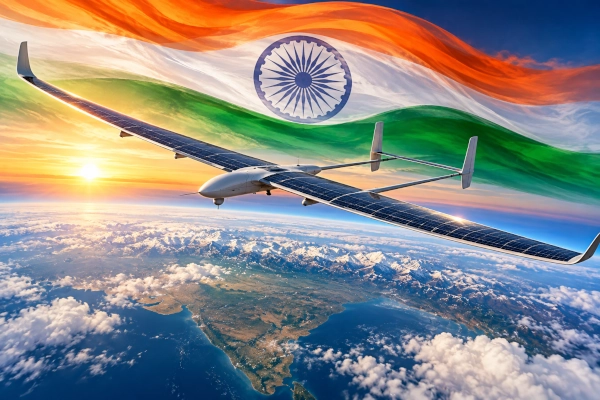
India’s indigenous aerospace industry is expanding into stratospheric aviation as EndureAir Systems and Maraal Aerospace have announced a collaboration to develop High-Altitude Pseudo-Satellite (HAPS) technology. The partnership brings together two Indian drone manufacturers to pursue unmanned aircraft capable of operating at extreme altitudes for extended periods, supporting persistent surveillance, military communications and connectivity across remote regions.
Announced on October 5, 2026, the collaboration combines EndureAir’s expertise in unmanned aerial systems, autonomous flight and aerospace engineering with Maraal Aerospace’s work in solar-powered, long-endurance aircraft. Both companies are based in Noida, Uttar Pradesh, and are developing technologies intended to strengthen India’s domestic unmanned aviation capabilities.
The proposed HAPS technology aims to bridge the operational gap between conventional unmanned aircraft and satellites. Operating in the stratosphere, such platforms can potentially remain above designated areas for weeks or months while carrying surveillance sensors or communication equipment.
Maraal Aerospace already has a development roadmap for a solar-powered HAPS designed to operate at altitudes of 18–30 kilometres, with an endurance objective exceeding 90 days. These remain proposed performance targets, and the companies have not announced a completed joint prototype or demonstrated stratospheric flight under the new collaboration.
The partnership reflects growing Indian interest in high-altitude unmanned systems that can provide persistent coverage without requiring a conventional orbital satellite.
EndureAir and Maraal Aerospace Combine Their UAV Engineering Capabilities
EndureAir Systems and Maraal Aerospace announced their collaboration to pursue indigenous HAPS development, bringing together complementary capabilities in aircraft engineering, unmanned systems and long-endurance aviation.
EndureAir specialises in unmanned aerial platforms, autonomous flight systems and the integration of advanced aerospace technologies. Its experience includes designing UAVs for defence, surveillance, logistics and other specialised applications. These capabilities provide an engineering foundation for developing aircraft intended to operate beyond the altitude and endurance limits of conventional drones.
Maraal Aerospace focuses on solar-powered fixed-wing UAVs and energy-efficient aviation technologies. The company is developing aircraft designed to achieve longer flight durations through efficient aerodynamics, solar energy collection and advanced onboard power management.
The collaboration aims to combine these capabilities in the development of high-altitude systems suitable for demanding operational environments. Both companies have identified persistent surveillance, communication services and connectivity across large or remote areas as important potential applications.
The announcement establishes a development collaboration rather than a confirmed procurement or production contract. Neither company has disclosed the financial value of the arrangement, a prototype completion schedule or a date for flight testing of the jointly proposed aircraft.
What Is a High-Altitude Pseudo-Satellite?
A High-Altitude Pseudo-Satellite is an unmanned aircraft designed to remain at very high altitudes for extended periods while performing selected functions commonly associated with satellites.
Conventional satellites orbit Earth at altitudes ranging from hundreds to thousands of kilometres, depending on their mission. HAPS platforms instead operate within the atmosphere, generally in the stratosphere, where they can maintain coverage over a particular geographical region.
The technology offers a different operating model from both traditional aircraft and orbital satellites. A high-altitude unmanned platform can potentially remain over a designated area for extended periods, allowing sensors and communication equipment to provide sustained regional coverage.
Unlike satellites, HAPS aircraft can be recovered, serviced and redeployed. Their payloads may also be changed or upgraded without requiring another orbital launch.
However, these capabilities depend on successful development of lightweight aircraft structures, efficient propulsion, reliable autonomous control and energy storage systems capable of supporting prolonged flight.
The ability to remain airborne through day-and-night cycles is particularly important for solar-powered HAPS platforms, which must balance energy generation during daylight with sufficient stored energy for nighttime operations.
Maraal Aerospace Targets Altitudes of Up to 30 Kilometres
Maraal Aerospace has outlined an ambitious technical roadmap for its proposed high-altitude platform.
According to the company’s official HAPS programme information, the aircraft is intended to operate between 18 and 30 kilometres above mean sea level, placing it well above the operating altitude of most commercial aircraft.
The proposed design incorporates a wingspan of approximately 30–50 metres and a maximum take-off weight of around 80 kilograms. Maraal also identifies a payload objective exceeding 5 kilograms, alongside a flight endurance target of more than 90 days.
The company describes a twin-propeller configuration and a solar-powered architecture intended to support ultra-long-duration operations. Its concept also incorporates lightweight construction and energy storage arrangements designed for extended flight in the stratosphere.
These specifications illustrate the engineering direction of Maraal’s HAPS programme. They should not be interpreted as verified performance figures for the newly announced EndureAir–Maraal platform.
Achieving such endurance would require the aircraft to maintain sufficient energy reserves, structural integrity and flight-control performance across changing atmospheric and environmental conditions.
The companies have not yet published the final design specifications of their proposed joint system.
Solar Power Could Enable Months-Long Unmanned Flight
Solar energy is central to Maraal Aerospace’s approach to high-altitude aviation.
A solar-powered HAPS typically uses photovoltaic cells mounted across its wings or other suitable surfaces to generate electricity during daylight. This energy powers the propulsion system, onboard electronics, communications equipment and mission payloads.
Excess energy can be stored in batteries or other storage systems for use when sunlight is unavailable. During nighttime operations, the aircraft must rely on stored energy while maintaining the flight conditions necessary to remain airborne.
This creates a demanding engineering balance between solar collection area, battery capacity, aircraft weight and aerodynamic efficiency.
A larger wingspan can provide additional surface area for solar cells, but it also introduces structural challenges. Aircraft intended for stratospheric operations must remain lightweight while tolerating aerodynamic loads and temperature variations.
Efficient propulsion is equally important because every reduction in electrical power consumption can contribute to longer endurance.
For an aircraft targeting several months of flight, energy management becomes one of the defining technical requirements. The system must sustain propulsion, navigation, flight control and payload operation through repeated day-and-night cycles.
Maraal’s development programme focuses on addressing these challenges through solar-assisted propulsion, efficient aerodynamic design and advanced energy management technologies.
EndureAir Brings Experience in Indigenous Unmanned Aircraft
EndureAir Systems has developed expertise in the design and manufacture of unmanned aircraft for a range of defence and civilian applications.
The company emerged from India’s academic and technology development ecosystem and has worked on autonomous aerial platforms intended for surveillance, logistics and specialised operations.
Its engineering capabilities include airframe development, avionics, flight-control integration and autonomous navigation. Such technologies are relevant to high-altitude systems because HAPS aircraft must maintain reliable flight over extended periods with limited direct intervention.
A stratospheric aircraft requires autonomous systems capable of managing its flight path, responding to environmental conditions and coordinating onboard power consumption.
Communication between the aircraft and ground stations must also remain dependable over considerable distances. This becomes especially important when the platform operates above remote regions where conventional ground infrastructure may be limited.
EndureAir’s participation provides the collaboration with experience in integrating multiple unmanned aircraft subsystems into operational platforms.
The company’s engineering capabilities complement Maraal’s work in solar-powered fixed-wing aircraft and long-endurance flight, creating a foundation for their proposed HAPS development programme.
Maraal Aerospace Develops Solar-Powered Tejasvaan UAV
Maraal Aerospace’s HAPS ambitions build on its existing programme to develop solar-powered fixed-wing unmanned aircraft.
The company has been developing Tejasvaan, a long-endurance solar-powered UAV intended for intelligence, surveillance, reconnaissance and civilian applications.
Its earlier solar UAV development roadmap targeted approximately 12 hours of endurance, a one-way range of 150 kilometres and operation at altitudes reaching around 6 kilometres above mean sea level.
These characteristics reflect the company’s focus on improving aircraft endurance through efficient aerodynamics and solar-assisted electric propulsion.
The technology is relevant to missions such as border surveillance, maritime monitoring, infrastructure inspection, disaster response and environmental observation.
Maraal is also pursuing a solar-hydrogen hybrid aircraft concept intended to extend endurance to approximately 24 hours. This forms an intermediate development objective between its conventional solar UAV and the much more demanding stratospheric HAPS programme.
The company’s approach therefore involves progressively developing longer-endurance aircraft technologies while expanding its expertise in propulsion, energy storage and autonomous operation.
HPCL Invests ₹2 Crore in Maraal Aerospace’s Clean-Energy Drone Technology
Maraal Aerospace received an important development boost earlier in 2026 through support from Hindustan Petroleum Corporation Limited (HPCL).
On January 29, 2026, HPCL signed a Share Subscription and Shareholders Agreement with Maraal Aerospace during India Energy Week in Goa. The agreement was announced publicly on January 30.
Under its HP Udgam startup support initiative, HPCL committed ₹2 crore to accelerate product development, testing and system validation.
The investment supports Maraal’s work in clean-energy unmanned aviation, particularly solar-powered and hybrid propulsion technologies.
HPCL identified three stages in the company’s development roadmap: a solar-powered long-endurance UAV, a future solar-hydrogen hybrid aircraft and a High-Altitude Pseudo-Satellite capable of missions exceeding 90 days.
The investment demonstrates the role of Indian public sector enterprises in supporting advanced technology startups operating beyond their traditional industrial sectors.
HPCL’s participation is particularly relevant because long-endurance electric and hybrid aircraft require expertise in energy systems, storage and efficient power utilisation.
The investment agreement predates Maraal’s collaboration with EndureAir. It should therefore be understood as support for Maraal’s broader aerospace technology development rather than a funding announcement specifically associated with the October partnership.
HAPS Technology Could Strengthen India’s Border Surveillance
Persistent surveillance is one of the most important potential defence applications of high-altitude pseudo-satellites.
India has extensive land borders covering mountainous terrain, deserts, forests and remote regions. Maintaining continuous surveillance across these environments requires a combination of ground sensors, aircraft, unmanned systems and satellites.
Conventional UAVs can provide detailed surveillance but must eventually return for refuelling, battery replacement or maintenance. Satellites offer wide-area coverage, although the observation opportunities of individual low Earth orbit satellites depend on their orbital paths.
A HAPS platform could complement these systems by maintaining a persistent presence over a selected region.
Equipped with appropriate electro-optical, infrared or other surveillance sensors, such an aircraft could provide information about activity within its coverage area.
Its ability to remain above a region for extended periods could reduce the need for repeated aircraft rotations during suitable missions.
Actual surveillance performance would depend on sensor capability, operating altitude, atmospheric conditions and communication arrangements.
The EndureAir–Maraal collaboration identifies persistent surveillance as a potential application, but no specific Indian military deployment or sensor configuration has been announced.
Maritime Surveillance Offers Another Important Application
India’s maritime security responsibilities extend across a vast area of the Indian Ocean Region, including coastal waters, important shipping routes and offshore infrastructure.
Monitoring maritime activity requires coordination between ships, patrol aircraft, satellites, coastal sensors and other surveillance systems.
High-altitude pseudo-satellites could contribute to this network by carrying sensors designed to monitor selected maritime areas over extended periods.
Their operating altitude can provide a substantial observation horizon, although detection capability depends on the sensors carried and environmental conditions.
Such platforms could support the observation of maritime traffic, provide additional situational awareness and help maintain communications with other surveillance assets.
For operations around offshore installations or designated maritime approaches, long-endurance aerial coverage could offer advantages over aircraft requiring frequent replacement.
The proposed collaboration has not announced a dedicated maritime HAPS variant. Nevertheless, surveillance over coastal and offshore areas is among the applications identified within Maraal’s broader development programme.
Stratospheric Aircraft Could Provide Communications to Remote Areas
Beyond defence surveillance, high-altitude pseudo-satellites could support communication services across locations where conventional terrestrial infrastructure is difficult to establish.
Mountainous terrain, remote settlements, island territories and disaster-affected regions can present challenges for constructing and maintaining communication networks.
A HAPS aircraft carrying suitable communication equipment could potentially function as an airborne relay station, extending connectivity across a designated area.
This capability could support emergency communication networks, remote connectivity and specialised communication requirements during disaster response operations.
Unlike orbital satellites, a HAPS platform can potentially remain over a particular region while maintaining communication links with compatible ground equipment.
Its service area and communication capacity would depend on operating altitude, payload design, frequency allocation and network architecture.
EndureAir and Maraal have identified long-endurance communication and connectivity among the potential applications of their proposed technology.
The collaboration remains focused on development, and neither company has announced a commercial telecommunications deployment.
High-Altitude Flight Presents Complex Engineering Challenges
Developing a solar-powered aircraft for extended stratospheric operation requires solutions to engineering problems that differ substantially from those encountered by conventional drones.
At altitudes approaching 20–30 kilometres, atmospheric density is considerably lower than near the Earth’s surface. Aircraft must therefore use aerodynamic designs capable of generating sufficient lift under low-density conditions.
Large, lightweight wings can improve aerodynamic efficiency but introduce challenges involving structural strength, flexibility and susceptibility to aerodynamic loading.
The propulsion system must operate efficiently while consuming limited electrical power. Solar arrays must generate adequate energy during daylight, while onboard batteries must sustain the aircraft through nighttime conditions.
Temperature variations, wind conditions and prolonged exposure to the high-altitude environment also influence material selection and system reliability.
Autonomous flight-control systems must manage these conditions while maintaining the aircraft’s intended position or flight pattern.
Communication links, payload operation and ground control arrangements must remain reliable throughout extended missions.
For EndureAir and Maraal, these challenges will require extensive design work, subsystem validation and progressive flight testing before a long-endurance stratospheric platform can be demonstrated.
India’s HAPS Development Ecosystem Continues to Expand
The EndureAir–Maraal collaboration forms part of a wider Indian effort to develop high-altitude unmanned systems for defence and civilian applications.
Government research establishments and private aerospace companies are exploring different approaches to persistent high-altitude operations, including solar-powered fixed-wing aircraft and lighter-than-air platforms.
On October 6, 2026, DRDO announced a successful flight trial of an indigenously developed High-Altitude Platform. The experimental system reached an altitude of 21 kilometres and remained at approximately 20 kilometres for more than 30 minutes before returning to the ground.
DRDO stated that the platform was developed by its Aerial Delivery Research and Development Establishment in Agra. Unlike the solar-powered fixed-wing HAPS concept pursued by Maraal, the DRDO system is a lighter-than-air platform intended for long-endurance stratospheric surveillance.
The two approaches address similar high-altitude mission requirements through different aircraft architectures.
The DRDO trial demonstrates progress in India’s high-altitude aerospace research, while private-sector initiatives such as the EndureAir–Maraal collaboration contribute to the development of alternative unmanned aircraft technologies.
Together, these efforts are broadening India’s technical capabilities in stratospheric aviation.
Indigenous HAPS Development Supports Aatmanirbhar Bharat
High-altitude unmanned systems require expertise across aerospace design, lightweight materials, propulsion, solar energy systems, electronics, autonomous navigation and communications technology.
Developing these capabilities domestically can strengthen India’s aerospace industrial base while creating opportunities for specialised component manufacturers and technology suppliers.
The partnership between EndureAir and Maraal represents cooperation between two Indian companies working in complementary areas of unmanned aviation.
EndureAir contributes experience in UAV engineering and autonomous systems, while Maraal brings its development work in solar-powered aircraft and long-endurance propulsion.
The collaboration also illustrates the importance of India’s startup ecosystem in pursuing advanced technologies that involve significant research and engineering challenges.
Support from institutions such as IIT Kanpur and public sector enterprises such as HPCL provides additional opportunities for early-stage companies to develop, test and refine new aerospace systems.
The development of a domestic HAPS capability would expand India’s options for persistent surveillance, specialised communications and high-altitude research while supporting the broader objectives of Make in India and Aatmanirbhar Bharat.
EndureAir–Maraal Partnership Opens a New Chapter in Indian Stratospheric Aviation
The October 5, 2026, announcement establishes a new collaboration between two Indian aerospace companies pursuing advanced high-altitude unmanned aircraft technologies.
The proposed HAPS programme combines EndureAir’s capabilities in autonomous unmanned systems with Maraal Aerospace’s expertise in solar-powered, long-endurance aviation.
Maraal’s existing development roadmap targets stratospheric flight at altitudes reaching 30 kilometres and endurance exceeding 90 days. These ambitious objectives provide a technical direction for its research, while the new partnership creates opportunities to combine complementary engineering capabilities.
The next stages will involve translating the development concept into validated aircraft systems through design, integration and flight testing. The companies have not yet announced a completed joint prototype or demonstrated operational performance.
The EndureAir–Maraal Aerospace collaboration represents another important step in India’s pursuit of indigenous stratospheric aviation technology. It strengthens cooperation within the domestic aerospace industry and contributes to the development of advanced unmanned systems capable of supporting India’s future surveillance, communication and connectivity requirements.
References
- EndureAir Systems — October 5, 2026. Official company announcement confirming collaboration with Maraal Aerospace for indigenous HAPS development.
https://www.linkedin.com/company/endureair/ - Maraal Aerospace — October 2026. Official company announcement concerning its HAPS development partnership with EndureAir Systems.
https://www.linkedin.com/company/maraal-aerospace-private-limited/ - Hindustan Petroleum Corporation Limited — January 30, 2026. HPCL Partners with Maraal Aerospace to Power India’s Next-Generation Clean-Energy UAV Platforms during India Energy Week 2026.
https://www.hindustanpetroleum.com/NewsroomDetails/454 - Maraal Aerospace — Official High-Altitude Pseudo-Satellite Programme. Proposed operating altitude, endurance, aircraft configuration and payload objectives.
https://maraalaerospace.com/haps/ - Maraal Aerospace — Official Solar-Powered UAV Programme. Technical information concerning the company’s long-endurance solar UAV development.
https://maraalaerospace.com/solar-powered-uav/ - Press Information Bureau, Ministry of Defence — October 6, 2026. DRDO Conducts Flight Trial of High-Altitude Platform.
https://www.pib.gov.in/PressReleaseIframePage.aspx?PRID=2319551 - AFI / IDRW — October 7, 2026. EndureAir and Maraal Aerospace Team Up for HAPS Development.
https://idrw.org/endureair-maraal-aerospace-haps-systems/
You may also like
-
Larsen & Toubro and Spain’s Navantia Partner to Develop Four Amphibious Assault Ships for Indian Navy
-
Punjab’s Rail Coach Factory Advances Vande Bharat Manufacturing as 16-Coach Trainset Undergoes 180 kmph Trial
-
Gujarat’s Svaayatt Systems Proposes Nine-Drone Autonomous Swarm for Indian Armed Forces
-
Serum Institute of India-Manufactured Ebola Vaccine Enters Clinical Trial in Uganda
-
Larsen & Toubro Selects Australian Orbital’s 350HFE Heavy-Fuel Engines for Indian Tactical UAV Programme
