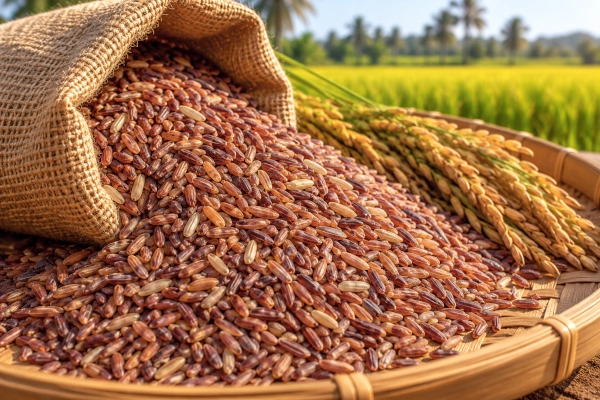
In the dry agricultural plains of southeastern Tamil Nadu, generations of farmers have preserved a distinctive indigenous rice variety known as Ramanadu Chithiraikar Rice (இராமநாடு சித்திரைக்கார் அரிசி). Traditionally cultivated in Ramanathapuram district, this heritage rice is recognised for its reddish grains, characteristic appearance and suitability for cultivation in the region’s challenging agricultural environment.
Unlike the long-grained aromatic varieties commonly associated with premium rice markets, Ramanadu Chithiraikar belongs to Tamil Nadu’s traditional red rice heritage. Its bold, rounded grains and distinctive pigmentation distinguish it from ordinary polished white rice. The variety also possesses culinary characteristics valued in traditional household preparations, particularly rice porridge and other regional dishes.
Ramanathapuram’s agricultural landscape differs considerably from the fertile, well-irrigated rice-growing regions of the Cauvery delta. The district experiences relatively low and irregular rainfall, with agriculture depending heavily on the northeast monsoon. Indigenous varieties such as Chithiraikar form part of a farming tradition shaped by these environmental conditions.
Ramanadu Chithiraikar Rice received Geographical Indication (GI) recognition on 31 March 2025, establishing its legally protected geographical identity under India’s Geographical Indications of Goods (Registration and Protection) Act, 1999. The registration recognised its association with Ramanathapuram district and the traditional farming communities responsible for preserving this indigenous variety.
Historical Origins and Traditional Heritage of Ramanadu Chithiraikar Rice
The history of Ramanadu Chithiraikar Rice is closely connected with the agricultural traditions of Ramanathapuram, historically known as Ramnad. This region has supported farming communities for centuries, despite an environment characterised by uncertain rainfall, seasonal water shortages and comparatively limited irrigation resources.
Ramanathapuram also possesses a rich historical identity associated with the Pandya kingdom, the Sethupathi rulers and the cultural landscape surrounding Rameswaram. Agriculture developed alongside these historical communities, with farmers cultivating crops suited to local soils and available rainfall.
The precise period when Chithiraikar first emerged as a distinct rice variety has not been conclusively documented. Its continued association with Ramanathapuram, however, demonstrates its place within the region’s traditional agricultural heritage.
A significant scientific reference appeared in the Madras Agricultural Journal in March 1981. Researchers from Tamil Nadu’s agricultural research system documented the development of MDU 1, a rainfed rice variety obtained by crossing IR8 with Chitraikar, identified as a native cultivar of Ramanathapuram district.
This research establishes that Chitraikar was already recognised as a local rice variety before the development and release of MDU 1. It also demonstrates that the traditional cultivar possessed agricultural characteristics considered valuable for developing improved rice varieties suited to drought-prone environments.
The preservation of Chithiraikar reflects the role of local farmers in maintaining indigenous planting material. Traditional seed selection allowed farming families to continue cultivating varieties suited to their agricultural requirements and household food preferences.
Its GI recognition in 2025 formally acknowledged a rice heritage that had already attracted scientific attention several decades earlier.
Geographical Origin and Cultivation Areas
Ramanadu Chithiraikar Rice is associated with Ramanathapuram district in southeastern Tamil Nadu, a coastal region extending towards the Gulf of Mannar and Palk Bay.
The district forms part of Tamil Nadu’s southern agricultural zone. Its landscape includes coastal plains, inland agricultural settlements, seasonal water bodies and areas with saline or alkaline soils.
According to the Ramanathapuram district administration, the region receives an average annual rainfall of approximately 827 mm, with the northeast monsoon providing the largest share. This distinguishes the district from much of India, where the southwest monsoon dominates agricultural rainfall.
The region contains several soil types, including clay, coastal alluvium, sandy loam, red soils and black cotton soils. Coastal areas also contain extensive stretches of saline and alkaline land.
Rice cultivation traditionally depends on seasonal rainfall and locally available irrigation resources. Agricultural tanks, known as kanmais in Tamil Nadu, have historically played an important role in storing monsoon water and supporting cultivation.
These geographical conditions influence crop selection and agricultural management. Farmers must contend with uncertain rainfall, water shortages and differences in soil quality across the district.
The Tamil Nadu State Agricultural Marketing Board identifies Ramanadu Chithiraikar Rice as a GI-registered agricultural product associated with Ramanathapuram.
Although the official registration lists Tamil Nadu as the state of geographical origin, the variety’s specific historical identity and traditional cultivation are centred on Ramanathapuram district.
Unique Characteristics of Ramanadu Chithiraikar Rice
Ramanadu Chithiraikar belongs to the species Oryza sativa L. and is distinguished by its pigmented grains, traditional cooking qualities and agricultural characteristics.
The variety is associated with relatively bold, rounded grains and a reddish appearance. The harvested paddy has a darker outer covering, while the grain beneath displays pigmentation that distinguishes it from conventional white rice.
The colour is particularly relevant because traditional red rice varieties retain naturally occurring pigments in the outer grain layers. Processing methods influence the appearance and nutritional characteristics of the finished product.
When rice undergoes extensive polishing, portions of the bran and germ are removed. Less-polished rice retains more of these outer components, including dietary fibre and certain naturally occurring compounds.
Chithiraikar is also valued for its distinctive flavour in traditional preparations. Rice porridge made from the variety is associated with the food traditions of Ramanathapuram, where simple grain-based meals form part of rural household diets.
Its agricultural importance extends beyond its appearance. Historical research identifies Chitraikar as a native rice cultivar used in breeding programmes aimed at developing improved rainfed rice.
The variety therefore possesses a distinctive identity that combines grain pigmentation, traditional culinary use and an established connection with rice cultivation in Ramanathapuram.
Traditional Cultivation and Agricultural Practices
Farmers traditionally cultivate rice in Ramanathapuram according to seasonal water availability, with the northeast monsoon playing a particularly important role.
Tamil Nadu Agricultural University’s cropping-pattern recommendations identify September to January as an important rice-growing period in the district’s tank-irrigated and command areas.
The availability of sufficient rainfall remains a major consideration. Delayed monsoons, uneven rainfall distribution and dry periods during crop development can affect agricultural productivity.
Traditional Chithiraikar belongs to a wider group of indigenous rice varieties maintained under these conditions. Its continued cultivation reflects farmers’ experience in selecting and managing locally suitable crops.
Scientific documentation has also recorded the agronomic characteristics of Chithiraikar. A 2023 study published in Frontiers in Nutrition examined five traditional rice varieties from Tamil Nadu, including Chithiraikar.
The researchers documented a crop duration of approximately 110–115 days and an average plant height of approximately 165 cm for the Chithiraikar material included in their investigation.
The study also recorded approximately 210–215 grains per earhead. These figures describe the research material grown under the study’s conditions and should not be interpreted as uniform measurements for every Chithiraikar crop.
The study used rice collected from farmers in the Cauvery delta region and grown under canal-irrigated conditions. Its agronomic observations therefore provide useful scientific information but do not directly establish the performance of every crop grown in Ramanathapuram.
Maintaining authentic seed material remains important for protecting the variety’s identity. Appropriate agricultural management can help farmers improve productivity while conserving the characteristics responsible for its traditional reputation.
Ramanadu Chithiraikar and the Agricultural Challenges of Ramanathapuram
One of the most significant aspects of Ramanadu Chithiraikar Rice is its association with a region where water availability creates persistent challenges for agriculture.
Ramanathapuram differs from Tamil Nadu’s major irrigation-supported paddy districts. Its agricultural systems depend heavily on the timing and distribution of northeast monsoon rainfall.
The district administration identifies saline and alkaline soils in several coastal blocks, including Mandapam, Ramanathapuram, Thiruppullani and Thiruvadanai. Such conditions can affect crop establishment and productivity.
Tamil Nadu Agricultural University’s Krishi Vigyan Kendra in Ramanathapuram has consequently prioritised the promotion of rice varieties suitable for drought-prone and saline agricultural environments.
Its research and extension activities include rainfed rice cultivation, drought management, micronutrient management and appropriate farming practices for areas affected by salinity.
The agricultural value of traditional Chithiraikar must be understood within this wider context. Historical evidence confirms its use as a parent in rice improvement work directed towards rainfed agriculture.
The 1981 Madras Agricultural Journal study reported that MDU 1, developed from IR8 and Chitraikar, produced approximately 1,800 kilograms per hectare under the research conditions, representing a 20% yield improvement over the traditional Chitraikar parent.
The study demonstrates that the indigenous cultivar contributed useful genetic material to crop improvement efforts. It does not, by itself, establish that Chithiraikar possesses complete drought resistance or can withstand every form of agricultural water stress.
Conserving traditional varieties remains important because their genetic diversity can support research into crops adapted to difficult growing conditions.
Nutritional Characteristics and Scientific Research
Ramanadu Chithiraikar belongs to the wider group of traditional pigmented rice varieties that have attracted scientific attention for their nutritional and biochemical characteristics.
In 2023, researchers from Tamil Nadu Agricultural University and collaborating institutions published a metabolomic study of five traditional rice cultivars in Frontiers in Nutrition.
The study examined Chinnar, Chithiraikar, Karunguruvai, Kichili Samba and Thooyamalli, using advanced laboratory methods to identify naturally occurring chemical compounds in their grains.
Researchers identified approximately 149 metabolites across the five varieties, grouped into 34 chemical classes. These included fatty acids, plant sterols, organic compounds and other naturally occurring constituents.
Chithiraikar and Karunguruvai were identified as pigmented varieties, while the remaining three belonged to the white rice group.
The researchers used brown rice samples to retain the bran-associated compounds that can be reduced or removed through extensive polishing.
The findings demonstrated biochemical diversity among traditional rice cultivars. They also provided information relevant to understanding grain composition, agricultural biodiversity and potential uses in food development.
However, identifying potentially beneficial compounds in laboratory samples does not establish that consuming Chithiraikar Rice prevents or treats specific diseases.
The study’s importance lies in its scientific characterisation of the variety and its contribution to understanding India’s traditional rice resources.
For consumers, the nutritional characteristics of Chithiraikar also depend on processing methods, cooking practices, portion sizes and the overall composition of the diet.
Culinary Importance and Traditional Uses
Ramanadu Chithiraikar Rice forms part of Tamil Nadu’s traditional red rice food culture, where indigenous grains have long been used in simple household preparations.
One of its characteristic uses is in kanji, a rice porridge prepared by cooking grains with sufficient water until they develop a soft consistency. Kanji remains an important traditional food across rural Tamil Nadu and is commonly consumed as part of everyday meals.
Chithiraikar is also suitable for preparations that benefit from the characteristic flavour and texture of traditional rice. These include cooked rice, idli, dosa and other rice-based foods associated with Tamil cuisine.
The use of traditional rice in fermented preparations reflects the versatility of indigenous varieties. Grain texture, moisture absorption and processing characteristics influence their suitability for different dishes.
Ramanadu Chithiraikar differs from premium aromatic varieties such as Seeraga Samba, whose reputation rests primarily on fragrance and culinary applications. Chithiraikar’s identity is more closely associated with its red grain characteristics, regional cultivation and traditional household uses.
The continued consumption of such varieties supports the preservation of regional food traditions. Demand for distinctive grains encourages farmers to maintain crops that might otherwise lose ground to widely marketed commercial rice.
Geographical Indication Recognition of Ramanadu Chithiraikar Rice
Ramanadu Chithiraikar Rice received formal GI registration under the Geographical Indications of Goods (Registration and Protection) Act, 1999.
The application was jointly submitted by the Tamil Nadu State Agricultural Marketing Board and the Ramnad Chithiraikar Rice Farmer Producer Association.
The involvement of the producer association reflects the role of local farming communities in protecting the geographical identity of traditional agricultural products.
The application was filed on 2 February 2023, under Application No. 1051. It sought recognition of the rice’s association with Ramanathapuram and its distinctive agricultural identity.
The registration process included examination of the supporting documents and the historical and geographical information submitted by the applicants.
The Geographical Indications Registry published the application in Journal No. 200 on 30 November 2024.
Following the statutory process, the registry issued Certificate No. 697 on 31 March 2025, formally registering Ramanadu Chithiraikar Rice under Class 31.
The recognition provided a legal framework for protecting the registered geographical indication and distinguishing the product from rice marketed without the required geographical association.
The registration remains valid until 1 February 2033, subject to renewal under India’s geographical indications legislation.
GI Tag Journey of Ramanadu Chithiraikar Rice
The journey of Ramanadu Chithiraikar Rice towards Geographical Indication recognition reflects the efforts of local farmers, agricultural institutions and the Tamil Nadu Government to preserve the identity of this traditional rice variety.
- Traditional Agricultural Heritage: Farmers in Ramanathapuram preserved Chithiraikar through traditional cultivation and seed selection. Its distinctive red grains and suitability for regional food preparations helped maintain its place in local agricultural traditions.
- March 1981 – Scientific Documentation: Research published in the Madras Agricultural Journal identified Chitraikar as an indigenous rice cultivar of Ramanathapuram. The variety served as a parent in developing the improved rainfed rice cultivar MDU 1.
- 2 February 2023 – GI Application Filed: The Tamil Nadu State Agricultural Marketing Board and Ramnad Chithiraikar Rice Farmer Producer Association submitted the application under No. 1051.
- 22 February 2023 – Formality Check Report: The Geographical Indications Registry issued its initial examination of the application documents.
- 26 September 2023 – Applicant’s Response: The applicants submitted their response to the formality check report, together with supporting documents and the statement of case.
- 12 September 2024 – Hearing Response: The registry recorded the applicants’ reply relating to the GI application hearing.
- 30 October 2024 – Examination Report: The Geographical Indications Registry issued its examination report assessing the application.
- 30 November 2024 – Publication in GI Journal: Ramanadu Chithiraikar Rice appeared in Geographical Indications Journal No. 200 as part of the statutory registration process.
- 31 March 2025 – GI Certificate Issued: The Geographical Indications Registry issued Certificate No. 697, formally recognising Ramanadu Chithiraikar Rice as a registered Geographical Indication.
- 2025 Onwards – Authorised-User Registration: The GI Registry recorded individual farmers and other eligible applicants as authorised users, strengthening formal participation in the protected geographical indication.
- 1 February 2033 – Registration Validity: The current GI registration remains valid until this date, subject to renewal under India’s geographical indications legislation.
GI Details at a Glance
- Geographical Indication: Ramanadu Chithiraikar Rice
- State: Tamil Nadu
- Product: Agricultural
- Class: 31
- Application Number: 1051
- Date of Filing: 2 February 2023
- GI Journal: No. 200
- Journal Availability Date: 30 November 2024
- Certificate Number: 697
- GI Certificate Date: 31 March 2025
- Registered Proprietors: Tamil Nadu State Agricultural Marketing Board and Ramnad Chithiraikar Rice Farmer Producer Association
- Registered Proprietor’s Location: Chennai and Ammapattinam, Ramanathapuram district, Tamil Nadu
- Geographical Area: Tamil Nadu, with the registered rice traditionally associated with Ramanathapuram district
- Registration Valid Until: 1 February 2033
Farmer Participation and Authorised-User Registration
An important development following the GI recognition of Ramanadu Chithiraikar Rice has been the registration of authorised users under India’s geographical indications framework.
The official GI Registry lists individual applicants associated with the registered product, including farmers from Rettaiyurani, Ammapattinam and neighbouring settlements in Ramanathapuram district.
The authorised-user records include both men and women, reflecting participation by local agricultural households in the formal protection system.
Authorised-user registration allows eligible producers to use the registered geographical indication in accordance with the requirements of the GI legislation.
This mechanism is particularly important for traditional agricultural products because it establishes a connection between the protected name and those entitled to market authentic produce under that identity.
The Ramnad Chithiraikar Rice Farmer Producer Association provides an organisational link between the registration process and local producers.
Such producer organisations can support collective marketing, quality management, agricultural guidance and product identification.
For small farmers, collective participation also offers opportunities to develop commercially recognisable products without losing the connection to their traditional geographical origin.
Preserving an Indigenous Rice Variety
The conservation of Ramanadu Chithiraikar Rice contributes to the preservation of Tamil Nadu’s agricultural biodiversity.
Traditional rice varieties often possess characteristics developed through generations of farmer selection. These may include differences in crop duration, grain pigmentation, plant architecture, cooking qualities and adaptation to local environments.
Chithiraikar has particular importance because of its documented role in rice improvement research. Its use in developing MDU 1 demonstrates that indigenous agricultural resources can contribute to scientific breeding programmes.
The 2023 metabolomic research further demonstrates the value of studying traditional rice varieties using modern laboratory techniques.
Such research helps agricultural institutions understand the biochemical diversity present within indigenous crops. It can also support future investigations into grain quality and the conservation of valuable genetic resources.
Preserving Chithiraikar requires continued cultivation and the maintenance of suitable seed material. Traditional landraces can lose their distinctive characteristics when seeds become mixed with unrelated varieties.
Farmer-led conservation, supported by agricultural research institutions, provides a practical approach to maintaining crop identity.
The recognition of Chithiraikar under the GI system adds an economic and legal dimension to these conservation efforts by formally associating the registered product with its traditional geographical origin.
Economic Importance and Opportunities for Farmers
Ramanadu Chithiraikar Rice offers opportunities for farmers seeking to develop specialised markets for traditional agricultural products.
Its distinctive red grain characteristics, documented agricultural heritage and geographical identity provide a basis for distinguishing it from conventional rice varieties.
The economic potential extends beyond paddy production. Farmers and local enterprises can develop value-added products through cleaning, milling, grading and packaging.
The growing interest in traditional and minimally processed rice also creates opportunities for product diversification. Brown rice, semi-polished rice and rice-based preparations can appeal to consumers seeking regional food products with identifiable origins.
However, these opportunities require consistent grain quality, reliable processing and transparent marketing.
Farmer producer organisations can help coordinate production and commercial activities. Collective procurement, processing and distribution can improve access to markets that individual smallholders may find difficult to reach.
The Tamil Nadu State Agricultural Marketing Board’s involvement in the GI registration provides an institutional foundation for promoting authentic Ramanadu Chithiraikar Rice.
Quality assurance remains particularly important because the variety’s geographical identity must be maintained as commercial distribution expands.
The registration also creates opportunities to market Ramanadu Chithiraikar as part of Tamil Nadu’s traditional agricultural heritage rather than as an undifferentiated commodity.
Ramanadu Chithiraikar and Tamil Nadu’s GI Agricultural Heritage
Tamil Nadu possesses a rich collection of traditional agricultural products recognised under India’s Geographical Indications system.
Ramanadu Chithiraikar Rice forms part of this heritage alongside products such as Ramnathapuram Mundu Chilli, Kanyakumari Clove, Cumbum Panneer Thratchai, Panruti Cashew and Kumbakonam Vetrilai.
Each product represents a distinct relationship between local agricultural conditions, traditional cultivation and regional reputation.
Ramanathapuram district has particular significance because both Chithiraikar Rice and Mundu Chilli reflect agricultural traditions developed within its comparatively dry environment.
Mundu Chilli is known for its association with the district’s chilli-growing communities, while Chithiraikar represents the region’s indigenous rice heritage.
The GI recognition of both products draws attention to agricultural traditions from a district more commonly associated with Rameswaram, coastal landscapes and religious tourism.
Ramanadu Chithiraikar also contributes to the diversity of GI-recognised rice products in southern India.
While some traditional rice varieties are celebrated for fragrance or long grains, Chithiraikar represents a different agricultural identity based on grain pigmentation, historical cultivation and regional food traditions.
This diversity demonstrates the importance of protecting agricultural products according to their geographical characteristics rather than treating all traditional rice varieties as interchangeable.
Future Prospects for Ramanadu Chithiraikar Rice
The future of Ramanadu Chithiraikar Rice is closely connected with the preservation of its traditional characteristics and the development of sustainable opportunities for the farming communities of Ramanathapuram.
Continued seed conservation can help maintain the variety’s distinctive grain appearance and agricultural identity. Scientific crop management can also support better productivity and more consistent cultivation.
Research into traditional rice varieties remains particularly valuable for regions facing uncertain rainfall and agricultural water shortages.
Chithiraikar’s documented contribution to the development of MDU 1 demonstrates the practical significance of conserving indigenous crop genetic resources.
The GI registration provides opportunities for stronger geographical branding, organised producer participation and improved product traceability.
Better processing infrastructure and appropriate packaging can help farmers develop premium regional rice products while maintaining their association with Ramanathapuram.
Greater awareness of Tamil Nadu’s indigenous food traditions can also encourage consumers to appreciate the diversity of rice varieties preserved by farming communities.
Ramanadu Chithiraikar Rice represents the enduring relationship between Ramanathapuram’s challenging agricultural landscape, generations of traditional farming knowledge and Tamil Nadu’s indigenous red rice heritage. Its GI recognition protects a distinctive geographical identity, while continued cultivation preserves an agricultural resource with documented scientific and cultural value. With farmer-led conservation, agricultural research and expanding market opportunities, Ramanadu Chithiraikar can strengthen the recognition of Ramanathapuram’s traditional rice heritage across India.
References
- Geographical Indications Registry, Government of India — Ramanadu Chithiraikar Rice, Application No. 1051, Certificate No. 697, dated 31 March 2025. Official registration record, application history, GI Journal publication, authorised-user details and registration validity.
https://search.ipindia.gov.in/GIRPublicSearch/Application/Details/1051 - Tamil Nadu State Agricultural Marketing Board, Government of Tamil Nadu — Registered GI Agricultural Products. Official identification of Ramanadu Chithiraikar Rice as a GI-registered agricultural product of Ramanathapuram district.
https://agrimark.tn.gov.in/home/tnsamb - District Administration, Ramanathapuram, Government of Tamil Nadu — Agriculture Department. Official information on rainfall, soil characteristics, agricultural conditions and irrigation resources in Ramanathapuram.
https://ramanathapuram.nic.in/departments/agriculture/ - Tamil Nadu Agricultural University — MDU 1 Rice: A High Yielding Rainfed Variety, Madras Agricultural Journal, Volume 68, Issue 3, March 1981, pages 148–152. Research documenting Chitraikar as a native cultivar of Ramanathapuram and its use in developing MDU 1.
https://masujournal.org/store_file/archive/68-3-3-148-152.pdf - Tamil Nadu Agricultural University, Agritech Portal — Krishi Vigyan Kendra, Ramanathapuram: Major Thrust Areas. Research and extension priorities relating to rainfed rice, drought management, salinity and agricultural productivity.
https://agritech.tnau.ac.in/kvk/kvk_ramnad_majorthrust.html - Tamil Nadu Agricultural University, Agritech Portal — Cropping Patterns of the Southern Agricultural Zone. Official crop calendars and recommended cultivation periods for Ramanathapuram district.
https://agritech.tnau.ac.in/agriculture/agri_agrometeorology_croppingpattern_southernzone.html - Frontiers in Nutrition, 2023 — Metabolomic Analysis for Disclosing Nutritional and Therapeutic Prospective of Traditional Rice Cultivars of Cauvery Deltaic Region, India. Scientific investigation of Chithiraikar and four other traditional Tamil Nadu rice varieties.
https://doi.org/10.3389/fnut.2023.1254624 - National Library of Medicine, PubMed Central — Full-text scientific publication on metabolomic characterisation of traditional Tamil Nadu rice varieties, including Chithiraikar.
https://pmc.ncbi.nlm.nih.gov/articles/PMC10568072/ - Agricultural and Processed Food Products Export Development Authority (APEDA) — Annual Report 2024–25. Documentation of GI-registered agricultural and food products, including Ramanadu Chithiraikar Rice.
https://apeda.gov.in/sites/default/files/annual_report/APEDA_Annual_Report_English_2024_25.pdf
You may also like
-
India’s Manufacturing Corporate Sector Records 9.28% GVA Growth in FY2024–25
-
NALCO Advances ₹30,000 Crore Aluminium Smelter Expansion in Odisha, Targets One Million Tonnes of Annual Capacity
-
India’s Ports and Inland Waterways: Major Maritime Projects, Operational Routes and Development Status in 2026
-
India’s Solar Manufacturing Industry Could Generate 32.3 Lakh Jobs and Attract $89 Billion Investment by 2047: ISMA
-
India’s River Interlinking Programme: Comprehensive Status of 30 Projects, Construction Progress and the Road Ahead in 2026
