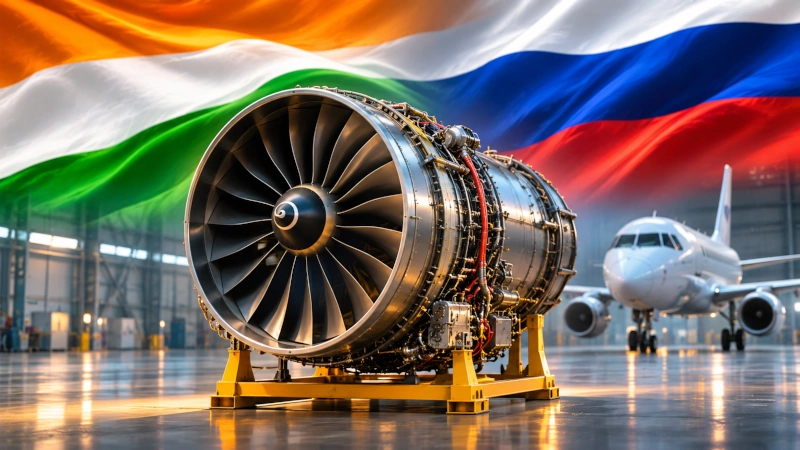
New Delhi, November 5, 2026: Russia has proposed expanding its aerospace manufacturing cooperation with India to include the possible local production of PD-8 turbofan engines, opening a new opportunity for India’s aircraft engine manufacturing industry. The proposal, involving Russia’s United Engine Corporation (UEC), comes as Hindustan Aeronautics Limited (HAL) and United Aircraft Corporation (UAC) advance their partnership for the licensed production of SJ-100 regional passenger aircraft in India.
According to a report published on November 4, Russia is prepared to consider technology transfer arrangements that would enable Indian aerospace companies to manufacture PD-8 engines, associated components, spare parts and maintenance equipment domestically. The proposal builds upon discussions held during the INNOPROM India exhibition in September 2026, when senior Russian industry officials publicly outlined opportunities for establishing aircraft and engine manufacturing facilities in India.
The development is particularly significant because aircraft engine manufacturing remains one of the most technologically demanding segments of the aerospace industry. Establishing domestic production capabilities for a modern commercial turbofan could strengthen India’s aviation manufacturing ecosystem, expand opportunities for specialised engineering companies and support the country’s ambitions to become a major producer of civil passenger aircraft.
Russia Offers Technology Transfer for PD-8 Engine Manufacturing
Russia’s United Engine Corporation, part of the Rostec State Corporation, has indicated its willingness to explore arrangements for localising the production of aircraft engines in India, including the PD-8 turbofan developed for the Russian SJ-100 regional passenger aircraft.
According to the November 4 report, the proposed cooperation could extend beyond engine assembly to cover components, spare parts and maintenance equipment required to support aircraft operations throughout their service lives. The Russian side is reportedly examining opportunities to work with Indian aerospace manufacturers capable of absorbing the technology and developing associated maintenance, repair and overhaul infrastructure.
The proposal follows statements made by UEC Director General Alexander Grachev in September 2026 concerning the possibility of organising licensed PD-8 engine production in India. During the INNOPROM India exhibition in New Delhi, Russian aerospace officials highlighted the potential for Indian companies to participate in manufacturing engines and aircraft components as part of a broader industrial partnership.
The discussions reflect an approach in which aircraft manufacturing cooperation would incorporate domestic production, engineering support, maintenance infrastructure and technological collaboration rather than remain limited to importing completed aircraft.
Although Russia has expressed its readiness to pursue such cooperation, the precise scope of technology transfer, potential Indian manufacturing partners, production investments and implementation schedules have not yet been established through a publicly confirmed final agreement.
HAL and UAC Advance SJ-100 Passenger Aircraft Manufacturing Partnership
The proposed PD-8 localisation initiative is closely connected with the industrial cooperation already established between Hindustan Aeronautics Limited and Russia’s United Aircraft Corporation.
On October 27, 2025, HAL and UAC signed a memorandum of understanding in Moscow for the production of SJ-100 civil passenger aircraft in India. The agreement marked an important step towards reviving India’s capabilities in the domestic manufacture of complete civilian passenger aircraft.
The partnership progressed further on January 28, 2026, when the two companies signed a cooperation agreement during the Wings India exhibition in Hyderabad. The agreement established a framework for licensed production of the SJ-100 and outlined the responsibilities of both organisations in developing the proposed manufacturing programme.
Under the arrangement, HAL is expected to support the certification and validation process required for introducing the aircraft into the Indian market. UAC has agreed to provide technical assistance, engineering expertise and support for establishing or modernising manufacturing facilities required for domestic aircraft production.
The cooperation framework also envisages granting HAL rights to manufacture and market the SJ-100, including assemblies, components and equipment required for maintenance and repair.
In September 2026, UAC Director General Vadim Badekha stated that more than 80% of the documentation associated with the broader licensing agreement had been finalised. The Russian company indicated that it was working towards completing the agreement and securing an initial Indian customer, with Aero India 2027 identified as a potential milestone.
These developments demonstrate that the partnership has progressed beyond its original memorandum, although the detailed industrial roadmap and commercial commitments remain subject to further agreements.
PD-8 Engine Represents a Major Russian Aerospace Development
The PD-8 is a modern Russian high-bypass turbofan developed by UEC-Saturn for the SJ-100 regional passenger aircraft and the Be-200 amphibious aircraft.
The engine is designed to deliver approximately eight tonnes of takeoff thrust and incorporates technologies developed through Russia’s efforts to establish domestically controlled aircraft propulsion capabilities.
According to Rostec, the PD-8 programme involved the development and introduction of advanced manufacturing technologies, including new materials and specialised engineering processes. The engine received its Russian type certificate in June 2026 after completing the required certification programme.
Following certification, United Engine Corporation began assembling the first commercial PD-8 engines for the Superjet aircraft programme. Rostec also reported investments in additional industrial equipment to modernise production processes and support the transition towards serial manufacturing.
The engine was prominently displayed during the INNOPROM India exhibition in September, where Russian aerospace companies presented aircraft and propulsion technologies intended for potential cooperation with Indian manufacturers.
For India, the proposed localisation of the PD-8 would represent an opportunity to participate in the manufacturing of a certified commercial turbofan engine, subject to agreement on technology access, industrial responsibilities and production requirements.
Indigenous Engine Manufacturing Could Strengthen India’s Aerospace Supply Chain
Aircraft engine production requires advanced capabilities in precision engineering, high-temperature materials, turbine manufacturing, compressor technology, combustion systems, digital engine controls and specialised testing infrastructure.
Developing domestic expertise across these areas is important for countries seeking to establish comprehensive aerospace manufacturing capabilities.
A licensed PD-8 manufacturing programme could provide opportunities for Indian companies to participate in the production of engine components, assemblies and associated systems. Depending on the eventual agreement, such cooperation could also support the development of testing facilities, specialised maintenance capabilities and technical training programmes.
India already possesses significant aerospace engineering expertise through organisations such as HAL, the Gas Turbine Research Establishment and a growing network of private-sector manufacturers supplying components to domestic and international aviation programmes.
HAL has also been expanding its participation in international commercial aircraft engine supply chains. In June 2025, the company signed an agreement with Safran Aircraft Engines for the industrialisation and production of rotating components for LEAP engines used in modern commercial passenger aircraft.
The proposed PD-8 programme could complement these existing capabilities by creating another avenue for Indian industry to participate in advanced propulsion manufacturing.
The industrial significance would depend on the depth of the eventual technology transfer. Licensed assembly, domestic component production and comprehensive engine manufacturing represent different levels of technological participation, each requiring distinct manufacturing capabilities and investment commitments.
Russia Explores Joint Aircraft Engine Manufacturing in India
The proposal to manufacture PD-8 engines in India forms part of a wider Russian initiative to establish aerospace industrial partnerships with Indian companies.
On September 9, 2026, Department for Promotion of Industry and Internal Trade Secretary Amardeep Singh Bhatia stated during the INNOPROM India forum that United Engine Corporation was exploring the possibility of joint aircraft engine production in India.
The statement provided confirmation from an Indian government official that the proposal was under consideration as part of broader bilateral industrial cooperation.
Russian Minister of Industry and Trade Anton Alikhanov subsequently outlined a comprehensive approach to localising Russian passenger aircraft production in India. The proposed cooperation included aircraft assembly, component manufacturing, maintenance infrastructure, technical support and training for Indian specialists.
Russian aerospace officials have also discussed the possibility of Indian manufacturers contributing to PD-8 component production, potentially creating additional capacity within the aircraft engine supply chain.
Such cooperation could become relevant to Russia’s plans for expanding civilian aircraft production while supporting India’s efforts to strengthen domestic aerospace manufacturing.
The discussions also demonstrate the growing importance of industrial partnerships that combine aircraft manufacturing with propulsion systems, component supply chains and long-term maintenance capabilities.
SJ-100 Programme Could Support India’s Regional Aviation Requirements
The SJ-100 is a twin-engine regional passenger aircraft designed for short-haul commercial operations. The latest Russian-built version incorporates domestically developed systems, including PD-8 engines, avionics, landing gear and other equipment.
According to UAC, the aircraft is designed to accommodate up to 103 passengers, making it suitable for regional aviation routes connecting cities with moderate passenger demand.
India’s expanding domestic aviation market has created opportunities for aircraft capable of serving shorter routes and connecting regional airports with major economic centres.
The government’s regional connectivity initiatives have encouraged the development of additional air routes, creating potential demand for aircraft suited to regional passenger services.
HAL and UAC are exploring the possibility of manufacturing the SJ-100 in India to serve domestic aviation requirements. The programme could also create opportunities for Indian companies involved in aircraft structures, avionics integration, electrical systems, landing gear, precision components and maintenance services.
Domestic PD-8 manufacturing would become particularly relevant if Indian production of the SJ-100 progresses to larger volumes. Locally manufactured engines and spare parts could support fleet maintenance, reduce dependence on overseas component deliveries and expand the industrial activities associated with the aircraft programme.
However, aircraft orders, certification requirements and the commercial viability of the proposed manufacturing arrangements will determine the scale and timing of future production.
HAL’s Civil Aviation Expansion Supports Aerospace Manufacturing Ambitions
HAL’s participation in the SJ-100 programme represents an extension of its manufacturing activities beyond military aircraft, helicopters and defence aviation systems.
India has considerable experience in manufacturing military aerospace platforms and aviation components, but domestic production of complete commercial passenger aircraft remains comparatively limited.
The proposed SJ-100 partnership is intended to establish a new industrial framework for manufacturing regional passenger aircraft in India, supported by licensing arrangements and engineering collaboration with the Russian manufacturer.
Such a programme could create opportunities for existing aerospace suppliers to diversify into commercial aircraft manufacturing while encouraging investment in specialised production infrastructure and technical expertise.
Engine manufacturing would add an important dimension to this industrial development because propulsion systems constitute a major technological and economic component of aircraft production.
The possibility of producing PD-8 engines domestically could therefore expand the significance of the HAL–UAC partnership beyond aircraft assembly, potentially supporting the creation of a more integrated civil aviation manufacturing ecosystem.
India–Russia Aerospace Cooperation Enters a New Phase
India and Russia have maintained extensive aerospace cooperation over several decades, particularly in military aviation, aircraft manufacturing and propulsion technologies.
The proposed localisation of the SJ-100 and PD-8 represents an opportunity to extend this relationship into civilian passenger aircraft and commercial engine manufacturing.
The emerging cooperation model places greater emphasis on domestic manufacturing, industrial partnerships, technology absorption and maintenance infrastructure within India.
For Indian aerospace companies, such arrangements could provide opportunities to acquire manufacturing experience in advanced commercial aviation systems while expanding participation in international supply chains.
The development also aligns with India’s broader objective of strengthening domestic industrial capabilities under the Atmanirbhar Bharat initiative.
By exploring cooperation in aircraft structures, propulsion systems, components and maintenance services, India and Russia are examining opportunities to establish a more comprehensive aviation manufacturing partnership.
PD-8 Localisation Could Expand India’s Role in Aircraft Engine Manufacturing
Russia’s proposal to localise PD-8 turbofan production in India represents a noteworthy development in the continuing evolution of the HAL–UAC aerospace partnership.
The initiative builds upon the October 2025 SJ-100 memorandum, the January 2026 cooperation agreement and the industrial discussions conducted during September 2026. Together, these developments establish a framework for examining the feasibility of manufacturing Russian regional passenger aircraft and associated propulsion systems in India.
The proposed engine collaboration is particularly relevant because it could create opportunities for domestic manufacturers to participate in advanced propulsion engineering, component production and maintenance infrastructure.
While the final technology-transfer arrangements and manufacturing commitments remain under discussion, the proposal reflects the increasing scope of India–Russia industrial cooperation in civil aviation.
For India’s aerospace sector, the significance extends beyond a single aircraft or engine programme. The development highlights the potential for Indian industry to expand its participation in complete aircraft manufacturing and sophisticated propulsion technologies, strengthening the domestic engineering ecosystem and supporting the country’s long-term ambitions in commercial aerospace production.
You may also like
-
INS Sahyadri Arrives in Japan for MALABAR 2026 Naval Exercise with Quad Nations
-
Zen Technologies Plans Annual Production Capacity of 1.8 Lakh HyperStrike Interceptor Drones
-
Philippines Hails BrahMos Missile Technology, Signals Growing Interest in Advanced Indian Defence Equipment
-
Cabinet Opens Pathway for All Agniveers to Join Regular Armed Forces Through Two-Year Service Extension
-
India Reportedly Evaluates 52 Russian Pantsir Air-Defence Systems with Domestic Manufacturing
