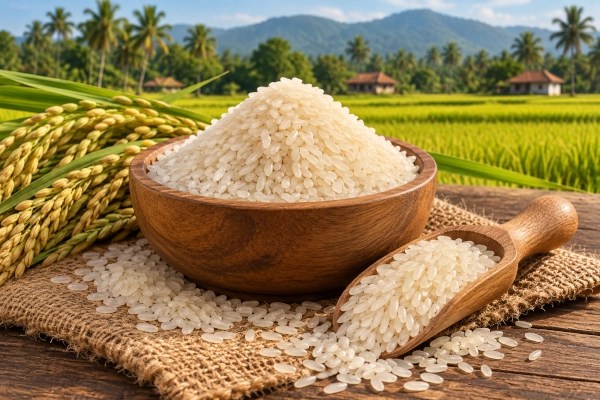
In the traditional paddy fields of Tamil Nadu grows Thooyamalli, an indigenous rice variety celebrated for its fine white grains, delicate appearance and longstanding association with the state’s agricultural heritage. Preserved through generations of cultivation, this traditional rice represents the richness of Tamil Nadu’s indigenous crop diversity and the farming knowledge maintained by rural communities.
The name Thooyamalli, also written as Thuyamalli, comes from the Tamil words thooya, meaning pure, and malli, meaning jasmine. The name reflects the rice’s distinctive appearance, particularly its resemblance to jasmine flowers and buds. During flowering, the crop produces attractive earheads that contribute to its traditional identity.
Unlike many modern commercial rice varieties developed primarily for high yields, Thooyamalli has been maintained for its grain quality, cooking characteristics and suitability for traditional South Indian meals. Its continued cultivation reflects the importance of preserving locally adapted rice varieties alongside modern agricultural production systems.
Thooyamalli Rice received Geographical Indication (GI) registration on December 1, 2025, recognising its geographical association with Tamil Nadu. The recognition marks an important development in efforts to conserve the state’s traditional agricultural resources and strengthen opportunities for farmers cultivating indigenous rice.
GI Details at a Glance
- Geographical Indication: Thooyamalli Rice
- State: Tamil Nadu
- Product: Agricultural – Rice
- Class: 31
- Application Number: 882
- Date of Filing: 25 April 2022
- GI Journal: 207
- Journal Availability Date: 31 July 2025
- Certificate Number: Not displayed in the public GI Registry
- GI Certificate Date: 1 December 2025, as recorded in the certificate document
- Registered Proprietor: Tamil Nadu State Agricultural Marketing Board
- Registered Proprietor’s Address: Chief Executive Officer, Thiru Vi Ka Industrial Estate, Guindy, Chennai – 600032, Tamil Nadu
- Geographical Area: Tamil Nadu
- Traditional Cultivation Regions: Kanchipuram, Salem and other rice-growing districts of Tamil Nadu
- Registration Valid Until: Not displayed in the public GI Registry
The Geographical Indications Registry identifies Thooyamalli Rice under Application Number 882 and confirms its registered status. The application appeared in GI Journal Number 207 on July 31, 2025, while the registration certificate document carries the date December 1, 2025.
Origins and History of Thooyamalli Rice in Tamil Nadu
Thooyamalli belongs to Tamil Nadu’s rich tradition of cultivating indigenous rice varieties, many of which were preserved by farming communities long before the introduction of modern high-yielding cultivars.
Rice cultivation has occupied a central position in Tamil agricultural history for centuries. Agricultural communities developed numerous varieties suited to different soils, growing seasons, rainfall conditions and culinary requirements.
Traditional varieties such as Mappillai Samba, Karuppu Kavuni, Seeraga Samba, Kichili Samba and Thooyamalli illustrate the diversity maintained within the state’s rice-growing systems.
The exact date when Thooyamalli first entered cultivation is not established in available historical records. However, Tamil Nadu Agricultural University’s documentation identifies it as a traditional landrace maintained through indigenous farming practices.
These landraces developed through generations of farmer selection. Cultivators retained seeds from plants exhibiting desirable characteristics and replanted them during subsequent agricultural seasons.
Over time, this process helped preserve distinctive grain qualities and agricultural characteristics suited to local conditions.
Thooyamalli’s continued cultivation demonstrates the importance of farmer-managed seed conservation in maintaining Tamil Nadu’s agricultural biodiversity.
The Geography and Agricultural Landscape Behind Thooyamalli
Thooyamalli has traditionally been cultivated in several rice-growing regions of Tamil Nadu.
Tamil Nadu Agricultural University’s Agritech Portal documents its cultivation in Sukkankollai village of Kanchipuram district, where farmers maintain traditional rice varieties through locally developed cultivation practices.
The university also records Thooyamalli cultivation in Kalapaganur village of Salem district, demonstrating its presence in different agricultural environments within the state.
Scientific research has additionally examined Thooyamalli grown by farmers in the Cauvery delta region, one of Tamil Nadu’s most important rice-producing landscapes.
These areas possess different soil conditions, irrigation systems and rainfall patterns. Their common agricultural feature is a longstanding tradition of rice cultivation supported by locally adapted farming practices.
Tamil Nadu’s rice-growing systems include irrigated lowlands, rain-fed agricultural fields and areas dependent on seasonal water availability.
The state’s traditional cropping seasons include Kuruvai, Samba, Thaladi and Navarai, although their suitability varies according to location, irrigation and crop duration.
Thooyamalli is particularly associated with the Samba season, which provides a relatively long growing period for medium-duration rice varieties.
Its cultivation across different agricultural areas demonstrates the adaptability of farmer-maintained traditional varieties within Tamil Nadu’s rice-growing landscape.
What Makes Thooyamalli Rice Unique?
Thooyamalli is distinguished by its fine white grains, traditional plant characteristics and distinctive flowering appearance.
Tamil Nadu Agricultural University’s documentation describes the rice as white in colour and fine in quality. The university also notes that the earheads resemble flowers during the flowering stage.
The crop’s name reflects this resemblance to jasmine, particularly the delicate appearance associated with the grain and flowering panicles.
Unlike red rice varieties that retain reddish pigmentation in their outer bran layers, Thooyamalli is traditionally recognised as a white rice variety.
Its fine grain structure makes it suitable for several everyday rice preparations. The variety is also valued by consumers interested in traditional Tamil rice rather than exclusively modern commercial cultivars.
Thooyamalli should not be confused with other jasmine-associated rice varieties marketed internationally. Its identity comes from Tamil Nadu’s indigenous agricultural tradition and the characteristics documented for the local crop.
The preservation of authentic seed material remains important because variations in grain appearance and cooking characteristics can occur when traditional varieties become mixed with unrelated rice cultivars.
Traditional Cultivation During the Samba Season
Thooyamalli is traditionally cultivated during the Samba season, one of Tamil Nadu’s important rice-growing periods.
According to Tamil Nadu Agricultural University, the crop generally requires 135–140 days to reach maturity.
This growing period allows farmers to establish the crop during suitable seasonal conditions and harvest it after the development and ripening of the grains.
Both direct sowing and transplanting are documented cultivation methods.
Under direct sowing, farmers place rice seeds directly into prepared agricultural fields. Transplanting involves raising seedlings in a nursery before transferring them into the main paddy field.
The choice between these methods depends on rainfall, irrigation, field conditions and local agricultural practices.
Thooyamalli cultivation also involves seed selection, soil preparation, water management and protection against pests and diseases.
The university’s indigenous farming records describe the variety as highly resistant to pests and diseases under traditional cultivation conditions.
However, this description should not be interpreted as immunity to every rice pest or disease. Actual crop performance depends on local pest pressure, climate, soil conditions and management practices.
Agricultural Productivity and Traditional Farming Methods
Thooyamalli has attracted attention because of its ability to produce a useful harvest while retaining the characteristics associated with traditional rice.
Tamil Nadu Agricultural University documents a grain yield of approximately 1,125 kilograms per acre under the traditional cultivation conditions described in its records.
This corresponds to approximately 2.78 tonnes per hectare.
The university also reports straw production of around 1,050 kilograms per acre in the documented cultivation system.
Rice straw remains an important agricultural by-product. Depending on local conditions, farmers may use it for livestock feed, bedding, mulching and other agricultural purposes.
However, productivity figures for traditional rice varieties should be understood in their proper agricultural context. Yield performance can vary according to soil fertility, irrigation, rainfall, seed quality and crop-management practices.
Modern high-yielding rice varieties may produce larger harvests under favourable conditions, while traditional varieties often retain characteristics valued for culinary quality, local adaptation and agricultural biodiversity.
Improved cultivation methods can help strengthen the productivity of heritage crops without necessarily replacing their original genetic identity.
Thooyamalli Rice in Traditional Tamil Cuisine
Thooyamalli is valued for its suitability for several traditional South Indian rice preparations.
Its fine white grains can be cooked and served with sambar, rasam, vegetable preparations and other dishes that form part of Tamil Nadu’s everyday food culture.
The rice is also suitable for mixed-rice preparations such as lemon rice, coconut rice and tamarind rice, where the cooked grains absorb the flavours of accompanying ingredients.
Tamil Nadu Agricultural University’s indigenous farming documentation specifically identifies Thooyamalli as suitable for preparing biryani.
The grain’s cooking characteristics make it an option for households seeking to incorporate traditional rice varieties into familiar meals.
Thooyamalli can also be used in other rice-based preparations according to local household practices, although the suitability of its flour for particular dishes depends on milling, grinding and processing methods.
Its culinary importance reflects the continuing relationship between traditional agricultural crops and the food preferences of Tamil communities.
Geographical Indication Recognition in December 2025
Thooyamalli Rice received Geographical Indication registration under India’s Geographical Indications of Goods (Registration and Protection) Act, 1999.
The Tamil Nadu State Agricultural Marketing Board filed the GI application on April 25, 2022.
Following examination, the Geographical Indications Registry published the application in Journal Number 207 on July 31, 2025.
The Registry subsequently recorded a certificate of registration dated December 1, 2025, formally acknowledging Thooyamalli’s geographical identity.
The registration places Thooyamalli among Tamil Nadu’s recognised heritage agricultural products.
Geographical Indication protection helps distinguish products originating from a defined geographical area and possessing qualities, characteristics or a reputation associated with that origin.
For Thooyamalli, GI recognition provides a framework for protecting the geographical identity developed through traditional cultivation and farmer knowledge.
The registration also creates opportunities for authorised producers to distinguish genuine Thooyamalli rice from unrelated products sold using the same name.
Maintaining this identity requires attention to varietal purity, production standards, traceability and compliance with the registered geographical specifications.
NABARD Supports GI Recognition and Rural Market Development
The National Bank for Agriculture and Rural Development (NABARD) has played an important role in supporting Geographical Indication initiatives across Tamil Nadu.
According to an official Ministry of Finance announcement issued on June 16, 2026, five traditional products from Tamil Nadu obtained GI recognition during the 2025–26 financial year.
These included Thooyamalli Rice under the agricultural category, alongside traditional handicrafts and other regional products.
NABARD has also supported the establishment of a Geographical Indication Facilitation Centre at the Madurai Agribusiness Incubation Forum (MABIF).
The centre supports the identification of potential GI products, preparation of registration applications, awareness programmes and market-linkage initiatives.
Such institutional arrangements are particularly important for traditional agricultural products because individual farmers may lack the financial and technical resources required to pursue geographical registration independently.
GI facilitation can help connect producer organisations with legal expertise, agricultural institutions and marketing agencies.
For Thooyamalli, the registration creates a foundation for developing more structured production and marketing arrangements while preserving its traditional identity.
Tamil Nadu Agricultural University Documents Thooyamalli’s Characteristics
Tamil Nadu Agricultural University has contributed to the documentation of Thooyamalli through its Indigenous Technical Knowledge programme.
The university’s Agritech Portal includes Thooyamalli among the traditional rice varieties cultivated in Tamil Nadu.
Its records describe the variety’s agricultural characteristics, growing period, cultivation methods, grain colour and reported resistance to pests and diseases.
The documentation draws on indigenous agricultural knowledge associated with the Centre for Indian Knowledge Systems in Chennai.
Such records are valuable because traditional rice varieties may remain poorly represented in conventional commercial seed catalogues despite their importance to local farming communities.
Scientific and agricultural documentation helps preserve information that might otherwise be lost when experienced farmers discontinue cultivation.
It also provides a foundation for future research into crop genetics, production practices and grain quality.
The continued documentation of Thooyamalli contributes to wider efforts to maintain the diversity of Tamil Nadu’s indigenous rice varieties.
Scientific Research Examines Thooyamalli’s Nutritional Composition
Thooyamalli has attracted scientific attention as part of research into the nutritional and biochemical characteristics of traditional rice varieties.
A study published in Scientific Reports in 2023 examined five indigenous rice cultivars from Tamil Nadu’s Cauvery delta region.
The varieties included Chinnar, Chithiraikar, Karunguruvai, Kichili Samba and Thooyamalli.
Researchers obtained the varieties from local farmers and cultivated them under comparable agricultural conditions during the Samba season of 2021.
The study used metabolomic analysis to investigate compounds present in the grains.
Metabolomics involves identifying and examining small molecules produced through biological processes. In agricultural research, it can provide information about the biochemical composition of crops and differences between varieties.
The study identified various metabolites associated with nutritional and biological functions across the traditional rice cultivars.
Such research contributes to understanding the chemical diversity preserved in indigenous agricultural varieties.
However, detecting potentially beneficial compounds in rice does not establish that consuming the grain can prevent or treat specific diseases. Clinical studies involving human participants are required to demonstrate particular health effects.
Thooyamalli is best understood as a traditional rice variety that can contribute dietary variety within a balanced nutritional pattern.
Research into Traditional Rice and Agricultural Biodiversity
The scientific investigation of Thooyamalli reflects growing interest in India’s indigenous rice genetic resources.
Traditional landraces often differ from modern commercial cultivars in plant structure, grain quality, maturity period and adaptation to environmental conditions.
These differences may provide useful material for crop breeding and agricultural research.
By studying indigenous rice, researchers can identify characteristics relevant to grain quality, plant development and responses to environmental stress.
The preservation of multiple traditional varieties is therefore important for maintaining genetic diversity within India’s agricultural systems.
Tamil Nadu possesses numerous indigenous rice cultivars, including white, red, brown and black-grained varieties.
Each represents agricultural characteristics shaped by local cultivation and farmer selection.
Research involving Thooyamalli and other traditional varieties demonstrates how scientific methods can help document and understand this diversity.
The Challenge of Preserving Traditional Rice Varieties
The expansion of modern high-yielding rice cultivars has significantly changed agricultural production across India.
Commercial varieties often offer advantages in yield, maturity period and market availability. Consequently, farmers may gradually reduce cultivation of traditional landraces when their economic returns become less predictable.
Thooyamalli faces the broader challenge shared by many indigenous rice varieties: maintaining sufficient cultivation to preserve authentic seed populations.
When traditional crops disappear from farmers’ fields, the associated agricultural knowledge may also decline.
Farmer-managed seed conservation remains particularly important because traditional varieties are often maintained through the selection and exchange of seeds within rural communities.
Agricultural institutions can support these efforts through seed characterisation, conservation programmes and cultivation research.
GI recognition provides an additional incentive for protecting regional agricultural identity, although registration alone does not guarantee the continued cultivation of a variety.
The participation of farmers remains essential for keeping Thooyamalli a living agricultural resource.
Thooyamalli Rice and India’s Growing Heritage Grain Market
Consumer interest in traditional foods and regional agricultural products has created new opportunities for indigenous rice varieties.
Thooyamalli’s fine white grains, traditional identity and suitability for familiar South Indian preparations provide a basis for its development within the speciality rice market.
GI recognition can help consumers distinguish geographically authentic Thooyamalli from unrelated products marketed under similar names.
Appropriate packaging, clear product information and reliable quality standards can strengthen consumer confidence.
Farmer producer organisations and agricultural cooperatives can also support collective processing and marketing.
Such arrangements may allow small farmers to participate in markets that would otherwise be difficult to access individually.
However, successful commercial development requires consistent grain quality, suitable storage, reliable buyers and prices that adequately compensate farmers for cultivation costs.
The involvement of agricultural institutions and GI facilitation organisations provides opportunities to strengthen these supporting systems.
Preserving Thooyamalli for Future Generations
Thooyamalli represents an important component of Tamil Nadu’s indigenous rice heritage.
Its identity has been maintained through generations of cultivation, traditional seed selection and the preservation of farming knowledge.
The GI registration granted in 2025 formally acknowledges this agricultural heritage and creates opportunities for wider recognition.
Research into nutritional composition, cultivation practices and crop characteristics can contribute to its long-term conservation.
Farmer organisations, agricultural universities and government institutions can support seed preservation, quality assurance and responsible commercial development.
Consumers also play a role by recognising the diversity of traditional rice and supporting authentic regional agricultural products.
Maintaining such varieties helps ensure that India’s agricultural future retains access to the genetic resources and traditional knowledge developed through centuries of farming.
Thooyamalli Rice: Tamil Nadu’s Jasmine-Like Agricultural Heritage
Thooyamalli rice reflects the close relationship between Tamil Nadu’s agricultural traditions, indigenous seed diversity and regional food culture.
Its fine white grains and distinctive jasmine-like appearance have helped establish its identity among the state’s traditional rice varieties. Generations of farmers have preserved the crop through cultivation practices adapted to local agricultural conditions.
The Geographical Indication recognition granted in December 2025 acknowledges this heritage and provides a framework for protecting the rice’s regional reputation.
Scientific research has added to the understanding of its biochemical characteristics, while agricultural documentation continues to preserve knowledge of its cultivation and distinctive qualities.
With continued farmer participation, institutional support and growing appreciation for traditional grains, Thooyamalli can strengthen rural livelihoods while preserving an important part of Tamil Nadu’s agricultural biodiversity.
Its future lies in bringing traditional knowledge and modern agricultural research together, ensuring that this jasmine-like heritage rice remains part of India’s living food traditions for generations to come.
References
- Geographical Indications Registry, Intellectual Property India — Thooyamalli Rice, Application Number 882. Official registration status, applicant details, geographical area, filing date, GI Journal publication and certificate document dated December 1, 2025.
https://search.ipindia.gov.in/GIRPublicSearch/Application/Details/882 - Press Information Bureau — NABARD Strengthens Tamil Nadu’s GI Ecosystem; Five Traditional Products Registered in FY 2025–26, June 16, 2026. Official confirmation of Thooyamalli Rice’s GI recognition and institutional support.
https://www.pib.gov.in/PressReleasePage.aspx?PRID=2273662 - Tamil Nadu Agricultural University — Indigenous Farming: Thuyamalli. Official agricultural documentation covering traditional cultivation, grain characteristics, maturity period and reported yields.
https://agritech.tnau.ac.in/itk/itk_crop_thuyamalli.html - Tamil Nadu Agricultural University — Traditional Rice Varieties: Mappillai Samba and Thuyamalli. Documentation of cultivation in Salem district and traditional agricultural characteristics.
https://agritech.tnau.ac.in/itk/rice_variety_mapillai%26thuyamalli.html - Tamil Nadu Agricultural University — Traditional Paddy Varieties of Tamil Nadu. Agricultural information on indigenous rice, regional cultivation methods and crop diversity.
https://agritech.tnau.ac.in/expert_system/paddy/TNvarieties.html - Scientific Reports — Metabolomic Analysis for Disclosing Nutritional and Therapeutic Prospective of Traditional Rice Cultivars of Cauvery Deltaic Region, India, 2023. Peer-reviewed research examining Thooyamalli and four other traditional Tamil Nadu rice varieties.
https://pmc.ncbi.nlm.nih.gov/articles/PMC10568072/ - Indian Council of Agricultural Research — Tamil Nadu Agricultural Development Profile. Official background on the state’s rice cultivation systems, agricultural conditions and research priorities.
https://icar.gov.in/en/node/17291
You may also like
-
Bengaluru Space Startup Akashalabdhi Tests Expandable Space Habitat Technology at 30 Kilometres Altitude
-
India Proposes Expanded Import Network for Medicines and Medical Devices to Improve Healthcare Logistics
-
Bihar Launches Nadi Sanjivani Initiative to Convert River Silt into Highway Construction Material
-
JNK India Secures Major Overseas Engineering Order Worth ₹300–600 Crore for Nigerian Energy Project
-
Hindustan Zinc Introduces VedAZ and VedAyush Zinc Alloys for Galvanising Industry
