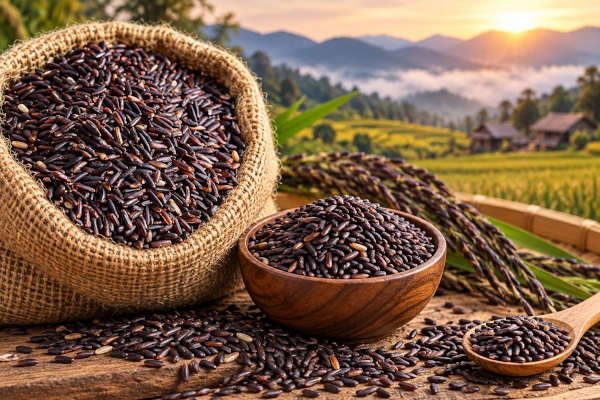
In the fertile valleys and hill landscapes of Northeast India grows Chak-Hao, an indigenous aromatic black rice celebrated for its deep purple colour, distinctive fragrance and traditional culinary importance. Closely associated with Manipur’s agricultural heritage, this remarkable rice variety also has a geographical connection with neighbouring Nagaland, as recognised under India’s Geographical Indications framework.
Chak-Hao is unlike ordinary white rice. Its uncooked grains possess a dark purple-black appearance, while cooking transforms them into a rich purple colour. The rice develops a characteristic aroma, a mildly nutty flavour and a soft, sticky texture that makes it particularly suitable for traditional desserts and ceremonial preparations.
For generations, farming communities have preserved Chak-Hao through traditional cultivation and seed selection. Its significance extends beyond agriculture because it forms part of Manipur’s culinary identity, particularly among the Meitei community, where black rice preparations occupy an important place in ceremonial feasts and family celebrations.
Chak-Hao received Geographical Indication registration on April 20, 2020, formally recognising its geographical association with Manipur and Nagaland. The recognition has strengthened the identity of this indigenous grain and created opportunities for farmers to participate in the growing market for speciality rice.
GI Details at a Glance
- Geographical Indication: Chak-Hao
- State: Manipur and Nagaland
- Product: Agricultural
- Class: 30
- Application Number: 602
- Date of Filing: 26 December 2017
- GI Journal: 126
- Journal Availability Date: 29 November 2019
- Certificate Number: 364
- GI Certificate Date: 20 April 2020
- Registered Proprietor: Consortium of Producers of Chak-Hao (Black Rice), Manipur
- Registered Proprietor’s Address: Office of the Nodal Officer, MOVCDNER Agri, Directorate of Agriculture, Sanjenthong, Imphal, Manipur – 795001
- Geographical Area: India (Manipur and Nagaland)
- Registration Valid Until: 25 December 2027
The official Geographical Indications Registry identifies both Manipur and Nagaland within Chak-Hao’s registered geographical area. Although the rice is most prominently associated with Manipur, its GI protection is not restricted to that state.
Origins and History of Chak-Hao Black Rice
Chak-Hao belongs to Northeast India’s longstanding tradition of cultivating indigenous rice varieties adapted to local agricultural conditions. Historical accounts and official agricultural documentation describe black aromatic rice as a crop cultivated in Manipur for centuries.
The precise period when Chak-Hao first entered cultivation remains uncertain. However, its continued presence in traditional food practices, ceremonial occasions and regional farming systems reflects a deeply established agricultural heritage.
In the Manipuri language, chak refers to rice or cooked rice, while hao is associated with its aromatic quality. The name has become closely identified with the dark-coloured scented rice varieties cultivated in the region.
Chak-Hao is particularly important in Meitei food traditions. Families have long prepared black rice dishes during religious ceremonies, community feasts and festive gatherings, preserving a connection between agricultural production and cultural identity.
Traditional farmers maintained the crop through successive generations by selecting and saving seeds from their harvests. This practice helped preserve the variety’s characteristic colour, fragrance and cooking properties long before modern commercial seed systems became widespread.
Unlike introduced speciality rice varieties, Chak-Hao represents a locally maintained agricultural resource closely connected with the communities that cultivated it.
The Geography and Climate Behind Chak-Hao Rice
The cultivation of Chak-Hao is closely associated with Manipur’s valleys and surrounding agricultural landscapes. Official state publications identify Imphal East, Imphal West, Bishnupur and Thoubal among the important traditional production areas.
The region experiences a monsoon-influenced climate, with seasonal rainfall supporting paddy cultivation. Its valleys provide agricultural land where farmers have maintained numerous indigenous rice varieties adapted to local conditions.
Chak-Hao also has a recognised geographical association with Nagaland, particularly areas adjoining Manipur. The registered GI geographical area encompasses both states, acknowledging the crop’s wider regional cultivation.
The combination of local growing conditions, traditional seed material and established farming practices contributes to Chak-Hao’s agricultural identity.
Manipur’s rice biodiversity includes varieties differing in grain colour, aroma, texture, maturity and adaptation to particular fields. Chak-Hao occupies a distinctive position within this diversity because of its pigmented grains and fragrant, sticky cooking characteristics.
The geographical recognition reflects the relationship between the rice, the landscapes where it has been maintained and the farming communities responsible for its preservation.
What Makes Chak-Hao Black Rice Unique?
Chak-Hao is distinguished by its natural pigmentation, aromatic quality and glutinous cooking texture.
The uncooked grains range from deep purple to almost black. During cooking, the natural pigments colour the surrounding water and give the prepared rice a distinctive dark-purple appearance.
Its colour comes primarily from anthocyanins, a group of naturally occurring plant pigments belonging to the flavonoid family. These compounds are also responsible for the red, blue and purple colours found in many fruits and vegetables.
Chak-Hao is also valued for its pleasant aroma and mildly nutty flavour. The Manipur Organic Mission Agency identifies the combination of fragrance and stickiness as an important characteristic distinguishing the region’s black aromatic rice from many other black rice varieties.
The cooked grains develop a soft, cohesive texture because of their starch composition. Rice varieties with a higher proportion of amylopectin tend to become stickier when cooked than varieties containing greater amounts of amylose.
Despite being described as glutinous rice, Chak-Hao does not naturally contain gluten. In rice terminology, glutinous refers to its sticky cooking properties rather than the presence of wheat-like gluten proteins.
These qualities make Chak-Hao suitable for dishes requiring a rich colour, pronounced aroma and cohesive texture.
Traditional Varieties of Chak-Hao Rice
Manipur maintains several traditional forms of black and coloured aromatic rice. Among the best documented are Chak-Hao Amubi and Chak-Hao Poireiton, both recognised in official agricultural publications.
Chak-Hao Amubi is known for its dark pigmentation, fragrance and sticky texture. It remains an important traditional variety used in domestic cooking and speciality food preparations.
Chak-Hao Poireiton is another prominent aromatic black rice variety. It is valued for its grain characteristics, distinctive flavour and suitability for traditional desserts.
The Manipur Organic Mission Agency identifies both varieties in its agricultural product catalogue, highlighting differences in their nutritional composition while recognising their common regional heritage.
Maintaining these varieties is important because replacing traditional seed populations with a narrow range of commercially preferred cultivars could reduce the diversity of Chak-Hao available to farmers and consumers.
The preservation of multiple local varieties also provides valuable genetic material for agricultural research and future crop improvement.
Traditional Cultivation and Seed Conservation
Chak-Hao cultivation reflects the agricultural knowledge developed by generations of farmers in Manipur and adjoining areas.
Farmers traditionally grow the crop during the seasonal paddy cultivation cycle, using locally adapted seed material and established field-management practices. Water availability, soil preparation and the selection of healthy seeds influence crop establishment and grain development.
Seed conservation plays an important role in maintaining the identity of traditional Chak-Hao varieties. Farmers preserve suitable grains from previous harvests for planting in subsequent seasons, helping retain the characteristic pigmentation, aroma and cooking qualities associated with the crop.
Organic cultivation has also become an important part of Chak-Hao’s commercial development. The Manipur Organic Mission Agency promotes black aromatic rice within its wider efforts to support organic agriculture, farmer organisations and speciality agricultural products.
However, traditional cultivation and certified organic production are not interchangeable. Formal organic certification requires compliance with prescribed standards and appropriate verification.
The continuation of farmer-managed seed systems remains central to conserving Chak-Hao as a living agricultural resource rather than merely a commercial product.
Chak-Hao in the Traditional Cuisine of Manipur
Chak-Hao occupies a special place in Manipuri cuisine, where it is associated with ceremonial meals, religious occasions and family celebrations. Its characteristic fragrance, deep colour and sticky texture make it particularly suitable for sweet preparations.
One of its best-known culinary applications is Chak-Hao Kheer, a traditional black rice pudding prepared with milk and sweetening ingredients. As the grains cook, their purple pigments spread through the milk, producing a distinctive lavender-to-deep-purple colour. The rice gradually softens while retaining a pleasantly chewy texture.
The dish is commonly served during festive occasions and ceremonial gatherings, particularly within the Meitei community. Its association with such occasions has helped preserve Chak-Hao’s cultural significance across generations.
Beyond kheer, black rice can be used in steamed rice preparations, traditional sweets, rice flour products and contemporary dishes. Its colour and flavour have also encouraged experimentation with bread, cakes, noodles and other value-added foods.
These applications demonstrate how an indigenous grain can retain its place in traditional cuisine while finding new uses in modern food processing.
Nutritional Properties and Natural Anthocyanin Pigments
Chak-Hao has attracted scientific interest because of its natural pigmentation and nutritional composition.
The grain contains anthocyanins, plant compounds responsible for its dark-purple colour. These pigments possess antioxidant activity in laboratory studies and form an important part of research into coloured rice varieties.
The Manipur Organic Mission Agency identifies Chak-Hao as a source of dietary fibre, protein, minerals and naturally occurring plant pigments. Its official product catalogue provides nutritional information for the Amubi and Poireiton varieties, demonstrating differences in their composition.
The grain’s outer layers contribute to its colour and fibre content. Consequently, polishing and processing methods can influence the nutritional properties of the final product.
However, the presence of anthocyanins does not establish that eating Chak-Hao can prevent or treat cancer, diabetes or cardiovascular disease. Although laboratory research has identified potentially beneficial biological activities, reliable human clinical evidence is required to establish specific disease-related benefits.
Chak-Hao is best understood as a distinctive whole-grain food that can contribute dietary variety and nutrients as part of a balanced diet.
Geographical Indication Recognition in 2020
Chak-Hao obtained Geographical Indication registration under the Geographical Indications of Goods (Registration and Protection) Act, 1999.
The Consortium of Producers of Chak-Hao (Black Rice), Manipur, filed the application on December 26, 2017. The Geographical Indications Registry published the application in Journal Number 126 on November 29, 2019, before granting registration on April 20, 2020.
The registration formally recognises Chak-Hao’s association with its defined geographical area covering Manipur and Nagaland.
GI protection provides a legal framework for safeguarding the product’s geographical identity. It helps distinguish rice originating from the recognised region and meeting the relevant specifications from unrelated products using the same geographical designation.
The protection is particularly important as speciality rice products gain wider commercial attention. Maintaining authenticity, traceability and quality helps protect consumer confidence and the reputation developed by traditional farming communities.
The registration also acknowledges the agricultural knowledge that has preserved Chak-Hao’s distinctive characteristics through successive generations.
Agricultural Research and the Development of Improved Black Rice Varieties
Scientific research has begun addressing some of the limitations affecting traditional Chak-Hao cultivation.
Indigenous black rice varieties can produce lower yields than modern commercial rice cultivars. Their relatively tall plants may also be susceptible to lodging, a condition in which stems bend or fall before harvest, making crop management and harvesting more difficult.
Researchers at the ICAR Research Complex for the North Eastern Hill Region, Manipur Centre, developed RC Manichakhao-1, an improved high-yielding black rice variety intended to address these challenges.
The variety received approval for release in Manipur on May 23, 2024, and was formally launched on June 7, 2025.
According to the Ministry of Agriculture and Farmers Welfare, RC Manichakhao-1 is a semi-dwarf variety capable of producing approximately 4.5–5.0 tonnes per hectare, compared with traditional Chak-Hao landraces that generally yield less than 2 tonnes per hectare.
The improved variety also offers favourable cooking characteristics and higher anthocyanin content, according to ICAR’s research findings.
This development represents an important effort to combine indigenous crop characteristics with modern agricultural breeding.
However, the commercial release of an improved black rice variety does not automatically establish its eligibility for sale under the Chak-Hao GI designation. GI compliance depends on the applicable registered product specifications and geographical requirements.
Research into the Genetics of Chak-Hao Rice
Chak-Hao has also become the subject of advanced research examining the genetic mechanisms responsible for its distinctive pigmentation and agricultural characteristics.
The Institute of Bioresources and Sustainable Development in Imphal has undertaken research on microRNAs associated with Chak-Hao, focusing on the regulation of plant development and anthocyanin accumulation.
MicroRNAs are small RNA molecules that help regulate gene expression. In plants, they influence several biological processes, including growth, development and responses to environmental conditions.
The research project, supported through India’s science funding framework, aims to improve scientific understanding of the mechanisms that regulate Chak-Hao’s distinctive colour and other important traits.
Such work could contribute to future crop improvement programmes seeking to enhance productivity while preserving valued characteristics of traditional black rice.
It also demonstrates how indigenous agricultural biodiversity can support modern research in plant genetics, biotechnology and crop breeding.
Chak-Hao’s Growing Presence in International Markets
Geographical Indication recognition has helped increase awareness of Chak-Hao beyond its traditional growing region.
The Agricultural and Processed Food Products Export Development Authority (APEDA) has included Chak-Hao among the distinctive agricultural products promoted from Northeast India.
In March 2022, the Ministry of Commerce and Industry reported that black rice from Manipur and Assam had been exported to the United Kingdom during 2021. APEDA also identified Chak-Hao among the products promoted through buyer-seller meetings and agricultural export development initiatives.
The rice’s unusual colour, fragrance and traditional identity make it attractive to speciality food markets interested in distinctive regional agricultural products.
Value addition offers further commercial possibilities. Carefully processed black rice flour, packaged whole grains and traditional food preparations can help farmers and producer organisations reach consumers beyond local markets.
Nevertheless, sustained commercial growth requires reliable production, quality testing, traceability, appropriate storage and effective marketing. These measures are particularly important for maintaining the reputation of a GI-recognised product.
Farmers and Institutions Supporting Chak-Hao Conservation
The continued cultivation of Chak-Hao depends on the farmers who preserve its seed material and maintain its traditional agricultural characteristics.
Farmer organisations and agricultural institutions can support this work through seed conservation, crop improvement, training and access to suitable marketing channels.
The Manipur Organic Mission Agency has promoted black aromatic rice as part of the state’s speciality agricultural production. Its product documentation highlights both the commercial potential and distinctive qualities of local Chak-Hao varieties.
APEDA has also organised capacity-building programmes and buyer-seller interactions involving northeastern agricultural products, including black rice.
These initiatives connect traditional farming communities with agricultural research, market development and opportunities for value addition.
Conservation remains essential because indigenous rice varieties may lose cultivation area when farmers shift towards higher-yielding commercial crops. Maintaining traditional seed populations preserves agricultural genetic diversity and the knowledge associated with their cultivation.
Preserving Chak-Hao for Future Generations
Chak-Hao represents an important component of Northeast India’s agricultural biodiversity. Its long association with Manipuri food traditions and its cultivation within the registered geographical region of Manipur and Nagaland make it a distinctive heritage crop.
Protecting this resource requires continued cultivation, careful seed conservation and documentation of traditional varieties.
Agricultural research can strengthen these efforts by identifying methods that improve productivity without compromising the qualities responsible for the rice’s reputation.
The development of improved black rice varieties demonstrates the opportunities emerging from cooperation between traditional farmers and scientific institutions. At the same time, preserving original landraces remains important for maintaining the genetic resources needed for future agricultural research.
Greater consumer awareness, authentic GI labelling and access to speciality markets can encourage farmers to continue growing Chak-Hao while preserving its connection with the region’s agricultural traditions.
Chak-Hao Black Rice: A Living Heritage of Northeast India
Chak-Hao is more than an unusually coloured rice. Its deep-purple grains, distinctive fragrance and traditional culinary applications embody generations of agricultural knowledge preserved by the farming communities of Northeast India.
The GI recognition granted in 2020 acknowledges its geographical identity and provides a foundation for protecting the reputation of this regional speciality. Scientific research, improved cultivation practices and growing interest in traditional grains are creating new opportunities for its development.
Chak-Hao also illustrates the wider importance of India’s indigenous rice diversity. Each traditional variety preserves characteristics shaped by local environments, farming knowledge and culinary preferences.
With continued conservation, responsible crop improvement and stronger market access, Chak-Hao can reach wider audiences while retaining its agricultural and cultural roots in Manipur and Nagaland. Its preservation strengthens India’s food heritage and contributes to a more diverse and resilient agricultural future.
References
- Geographical Indications Registry, Intellectual Property India — Chak-Hao, Application No. 602. Official registration details, applicant, geographical area, journal publication, certificate number and validity.
https://search.ipindia.gov.in/GIRPublicSearch/Application/Details/602 - Manipur Organic Mission Agency — Black Aromatic Rice (Chak-Hao). Official description of the rice’s appearance, fragrance, nutritional characteristics and commercial potential.
https://momamanipur.mn.gov.in/chak-chao/ - Manipur Organic Mission Agency — Product Catalogue 2025. Information on Chak-Hao Amubi and Chak-Hao Poireiton, including nutritional composition.
https://momamanipur.mn.gov.in/wp-content/uploads/2025/10/Product-Catalogue-2025.pdf - MyGov India — GI-Tagged Agricultural Products of Manipur. Government information on Chak-Hao’s traditional cultivation, varieties and distinctive characteristics.
https://blog.mygov.in/gi-tagged-agricultural-products-of-manipur/ - Ministry of Agriculture and Farmers Welfare — Manipur Unveils First High-Yielding Black Rice Variety: RC Manichakhao-1, June 7, 2025. Official announcement of the improved rice variety and its agricultural performance.
https://www.pib.gov.in/PressReleasePage.aspx?PRID=2134934 - India Science, Technology & Innovation Portal — Characterization and Expression Profiling of miRNAs in Chakhao. Government research project examining molecular mechanisms associated with black rice pigmentation.
https://www.indiascienceandtechnology.gov.in/research/characterization-and-expression-profiling-mirnas-chakhao-black-scented-rice-manipur - Ministry of Commerce and Industry — Centre Focuses on Promoting Exports of GI-Tagged Niche Agricultural Products, March 2022. Official information on exports of black rice and APEDA’s promotional initiatives.
https://www.pib.gov.in/Pressreleaseshare.aspx?PRID=1806816 - Directorate of Information and Public Relations, Government of Manipur — Manipur Today, September 2022. Government publication covering Chak-Hao’s traditional uses, cultivation areas and varietal characteristics.
https://dipr.mn.gov.in/NewsFiles/CE_19Oct22_1002_Text%208%20by%2011%20September%202022_Compressed.pdf
You may also like
-
PM Modi to Inaugurate RBI’s Tier IV Data Centre and Cybersecurity Training Institute in Bhubaneswar
-
India Creates 11 Crore Digital Farmer IDs Five Months Ahead of Target, Strengthening AgriStack Infrastructure
-
Oil India Discovers Natural Gas in Krishna-Godavari Basin, Records Peak Flow of 2 Lakh Cubic Metres Per Day
-
India’s Business Confidence Index Rebounds to 107.8 as Industry Sentiment Improves in Q2 FY 2026–27
-
India Targets Indigenous Mobile Phone Brands by 2028 with Focus on Indian Design, Technology and Manufacturing
