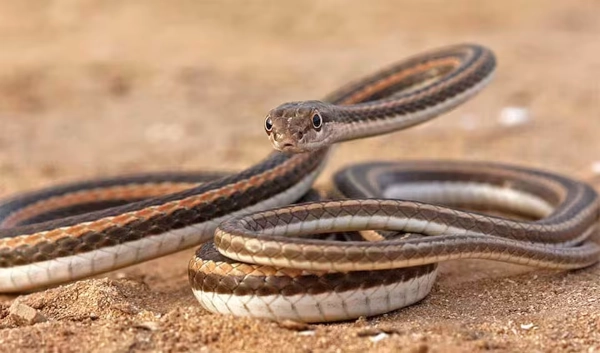
A routine forest patrol in Gujarat’s Kutch district has produced an extraordinary wildlife record, with an Afro-Asian sand snake, also known as the Schokari Sand Racer, photographed near Kala Dungar more than 150 years after the species was last conclusively documented in the region.
The snake, identified as Psammophis schokari, was encountered by Range Forest Officer Jayesh Dumadiya of the Gujarat Forest Department during a patrol near the Kala Dungar area. Photographs and video taken at the site were later examined by experts, who confirmed the identity of the species.
Sighting Reconnects Kutch With an 1872 Wildlife Record
The importance of the discovery lies in the age of the previous confirmed record.
The species was documented in Kutch in 1872 by naturalist Ferdinand Stoliczka during his surveys of the region. Although there have been possible sightings in the decades since, forest officials said none had been conclusively confirmed until the latest encounter.
The new observation therefore reconnects a 19th-century herpetological record with the modern biodiversity of Kutch and provides fresh evidence that the species continues to survive in the region’s arid landscape.
Snake Was Found During Routine Patrol
The encounter occurred during an evening forest patrol near Kala Dungar.
According to published accounts based on Gujarat Forest Department information, the patrol team initially encountered a Black-headed Royal Snake before noticing another unfamiliar snake on the road. Dumadiya photographed and filmed the second reptile before forwarding the material for expert identification.
The identification was subsequently confirmed as the Afro-Asian sand snake, a slender and fast-moving species adapted to dry environments.
Afro-Asian Sand Snake Is Adapted to Arid Habitats
Psammophis schokari occurs across dry and semi-arid landscapes extending from parts of India through West Asia and into North and East Africa.
Within India, the species is known mainly from Rajasthan and Gujarat, but sightings are uncommon. It is a lightly built, rapidly moving snake that typically preys on small animals, including lizards and rodents.
The species possesses mild venom associated with prey capture but is generally regarded as presenting little danger to humans.
Kutch’s Dry Landscape Supports Rich Biodiversity
Kutch is often perceived primarily as a dry and sparsely vegetated landscape, but its deserts, scrublands, rocky terrain and seasonal wetlands support a wide range of wildlife.
The region is home to specialised reptiles, desert-adapted mammals, migratory birds and several species associated with arid ecosystems.
The rediscovery of the Afro-Asian sand snake reinforces the ecological importance of these habitats and suggests that parts of Kutch remain under-documented from a biodiversity perspective.
Forest Officials Plan Further Scientific Documentation
Forest authorities have indicated that the sighting will be documented further and may be submitted for scientific publication.
Such documentation is important because confirmed locality records help researchers understand a species’ distribution, habitat use and persistence over time.
A modern record can also help determine whether the snake is confined to a small part of Kutch or survives more widely across suitable habitat in the region.
Rediscovery Highlights Value of Routine Field Observation
The sighting also demonstrates the value of regular forest patrols beyond enforcement and habitat protection.
Field officers often encounter species in places that have received limited scientific attention, and careful photographic documentation can turn an incidental observation into an important biodiversity record.
In this case, a routine patrol produced evidence linking present-day Kutch with a species first documented there more than a century and a half ago.
A Significant Record for Gujarat’s Reptile Diversity
The confirmed presence of the Afro-Asian sand snake after such a long interval adds an important chapter to Gujarat’s natural history.
Rather than representing the discovery of a new species, the finding confirms the continued survival of a historically recorded reptile in a landscape where its presence had remained uncertain for generations.
The record strengthens the case for continued reptile surveys and systematic biodiversity documentation across Kutch, where specialised wildlife continues to survive in habitats that remain comparatively underexplored.
References
Gujarat Forest Department — Field documentation and official acknowledgement of the Afro-Asian sand snake sighting near Kala Dungar, Kutch, September 2026.
Dheeraj Mittal, IFS — Official public communication regarding the Kutch record of Psammophis schokari, September 19, 2026.
Indian Express — “In Kutch, a forest officer finds a snake species last. seen 150 years ago,” September 30, 2026.
https://indianexpress.com/article/cities/ahmedabad/kutch-afro-asian-sand-snake-sighting-gujarat-wildlife-10899757
Reptiles of India, Indian Foundation for Butterflies — Psammophis shokari species information.
https://www.indianreptiles.org/Psammophis-shokari
Image courtesy: biodb.com
You may also like
-
Indravati Tiger Reserve to Reopen for Wildlife Safaris After Four Decades
-
Tiny 3.3-mm Parasitic Wasp Discovered in Assam Marks First Record of Its Genus in India
-
How India Brought the Greater One-Horned Rhinoceros Back From the Brink
-
From Periyar to Thuruthi, New Surveys Reveal the Remarkable Diversity of Kerala’s Dragonflies, Birds and Butterflies
-
Delhi Biodiversity Survey Records Two Dragonfly and Damselfly Species for the First Time
