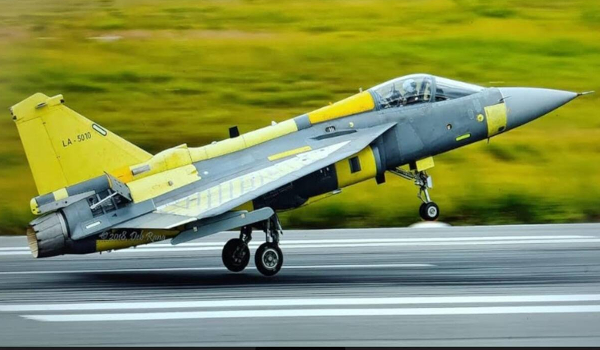
India’s Tejas Mk1A programme is approaching one of its most important milestones, with the Indian Air Force indicating that the first aircraft could be inducted within the coming months once the remaining technical points are demonstrated. The immediate focus has shifted from airframe production and engine availability to the final proving of radar, weapons and associated software integration before the fighter is formally taken on charge.
The development marks a decisive phase for the Light Combat Aircraft programme. Hindustan Aeronautics Limited has already built a substantial number of Tejas Mk1A airframes, while the supply of GE Aerospace F404-IN20 engines has improved compared with the earlier period of disruption. The remaining work is therefore increasingly concentrated on validating the combat configuration that the IAF expects before accepting the aircraft into operational service.
IAF Says Only a Few Technical Points Remain
Vice Chief of the Air Staff Air Marshal Ashutosh Dixit said in September 2026 that the Tejas Mk1A could be inducted within approximately one or two months, subject to completion of the remaining technical demonstrations. He indicated that only two or three points still had to be proven before the aircraft could be formally inducted.
The statement is important because it reflects the IAF’s own assessment of the programme rather than simply a production forecast from HAL. The Air Force has been closely involved in testing and acceptance of the aircraft and has maintained that the Mk1A must enter service with the required operational capabilities demonstrated.
Earlier delays were heavily influenced by the availability of F404 engines. With additional engines now received and installed in aircraft, attention has moved towards completing the systems-validation programme and establishing a configuration suitable for delivery.
Radar Integration Moves Into Final Stage
One of the principal areas under validation is the Tejas Mk1A’s Active Electronically Scanned Array radar installation and associated mission software. HAL Chairman and Managing Director Ravi K said in September that radar-related corrections were among the final issues being addressed before deliveries could begin.
An AESA radar gives the Mk1A a major capability improvement over the original Tejas Mk1 configuration. It provides faster electronic beam steering, improved target tracking, greater resistance to electronic interference and the ability to manage multiple airborne targets simultaneously.
However, integrating an advanced radar into a combat aircraft involves substantially more than installing the hardware. The radar must work correctly with the aircraft’s mission computer, cockpit displays, navigation systems, electronic warfare suite, weapons-management system and data architecture.
Flight testing is therefore required across different altitudes, speeds, manoeuvres and engagement conditions before the complete system can be accepted for operational use.
Missile and Weapons Integration Remains Crucial
The other major requirement is completion of weapons integration and associated firing trials. HAL has said that final weapons-integration testing remains part of the work required before the first Mk1A aircraft are delivered.
The Tejas Mk1A is intended to operate a wider and more advanced weapons package than the original Mk1. Beyond-visual-range air-to-air capability is especially important because modern fighter combat increasingly depends on detecting, tracking and engaging hostile aircraft before visual contact occurs.
India has already demonstrated the Astra Mk1 beyond-visual-range air-to-air missile from the Tejas platform. In March 2025, the missile was successfully launched from a Tejas aircraft off the Odisha coast and achieved a direct hit against an airborne target at a range exceeding 100 kilometres.
For the Mk1A, the significance lies in fully integrating the missile with the fighter’s radar, fire-control software and mission-management systems. Radar detection, target tracking, missile cueing, launch parameters and post-launch guidance must operate together as a single combat system.
Software Has Become as Important as Hardware
The remaining Tejas Mk1A work also highlights how modern combat aircraft have become increasingly software-defined platforms. Radar performance, electronic warfare functions, weapons management and cockpit information are controlled by interconnected software systems.
Changes introduced during flight testing can therefore require new software builds followed by further verification. Even when the aircraft, engine, radar and missile individually perform correctly, their combined behaviour must be demonstrated before operational acceptance.
This explains why completed airframes do not automatically translate into deliverable fighters. The aircraft must first reach the contracted configuration and demonstrate that its major combat systems operate together reliably.
HAL Has Already Built 27 Mk1A Airframes
HAL disclosed in September that 27 Tejas Mk1A airframes had already been produced out of the larger requirement placed by the Indian Air Force. Production has continued even while the final integration work proceeds.
This approach allows aircraft to move comparatively quickly towards delivery once engines are installed and the required software and systems configuration has been cleared. HAL has also expanded Tejas manufacturing beyond its Bengaluru facilities, including the development of additional production capacity at Nashik.
India’s private aerospace industry is becoming increasingly involved in this production network. Major aircraft structures and assemblies are being manufactured by private companies before being supplied to HAL for final integration.
The Ministry of Defence highlighted this transition in May 2025 when VEM Technologies handed over the first privately manufactured centre fuselage assembly for the Tejas Mk1A to HAL. The move represented an important step towards distributing aircraft production across a broader domestic industrial base.
Mk1A Represents a Major Step Beyond the Original Tejas
The Tejas Mk1A retains the fundamental aerodynamic design of the Tejas Mk1 but incorporates extensive improvements intended to increase combat capability and maintainability.
The new configuration includes an AESA radar, electronic warfare improvements, beyond-visual-range missile capability, air-to-air refuelling and significant changes to avionics and aircraft systems. Maintainability improvements are also intended to increase availability and reduce turnaround time between missions.
These changes make the Mk1A more than a simple production refinement. It represents the transition of the Tejas programme towards a more networked and electronically capable fighter designed for contemporary air-combat requirements.
Original Tejas Mk1 Order Now Complete
The Mk1A programme is progressing as HAL completes the original generation of the Tejas programme.
On 18 September 2026, HAL handed over the final two Tejas Final Operational Clearance twin-seat trainers to the Indian Air Force in Bengaluru. Their delivery completed the original Tejas Mk1 order placed in two stages by the government.
The same ceremony also included the handover of the first HTT-40 basic trainer aircraft to the IAF and four Dhruv Next Generation helicopters to Pawan Hans.
Completion of the Mk1 production commitment allows greater industrial attention to move towards the much larger Mk1A programme.
IAF Has Ordered 180 Tejas Mk1A Aircraft
The scale of the Mk1A programme is considerably larger than that of the original Tejas fleet.
The first major contract covers 83 aircraft, including 73 fighters and 10 trainers. A subsequent order increased the overall planned Mk1A fleet to 180 aircraft.
Such numbers make the programme central to the future structure of the Indian Air Force. Large-scale induction of the Tejas Mk1A will progressively expand the IAF’s indigenous fighter component while also establishing the manufacturing ecosystem needed for later combat-aircraft programmes.
The second production batch will also progressively incorporate additional indigenous systems, including Indian radar and electronic warfare technologies.
From Aircraft Production to Combat Capability
The Tejas Mk1A programme has now reached a stage where the central question is no longer whether aircraft can be manufactured. Airframes are already emerging from the production system, engine deliveries have resumed and additional manufacturing capacity has been established.
The decisive requirement is proving the complete combat configuration.
Radar performance, mission software, electronic warfare systems and missile integration must operate together reliably before the aircraft enters frontline service. The remaining testing therefore represents the final transition from a manufactured fighter aircraft to an operational weapons system.
With the IAF publicly indicating that only a small number of technical points remain and HAL continuing production of aircraft in parallel, the Tejas Mk1A is moving closer to formal induction. Its arrival will open the next major chapter of India’s indigenous fighter programme and significantly expand the role of domestically produced combat aircraft within the Indian Air Force.
References
Press Information Bureau, Ministry of Defence — First Centre Fuselage for LCA Tejas Mk1A Handed Over to HAL, 30 May 2025
https://www.pib.gov.in/PressReleasePage.aspx?PRID=2132890
Akashvani News — HAL Hands Over Tejas Twin-Seater, HTT-40 Trainer Aircraft to Indian Air Force, 18 September 2026
https://newsonair.gov.in/hal-hands-over-tejas-twin-seater-htt-40-trainer-aircraft-to-indian-air-force/
The New Indian Express — Tejas Mk1A Induction Likely in a Month or Two: IAF Vice Chief Air Marshal Dixit, 22 September 2026
https://www.newindianexpress.com/india/2026/Sep/22/tejas-mk-1a-induction-likely-in-a-month-or-two-iaf-vice-chief-air-marshal-dixit
The Week — LCA Tejas Mk1A Fighter Jets Almost Ready, but Final Radar and Weapons Integration Work Remains, 18 September 2026
https://www.theweek.in/news/defence/2026/09/18/lca-tejas-mk1a-fighter-jets-almost-ready-but-these-two-key-issues-must-be-fixed-before-iaf-delivery.html
You may also like
-
BHEL Awards ₹480.73 Crore Cryogenic Air Separation Unit Contract for Odisha Coal-to-Ammonium Nitrate Project
-
From Kaveri Dry Engine to IAF Fighter Powerplant: What India Must Achieve Next
-
Indian Navy Targets Historic Induction of 18 Warships in 2026
-
TakeMe2Space to Launch India’s First Orbital Computing Satellite MOI-1A on October 1, 2026
-
CSIR-CGCRI and DRDO Advance Lightweight Bullet-Resistant Glass-Ceramic Armour for Military Platforms
