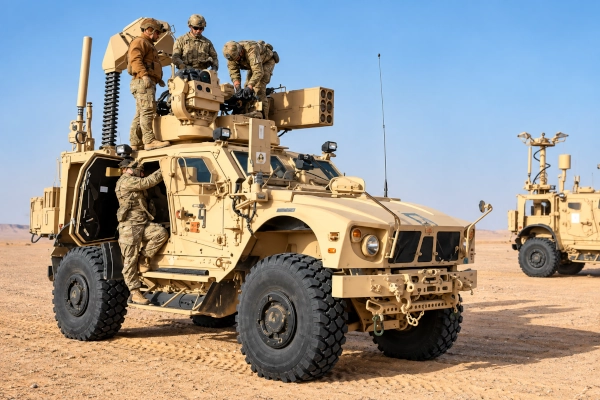
The US Army has deployed its Mobile Low, Slow, Small Unmanned Aircraft Integrated Defeat System, or M-LIDS, at the Mahajan Field Firing Range in Rajasthan during Exercise Yudh Abhyas 2026, giving Indian Army personnel direct exposure to one of the United States’ principal mobile counter-drone systems. Official US Army imagery released from Mahajan shows M-LIDS operating during the bilateral exercise, while Indian and American troops trained together to detect, track and counter simulated unmanned-aircraft threats.
The deployment forms part of the 22nd edition of Yudh Abhyas, being conducted simultaneously at Auli in Uttarakhand and Mahajan in Rajasthan. Approximately 600 personnel from each army are participating in training that combines mountain warfare, integrated battle-group operations, drones, counter-UAS systems, precision fires and other emerging battlefield technologies.
M-LIDS Enters the Mahajan Training Environment
The US Army had confirmed before the exercise that M-LIDS would participate in live-fire activities at Mahajan alongside HIMARS and Stinger systems. Subsequent official photographs and video released by the US military showed the counter-UAS system positioned at the Rajasthan range during training on 22 September.
Preparations for the demonstration had begun several days earlier. On 17 September, Indian and American soldiers conducted target-drone test flights at Mahajan to validate the aerial targets that would subsequently be used during M-LIDS training.
The sequence allowed both armies to move from target preparation and familiarisation into an integrated counter-drone scenario rather than treating M-LIDS merely as a static equipment display.
A Layered Response to Drone Attacks and Swarms
The Mahajan phase demonstrated M-LIDS as part of a much larger battlefield network. US Army footage shows Indian and American personnel identifying and plotting targets, sharing targeting information and relaying fire commands during scenarios involving simulated drone attacks and swarms.
The exercise integrated M-LIDS with Indian systems including Pinaka multi-barrel rocket launchers, Dhanush and M777 howitzers and L/70 air-defence guns. The objective was to connect surveillance, targeting, fire support and counter-UAS capabilities into a coordinated response rather than operate each weapon independently.
This is increasingly important as small unmanned aircraft become capable of reconnaissance, target acquisition, precision attack and massed swarm operations. Defending against them requires more than a single gun or jammer; it requires sensors, command-and-control networks and several different methods of defeating the threat.
What M-LIDS Is Designed to Do
M-LIDS was developed to give mobile US Army formations the ability to detect, identify, track and defeat low-flying small unmanned aircraft while retaining the mobility needed to accompany ground forces.
The broader LIDS family uses multiple sensor and engagement technologies. Radar provides initial detection and tracking, electro-optical and infrared equipment assists identification, electronic-warfare systems can interfere with hostile drones, and kinetic weapons can physically destroy aircraft that continue towards the defended area.
This combination allows operators to select an appropriate response according to the nature of the threat rather than relying on one method against every drone.
Radar Finds the Threat First
Detection represents the first layer of the M-LIDS engagement process. The system employs radar technology capable of locating relatively small and slow-moving aerial targets that can be difficult for conventional air-defence sensors to distinguish.
US Army documentation for the latest M-LIDS architecture describes a high-fidelity Ku-band fire-control radar capable of tracking large numbers of targets. Sensor information is fed into the wider command-and-control architecture so that operators can establish an air picture and determine which contacts represent threats.
The ability to track numerous targets has become increasingly important as militaries prepare for scenarios involving multiple drones approaching simultaneously rather than individual unmanned aircraft.
Electronic Warfare Provides a Non-Kinetic Option
Not every drone needs to be destroyed with ammunition. M-LIDS incorporates electronic-warfare capability intended to disrupt the communications or navigation links used by hostile unmanned aircraft.
Electronic attack can provide a comparatively economical method of countering drones that depend on radio-frequency command links or satellite navigation. Depending on the target and its level of autonomy, disrupting these links can force the aircraft to lose control, abort its mission or become ineffective.
The presence of both electronic and kinetic options is central to the layered concept behind M-LIDS. Operators can use different defeat mechanisms depending on the target, operational circumstances and available resources.
30 mm Cannon Provides Close-Range Kinetic Defence
One of M-LIDS’ most visible weapons is the 30 mm cannon integrated into the mobile system. The US Army has used the XM914 30×113 mm chain gun as an anti-drone weapon, giving crews a rapid kinetic means of engaging unmanned aircraft that penetrate the outer defensive layers.
The weapon can employ ammunition designed specifically to improve effectiveness against aerial targets. Proximity-fuzed rounds are especially useful because they do not necessarily require a direct physical impact with a small and manoeuvring drone before producing a lethal effect.
This provides M-LIDS with an inner kinetic defensive layer that can engage targets at relatively close range without consuming a more expensive interceptor missile.
Coyote Interceptor Takes the Fight Farther Out
M-LIDS can also employ the Coyote interceptor, another important element of the US Army’s counter-UAS architecture. The Coyote is a ground-launched, radar-guided interceptor developed specifically to engage unmanned-aircraft threats.
US Army documentation identifies the Coyote as capable of integration with both fixed and mobile LIDS configurations. It provides a kinetic interception option against drones that need to be engaged before they reach the innermost gun-defence layer.
The US Army has expanded procurement of Coyote interceptors in response to the rapid growth of small-UAS threats, including ordering hundreds of additional interceptors to support operational counter-drone requirements.
M-LIDS Is Evolving Into a Single-Vehicle System
The M-LIDS architecture itself has continued to evolve. Earlier operational versions used two MRAP All-Terrain Vehicles to distribute sensors and weapons across separate platforms.
The US Army has subsequently developed the M-LIDS 2.1 single-vehicle configuration based on the Stryker platform. The newer architecture consolidates counter-UAS technologies onto one purpose-built vehicle while retaining radar, electronic warfare and kinetic engagement capabilities.
Official US Army documentation lists a Coyote kinetic interceptor, 30 mm and 7.62 mm direct-fire weapons, Ku-band fire-control radar and electronic-warfare capability within the latest configuration. The system is also integrated with the Army’s Forward Area Air Defense Command and Control network.
The official material released from Yudh Abhyas confirms M-LIDS deployment at Mahajan but does not identify the exercise appearance simply by the latest Stryker 2.1 designation. The relevant point for the exercise is the operational exposure Indian personnel received to the M-LIDS counter-UAS architecture.
Counter-Drone Warfare Has Become a Core Battlefield Requirement
The prominence given to M-LIDS during Yudh Abhyas reflects how dramatically the drone threat has changed modern land warfare. Small unmanned aircraft that were once used mainly for surveillance can now carry explosive payloads, direct artillery fire, perform one-way attacks and operate in coordinated groups.
Their relatively low cost creates an additional problem for conventional air defence. Using expensive surface-to-air missiles against every inexpensive quadcopter or one-way attack drone can rapidly become economically and operationally unsustainable.
Layered counter-UAS systems attempt to solve this problem by combining electronic warfare, guns and interceptors so that commanders can match the cost and capability of the defensive weapon to the threat being engaged.
Indian and US Systems Work Inside the Same Kill Chain
The Mahajan training was notable because counter-drone defence was not isolated from the rest of the exercise. Indian and American personnel worked together on the sequence extending from target identification and plotting to the transmission of firing information and engagement.
Pinaka, Dhanush, M777 and L/70 systems formed part of the wider training environment alongside M-LIDS. This brought offensive firepower, air defence and counter-drone capabilities into the same exercise architecture.
Such training is particularly relevant to modern battlefield operations because drones can serve both as threats and as sensors identifying targets for artillery. Countering the aircraft can therefore disrupt not only an individual drone mission but also an adversary’s wider reconnaissance and targeting network.
Mahajan Complements Counter-UAS Training at Auli
Yudh Abhyas 2026 has divided different aspects of training between two geographically distinct environments. Mahajan provides the open terrain and ranges necessary for major weapon demonstrations and live firing, while Auli supports mountain and high-altitude training.
Counter-UAS operations form part of both locations. At Auli, Indian and American soldiers have exchanged experience with drones and counter-drone equipment, while Mahajan has allowed the systems to be integrated into larger live-fire and battlefield scenarios.
The arrangement gives the two armies an opportunity to study how unmanned systems and their counters operate across very different terrain and operational conditions.
No Evidence of an Indian M-LIDS Acquisition
The presence of M-LIDS at Mahajan should not be interpreted as evidence that India has purchased or selected the American system.
The official announcements describe its deployment as part of Exercise Yudh Abhyas and the broader effort to improve interoperability between the Indian and US armies. The exercise gives Indian personnel an opportunity to observe and train alongside the system, but no acquisition decision has been announced in connection with its Mahajan deployment.
India is simultaneously developing and fielding its own counter-UAS technologies across the armed forces and defence industry. Exposure to foreign systems during bilateral exercises provides another means of examining different approaches to detection, electronic attack, kinetic interception and battlefield integration.
More Than a Counter-Drone Demonstration
The significance of M-LIDS at Mahajan lies less in the appearance of a single American weapon than in the operational concept demonstrated around it.
The system brings together radar, electro-optical sensing, electronic warfare, command and control, a 30 mm gun and specialised interceptors within a layered mobile defence architecture. Yudh Abhyas 2026 has allowed Indian and American troops to place that architecture within a battlefield environment containing artillery, rocket systems, air defence and simulated drone swarms.
As unmanned aircraft become increasingly embedded in reconnaissance and strike operations, counter-UAS systems are moving from specialised equipment to a fundamental component of battlefield protection. The Mahajan phase of Yudh Abhyas provides a close look at how the US Army is approaching that challenge and gives both armies an opportunity to integrate counter-drone tactics into the wider network of sensors, commanders and weapons that defines contemporary land warfare.
References
Press Information Bureau, Ministry of Defence — “India-US Joint Military Exercise Yudh Abhyas 2026 Commences at Auli and Mahajan,” 15 September 2026.
https://www.pib.gov.in/PressReleseDetailm.aspx?PRID=2310476
United States Army — “US, Indian Armies Open Exercise Yudh Abhyas 2026,” 17 September 2026.
https://www.army.mil/article/295425/us_indian_armies_open_exercise_yudh_abhyas_2026
US Department of Defense, Defense Visual Information Distribution Service — “U.S., Indian Army Soldiers conduct drone target test flights during Yudh Abhyas 2026,” Mahajan Field Firing Range, 17 September 2026.
https://www.dvidshub.net/image/9943999/us-indian-army-soldiers-conduct-drone-target-test-flights-during-yudh-abhyas-2026
US Department of Defense, Defense Visual Information Distribution Service — Official M-LIDS imagery from Mahajan Field Firing Range, 22 September 2026.
https://www.dvidshub.net/image/9956547/us-indian-army-soldiers-integrate-capabilities-during-yudh-abhyas-2026
US Department of Defense, Defense Visual Information Distribution Service — “U.S., Indian Army Soldiers integrate capabilities during Yudh Abhyas 2026,” official video, 22 September 2026.
https://www.dvidshub.net/video/1023916/us-indian-army-soldiers-integrate-capabilities-during-yudh-abhyas-2026
US Army Acquisition Support Center — “Innovation Draws International Interest,” description of LIDS and M-LIDS sensor, electronic-warfare, XM914 30 mm cannon and Coyote Block 2 capabilities.
https://asc.army.mil/web/news-innovation-draws-international-interest/
US Army, Program Executive Office Missiles and Space — M-LIDS Single Vehicle 2.1 official system description, including Coyote interceptor, 30 mm weapon, Ku-band fire-control radar, electronic warfare and FAAD C2 integration.
https://api.army.mil/e2/c/downloads/2025/05/21/71f75107/equipment-at-army-festival-parade.pdf
US Army — “Army announces rapid acquisition authority contract for Coyote Interceptors,” 9 February 2024.
https://www.army.mil/article/273625/army_announces_rapid_acquisition_authority_contract_for_coyote_interceptors
You may also like
-
WB Group Plans Indian Production of Warmate Loitering Munition as Localisation Push Expands
-
BEL Flags Off Indigenous 3D CAR Prime Radar, Strengthening India’s Air-Defence Surveillance Capability
-
Jupiter Defence Gets 256 Acres in Purulia for West Bengal’s First Major Defence Manufacturing Facility
-
Pinaka and HIMARS Take Centre Stage in India-US Integrated Firepower Drills at Mahajan
-
Draft DAP 2026 Puts Indigenous Design and Indian IPR at the Centre of Defence Procurement
