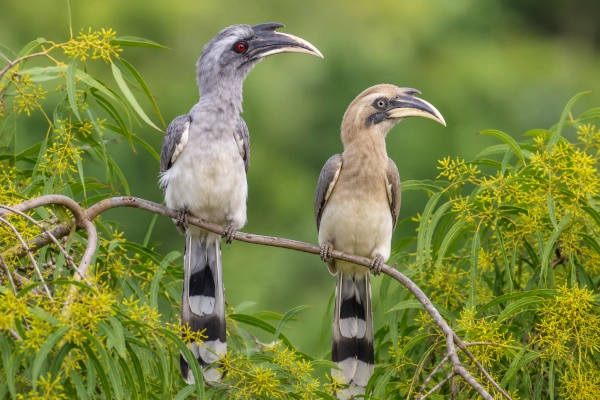
A significant conservation milestone has been achieved in Gujarat’s Gir landscape, where the Indian Grey Hornbill has successfully returned after nearly six decades of absence. The species, which had disappeared from Gir during the latter half of the 20th century, has now established itself through a carefully planned reintroduction programme and has successfully bred in the wild.
The recovery of the Indian Grey Hornbill adds a new chapter to Gir’s conservation history, which is internationally recognised for protecting the Asiatic lion. The successful return of the hornbill demonstrates how scientific interventions, habitat protection and long-term monitoring can help restore species that have disappeared from parts of their former range.
Bringing Back a Species Lost From Gir
The Indian Grey Hornbill (Ocyceros birostris) is a medium-sized hornbill species found across parts of the Indian subcontinent. Known for its distinctive curved bill and casque, the bird plays an important ecological role as a seed disperser, helping maintain forest regeneration and plant diversity.
The Gujarat Forest Department initiated a conservation programme to restore the species in the Gir ecosystem after recognising that suitable habitat conditions still existed within the landscape. Around 40 Indian Grey Hornbills were released in two phases between 2021 and 2023 as part of the reintroduction effort.
Following their release, the birds were carefully monitored to understand their movement patterns, habitat preferences, survival and adaptation to the Gir environment. Tracking and field observations helped researchers assess whether the reintroduced population could establish itself naturally.
Successful Breeding Signals Population Recovery
The most important achievement of the programme has been the successful breeding of the reintroduced hornbills in the wild. The birds have established territories and produced offspring, showing that they have adapted to the local environment and are beginning to form a stable population.
Breeding success is considered one of the strongest indicators of a successful wildlife reintroduction programme. It demonstrates that the habitat provides suitable food resources, nesting sites and ecological conditions necessary for long-term survival.
The return of breeding hornbills also reflects the improved ecological health of the Gir landscape, where decades of conservation efforts have helped maintain forest habitats capable of supporting diverse wildlife.
Gir’s Conservation Story Expands Beyond the Asiatic Lion
Gir is globally known as the last remaining natural habitat of the Asiatic lion, but the ecosystem supports a wide variety of species, including leopards, deer, antelopes, reptiles and numerous bird species.
The recovery of the Indian Grey Hornbill highlights the importance of conserving complete ecosystems rather than focusing only on individual flagship species. Forest ecosystems depend on complex relationships between plants, birds, mammals and other organisms.
As a seed-dispersing species, the hornbill contributes to forest regeneration by transporting seeds across different areas. Its return can therefore support broader ecological processes within the Gir landscape.
A Model for Species Restoration in India
The success of the Indian Grey Hornbill reintroduction programme provides valuable lessons for future wildlife restoration projects in India.
Species recovery requires careful planning, scientific monitoring, habitat assessment and long-term management. The Gir initiative demonstrates that conservation efforts can go beyond protecting existing populations and can also restore species in landscapes where they once occurred.
The return of the Indian Grey Hornbill after six decades represents an important achievement for Gujarat’s biodiversity conservation efforts. It highlights the potential of targeted restoration programmes to revive lost wildlife populations and strengthen India’s natural heritage.
References
- Gujarat Forest Department updates on Indian Grey Hornbill reintroduction programme in Gir.
- Research studies on Indian Grey Hornbill habitat use, nesting behaviour and population recovery in the Gir landscape.
You may also like
-
Indian Scientists Discover New Deep-Sea Conger Eel 300 Metres Below Arabian Sea Off Kerala
-
Black-Headed Ibis Flock Turns Tirunavaya Paddy Fields Into a Spectacular Bird Haven
-
Bihar’s 700-Year-Old Banyan Becomes World’s Oldest Scientifically Dated Ficus benghalensis
-
Mizoram Adds Two New Amphibians as Scientists Uncover Hidden Diversity in Northeast India
-
New Metallic Golden-Green Beetle Species Discovered in Wayanad Wildlife Sanctuary
