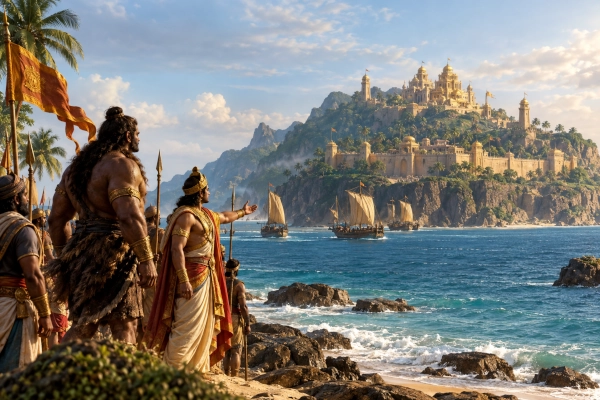
Among the lands lying beyond the continental boundaries of ancient Bharata, few possess the cultural importance of Lanka. The island is inseparably associated with the story of Rama, Ravana and Vibhishana, but it also occupies a significant place in the geographical world of the Mahabharata. During the political events surrounding Yudhishthira’s Rajasuya, Lanka appears not merely as a remembered land of an earlier age, but as a functioning southern kingdom ruled by Vibhishana.
In traditional geographical identification, Lanka corresponds to Sri Lanka, the large island immediately south of the Indian peninsula. This association is reinforced by the island’s proximity to Tamil Nadu and by the chain of shoals between Rameswaram and Mannar traditionally linked with Rama Setu. For epic geography, Sri Lanka remains the clearest modern reference point, though the literary Lanka should not be treated as identical in every detail with the modern political state.
Lanka Within Sahadeva’s Southern Campaign
Lanka appears most clearly during the preparations for Yudhishthira’s Rajasuya sacrifice. To establish the political authority required for the ceremony, the Pandava brothers undertook expeditions in different directions. Sahadeva was assigned the south.
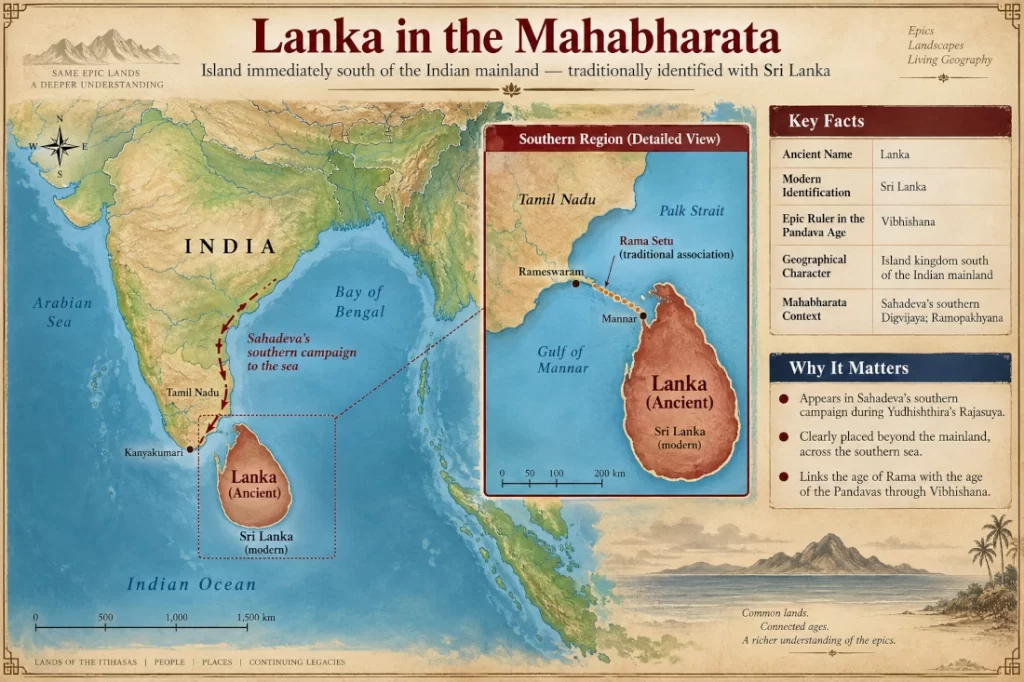
His campaign carried him through numerous regions of peninsular India, including territories associated with the Deccan and the far south. The narrative mentions peoples such as the Dravidas, Andhras, Kalingas and others before Sahadeva eventually reaches the seashore.
It is only at this point that the narrative turns towards Lanka. From the coast, Sahadeva sends messengers to Vibhishana, identified as a descendant of Pulastya. The sequence is significant because it clearly places Lanka beyond the mainland rather than among the southern kingdoms through which Sahadeva had already marched.
Vibhishana Rules Lanka
The ruler encountered in the age of the Pandavas is not Ravana but Vibhishana, Ravana’s younger brother. According to the older Rama tradition, Vibhishana had sided with Rama during the war against Ravana and was established as ruler after Lanka’s defeat.
The Mahabharata assumes familiarity with this earlier history. By presenting Vibhishana as the reigning ruler, it creates a direct connection between the age of Rama and the political world of the Pandavas.
This is one of the more interesting features of Lanka in the epic. The island belongs simultaneously to remembered history and contemporary politics. Ravana’s Lanka belongs to the heroic past, while Vibhishana’s Lanka is an active kingdom participating in Yudhishthira’s imperial ceremony.
Ghatotkacha’s Embassy in the Southern Tradition
Some southern textual traditions preserve a more elaborate version of the episode in which Sahadeva sends Ghatotkacha, the Rakshasa son of Bhima and Hidimbi, as his envoy to Lanka.
The choice is appropriate within the narrative world. Ghatotkacha is himself a powerful Rakshasa prince and can therefore approach Vibhishana as a figure of related ancestry and status.
In this expanded account, Ghatotkacha travels towards the southern sea, encounters the region associated with Rama Setu, and proceeds to Lanka. The episode reinforces the idea that the landscape of the Mahabharata already carries memories of Rama’s earlier campaign.
Rather than describing Lanka as an unknown frontier, the narrative treats it as a famous kingdom whose past remains part of the cultural memory of later generations.
Lanka Accepts Yudhishthira’s Authority
The meeting with Lanka does not result in warfare. Vibhishana accepts the demand made on behalf of Yudhishthira and sends tribute.
The gifts attributed to his kingdom include jewels, gems, sandalwood, ornaments, garments and pearls. Such items are consistent with the literary image of a prosperous maritime kingdom connected with valuable resources and long-distance exchange.
This peaceful submission distinguishes Lanka from several mainland rulers encountered during Sahadeva’s campaign. Some had to be defeated before recognising Yudhishthira’s supremacy, whereas Lanka entered the Rajasuya political order through diplomacy and tribute.
The episode therefore shows that the epic’s concept of sovereignty did not depend exclusively on conquest. Recognition, tribute and ceremonial participation could also establish political hierarchy.
Lanka and the Rajasuya World
The four directional campaigns associated with the Rajasuya provide one of the Mahabharata’s broadest geographical frameworks. The expeditions extend from the Himalayan world to western regions, eastern kingdoms and the southern ocean.
Within this structure, Lanka marks the farthest maritime extension of Sahadeva’s southern sphere. His campaign reaches the coast, and diplomatic contact then carries Yudhishthira’s influence beyond the mainland.
This makes Lanka important not because of its size alone, but because of what it represents. It shows that the political imagination of the epic extended across the sea and included island kingdoms within the wider network of rulers connected to Bharata.
Lanka in the Ramopakhyana
Lanka appears again in the Ramopakhyana of the Vana Parva, where the sage Markandeya recounts the story of Rama to Yudhishthira. This retelling includes Sita’s abduction, Rama’s alliance with the Vanaras, the crossing to Lanka, the war with Ravana and Rama’s victory.
The Ramopakhyana gives Lanka a second narrative identity. In one context, it is the stronghold of Ravana and the centre of a great war. In another, it is the kingdom of Vibhishana participating peacefully in the age of the Pandavas.
The contrast creates a sense of historical continuity. The island has a remembered past, a changed dynasty and a new political role.
From Ravana’s Stronghold to Vibhishana’s Kingdom
The transition from Ravana to Vibhishana is central to Lanka’s place in the Mahabharata. Under Ravana, the island is remembered as a powerful enemy fortress. Under Vibhishana, it becomes a legitimate and diplomatically connected monarchy.
This change reflects a broader feature of epic geography. Places are not static names. They carry dynastic histories and inherited memories, and their political meaning can change from one age to another.
Lanka therefore acts as a bridge between two great chronological worlds of Sanskrit epic tradition: the age of Rama and the age of the Pandavas.
Lanka on the Modern Map
The traditional modern identification of Lanka is Sri Lanka, immediately south of Tamil Nadu and separated from the Indian mainland by the Palk Strait and Gulf of Mannar. The Rameswaram–Mannar chain traditionally associated with Rama Setu further strengthens the long-standing cultural connection between epic Lanka and the island.
For geographical reference:
Ancient name: Lanka
Sanskrit: लङ्का — Laṅkā
Ruler during the Pandava period: Vibhishana
Earlier ruler: Ravana
Geographical character: Island kingdom south of the Indian mainland
Traditional modern identification: Sri Lanka
Nearest mainland region: Tamil Nadu
Associated feature: Rama Setu
Mahabharata context: Sahadeva’s southern Digvijaya and the Ramopakhyana
Lanka thus occupies a distinct place in the Mahabharata world. It is at once a famous kingdom of the remembered Ramayana past and an active political state in the age of Yudhishthira. Its appearance in Sahadeva’s campaign demonstrates that the epic’s geographical horizon extended beyond the mainland and into the maritime world immediately south of India.
You may also like
-
Cina in the Mahabharata: The Trans-Himalayan World at the Edge of the Epic’s Geography
-
India and France Sign Agreement to Preserve and Digitise Ancient Indian Manuscripts
-
Huna in the Mahabharata: Nakula’s Western Campaign, the Harahunas and Central Asia’s Changing Frontiers
-
GeM’s AABHAR Collection Showcases 294 Indigenous Products, Strengthens Market Access for Indian Artisans
-
Tushara in the Mahabharata: The Lands Beyond the Hindu Kush and the Horsemen Who Faced Arjuna
