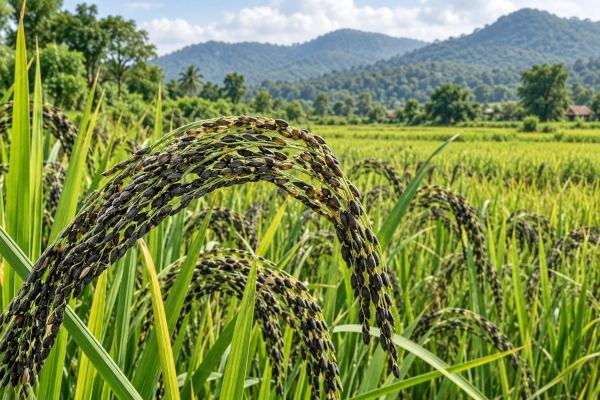
In the forested hills and fertile valleys of southern Odisha, generations of farmers have preserved a small-grained aromatic rice whose reputation rests not on size or yield, but on fragrance, flavour and an extraordinary connection with the agricultural history of the region. Known as Koraput Kalajeera Rice, this traditional landrace is distinguished by its dark paddy husk, delicate white grain and characteristic aroma.
The rice is commonly called the “Prince of Rice”, an indication of the esteem in which it is held locally. Its name itself describes one of its most unusual characteristics. The dark, slender unhusked grains resemble tiny cumin seeds, giving rise to the name Kala Jeera — literally “black cumin.” Once the husk is removed, however, the edible rice inside is predominantly white rather than black.
Kalajeera belongs to the remarkable collection of indigenous rice varieties associated with the Koraput–Jeypore tract, one of India’s important centres of traditional rice diversity. Tribal farming communities have maintained these landraces through generations of seed selection and cultivation, preserving varieties adapted to different elevations, soils, water conditions and culinary requirements.
GI recognition has now given this traditional grain a formal geographical identity. Koraput Kalajeera Rice received its Geographical Indication registration certificate on 2 January 2024, protecting a rice heritage that long predates modern commercial agriculture.
A Rice From the Ancient Agricultural Landscape of Koraput
Koraput lies within the Eastern Ghats of southern Odisha, where plateaus, hills, valleys and streams create an unusually varied agricultural landscape. Rice cultivation has developed here under conditions very different from the broad irrigated plains associated with large-scale paddy production elsewhere in India.
The wider Jeypore tract has long attracted attention from agricultural researchers because of the extraordinary diversity of traditional rice maintained by farming communities. Different varieties were selected for uplands, medium lands and low-lying fields, while others survived because of special characteristics such as aroma, colour, cooking quality or ceremonial importance.
Kalajeera belongs to this heritage of farmer-selected landraces. The GI-related documentation describes the ancestors of the present tribal communities of Koraput as having domesticated and conserved the variety over generations. APEDA’s agriculture news archive similarly describes the rice as originating in Koraput and identifies the Jeypore area and its surrounding landscape as particularly important for its cultivation.
Areas traditionally associated with Kalajeera include Tolla, Patraput, Pujariput, Baliguda and Mohuli in Koraput district. The variety has also historically been encountered across the wider agricultural landscape connected with old Koraput, reflecting the movement and exchange of indigenous seed among farming communities over long periods.
Why It Is Called Kalajeera
The name provides a clue to the rice even before it is cooked. The paddy grains are small and relatively slender, with a greyish to dark or blackish husk that gives them an appearance reminiscent of cumin seeds.
This resemblance explains the term Kalajeera, derived from kala, meaning black, and jeera, meaning cumin. The rice itself becomes white once the dark husk isYavana removed, which means Koraput Kalajeera should not be confused with pigmented black rice varieties such as Chak-Hao.
Its identity instead comes from the unusual appearance of the paddy combined with its strong aroma, fine grain, taste and cooking quality. Recent research describing Odisha’s surviving rice landraces similarly identifies Kalajeera as an aromatic variety with a distinctive black cumin-like appearance.
These characteristics have earned it the popular description “Prince of Rice.” The term reflects its status as a premium traditional grain rather than an officially defined botanical classification.
Aroma Is the Heart of Kalajeera
The most important characteristic of Koraput Kalajeera is its fragrance. When the grain is cooked, it releases a noticeable aroma that distinguishes it from ordinary non-aromatic rice.
Unlike Basmati, which is associated primarily with the northwestern Indo-Gangetic region and possesses its own grain characteristics, Kalajeera belongs to India’s diverse family of regional aromatic rice landraces. These varieties developed independently within local agricultural systems and often survived because farmers and consumers valued their flavour even when they produced lower yields than modern commercial varieties.
Kalajeera’s grains are comparatively small and fine. After cooking, the rice becomes soft and aromatic while retaining the distinctive sensory qualities for which the landrace has traditionally been valued.
Its appeal therefore lies in qualities that industrial agriculture does not always reward: aroma, texture, local adaptation and cultural importance rather than maximum grain production.
The Jeypore Tract and India’s Rice Diversity
The story of Kalajeera becomes even more significant when placed within the wider agricultural history of Koraput. The Jeypore tract is widely recognised by researchers as an important region for indigenous rice diversity.
For generations, farmers here maintained large numbers of landraces adapted to different ecological niches. Some tolerated drought, others grew in wetter areas, while particular varieties were selected for aroma, taste, festival foods or other household uses.
Such agricultural diversity effectively functioned as a living seed bank. Rather than being stored permanently in laboratories, seeds were conserved because farmers continued planting them.
Kalajeera survived through precisely this process. Families selected seed from desirable plants, retained it after harvest and passed planting material between generations and communities.
This form of conservation is particularly important because many traditional rice varieties disappeared elsewhere following the spread of high-yielding varieties during the decades of agricultural modernisation.
Farming Communities as Custodians of the Grain
Koraput Kalajeera is therefore inseparable from the tribal and small-farmer communities that conserved it.
The official applicant for the GI registration, Jaivik Sri Farmers Producer Company Limited, states that more than 1,000 farmers are involved in cultivating Kalajeera using organic practices and that farmers also participate in seed production and conservation. The organisation credits support from the Department of Agriculture and Farmers’ Empowerment, Government of Odisha, NABARD and Pragati Koraput in the effort to secure GI protection and expand the market for the grain.
This farmer-led seed conservation is particularly important for a landrace. Unlike a uniform commercial hybrid that farmers purchase repeatedly, traditional varieties survive because viable seed continues circulating within farming communities.
Every cultivation cycle therefore becomes part of the conservation process.
A Tall, Traditional Rice Rather Than an Industrial Variety
Traditional Kalajeera differs considerably from the shorter, input-intensive rice varieties developed for large-scale commercial production.
Agricultural descriptions identify it as a tall, late-maturing, scented lowland landrace. One documentation initiative focused on traditional rice reports a crop duration of around 135–140 days, with sowing beginning around the monsoon season before seedlings are transplanted into the field.
The precise cultivation schedule naturally varies with rainfall, location and farming practice, but the broader pattern reflects traditional monsoon-based paddy cultivation.
Such varieties may not compete with modern rice purely on yield. Their value instead rests on characteristics that cannot easily be measured in tonnes per hectare: flavour, aroma, heritage, biodiversity and premium market potential.
This is where GI protection becomes especially important.
From Household Grain to Premium Heritage Rice
Traditional aromatic rice once circulated mainly through village markets, household exchanges and local festivals. That is beginning to change.
Recent research on rice landrace conservation in Odisha reports strong consumer demand for Kalajeera and identifies marketing support from organisations such as the Odisha Rural Development and Marketing Society, district authorities and agricultural institutions as helping the grain reach markets beyond Koraput.
The same study notes that commercial demand has encouraged cultivation to spread from a smaller group of custodian farmers to other farmers, creating a financial incentive for continued conservation.
This represents an important shift in the economics of traditional crops. A landrace that might disappear because of low productivity can acquire new value when consumers are prepared to pay for aroma, provenance and authenticity.
GI recognition strengthens that process by linking the premium identity of the rice directly with its place of origin.
Kalajeera in Traditional Food Culture
Kalajeera has traditionally been valued for special meals and occasions where aroma and cooking quality matter more than quantity.
Its fine grains and fragrance make it suitable for dishes in which the rice itself remains central to the flavour. Depending on household tradition, aromatic rice may accompany festive meals or be prepared in sweet and savoury dishes where ordinary rice would provide far less fragrance.
Research into landrace conservation in Odisha records Kalajeera’s cultural significance and role in local food traditions and festivals among the reasons farmers continue cultivating it.
The continuing demand for the grain therefore cannot be explained solely through modern premium marketing. Its economic revival rests upon an older cultural preference that allowed the variety to survive in the first place.
A Rice With a Sacred Journey
The revival of Koraput Kalajeera has also acquired a religious dimension.
Following GI recognition, farmer organisations arranged for Kalajeera rice from Koraput to be carried as an offering from Sabara Srikhetra in Koraput toward the Jagannath tradition associated with Puri. Jaivik Sri Farmers Producer Company records that a group of farmers delivered Koraput Kalajeera Rice and organic produce in February 2024 as part of an initiative intended to create greater visibility for the grain and strengthen demand for farmers’ produce.
Such initiatives link the modern effort to develop a market for a GI product with the older relationship between food, agriculture and temple traditions in Odisha.
They also provide something conventional commodity marketing cannot easily create: a narrative linking farmers, landscape, heritage and cultural identity.
Preserving Seed Means Preserving Knowledge
The survival of Kalajeera illustrates why conserving traditional crops involves far more than storing seeds.
Farmers possess knowledge about when to sow a particular variety, which field conditions suit it, how seedlings should be handled, how harvesting affects grain quality and how seed should be selected for the following year.
When cultivation disappears, much of this knowledge can disappear with it.
Maintaining Kalajeera as an economically viable crop therefore protects both the genetic material of the rice and an associated system of indigenous agricultural knowledge.
This has wider importance for food security. Agricultural biodiversity gives breeders and farming systems a larger pool of genetic characteristics from which future crops may be developed or selected.
GI Protection Gives the Grain an Economic Identity
Before geographical protection, any rice resembling Kalajeera could potentially be marketed using the name without consumers having a clear means of distinguishing its origin.
A GI changes that relationship.
The name Koraput Kalajeera Rice is now associated with a legally recognised geographical origin and documented product characteristics. Producers operating within the recognised system can build a market around authenticity rather than competing purely as suppliers of ordinary rice.
For small and marginal farmers, that difference can be substantial. Commodity rice is typically sold according to weight and broad quality categories. A GI product can potentially command additional value because consumers are purchasing provenance, tradition and specific characteristics along with the grain itself.
The success of the GI will ultimately depend on producer participation, traceability, quality control, marketing and consumer awareness. The registration itself creates the framework; farmers and producer organisations must convert that protection into durable economic value.
The GI Journey
The formal journey toward protecting Koraput Kalajeera began when Jaivik Sri Farmers Producer Company Limited, based at Pujariput in Koraput district, submitted its application to India’s Geographical Indications Registry on 11 January 2022.
The application was subsequently published in GI Journal No. 178, made available on 31 August 2023. After completion of the registration process, Intellectual Property India issued Certificate No. 543 on 2 January 2024.
The current official GI Registry record provides the following details:
Geographical Indication: Koraput Kalajeera Rice
GI Application Number: 814
Category: Agricultural
Class: 30
Applicant/Registered Proprietor: Jaivik Sri Farmers Producer Company Limited
Applicant Location: Pujariput, Koraput district, Odisha
Date of Filing: 11 January 2022
Geographical Area: Odisha
GI Journal: No. 178
Journal Availability Date: 31 August 2023
Certificate Number: 543
Certificate Date: 2 January 2024
Current Registration Valid Until: 10 January 2032
The Registry presently lists the status of Koraput Kalajeera Rice as Registered.
It is worth noting that some secondary databases describe the product under Class 31. However, the current Intellectual Property India application record lists Class 30, and that primary official record has therefore been followed here.
The Prince of Rice Finds a New Future
Koraput Kalajeera demonstrates how India’s GI system can serve a purpose much larger than branding.
The rice survived because generations of farming families continued to consider its aroma, taste and cultural meaning valuable enough to preserve. Modern markets can now give those same qualities economic value.
What was once primarily a local landrace can reach consumers across India without becoming detached from the landscape and communities that created it.
That distinction matters. Koraput Kalajeera is not simply another aromatic rice produced in Odisha. It represents the agricultural biodiversity of the Koraput–Jeypore landscape, the accumulated seed knowledge of its farmers and a culinary tradition that survived generations of change in Indian agriculture.
Its tiny cumin-like paddy grains may appear modest, but they carry an unusually large inheritance. Through GI protection, that inheritance now has both a legal identity and an opportunity for a wider future — ensuring that Odisha’s “Prince of Rice” remains rooted in the land where generations of farmers preserved it.
You may also like
-
India’s Exports to US Rise to $50.81 Billion in April–September 2026 Despite Tariff Disruptions
-
Tata Advanced Systems Reportedly Considering LAMV 4×4 Production in Morocco
-
TDB Backs Panacea Medical Technologies to Develop Indigenous 32-Slice CT Scanner in Karnataka
-
Mormugao Port Becomes India’s First Major Port to Secure Private 5G Network Authorisation
-
PM Modi Inaugurates ₹3,350 Crore Development Projects in Ladakh
