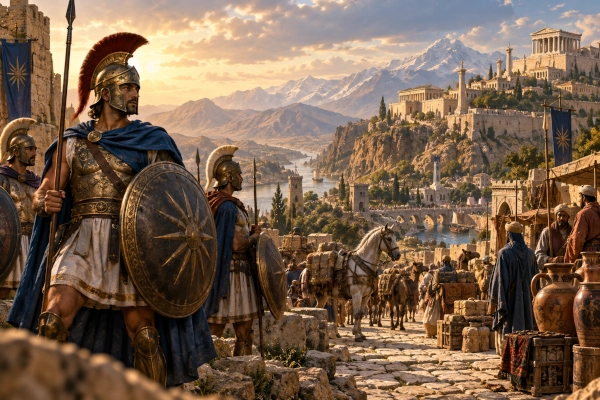
The Mahabharata names peoples who extend its geographical horizon beyond the kingdoms surrounding Hastinapura and Indraprastha. Among them, the Yavanas appear in accounts of royal campaigns, sacred narratives and battlefield encounters. Their presence connects the epic’s central story with communities beyond the Kuru heartland, although the text does not consistently describe them as inhabitants of one clearly bounded kingdom.
The name Yavana has an established linguistic connection with the Greeks, particularly the Ionians. In later Indian literature, its meaning broadened to include other foreign peoples. Understanding the Yavanas therefore requires two related enquiries: where the name originated, and whom a particular passage describes. Greece and the eastern Mediterranean explain its western roots, while Greek communities nearer India provide another important geographical setting.
The Ionian Connection
The Sanskrit name Yavana and the related form Yona belong to a wider family of eastern names for the Greeks. The Old Persian designation Yauna is associated with the Ionians, whose name came to represent Greeks more broadly. This linguistic relationship explains why historians commonly identify Yavanas in early historical Indian contexts with Greek peoples. It does not mean that every community bearing the name came directly from Ionia.
Ionia occupied part of the Aegean coast of Anatolia and included important centres such as Miletus and Ephesus. Its Greek-speaking communities belonged to the wider Greek world, although their mainland settlements lie within present-day Türkiye. A geographical account of Yavana must therefore look beyond modern Greece to the eastern shores of the Aegean Sea.
This distinction becomes important when placing ancient names on a modern map. “Greek” describes a cultural and linguistic identity that extended across many cities and territories. It does not necessarily identify a person as an inhabitant of the territory enclosed by Greece’s present borders.
Why Yavana Cannot Be Given One Fixed Border
Yavana could identify people whose communities existed far apart. A Greek ruler in the eastern Mediterranean and a Greek-speaking community near India could belong to the same broad cultural world without sharing a kingdom. The location implied by the name must consequently depend on the source and historical setting.
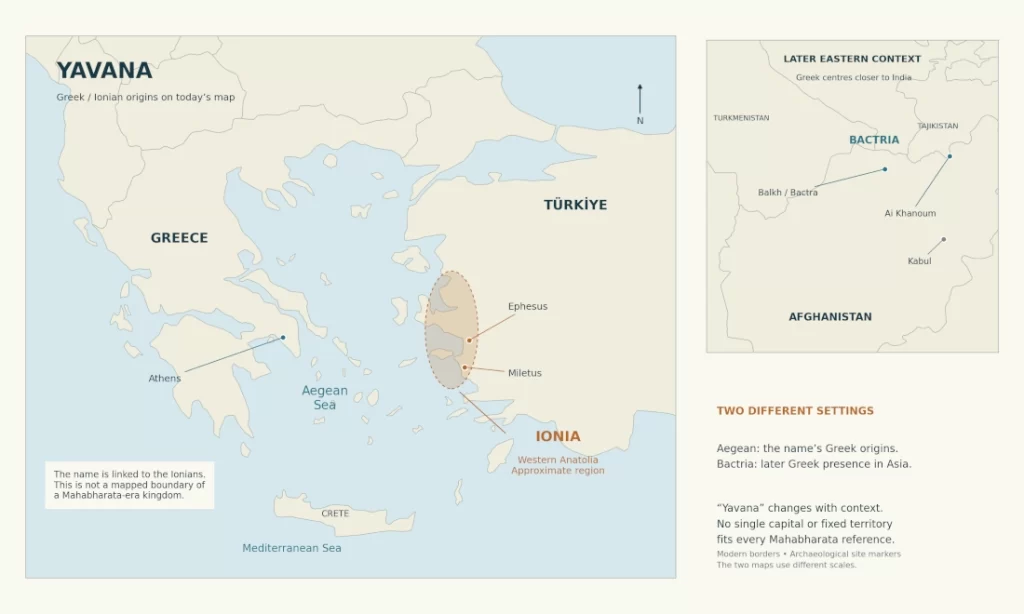
Greek-ruled states developed in Bactria and subsequently south of the Hindu Kush. Their territories brought Greek dynasties into Afghanistan and the northwestern Indian subcontinent. These historical developments explain why an Indian reference to Greeks need not point across the entire distance to the Aegean. They do not, by themselves, identify the particular Yavanas mentioned in an epic episode.
Yavana Warriors in the Story of Vasistha and Vishvamitra
One of the most vivid appearances of the Yavanas occurs in the Adi Parva’s account of Vasistha and Vishvamitra. Vishvamitra, still a king, arrives at Vasistha’s hermitage after hunting. The sage welcomes him and feeds his companions through the miraculous abundance supplied by Nandini, his divine cow. Astonished by her powers, Vishvamitra offers wealth and even his kingdom in exchange for her.
Vasistha refuses because Nandini sustains his sacrifices and hospitality. When Vishvamitra attempts to seize her, she produces armed hosts, including Yavanas, Pahlavas and Sakas. These forces scatter the king’s soldiers. Ganguli’s translation explicitly states that the defenders drive the attackers away without killing them. The defeat makes Vishvamitra recognise the strength of ascetic power and turn towards austerities.
Within this sacred story, Yavana warriors help protect a sage’s hermitage. Their role therefore differs from that of enemies opposing the Pandavas elsewhere. The episode offers a literary explanation for the appearance of diverse warrior peoples, rather than geographical evidence that the hermitage stood in Greece.
Yavanas in Nakula’s Western Expedition
The Sabha Parva includes the Yavanas in its account of Nakula’s western campaign before Yudhishthira’s Rajasuya sacrifice. Nakula sets out to secure recognition of his elder brother’s authority and gather the wealth required for the ceremony. His campaign brings numerous rulers and communities within the Pandavas’ political reach.
In Kisari Mohan Ganguli’s translation, the Yavanas appear alongside the Palhavas, Kiratas and Sakas among the peoples Nakula brings under submission. Their inclusion places them within the narrative’s western political horizon. However, the passage gives no named Yavana capital or detailed description of their territory.
The episode therefore supports a connection between Yavanas and the Pandavas’ western campaign, but it does not describe an expedition to Athens, Sparta or an identifiable Ionian city. Its geographical significance lies in the direction of the campaign and the peoples included in it. A claim that Nakula conquered modern Greece would go beyond the information supplied by the text.
A Yavana City in Sahadeva’s Southern Campaign
The Sabha Parva also places Yavanas within Sahadeva’s southern expedition. Towards the end of the account, the narrative lists peoples and places from which he receives tribute. Alongside southern communities and the city of Atavi, Ganguli’s translation mentions a city of the Yavanas. The account then describes Sahadeva reaching the seashore and sending messengers to Vibhishana.
This reference complicates any attempt to assign every epic Yavana community to the Mediterranean. Here the name appears within a southern campaign, but the text does not supply enough detail to identify the city securely. A foreign settlement or a broader use of the designation might explain the reference; neither possibility establishes a particular modern location.
Read beside Nakula’s expedition, the passage suggests that the epic’s Yavana references cannot all be treated as descriptions of one distant state. The two campaigns bring the name into different geographical sequences. Their shared purpose is to establish Yudhishthira’s authority before the Rajasuya, while the precise relationship between the Yavana groups remains unstated.
Krishna’s Political Survey and the Bhagadatta Reference
Another Sabha Parva passage illustrates the complexity of the name. During Krishna’s discussion of the obstacles facing Yudhishthira’s proposed Rajasuya, he describes the power of Jarasandha and the rulers associated with him. In Ganguli’s translation, this survey includes a ruler called Bhagadatta, described as a king of the Yavanas who rules in the west.
Krishna also identifies this ruler as an old friend of Pandu. Although he has acknowledged Jarasandha’s authority, he retains affection for the Pandavas. Within the passage, political allegiance and personal attachment do not necessarily point in the same direction. The reference belongs to Krishna’s assessment of the relationships Yudhishthira must understand before pursuing imperial recognition.
The identification is difficult when compared with Bhagadatta’s better-known association with Pragjyotisha elsewhere in the epic tradition. It should not become the basis for relocating Pragjyotisha to Greece or assigning Bhagadatta a historical Greek dynasty. The passage requires attention to textual context and differences between editions, rather than a forced modern geographical solution.
Satyaki’s Encounter with Yavana Archers at Kurukshetra
The Drona Parva brings the Yavanas directly into the battlefield narrative. During the fighting associated with Arjuna’s attempt to reach Jayadratha before sunset, Satyaki advances through the Kaurava army towards Arjuna. He points out the enemy formations to his charioteer, identifying Yavanas armed with bows and arrows among the forces ahead. Kambojas, Sakas, Daradas and other peoples also appear in this description.
The encounter develops into an assault on Satyaki. As his chariot approaches, numerous Yavana warriors meet him and shower him with arrows. The narrative gives them an active military role: they form part of the resistance confronting a leading Pandava ally during a crucial advance. It also credits them with speed and skill in handling their weapons.
The following section records that Satyaki has defeated the Yavanas and Kambojas and continues towards Arjuna. His progress then provokes further attacks by Kaurava leaders. Within the episode, the Yavana formation is one of the obstacles he must overcome while crossing an army drawn from many peoples.
Yavanas in the Renewed Attack on Satyaki
The resistance does not end with that encounter. A subsequent Drona Parva passage includes Yavanas among the mixed forces rushing against Satyaki under Duryodhana’s leadership. Duhsasana urges the assembled warriors to kill him, while Satyaki fights through the surrounding troops. The episode places Yavana combatants clearly within the Kaurava military coalition at this point in the war.
These battle scenes provide a stronger narrative connection than a simple listing of a country’s name. They show whom these warriors oppose, how they fight and where they stand within the immediate conflict. They do not identify their Mediterranean city of origin or name a Greek monarch who dispatched them. Describing them as Yavana contingents preserves the text’s information without inventing an expedition from Athens or Macedonia.
What the Incidents Reveal About the Yavanas
Across these episodes, the Yavanas occupy several roles: defenders in the Nandini story, subjects of Pandava campaigns and opponents of Satyaki. The differences matter. The Mahabharata does not present them through one uninterrupted account of a single king, capital and dynasty. Its references instead bring different Yavana groups into separate religious, political and military settings.
Their repeated association with other peoples also broadens the epic’s view of warfare. The fighting around Satyaki involves contingents with distinct names, weapons and regional associations. Reading these scenes together suggests an awareness of a diverse world beyond the central Kuru realm, even where the narrative leaves the precise homelands uncertain.
Historical Evidence Beyond the Epic
Ashoka’s inscriptions offer a different kind of evidence for Indian awareness of the Greek world. His thirteenth major rock edict names the Greek ruler Antiochus and other Hellenistic kings, including Ptolemy, Antigonus, Magas and Alexander. These references place Greek rulers within a historical account of the Mauryan king’s proclaimed reach of dhamma. They provide a firmer chronological setting for Indo-Greek awareness than an isolated epic ethnonym can supply.
Coins also document the Greek dynasties that ruled closer to India. Indo-Greek kings issued bilingual coinage, commonly combining Greek legends with Prakrit written in Kharoshthi. Such objects reveal rulers addressing different linguistic communities within their territories. They help explain the historical setting in which Greek identities became familiar in South Asia, while remaining independent of claims about the historicity of the Pandavas’ campaigns.
How the Meaning Broadened
Over time, Indian writers also applied Yavana more broadly to western or foreign peoples. Its meaning could therefore extend beyond the specific Greek identity associated with its early historical usage. A reader cannot safely substitute “Greek” for every occurrence without considering the date and context of the work.
This change in meaning also matters when reading the Mahabharata. A name’s linguistic origin, its use in a particular passage and the date of the events narrated are separate questions. The Greek connection provides a strong starting point for interpretation, but the name alone cannot establish the identity of an army, the location of a capital or the chronology of the Kurukshetra war.
Yavana in the Mahabharata’s Wider Geography
Yavana connects the Mahabharata’s readers with a world extending from the Aegean to India’s northwestern approaches. Its linguistic origins lead towards the Ionians, while historical Greek expansion supplies additional geographical settings in Central and South Asia. Within the epic itself, the name appears in episodes involving sages, conquering princes and battlefield coalitions.
The most useful geographical understanding preserves all these dimensions. Greece, western Türkiye and the eastern Mediterranean explain the name’s western roots. Bactria and the northwestern subcontinent explain why Greek-associated communities could also appear much nearer India. The Mahabharata’s incidents give the Yavanas a place in its narrative, while leaving the exact homeland of individual groups open to interpretation.
You may also like
-
India and Sri Lanka Launch SAMHiTA Manuscript Digitisation Project to Preserve Ancient Buddhist Heritage
-
ASI Uses Ground-Penetrating Radar to Investigate Ancient Buddhist Stupa at Ujjain After Nearly 90 Years
-
Pahlava: The Parthian World Beyond India’s Northwestern Frontiers in the Mahabharata
-
Namami Gange in 2026: 368 Projects Completed, 4,339 MLD Sewage Treatment Capacity Created as Ganga Rejuvenation Advances
-
ASI’s Kashipur Archaeological Site Reveals Ancient Govisana, Gupta-Era Temples and Mahabharata Traditions
