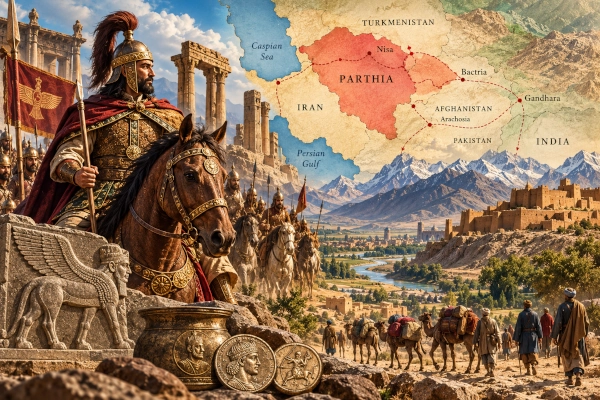
The Mahabharata’s geographical horizon extends far beyond the kingdoms surrounding Hastinapura and Indraprastha. Its accounts of conquest, tribute and royal gatherings include peoples whose names connect the epic with the Iranian world. Among them are the Pahlavas, generally identified with the Parthians. Their presence invites readers to look westward, towards the lands linking the Indian subcontinent with Iran and Central Asia.
For a modern reader, Iran, Afghanistan and Turkmenistan provide useful geographical reference points. However, they do not mark the boundaries of a single, securely identifiable Pahlava kingdom. Historical Parthia had its heartland in northeastern Iran, while neighbouring territories and later Parthian-related dynasties explain the wider association. Understanding Pahlava therefore requires attention to both the epic’s descriptions and the changing geography of historical peoples.
Who Were the Pahlavas?
The name Pahlava belongs to the linguistic family associated with Parthava, the ancient Iranian name for Parthia. This connection underlies the usual identification of the Pahlavas in Sanskrit literature with the Parthians. Yet a people’s name can travel beyond its original homeland, accompanying migration, military service and the establishment of new ruling houses. A reference to Pahlavas need not always indicate inhabitants living within Parthia’s earliest boundaries.
Historical Parthian power developed under the Arsacid dynasty during the third century BCE. Encyclopaedia Iranica explains that the Parni occupied the province of Parthava and subsequently adopted the Parthian designation. The name thus connected a territory, its inhabitants and an expanding political power. This background helps explain why Pahlava is more useful as a historical and cultural identification than as the label for an unchanging territory.
Locating Pahlava on the Modern Map
The strongest starting point is northeastern Iran, within the broader historical region of Khorasan. From there, the Parthian world extended towards the southern margins of present-day Turkmenistan. These adjoining landscapes formed part of an ancient geographical setting that modern international borders now divide. Identifying Pahlava with the whole of modern Iran would therefore obscure the more specific northeastern connection of historical Parthia.
Turkmenistan’s connection becomes particularly clear at Nisa, near modern Ashgabat and at the foot of the Kopet-Dag mountains. UNESCO identifies Old and New Nisa as the remains of one of the earliest and most important cities of the Parthian Empire. Its archaeological remains provide a firm historical reference for the Parthian presence in this region. They do not, by themselves, establish Nisa as the capital of the Pahlavas described in the Mahabharata.
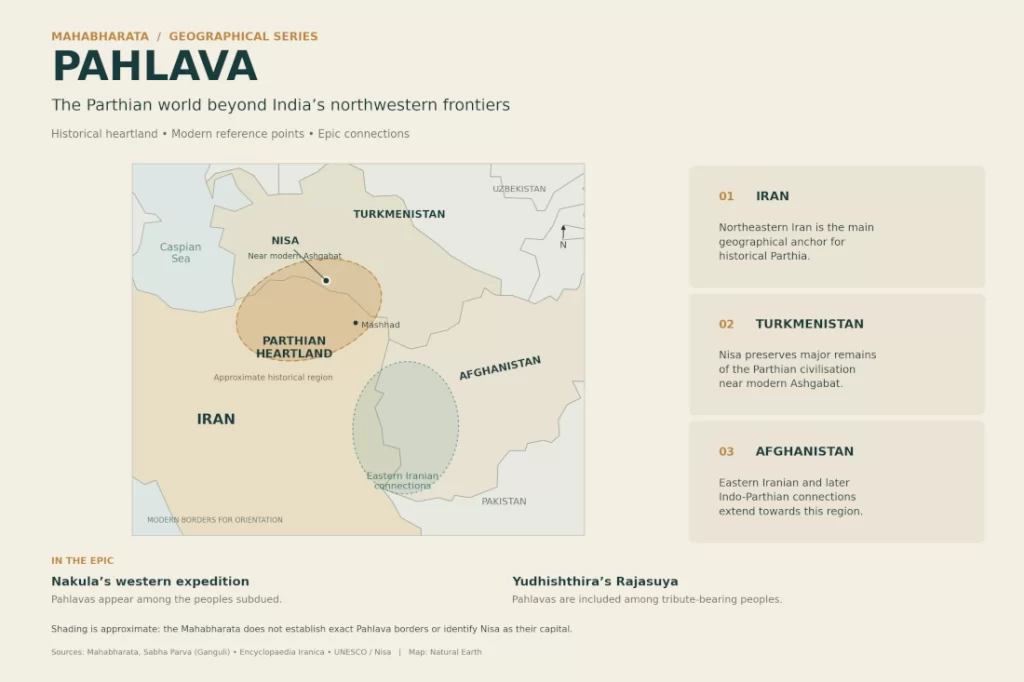
Afghanistan belongs to the discussion chiefly through the eastern Iranian borderlands and the later Indo-Parthian sphere. Evidence for rulers associated with the Pahlava designation reaches across Drangiana, Arachosia and Gandhara. Consequently, the wider historical picture also extends into present-day Pakistan. These connections should be distinguished from the original Parthian heartland, rather than combined into one fixed epic-era map.
Pahlavas in Nakula’s Western Expedition
The Sabha Parva places the Pahlavas within the account of Nakula’s western campaign before Yudhishthira’s Rajasuya sacrifice. In Kisari Mohan Ganguli’s translation, the name appears as “Palhavas.” The narrative includes them among the peoples Nakula subdues, alongside Kiratas, Yavanas and Sakas. Their inclusion gives them a direct place in the epic’s account of the Pandavas’ expanding political influence.
The passage establishes a literary association with the western campaign, but it supplies no precise boundaries for Pahlava territory. It also does not describe a march to a named Parthian capital. Reading the episode as a modern military itinerary would therefore go beyond its evidence. Its geographical value lies in showing how the epic incorporates these peoples into its western political horizon.
At Yudhishthira’s Rajasuya
The Pahlavas appear again in the Sabha Parva’s descriptions of the tribute brought to Yudhishthira. Ganguli’s translation includes the Palhavas among numerous organised warrior communities whose representatives contribute to the king’s wealth. This places them within the ceremonial gathering through which the narrative expresses Yudhishthira’s prestige and authority.
Read together, the expedition and tribute passages give the Pahlavas a political role within the story. They belong to the wider community of peoples whom the epic brings into contact with the Pandava court. These passages support discussion of the Mahabharata’s geographical imagination, although they cannot independently establish the historical submission of a particular Parthian dynasty.
What Nisa Adds to the Picture
Nisa helps readers visualise the historical civilisation associated with the Parthian name. Archaeologists have uncovered decorated buildings serving domestic, official and religious purposes. UNESCO also emphasises the site’s position along important routes and the interaction between Central Asian and Mediterranean cultural influences. The surviving remains reveal a society with substantial urban institutions and connections across considerable distances.
This evidence gives substance to the geographical background without turning archaeology into proof of an epic episode. Nisa illustrates the historical Parthian world; the Mahabharata preserves literary references to the Pahlavas. Considering both together is valuable when the distinction between them remains clear.
Reading Epic Geography Carefully
A historical identification does not automatically establish a date for the events described in an epic. The documented Arsacid dynasty belongs to the centuries from approximately the middle of the third century BCE to the early third century CE. Those dates provide a framework for historical Parthian power, not a direct date for Nakula’s expedition or Yudhishthira’s sacrifice.
Pahlava is therefore best approached through three related questions: whom the name identifies, where those people lived at different times, and how the Mahabharata uses them within its narrative. The sources support a broad Parthian association and a western orientation. They leave the precise location, boundaries and political organisation of the epic’s Pahlavas uncertain.
A Western Horizon in the Mahabharata
Within the Mahabharata’s geography, Pahlava draws attention to the connections between the subcontinent and the Iranian world. Nakula’s campaign and Yudhishthira’s royal gathering place these distant peoples within the story’s political reach. The historical geography of Parthia, meanwhile, provides a starting point for understanding the name beyond the text.
Northeastern Iran offers the clearest geographical anchor, southern Turkmenistan preserves major Parthian remains, and Afghanistan belongs to the wider eastern connections. Together, these regions help modern readers understand the world associated with Pahlava while preserving the uncertainties that the surviving evidence cannot resolve.
You may also like
-
Yavana in the Mahabharata: Greek Connections, Pandava Campaigns and the Warriors of Kurukshetra
-
India and Sri Lanka Launch SAMHiTA Manuscript Digitisation Project to Preserve Ancient Buddhist Heritage
-
ASI Uses Ground-Penetrating Radar to Investigate Ancient Buddhist Stupa at Ujjain After Nearly 90 Years
-
Namami Gange in 2026: 368 Projects Completed, 4,339 MLD Sewage Treatment Capacity Created as Ganga Rejuvenation Advances
-
ASI’s Kashipur Archaeological Site Reveals Ancient Govisana, Gupta-Era Temples and Mahabharata Traditions
