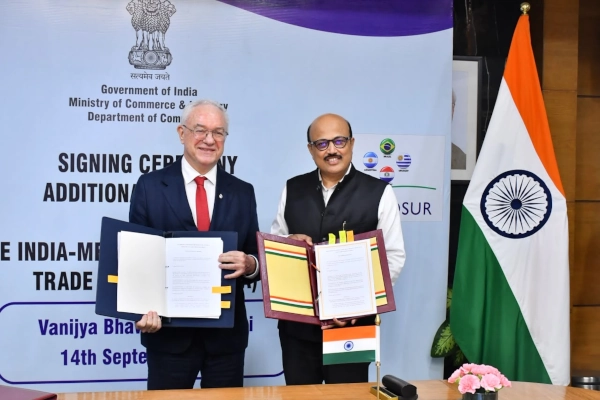
India and the MERCOSUR trade bloc have taken another step toward modernising their preferential trade framework by signing the First Additional Protocol to the India–MERCOSUR Preferential Trade Agreement, allowing Certificates of Origin to be issued and accepted electronically.
The protocol, signed on September 14, gives electronic Certificates of Origin the same legal validity as their paper counterparts. The change is intended to simplify customs procedures, reduce paperwork and shorten the time required to verify whether goods qualify for preferential tariff treatment under the existing India–MERCOSUR trade agreement.
Electronic Certificates Gain Equal Legal Status
Under the new protocol, Article 16 of Annex III concerning Rules of Origin has been amended to formally recognise Certificates of Origin issued in electronic format. These documents will carry the same legal value as certificates issued on paper, provided they are generated and electronically signed in accordance with the domestic laws of the participating countries.
Only authorised entities and officials will be permitted to issue the electronic certificates. This preserves the existing verification framework while allowing exporters, importers and customs authorities to move away from physical documentation.
The measure could substantially reduce administrative delays associated with the issuance, transmission and verification of trade documents. For businesses operating across multiple jurisdictions, particularly exporters making use of preferential tariff concessions, digital certification can reduce both processing time and transaction costs.
India–MERCOSUR Trade Agreement Dates Back to 2004
India and MERCOSUR signed their Preferential Trade Agreement on January 25, 2004, and it entered into force on June 1, 2009. Under the agreement, India provides preferential tariff concessions on 450 tariff lines, while MERCOSUR countries extend concessions across 452 tariff lines.
MERCOSUR currently comprises Argentina, Brazil, Paraguay and Uruguay as full members, with the grouping forming one of South America’s most important economic blocs. The India–MERCOSUR PTA provides a limited but institutionalised framework through which India and the bloc can expand preferential trade.
The newly signed protocol does not alter the tariff concessions themselves. Instead, it modernises the administrative mechanism through which traders establish the origin of goods and claim benefits available under the agreement.
Customs Modernisation and Paperless Trade
Certificates of Origin are critical documents in preferential trade agreements because they establish that a product originates in a country eligible for reduced customs duties. Traditionally, such certificates have depended heavily on paper documentation, physical signatures and manual verification.
Recognition of electronic certificates makes it possible for customs administrations to process origin documentation more rapidly while reducing dependence on physical paperwork. It also brings the India–MERCOSUR framework closer to emerging international practices in digital customs administration and paperless cross-border trade.
For exporters, faster issuance and verification can reduce the risk of consignments being delayed because of documentation requirements. Customs authorities can also benefit from more standardised electronic records and easier verification of certificates issued by authorised agencies.
Proposal Developed Through Joint Administrative Committee
The move follows discussions within the Joint Administrative Committee responsible for overseeing the India–MERCOSUR PTA. At its fourth meeting on November 27, 2025, both sides supported updating the agreement to permit the use of digital Certificates of Origin.
The proposal was subsequently adopted by mutual consent during the fifth meeting of the Joint Administrative Committee on April 9, 2026, paving the way for the formal signing of the Additional Protocol.
The protocol was signed by Commerce Secretary Rajesh Agarwal along with Uruguay’s Ambassador to India Alberto Guani and Paraguay’s Ambassador Fleming Raul Duarte Ramos. Uruguay was acting in its capacity as holder of the Pro Tempore Presidency of MERCOSUR. Uruguayan Foreign Minister Mario Lubetkin and representatives of the Argentine and Brazilian embassies were also present.
Protocol to Take Effect After Domestic Procedures
The new arrangement will not become operational immediately. It will enter into force after India and the MERCOSUR countries complete their respective internal procedures and formally notify one another.
Once implemented, the protocol will provide the legal basis for electronic origin certification across preferential trade covered by the existing agreement.
The agreement represents a relatively technical change, but one with practical consequences for traders. By reducing reliance on physical certificates and simplifying customs documentation, India and MERCOSUR are gradually building a more efficient institutional framework for trade between the two sides.
The development also comes as India continues to expand its economic engagement with Latin America. Modernising the existing PTA could provide a stronger administrative foundation for any future effort to deepen or widen preferential trade between India and the MERCOSUR economies.
You may also like
-
CarbonCraft Design Turns Industrial Carbon and Construction Waste Into Building Materials
-
Inbound Aerospace Turns to Australia to Test India’s Recoverable Re-Entry Spacecraft
-
BRICS Looks Beneath the Oceans as Bloc Moves Toward High-Speed Submarine Cable Network
-
India Proposes BRICS Gateway to Help 100 Startups Expand Across Member Markets Every Year
-
Quad Moves Indo-Pacific Logistics Network Toward Operational Stage With Tokyo Exercise
