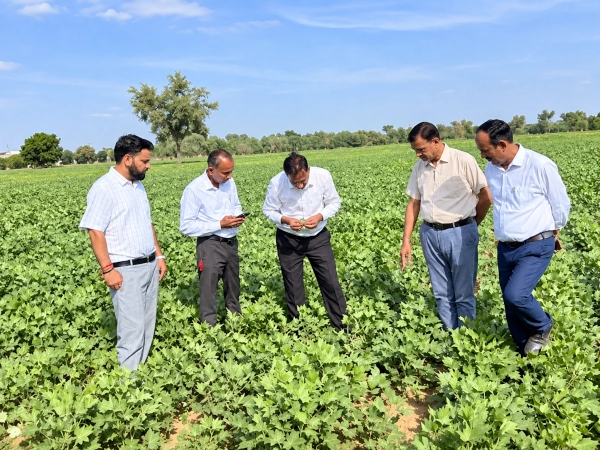
Four recently developed moth bean varieties from the ICAR–Central Arid Zone Research Institute in Jodhpur have demonstrated strong resilience under severe moisture stress during the Kharif 2026 season, maintaining growth and pod development despite a prolonged dry spell of around 35 days in western Rajasthan.
The varieties — CAZRI Moth-4, CAZRI Moth-5, CAZRI Moth-6 and CAZRI Moth-7 — were released over the past three years as part of a long-term breeding programme aimed at developing high-yielding moth bean suited to the hot, dry and highly unpredictable conditions of the Thar region.
A Crop Built for Rajasthan’s Harsh Arid Conditions
Moth bean is one of the most important pulse crops cultivated in the hot arid regions of western Rajasthan, where it covers nearly 10 lakh hectares. Productivity, however, remains relatively low at around 350 kg per hectare because farmers frequently contend with erratic rainfall, prolonged dry periods and limited soil moisture.
Annual rainfall in the major moth bean-growing areas is often only around 150–250 mm, while dry spells lasting 20–30 days are common. Under such conditions, crop varieties must be capable of surviving moisture stress without abandoning vegetative growth or reproductive development.
CAZRI has therefore spent more than a decade breeding moth bean varieties that combine developmental flexibility, drought tolerance and higher yield potential.
Varieties Survive More Than a Month Without Significant Rain
The resilience of the new varieties became particularly visible during the 2026 cropping season. Between July 10 and September 2, cumulative pan evaporation reached around 317 mm, indicating substantial atmospheric demand for moisture.
The last significant rainfall event before the prolonged dry period occurred on August 3. From August 3 to September 7, the crop experienced a rainless period of around 35 days, apart from three to four scattered rainfall events of less than 2.5 mm each.
During this 35-day period, cumulative pan evaporation was around 180 mm. Despite these conditions, the CAZRI varieties continued to maintain a green canopy, active growth and strong pod development.
Deeper Soil Moisture Helped Sustain the Crop
Soil moisture measurements showed why the crop was able to survive the prolonged dry period.
At a depth of 0–10 cm, soil moisture remained around 15–16 per cent until August 2, when the last major rainfall of around 86 mm was received. As the dry spell continued, surface moisture gradually fell to around 5–6 per cent.
Moisture in the deeper 10–40 cm soil layer declined more slowly, falling from around 23 per cent to about 16 per cent. This residual subsurface moisture continued to support the crop and helped meet part of its water requirement during the rainless period.
The early development of the crop canopy, together with soil binding and moisture retention around the root zone, also helped the plants withstand extended water stress.
Flowering and Pod Formation Continued Under Stress
The most significant aspect of the performance was that the severe moisture deficit occurred during critical reproductive stages, including flowering and pod formation.
Despite the lack of substantial rainfall, the four varieties maintained vegetative activity and developed profuse pods at around 55 days after sowing. This ability to continue reproductive growth under moisture stress is particularly important because drought during flowering and pod formation can sharply reduce pulse yields.
CAZRI researchers said the field performance provides an important indication of the genetic adaptability of the new varieties to the harsh and unpredictable environment of western Rajasthan.
Developmental Plasticity Gives Varieties an Advantage
One of the key characteristics bred into the new moth bean varieties is what researchers describe as developmental plasticity.
The varieties begin flowering at around 30 days after sowing and can adjust their subsequent growth and maturity according to the amount of soil moisture available. This allows the plants to move rapidly towards reproductive development when rainfall becomes uncertain while continuing growth when additional moisture is available.
Such flexibility is particularly valuable in the Thar Desert, where rainfall can vary widely not only in quantity but also in timing and distribution.
Crop Management Played an Important Role
The performance of the varieties was also supported by carefully planned agronomic practices. The crop was sown with the onset of the monsoon in July and maintained at an optimum plant spacing of 45 × 10 cm.
Mechanical interculture was carried out around 20 days after sowing to help conserve soil moisture. Mechanical weed control, supplemented by manual spot weeding, reduced competition for available water and nutrients.
The trials were conducted under relatively poor soil fertility conditions. Organic carbon content ranged from 0.13 to 0.18 per cent, while soil pH stood between 7.9 and 8.1. Available nitrogen was around 90–100 kg per hectare, phosphorus around 10–15 kg per hectare and potassium around 250–260 kg per hectare.
The results therefore underline the importance of combining climate-resilient genetics with appropriate crop management rather than relying on varietal improvement alone.
Seed Multiplication Underway for Wider Cultivation
CAZRI has also begun expanding breeder-seed production of the four varieties so that they can reach farmers on a larger scale.
Seed production is currently underway over seven hectares at the CAZRI Research Farm to meet a Saathi Portal-indented requirement of 23.32 quintals for 2026. In 2025, the combined seed indent for all four varieties had reached 63.2 quintals.
According to CAZRI estimates, one quintal of breeder seed can eventually produce around 1,000–1,400 quintals of certified seed through successive multiplication. Properly multiplied and marketed, this quantity could support cultivation across around 10,000 hectares.
Even if only half of that theoretical potential is realised, wider adoption could eventually bring the new varieties to roughly a quarter of Rajasthan’s total moth bean area.
Seed multiplication is being undertaken through the Rajasthan State Seeds Corporation, National Seeds Corporation and selected private-sector participants.
Climate-Resilient Pulses Could Strengthen Farmer Incomes
Dr M. L. Jat, Secretary of the Department of Agricultural Research and Education and Director General of ICAR, said moth bean has a unique place in the agriculture of the Thar Desert and that climate-resilient CAZRI varieties could help improve farm prosperity while contributing to India’s efforts to become more self-reliant in pulses.
He noted that the ability of the new varieties to maintain growth and pod formation during a prolonged rainless period demonstrates how genetic improvement can strengthen climate-resilient agriculture.
At the same time, he stressed that varietal improvement must be supported by good agronomic practices, including timely sowing, optimum plant population, weed management and moisture-conservation measures, if farmers are to fully realise the genetic potential of such crops under severe stress conditions.
The performance of CAZRI Moth-4, Moth-5, Moth-6 and Moth-7 therefore represents more than a successful field trial. It points towards a practical pathway for improving pulse production in some of India’s most water-stressed farming regions, where resilience to rainfall uncertainty is becoming increasingly important for both food security and farmer livelihoods.
You may also like
-
India Proposes BRICS Gateway to Help 100 Startups Expand Across Member Markets Every Year
-
RVNL Completes 10.8-km Himalayan Escape Tunnel as Rishikesh–Karnaprayag Rail Project Nears Final Tunnelling Stage
-
India Emerges as World’s Largest Vaccine Producer as CEPI Partnership Enters Next Phase
-
Indian Railways Freight Loading Rises 5.4% in August as Passenger and Cargo Connectivity Expands
-
The Return of Strategic Autonomy in a Fragmented World
