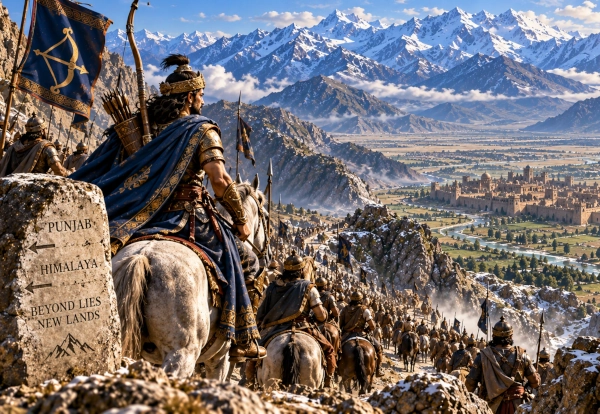
Among the far northwestern lands remembered in the Mahabharata, Bahlika occupies an especially important position. Ancient geographical traditions generally associate the name with Balkh and the wider region of Bactria, centred in what is now northern Afghanistan. The country lay beyond the Hindu Kush, in the fertile plains between the mountains and the Oxus, or Amu Darya, forming one of the great crossroads between the Indian subcontinent, Iran and Central Asia.
The identification is not completely without difficulty. Sanskrit literature sometimes appears to use Bahlika or Vahlika for more than one northwestern population, and some texts also refer to Bahika peoples of Punjab. Nevertheless, the distant Bahlika repeatedly associated with northern and trans-Indus peoples has traditionally been identified by scholars with Bactria and its ancient capital Bactra, modern Balkh. Older geographical commentaries on the Puranas explicitly equate the Bahlikas with the people of Balkh and ancient Bactria.
The Land of Bahlika
Ancient Bactria occupied the great plain immediately north of the Hindu Kush and south of the Amu Darya. Its agricultural settlements depended on rivers flowing northwards from the mountains, including the Balkhab, Kunduz and other waterways that created fertile oases across an otherwise difficult continental landscape.
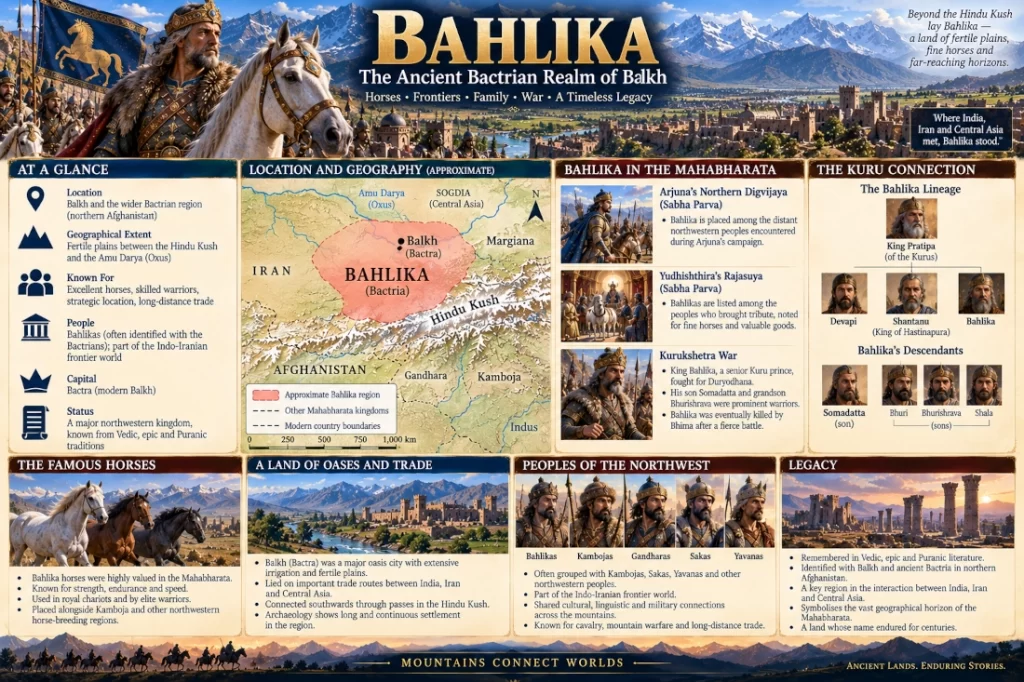
Encyclopaedia Iranica defines ancient Bactria essentially as the plain between the Hindu Kush and the Amu Darya, with its capital at Bactra. The region was supported by a network of irrigated oases and could at times extend politically far beyond this geographical core.
This was a very different environment from the Gangetic kingdoms of the Mahabharata. Bahlika lay beyond major mountain barriers, connected to the south through passes crossing the Hindu Kush and to the west and north through routes leading towards Iran, Sogdia and the Central Asian steppe.
Its remoteness explains why ancient Indian literature repeatedly treats the Bahlikas as belonging to the far northern or northwestern world.
Balkh — Ancient Bactra
The geographical centre of Bahlika is traditionally identified with Balkh, known to Greek and Roman writers as Bactra.
Modern Balkh lies in northern Afghanistan, west of Mazar-i-Sharif and south of the Amu Darya. Archaeological investigations show that the surrounding oasis supported settlement over an exceptionally long period. The French archaeological mission in Afghanistan describes Balkh and its oasis as one of northern Afghanistan’s largest archaeological complexes, with occupation extending from prehistoric times through the Achaemenid, Kushan and later periods.
The importance of Bactra arose largely from geography. Balkh stood where major east-west and north-south routes intersected. One route followed the northern foot of the Hindu Kush towards Iran and Central Asia, while another crossed the mountains through Bamiyan and Kabul towards northwestern India. Iranica identifies precisely this crossroads position as one of the principal reasons why a major city developed there.
This makes the traditional identification of Bahlika with Balkh geographically plausible. A people occupying this region would have been familiar to the kingdoms farther southeast through trade, horses, warfare and long-distance diplomacy.
Bahlika and Bahika — An Important Distinction
One difficulty in reconstructing Bahlika geography is that ancient Sanskrit literature also refers to peoples called Bahikas, associated more closely with Punjab.
Some geographical commentaries explicitly distinguish the two. The Bahikas are placed among populations of Punjab between the Sutlej and Indus, whereas the Bahlikas are associated with the much more distant northern or trans-Indian region of Balkh.
The Mahabharata itself preserves enough variant spellings and geographical lists to make the distinction occasionally uncertain. As a result, not every occurrence of “Bahlika” in later translations should automatically be mapped to Bactria.
For geographical purposes, the most defensible approach is to identify the far northwestern Bahlika country with Balkh/Bactria, while recognising that other similarly named populations may have existed closer to Punjab.
Bahlika Was Known Long Before the Epic Tradition
The name Bahlika belongs to a very old layer of Indian geographical memory.
Scholarly studies note references to the Bahlikas in Vedic and later Sanskrit literature, and they continue to appear in the epics and Puranas. One compilation of Mahabharata peoples describes the Bahlikas as an ancient northwestern people known from early Sanskrit tradition and traditionally identified with the Bactrians of Balkh.
This long literary history is significant because Bactria itself was one of the great settled regions of Central Asia long before the Hellenistic period.
Archaeology shows that oasis communities in Bactria developed substantial irrigation systems and participated in long-distance commerce, including the movement of bronze and lapis lazuli towards India and Mesopotamia.
Bahlika therefore fits naturally into the larger network of regions known to early Indian traditions beyond the northwestern mountains.
Bahlika and Arjuna’s Northern World
Ancient geographical commentaries associate Bahlika with the northern regions encountered in the course of Arjuna’s Digvijaya.
The northern campaign described in the Sabha Parva takes Arjuna through increasingly distant territories beyond the familiar Punjab and Himalayan kingdoms. Traditional commentaries place Bahlika among these difficult northern countries and describe it as lying beyond the ordinary northwestern frontier.
The broader geographical sequence of Arjuna’s campaign includes Daradas, Kambojas, Rishikas and other peoples associated with the Upper Indus, Hindu Kush and Central Asian approaches.
Bahlika belongs naturally to this same trans-Himalayan and Indo-Iranian world.
Even if the precise sequence cannot be converted into a modern itinerary, the narrative clearly demonstrates that the political horizon of the Mahabharata extended far beyond the Indus.
The Famous Horses of Bahlika
Perhaps the most distinctive characteristic of Bahlika in the epic tradition is its reputation for excellent horses.
The Mahabharata repeatedly refers to horses of the Bahlika breed, placing them alongside animals from Kamboja and other northwestern regions famous for cavalry and horse breeding. One battlefield passage lists Kamboja, Aratta and Bahlika horses among fast and well-trained animals used by accomplished warriors.
A modern archaeological study of material culture in the Mahabharata similarly notes that the epic treats Bahlika, Kamboja, Gandhara and Sindhu as important sources of quality horses.
The reputation makes excellent geographical sense.
The Bactrian and Central Asian frontier possessed extensive grazing lands and long traditions of mounted warfare. Horses bred in these environments could travel long distances and were immensely valuable to the kingdoms of the Indian plains.
For states dependent upon chariot warfare and cavalry, access to northern horses was strategically important.
Bahlika Horses in Royal Diplomacy
Bahlika horses were not merely battlefield animals. They also appear as prestigious diplomatic gifts.
Ancient traditions record royal chariots drawn by Bahlika horses and describe animals of this breed being presented as part of important exchanges. The term itself became sufficiently well established that Sanskrit lexicographical traditions could use Bahlika to denote a recognised breed of horse.
This provides an important clue to Bahlika’s economic relationship with the subcontinent.
Long-distance trade from Central Asia did not consist only of luxury objects. Horses were among the most strategically valuable commodities moving southwards across the Hindu Kush, and Balkh stood directly on routes capable of supplying them.
Bahlika and the Kuru Dynasty
One of the most fascinating complications surrounding the name Bahlika is that Bahlika was also the personal name of a senior prince of the Kuru dynasty.
According to the Kuru genealogy, King Pratipa had three sons: Devapi, Shantanu and Bahlika. Shantanu became king at Hastinapura and later fathered Bhishma, making Bahlika Bhishma’s paternal uncle. The Vishnu Purana preserves the same genealogy, naming Bahlika as one of Pratipa’s three sons.
This Bahlika later became the father of Somadatta, whose sons included Bhuri, Bhurishrava and Shala.
The result is an unusually close relationship between the Bahlika royal line and the Kurus.
However, the existence of a Kuru prince named Bahlika does not by itself prove that every passage concerning him refers directly to the Bactrian country. The epic traditions surrounding his kingship and the geographical Bahlika people have become intertwined, and scholars have long noted that more than one Bahlika or Bahlika-related group may be represented in the text.
Somadatta and Bhurishrava
Bahlika’s descendants became important figures in the political world surrounding Hastinapura.
His son Somadatta attended Draupadi’s svayamvara and participated in Yudhishthira’s Rajasuya. Somadatta’s own sons included Bhuri, Shala and Bhurishrava, all recognised warriors.
Bhurishrava became especially prominent.
He belonged to the same extended Kuru family as the Pandavas and Kauravas, yet his branch ultimately fought for Duryodhana. The Mahabharata records Bhurishrava arriving to support the Kauravas with a substantial military force.
This is another reminder that Kurukshetra was fundamentally a war within an interconnected aristocratic world. Kinship did not guarantee political unity.
Bahlika Joins the Kaurava Side
The elderly King Bahlika himself eventually fought for Duryodhana.
This is particularly striking because of his age and his position within the Kuru genealogy. He belonged to the generation before Bhishma and was therefore among the oldest royal warriors participating in the conflict.
The Drona Parva places Bahlika among important Kaurava commanders. In one major formation, Bhurishrava, Shalya, Somadatta and Bahlika together occupied the right wing of Drona’s Garuda formation, supported by a large body of troops.
Another battle passage describes the powerful King Bahlika actively blocking Pandava forces while fighting with his army and ministers.
His presence on the field demonstrates that the Bahlika line remained militarily significant even at an advanced stage of the Kuru dynasty.
Bahlika Forces on the Battlefield
The epic does not portray Bahlika participation as confined to one elderly king.
The Drona Parva refers to a substantial Bahlika army, describing troops equipped with numerous weapons and positioned alongside other powerful contingents.
Northwestern forces such as the Bahlikas, Kambojas, Sakas and others are also associated in later battle descriptions with forms of fighting distinct from those of the central Gangetic kingdoms.
An archaeological study of the Mahabharata’s military descriptions notes that the Bahlikas belonged to the northwestern group of peoples associated with mountain or frontier warfare, alongside Kambojas and Gandharas.
The association again reflects geography. Bactria lay at the junction of sedentary oasis civilisation and mobile horse cultures, making cavalry and mounted warfare particularly important.
Bhurishrava and Satyaki
One of the most dramatic episodes involving Bahlika’s descendants was the duel between Bhurishrava and Satyaki.
The hostility between their families stretched back to an earlier rivalry involving Somadatta and Sini. During the Kurukshetra War, that inherited feud erupted violently.
Bhurishrava fought Satyaki and gained the advantage. As he prepared to kill him, Arjuna intervened and severed Bhurishrava’s arm. Bhurishrava then ceased fighting and sat in meditation, after which Satyaki killed him.
The event became one of the war’s most debated episodes concerning battlefield conduct and dharma.
Bhurishrava’s death deeply affected his father Somadatta and ultimately drew the elderly Bahlika himself into another fierce confrontation.
The Death of King Bahlika
After Bhurishrava’s death and during the terrible night fighting of the Drona Parva, Somadatta confronted Satyaki, seeking vengeance for his son.
Bahlika subsequently entered the battle when he saw Somadatta overcome.
The elderly king attacked Satyaki and also struck Bhima with a powerful dart, temporarily stunning him. Bhima recovered and hurled his mace at Bahlika. The blow killed the aged warrior.
Thus one of the oldest members of the Kuru family fell at the hands of one of its younger descendants.
The episode captures the central tragedy of the Mahabharata: Kurukshetra did not simply destroy rival armies. It destroyed generations of the same extended family.
Duryodhana Remembers Bahlika
Bahlika’s stature is reflected even in Duryodhana’s final moments.
After the Kaurava army had been destroyed and Duryodhana stood virtually alone, he listed the great warriors who had died fighting for him. Among Bhishma, Drona, Karna, Jayadratha, Bhagadatta and Shalya, he also remembered Bahlika and Bhurishrava.
This placement among the principal fallen leaders illustrates the respect accorded to the old king.
Bahlika was not merely an incidental warrior. He belonged to the senior-most generation of the Kuru aristocracy and represented a royal lineage with its own military following.
Bactria as an Ancient Crossroads
The historical geography of Bactria helps explain why Bahlika remained so prominent in Indian geographical memory.
Bactra stood on routes linking Iran, Central Asia, the Oxus basin and northern India. The city could communicate southwards through Bamiyan and Kabul and eastwards towards the Indus. Iranica describes Bactra as occupying a commanding position on routes leading towards India, while its agricultural wealth and participation in long-distance trade made the region prosperous.
The surrounding oasis was exceptionally productive.
French archaeological research describes an irrigated zone extending across thousands of square kilometres around Balkh, fed by numerous canals from the Balkhab River.
Bahlika was therefore not simply an arid frontier.
It was a wealthy oasis civilisation situated at the edge of some of the most important commercial corridors in Eurasia.
Bactria in Recorded History
The securely historical record of Bactria becomes particularly clear during the Achaemenid period.
By the sixth century BCE, Bactria formed part of the Persian Empire. Later, Alexander entered the region during his campaigns in Central Asia. After the fragmentation of his empire, Bactria eventually became the centre of the Greco-Bactrian Kingdom, whose rulers controlled extensive territories and later expanded towards the Indian northwest.
These events occurred in historical periods separate from the narrative setting of the Mahabharata. They should not be used to assign a specific date to the epic war.
What they demonstrate is the continuing importance of the same region traditionally remembered in Sanskrit sources as Bahlika.
Centuries after the epic traditions were formed, Bactria remained a major political and commercial centre linking Central Asia with India.
Balkh as the “Mother of Cities”
Balkh acquired an extraordinary reputation in later traditions.
Its enormous earthen fortifications and ancient settlement mound still preserve evidence of its long urban history. UNESCO describes the archaeological city of Balkh as covering around 11 square kilometres, with visible remains of extensive walls and fortified areas.
Later Buddhist, Iranian and Islamic traditions all regarded Balkh as an important religious and intellectual centre.
These later developments should not be projected backwards into the Mahabharata. Nevertheless, they underline how unusually persistent the urban importance of the Bactrian oasis was.
Few places associated with ancient Indian geographical traditions remained major centres across so many different cultural periods.
Bahlika and the Indo-Iranian World
Like neighbouring Kamboja, Bahlika belonged to a transitional world between the Indian and Iranian cultural spheres.
Its people were exposed to languages, customs and military traditions circulating through Bactria, Iran and Central Asia. Indian texts consequently often group Bahlikas with Kambojas, Yavanas, Sakas and other northwestern peoples.
This grouping does not mean that all these peoples were ethnically identical.
Rather, from the perspective of the kingdoms farther east, they belonged to the broad geopolitical world lying beyond Gandhara and the Indus, where Indian, Iranian and Central Asian networks overlapped.
Bahlika was one of the most important regions within that frontier system.
Bahlika in Modern Geography
In modern geographical terms, the traditional Bahlika heartland corresponds most closely to Balkh Province and the surrounding plains of northern Afghanistan.
Ancient Bactria extended more broadly across the country south of the Amu Darya and north of the Hindu Kush, including areas towards Kunduz and other northeastern Afghan oases. At various historical periods, political Bactria could reach substantially farther.
For the purposes of ancient geographical identification, the clearest formulation is:
Bahlika — Balkh and the ancient Bactrian region north of the Hindu Kush and south of the Amu Darya — principally modern northern Afghanistan.
The ancient political boundaries cannot be reconstructed precisely, and some Sanskrit references to similarly named Bahlikas or Bahikas may describe other northwestern populations.
The Distant Northwestern Realm of the Mahabharata
Bahlika is one of the most revealing geographical names in the Mahabharata because it connects the Kuru world with the ancient civilisation of Bactria beyond the Hindu Kush.
Its location around Balkh placed it on routes carrying horses, merchants, warriors and ideas between India, Iran and Central Asia. The region became famous in Indian tradition for its horses, while Bahlikas appear among the major northwestern peoples remembered in the epic.
The name also became deeply intertwined with the Kuru dynasty itself. King Bahlika, brother of Shantanu and uncle of Bhishma, stood at the head of a lineage that included Somadatta and Bhurishrava. Despite their blood relationship with the Pandavas and other Kurus, this branch fought for Duryodhana. Bhurishrava died during the fierce struggle with Satyaki, Somadatta continued the feud, and the aged Bahlika finally fell to Bhima.
At the same time, the geographical Bahlika should be distinguished carefully from the similarly named Bahika groups associated with Punjab. The strongest traditional identification of the distant Bahlika country remains Balkh and ancient Bactria in northern Afghanistan, a fertile oasis world positioned beyond the Hindu Kush.
Bahlika therefore represents one of the furthest western and northwestern horizons of the Mahabharata: a land of celebrated horses, formidable warriors and ancient trade routes, situated where the political world of Bharat met the Iranian and Central Asian civilisations beyond the mountains.
You may also like
-
Kamboja: The Horse-Breeding Frontier Kingdom of the Hindu Kush in the Mahabharata
-
Darada: The Upper Indus Mountain Realm of the Mahabharata
-
Abhisara: The Himalayan Frontier Kingdom Between Kashmir and Punjab in the Mahabharata
-
India to Build National Digital Repository for Tribal Languages with IITs and Universities
-
Gandhara: The Northwestern Kingdom of Gandhari and Shakuni in the Mahabharata
